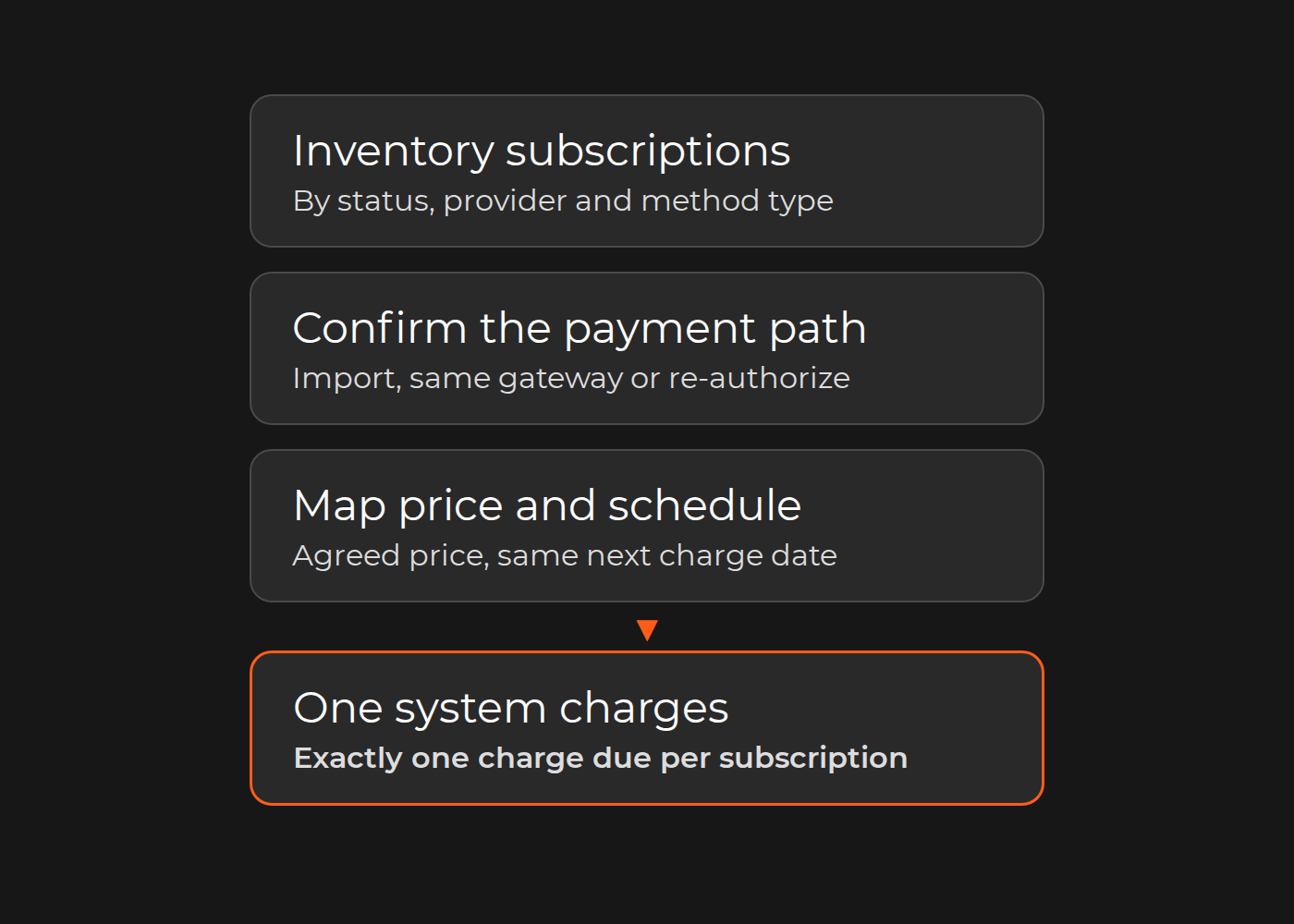
Imported customer records do not make a subscription migration safe. Each active subscription needs a usable payment method, the agreed price and a next charge that exactly one system will take.
Active subscriptions can move to a new platform without losing the customer's payment method, agreed price or next charge date, but only if three things are true for each subscription. First, the payment method follows the customer through a route the payment provider supports: a processor-to-processor data export and import, a destination platform that can use the existing gateway's stored payment methods, or the customer re-authorising. Second, price, currency, tax, address, frequency, status and next charge date are recreated and reconciled field by field. Third, only one system may charge a subscription at any moment.
That third rule answers the timing question. The old system must stop billing a subscription after it has taken its last charge and before the new system's first scheduled charge for that subscription. In practice that means an agreed cutover per cohort, recorded in a reconciliation sheet, with the old schedule disabled before the new one can fire.
This guide is for established D2C and subscription retailers replacing a subscription app, billing system or commerce platform. It gives you a field-level migration and reconciliation sheet, a cutover timeline, dry-run and cutover acceptance tests, and a scoping worksheet. Provider rules quoted here come from Stripe and Shopify documentation; your source and destination may differ, so confirm the route with your own providers.
The migration and reconciliation sheet
Fill one row per subscription for a pilot cohort before you plan the rest. The example below is illustrative: subscriber C104 pays GBP 20.00 a month including VAT, and the next charge is due on 1 December.
Field
Source (old system)
Target (new system)
Check before cutover
Owner
Customer ID
C104
New customer ID from the import mapping file
Old and new IDs linked in the sheet
Data migration lead
Subscription ID
S-5531
New subscription or contract ID
One target per source subscription
Data migration lead
Payment method and provider
Card stored with the current processor
Imported method ID, or "re-authorisation pending"
Method usable by the new billing system, not just copied
Payments owner
Payment path
Processor export, same gateway connected, or re-authorisation
Recorded per subscription
Path confirmed by the provider in writing
Payments owner
Price and currency
GBP 20.00
GBP 20.00
Same amount and currency, including any grandfathered price
Pricing owner
Discount
None
None
Remaining discount cycles carried over
Pricing owner
Tax
VAT included
VAT included, same rate
Tax-inclusive or exclusive treatment unchanged
Finance
Shipping address
Current address
Same address
Latest change captured, not the export snapshot
Customer service
Frequency
Monthly
Monthly
Interval and interval count match
Subscriptions owner
Next charge
1 December
First billing date 1 December
Same date; no charge earlier
Subscriptions owner
Status
Active
Active
Paused, cancelled and failed-payment states mapped
Subscriptions owner
Source-system cancellation
Old schedule cancelled on 24 November
Not applicable
Old system shows no charge due
Billing owner
Reconciliation result
Last old charge 1 November, GBP 20.00
Exactly one GBP 20.00 charge due, in the new system
Signed off for the cohort
Billing owner
Do not treat a copied customer record as a usable payment method. If the provider does not support transferring C104's stored card, C104 completes the provider's re-authorisation route first, and the subscription moves only once the new method is attached.
Illustrative cutover for one subscriber. Before cutover only the old system may charge C104; after it only the new system may. The cutover sits between the final old-system charge and the first new-system charge.
Inventory the subscriptions that must survive
Start with a count, not a migration script. Export every subscription with its status, then answer a short problem-to-decision note for the project:
Symptom: the current subscription platform must be replaced, and existing subscribers have to keep being charged and shipped without interruption.
Affected users: active, paused and prepaid subscribers; customers in a failed-payment retry; customer service.
Business consequence: a missed charge, a double charge or a wrong price at the first renewal after migration.
Evidence: subscription counts by status, payment provider and method type, legacy and discounted prices, and next charge dates over the cutover window.
Accountable owner: one person who signs off each cohort's reconciliation.
Split the inventory by payment provider and method type early. Those two fields decide which subscriptions can keep their payment method and which need the customer to act. Grandfathered prices and provider-specific payment restrictions can change the route for a whole group. At no point should anyone on your side extract or handle raw card numbers: card data moves only between payment providers through their own secure process.
Supported token migration or customer re-authorisation?
A stored payment method is a reference held by a payment provider, and moving it is the provider's process, not a database export. Choose the route per provider and method type.
Option
Hard constraint
Workaround
Operating owner
Disqualifying condition
Processor-to-processor payment data import
The old processor must export; lead times vary; not every method type or field transfers
Request the export first; keep charging existing customers on the old processor until import and mapping are done
Payments owner with both processors
The old processor will not export, or the method type is unsupported
Keep the existing gateway and connect it to the new platform
The destination must support that gateway and method type for subscriptions
Re-authorise the methods it cannot use
Ecommerce platform owner
Gateway or method type not supported for recurring billing on the destination
Customer re-authorisation
Customers must act before their next charge
Start early; staged messages; keep the subscription on the old system until it is re-authorised or an agreed end date
CRM and customer service
None technical, but the cohort cannot cut over until it is complete
Copy customer records only
Not a payment route
None
—
Always: no usable payment method exists
What the providers' own documentation says:
Stripe, as the destination processor. You request a data export from your previous processor; Stripe notes that processors handle export requests differently ("some charge a fee, and some require specific forms") and that producing a final export "can take anywhere from a few days to several months". The previous processor encrypts the data and uploads it to Stripe; Stripe validates it, you approve a summary, and imports are usually completed within 10 business days of receiving valid data. Stripe returns a mapping file linking the previous processor's IDs to the new IDs. It cannot import card verification codes, and it does not import subscriptions, invoices or other billing data; those are migrated separately, with Stripe's Billing migration toolkit or its API. Stripe also tells merchants never to send sensitive card data directly.
Stripe, on declines after the move. Your new account has a different merchant identifier that issuers may not recognise, so Stripe warns of a temporary rise in declines and recommends ramping volume gradually, sending customer-initiated and one-off payments before recurring ones.
Shopify, as the destination platform. Shopify's subscription migration guide supports importing only card payment methods from Stripe, and only cards and Apple Pay from Braintree; PayPal, Google Pay and other Braintree methods are not supported, and PayPal billing agreements need the merchant to be approved for PayPal reference transactions. Stripe or Braintree then "connects as a legacy subscription payment gateway for billing your existing contracts", while new or updated contracts charge through Shopify Payments. Test what happens when a migrated customer changes their plan, because that change can move the payment path.
Subscription apps also publish their own migration-in and migration-out guides; Recharge, for example, has separate articles on migrating to and away from its platform. Read the current version for your exact source and destination, because supported routes differ by provider and change over time.
Map identity, price, schedule and status
Reconcile identity first, then money, then time. Using the sheet above, a pilot cohort should pass these steps in order: inventory subscriptions and payment-method ownership; confirm the provider-supported payment path; map identity, prices and schedules; dry-run; cut over charging; reconcile and disable the old schedule.
Identity. Link old and new customer, subscription and payment method IDs from the import mapping file. Stripe's subscription import guide says customers you plan to charge automatically need a default payment method, otherwise subscription invoices cannot be collected. Shopify's guide says that for Stripe the payment method ID is required and Shopify "doesn't fall back to the customer's default payment method".
Price. Recreate the price the customer agreed to, not today's list price. Stripe's guide describes a placeholder "legacy plan" product with prices passed per subscription for legacy pricing models. Carry over remaining discount cycles and tax treatment explicitly.
Schedule. The first charge in the new system must fall on the old next charge date. Stripe's guide asks you to make sure the billing cycle anchor and start date reflect where each customer is in their term, and recommends its Subscription Schedules API, which lets subscriptions start at a future date so you can check the import before customers are billed. In Shopify, an imported contract carries a next billing date, and your app triggers each charge by creating a billing attempt ("You need to create billing attempts to trigger the billing schedule of a contract"); each billing attempt takes an idempotency key, which Shopify describes as "a unique key generated by the client to avoid duplicate payments".
Status. Map paused, cancelled, prepaid and failed-payment states one to one. A subscription in a retry cycle on the old system needs a single owner for that retry: finish it there, or move it with its state, but never both.
Dry-run charges and reconcile cutover exceptions
Run the pilot cohort through a sandbox first. Stripe recommends running the import process through a sandbox at least once before live mode, and its test clocks simulate subscriptions advancing through time, so you can watch the first renewal happen. Then use acceptance tests like these for the dry run and again at cutover:
Starting state
Action
Expected result
Adverse result
Evidence
Pass/fail owner
C104 active, next charge 1 December
Cut over on 24 November
Old schedule cancelled; one GBP 20.00 charge due on 1 December, in the new system only
Both systems show a charge due
Due-charge report from both systems
Billing owner
Subscription paused in the old system
Migrate
Paused in the new system; no charge due
Reactivated by the import
Status comparison
Subscriptions owner
Customer cancels during the freeze window
Migrate from an earlier export
Stays cancelled
Revived from a stale snapshot
Delta export after freeze
Data migration lead
Last old charge failed and is in retry
Cut over
Retry owned by one system, as agreed
Retried in both systems
Payment logs
Payments owner
Customer changes address or frequency during the freeze
Change request received
Change applied once in the new system
Lost, or applied to the old record only
Change log
Customer service
Payment method not transferable; customer has not re-authorised
Cohort cutover date arrives
Subscription stays on the old system, or follows the agreed rule
Migrated without a usable method; first charge fails
The sign-off for each cohort is the reconciliation sheet: every subscription has a last old charge, a cancelled old schedule, a first new charge date and exactly one charge due. Both providers say to stop the old billing: Stripe says to cancel previous subscriptions as soon as the new ones become active "or you'll bill your customers twice", and Shopify strongly recommends pausing billing in the current application during migration to avoid double billing. None of this guarantees zero payment failures; issuer declines and customers who do not re-authorise will still need handling.
Verify migration experience and shutdown ownership
Ask any partner, including us, for a next-charge reconciliation record from a dry run, not a statement that subscriptions "were migrated". Then ask who switches off the old schedule, when, and how they would prove that no old charge is still queued. Check each claim in an evidence ledger:
ERP data synchronisation in early sprints produced inventory inconsistencies that needed manual reconciliation; they were resolved in the first month by adjusting sync frequency and adding a validation layer
Payment modules for Magento and Shopware: new payment method at checkout, authorisation flow after the order, payment status via API
The case page's own description
Payment acceptance, not migration of stored methods
Public page, checked November 2026
Partner has migrated subscription billing
Partner's own case or a reference you can call
Ask for the source and destination, the payment path and their part in it
A reconciliation record with one charge per subscription
Ask permission to speak to the reference
Your check
Our public case pages show data migration, post-migration reconciliation and payment integration work. They do not describe a payment-token migration or a subscription billing cutover, and we make no churn or billing-result claim for this kind of project. Judge us, and anyone else, on how a pilot cohort's reconciliation sheet looks.
Scope the parallel run and retained customer support
"Parallel run" should mean both systems live while cohorts move, never both systems charging the same subscription. Scope the project with this worksheet, and mark any unknown as unavailable rather than zero:
Item
What to record
Typical owner
Provider support
Export or import route per provider and method type; written lead time; fees
Payments owner
Cohorts
Order of cohorts, cutover dates, the next charge dates they cover
Subscriptions owner
Cohort exceptions
Paused, prepaid, in retry, grandfathered price, unsupported method
Data migration lead
Customer re-authorisation
Who must act, messages, deadline, what happens if they do not
CRM and customer service
Dry runs
Sandbox runs, test-clock renewals, pilot cohort sign-off
QA and billing owner
Cutover operations
Freeze window, old schedule disabled, new schedule enabled, reconciliation report
Billing owner
Retained support
Decline monitoring after the first renewals, customer questions, refund rule for any double charge
Take your subscription export and fill the sheet for ten subscriptions: some active, some paused, one in a failed-payment retry, one on a grandfathered price, one with a payment method your destination may not support. Ask each payment provider in writing which route they support. Mark every field you cannot yet reconcile. That is your migration brief.
If you would like a second view, send it to Dinarys. Our ecommerce replatforming consultancy team will review the sheet against your source and destination, mark which subscriptions can keep their payment method and which need re-authorisation, and propose a cohort and cutover plan with the reconciliation checks it depends on.