OUTSTAFFING, FINTECH, AI
Oze: Developing a scalable AI-powered lending platform for microfinance institutions across Africa
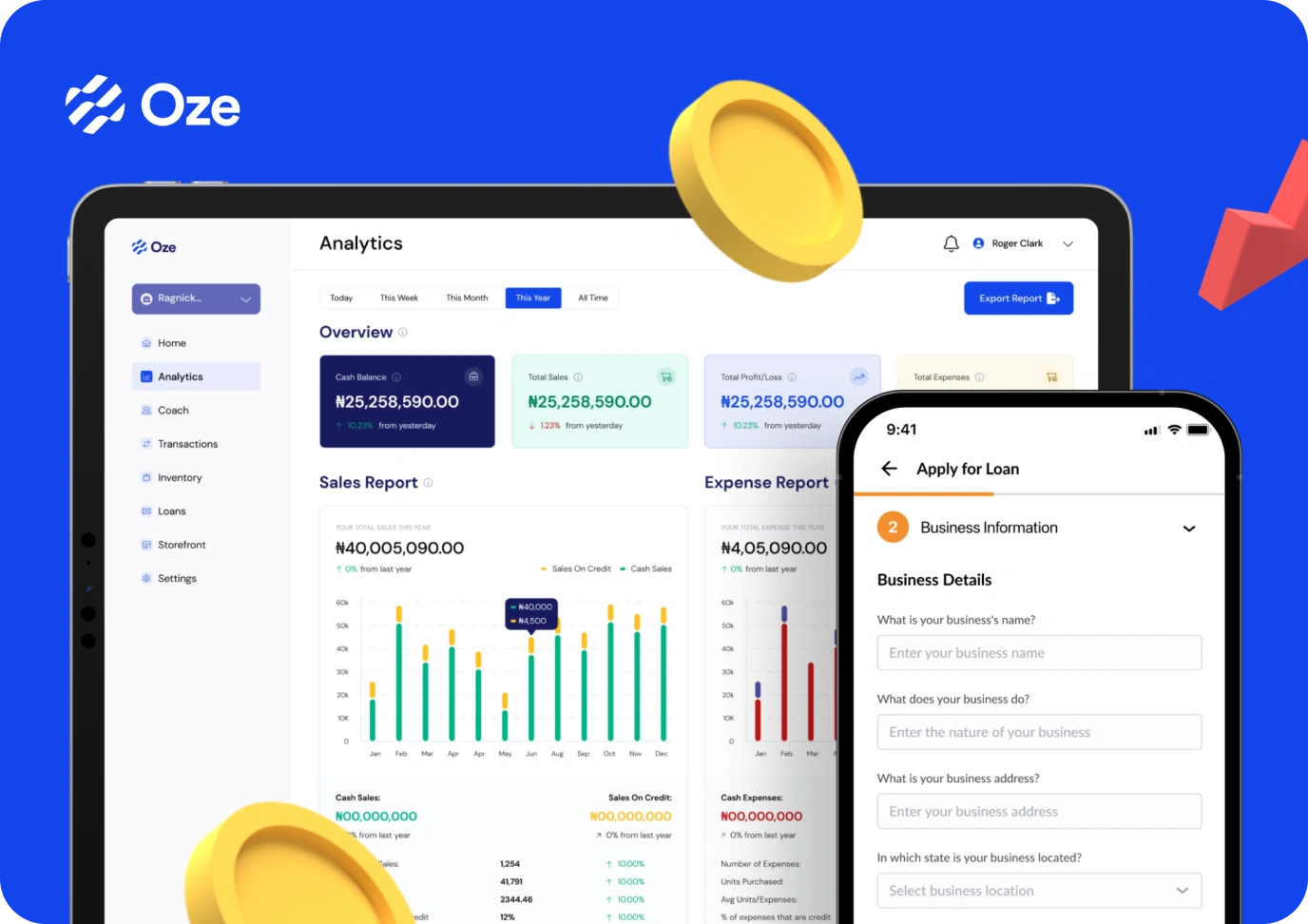

Oze partnered with Dinarys to develop a digital lending ecosystem for microfinance institutions operating across African markets. They approached Dinarys during an early product stage, when the platform vision had already been formed but the technical foundation and product architecture still required significant restructuring and expansion.
This case study is relevant for:
-

01
Companies modernizing legacy financial systems
-

02
Organizations building multi-tenant fintech platforms
-

03
SaaS businesses developing white-label loan management systems
-

04
Fintechs implementing AI-powered financial workflows
-

05
Financial institutions expanding into emerging markets
-

06
Startups building regulated financial products from scratch
-

07
Scaleups that need to improve product infrastructure before scaling
-

Project card: Essential information
on the client and development efforts
Project type
Multi-tenant white-label platform development, AWS infrastructure integration, frontend architecture rebuild, custom loan workflow system development, AI-assisted document processing integration, secure authentication and permission architecture, multilingual experience development, product and business logic consulting
Key challenge
The initial platform contained architectural and code quality limitations that created scalability, maintainability, and stability issues, making it unsuitable for long-term product growth.
Complexity factors
Simultaneous redevelopment of product architecture, business logic, and user workflows; multi-tenant white-label SaaS requirements; evolving requirements under ambitious delivery timelines; need to balance rapid MVP development with long-term architectural stability and security readiness
Key results:
-

01
Rebuilt and launched 2 full-scale fintech platforms from scratch
-

02
Enabled the platform to support 30+ loan products within the production environment
-

03
Reduced loan evaluation time
from days or weeks to minutes -

04
Built a white-label customization system that can generate a new branded platform design in under 5 seconds
-

05
Improved and scaled the platform architecture while resolving 95% of post-release issues within the first few days after launch
-


Have a project with similar complexities?
Learn how we handle them.
Book a consultation
About the client
Oze is a fintech company focused on simplifying digital lending operations for microfinance institutions and lenders across Africa. The company provides a SaaS-based lending platform that allows financial organizations to issue and manage loans digitally without building custom loan management infrastructure from scratch.
Product description
Platform type
Target users
Multi-tenant SaaS lending platform
-
Microfinance institutions
-
Lending companies
-
Financial service providers
-
Businesses and individuals applying for loans
The Oze platform helps organizations digitize loan management processes, automate lending workflows, and launch customer-facing lending services without building infrastructure from scratch.
The state of the platform when the client came to us
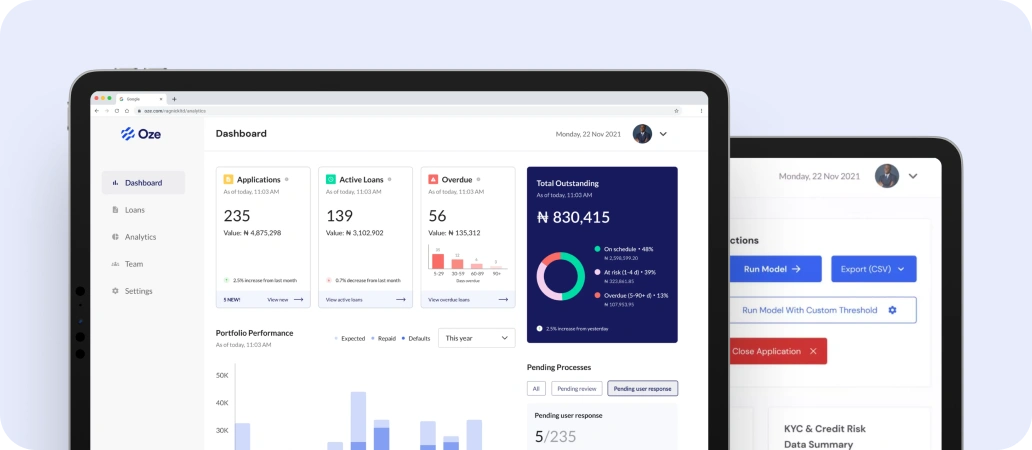
When Oze approached Dinarys, the company already had an early version of the lending platform and an initial technical foundation for the product. However, as the platform vision expanded and the complexity of the lending workflows increased, the existing implementation became difficult to scale and efficiently evolve further.
The client needed a technology partner capable of improving and expanding the platform while supporting future product growth. The project required not only active frontend and backend development but also architectural improvements, workflow refinement, scalability planning, and preparation for more advanced fintech functionality.
At final stage, the platform was expected to support:
-
01
multiple
financial institutions -
02
AI-powered
credit scoring -

03
customizable
loan workflows -

04
white-label
environments -

05
multilingual
interfaces -
06
future security and
compliance-related functionality
The existing implementation, however, was not fully prepared for the growing complexity of these requirements, which created challenges for further feature expansion and long-term maintainability.
Why the engineering team advised redevelopment instead of proceeding with the existing platform
After analyzing the existing implementation, the engineering team identified several architectural and technical limitations that could significantly complicate future platform growth and long-term maintenance.
The initial version of the platform had been developed during the early product stage and already contained core functionality. However, as business requirements evolved, the system needed to support significantly more complex workflows, including multi-tenant infrastructure, white-label customization, AI-powered credit scoring, dynamic loan configuration, multilingual support, and scalable role-based functionality.
Continuing development on top of the existing implementation
would have introduced growing technical complexity and increased the risk of scalability, maintainability, and stability issues in the future.
Based on these findings, Dinarys engineers worked closely with the CTO, Director of Product, and internal team to define the best path forward. Together, they aligned on rebuilding key parts of the platform architecture to create a stronger foundation for future growth. This approach enabled the team to improve scalability and maintainability, streamline frontend-backend interactions, simplify future feature development, and better prepare the platform to support expansion across multiple financial institutions and markets.

The Oze project is a good example of what we mean when we talk about building products, not just writing code. We came in at an early stage, and inherited a platform with significant opportunities for improvement, and had to make hard architectural decisions under real delivery pressure.
The team didn’t just ship features. Our developers thought deeply about how every decision would compound over time. The result is a platform that launched with 30+ loan products and is genuinely ready to scale. That kind of work is hard to do, and I’m proud of how the team handled it.

Jane Vyshnova
CEO at Dinarys
Scope of work defined
based on platform redevelopment
After deciding to rebuild core parts of the platform instead of continuing development on top of the existing implementation, Dinarys and the client defined several strategic areas of work required to create a scalable and production-ready fintech product:
-

01
Rebuilding the platform architecture
Redesigning critical frontend and backend foundations to establish a more scalable, maintainable, and extensible architecture capable of supporting long-term platform growth
-

02
Building an end-to-end digital lending journey
Developing the complete borrower experience across dedicated customer and administrator portals — from product selection and loan application submission to document upload, underwriting, offer approval, and digital signature workflows
-

03
Developing a flexible loan workflow system
Building configurable lending workflows, dynamic form generation, customizable approval logic, and scalable product management functionality for different lending organizations
-

04
Integrating AI-assisted underwriting and document analysis
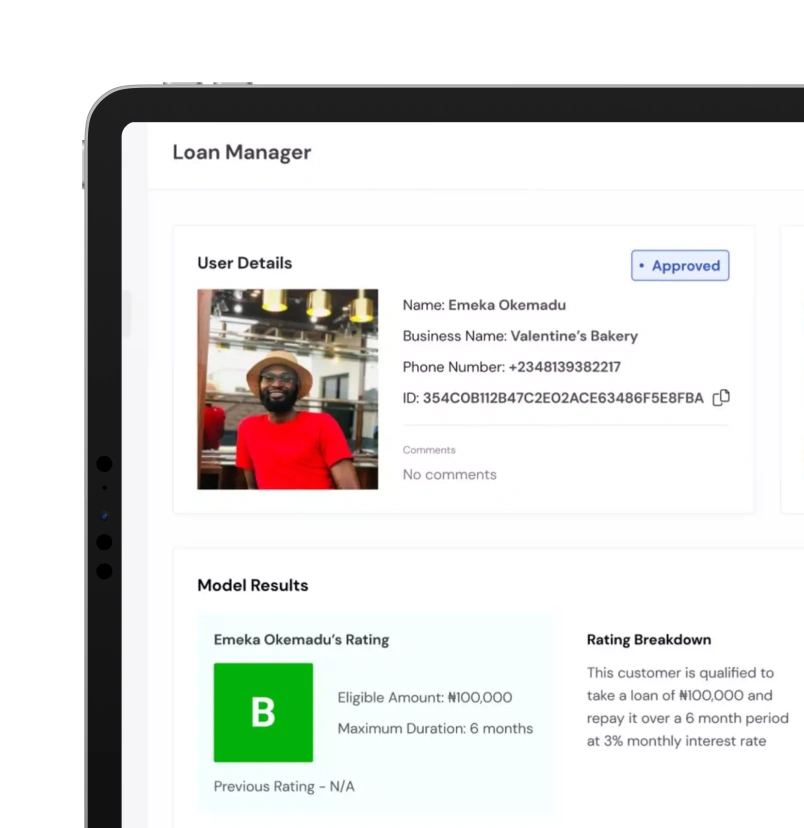
Implementing asynchronous bank statement processing and AI-powered credit analysis workflows, including retry mechanisms, transaction review flows, and decision support tools for administrators
-
05
Developing multi-tenant white-label functionality
Creating a tenant-aware SaaS architecture with company-specific routing, customizable branding configuration, and dynamic theme generation, allowing financial institutions to quickly launch branded lending environments without additional development effort
-
Technologies and infrastructure chosen to support the platform’s long-term growth
To support scalability, security, and future product expansion, the platform was developed inside the AWS ecosystem and integrated with multiple infrastructure and financial analysis services.
The technical foundation was designed to support future integrations, additional lending functionality, and expanding operational requirements without major restructuring.
The solution included:
Technologies and infrastructure chosen to support the platform’s long-term growth
To support scalability, security, and future product expansion, the platform was developed inside the AWS ecosystem and integrated with multiple infrastructure and financial analysis services.
The technical foundation was designed to support future integrations, additional lending functionality, and expanding operational requirements without major restructuring.
The solution included:
-
01
AWS Cognito for authentication
and authorization -
02
AWS S3
for file storage -
03
Kubernetes-based
infrastructure -
04
AI-powered credit scoring
integrations
Rebuilding
a product with the focus on scalability
One of the major challenges during the project involved restructuring existing platform foundations that created scaling and maintainability limitations.
After analyzing the existing implementation, the team decided to rebuild major parts of the frontend architecture instead of continuing to expand foundations. This allowed the platform to support future growth more efficiently while reducing long-term maintenance complexity.
The team redesigned:
-

Frontend
architecture -
API communication
layers -

Reusable
component systems -

Routing
logic -

Authorization
structure -

Caching
behavior -

Scalability
patterns -
Future white-label
functionality
Instead of focusing only on short-term MVP delivery, the developers invested time into building a system that would remain maintainable and extensible as the platform grew.
Building a fintech platform with evolving requirements
The platform required complex interactions between customers, financial institutions, administrators, AI scoring services, and future compliance-related functionality. The borrower-facing experience covered the full digital lending journey:
-

01
Product Discovery
Borrowers explore loan options
-

02
Application Start
Borrowers begin the application process
-

03
Document Uploads
Borrowers submit necessary documents
-

04
Underwriting Review
Lenders assess the application
-

05
Offer Acceptance/Decline
Borrowers decide on the loan offer
-

06
Digital Agreement
Borrowers sign the loan agreement
As development progressed, many workflows and business requirements continued evolving, requiring close collaboration between technical and product stakeholders. The project involved continuous refinement of both system logic and user flows to ensure the platform remained flexible, scalable, and convenient for end users.
One of the most technically demanding parts of the system became the versioned multilingual workflow engine — a custom form system that went well beyond standard form builders. It had to support:
-

01
Dynamic Field Generation
Supports dynamic field generation with conditional visibility logic.
-

02
Configurable Validations
Supports configurable validations to ensure data integrity.
-
03
Multilingual Content
Supports multilingual content for global reach.
-

04
Product-Specific Workflows
Supports product-specific workflows for tailored processes.
-

05
Backend Schema Integration
Supports backend schema integration for seamless data flow.
-
06
Schema Versioning
Supports schema versioning with historical replay for application review.
Balancing MVP delivery with scalable architecture
The project required balancing rapid MVP delivery with long-term architectural stability.
While the client aimed to move quickly toward production releases, the platform still required significant foundational work to support future scalability and maintainability.
To avoid technical limitations down the line, the team focused on creating reusable and extensible system foundations from the beginning.
Balancing MVP delivery with scalable architecture
The project required balancing rapid MVP delivery with long-term architectural stability.
While the client aimed to move quickly toward production releases, the platform still required significant foundational work to support future scalability and maintainability.
To avoid technical limitations down the line, the team focused on creating reusable and extensible system foundations from the beginning.
This included:
-
Scalable routing systems
-

Reusable UI architecture
-
Permission-ready infrastructure
-

Flexible product customization
-
Maintainable code organization
This approach helped establish a stable product foundation capable of supporting future expansion without repeated restructuring.
This approach helped establish a stable product foundation capable of supporting future expansion without repeated restructuring.
Need to launch an mvp without creating technical bottlenecks for future growth?
Dinarys helps fintech companies and SaaS startups build scalable MVPs that are ready not only for launch but also for long-term product expansion, operational stability, and future architectural growth.
We can help you:
Need to launch an mvp without creating technical bottlenecks for future growth?
Dinarys helps fintech companies and SaaS startups build scalable MVPs that are ready not only for launch but also for long-term product expansion, operational stability, and future architectural growth.
We can help you:

Konstantin Suhinin
Delivery Director

Andrii Bugakov
Deputy CTO at Dinarys

Roman Fesko
CTO at Dinarys
-
01
Rebuild unstable or difficult-to-scale product foundations
-
02
Develop customer-facing
and administrator-facing fintech platforms -
03
Implement AI-assisted workflows
and lending automation -
04
Prepare your platform for white-label scaling and multi-tenant growth
-
05
Establish scalable frontend and backend architecture from the early stages
Implementing AI-assisted document processing and underwriting automation

One of the key platform capabilities developed during the project was an AI-assisted document processing and underwriting workflow designed to accelerate loan evaluation for lenders while reducing manual effort.
Traditionally, loan approval processes require financial institutions to manually review bank statements, borrowers’ financial histories, and supporting documents before making lending decisions. This process can take significant time and creates operational overhead for lenders managing large numbers of applications.
To help automate this process, Dinarys built a full bank statement processing pipeline in collaboration with Oze’s internal team:
-

01
Secure Document Upload
Borrowers securely upload financial documents via AWS S3.
-
02
Asynchronous AI Analysis
The platform triggers asynchronous AI analysis of uploaded documents.
-
03
Background Polling
The system continuously polls for document processing status.
-

04
Retry Flows
The system automatically retries document processing on failure.
-

05
Manual Template Fallback
The system uses manual templates for edge cases.
-

06
Structured Error Remediation
Errors are grouped by type for efficient resolution.
On the administrator side, the platform includes a full decision support underwriting workflow. After AI processing, administrators can:
-

Review credit bureau
reports -

Trigger internal risk
model reruns -

Apply approval amount caps based
on model output -

Preview a complete repayment schedule
and loan terms before issuing final approval
This gives lenders a structured, auditable path from application intake to offer issuance without leaving the platform.
The AI integration became an important part of the platform’s overall value proposition, helping financial institutions simplify digital lending operations while improving scalability across multiple loan products and workflows.

Enabling digital agreement acceptance and signature capture
A key fintech capability that the platform delivers end to end is digital agreement acceptance with signature capture.
Once a loan offer is approved, borrowers can review the full loan agreement, repayment schedule, and terms directly inside the customer portal, then sign digitally without leaving the platform.
The signed agreement is captured and stored as part of the application record, giving lenders a complete, auditable closing workflow entirely within the system. This removes the need for paper-based or third-party signing tools and brings the entire lending lifecycle (from application to signed agreement) into one integrated platform.
Enabling digital agreement acceptance and signature capture
A key fintech capability that the platform delivers end to end is digital agreement acceptance with signature capture.
Once a loan offer is approved, borrowers can review the full loan agreement, repayment schedule, and terms directly inside the customer portal, then sign digitally without leaving the platform.
The signed agreement is captured and stored as part of the application record, giving lenders a complete, auditable closing workflow entirely within the system. This removes the need for paper-based or third-party signing tools and brings the entire lending lifecycle (from application to signed agreement) into one integrated platform.

Designing a white-label multi-tenant
lending platform
One of the most technically interesting challenges involved building a tenant-aware white-label architecture. The platform had to support multiple lending companies inside one ecosystem while allowing every organization to maintain its own visual identity, routing, and branding configuration.
One of the most technically interesting challenges involved building a tenant-aware white-label architecture. The platform had to support multiple lending companies inside one ecosystem while allowing every organization to maintain its own visual identity, routing, and branding configuration.
The Dinarys team developed a dynamic customization system where administrators could:
-
Upload logos
-
Configure primary brand colors
-

Automatically generate unique platform themes
The architecture used company-based routing to direct users to the correct tenant environment. Inside the admin portal, administrators could configure logos and brand colors, while the customer-facing app dynamically generated themes at runtime from those settings. This meant that new lending organizations could be onboarded with a fully branded experience in minutes, without any frontend code changes.
This functionality became an important part of the platform’s scalability as a SaaS lending product.
Collaboration
and delivery process
One of the important aspects of the project was collaboration between distributed international teams working across multiple locations and time zones.
The development process involved participants from the engineering, product, and stakeholder sides across multiple countries, requiring continual coordination during both architectural planning and active feature development.
As the platform evolved, teams worked together to refine workflows, clarify functional requirements, and align technical implementation with business goals. Since the product itself continued evolving during development, close communication between frontend, backend, and infrastructure teams became essential for maintaining consistent delivery and scalability across the platform.


At the beginning, we were not simply implementing features. We were constantly thinking about how the product should actually work for users, how it would scale later, and what technical decisions would become important in the future. Many of those early architecture decisions later became the foundation of the whole platform.

Dinarys
engineering team


Results
achieved
By the end of the active development phase, Dinarys helped Oze transform an early-stage implementation into a fully operational digital lending platform capable of supporting multiple financial institutions and loan products.
Key project results
-

01
Rebuilt and launched two full-scale fintech platforms from scratch
The engineering team redesigned and rebuilt major frontend and backend foundations, delivering two production-ready platforms: a customer-facing loan application portal and an administrator portal for lending organizations.
-

02
Enabled support
for 30+ lending productsThe rebuilt platform architecture allowed Oze to successfully launch and manage more than 30 lending products within the production environment while maintaining scalable and configurable lending workflows.
-

03
Reduced loan evaluation
time from days or weeks
to minutesThe implementation of AI-assisted document analysis and underwriting workflows significantly accelerated loan evaluation processes, helping financial institutions automate critical decision-making stages and reduce manual operational effort.
-
04
Built scalable white-label customization functionality
The team developed a multi-tenant white-label system that allows lending organizations to generate and launch customized branded platform experiences in under 5 seconds with dynamic logo, color, and theme configuration.
-
05
Improved and scaled the platform architecture
Dinarys established a more scalable and maintainable technical foundation for future platform growth while
resolving 95% of post-release issues within the first days after launch, helping to ensure stable platform operations during active product rollout. -

Building a product that’s already starting to hit scalability limits?
Dinarys helps fintech companies and SaaS startups build scalable MVPs that are ready not only for launch but also for long-term product expansion, operational stability, and future architectural growth.Dinarys helps companies redesign and scale digital products without losing development speed, operational stability, or flexibility for future expansion.
We can help you:
Building a product that’s already starting to hit scalability limits?
Dinarys helps fintech companies and SaaS startups build scalable MVPs that are ready not only for launch but also for long-term product expansion, operational stability, and future architectural growth.Dinarys helps companies redesign and scale digital products without losing development speed, operational stability, or flexibility for future expansion.
We can help you:
Konstantin Suhinin
Delivery Director
Andrii Bugakov
Deputy CTO at Dinarys
Roman Fesko
CTO at Dinarys
-
01
Rebuild an unstable or difficult-to-scale platform architecture
-
02
Redesign workflows and product logic
for long-term growth -
03
Develop scalable SaaS
and multi-tenant systems -
04
Automate complex operational and approval processes
-
05
Prepare platforms for future integrations, compliance, and high-load scaling
Capabilities demonstrated
-

01
Fintech platform redevelopment under architectural constraints
-
02
Multi-tenant white-label SaaS architecture
-
03
AI-assisted underwriting and document processing integration
-

04
Digital lending workflow system development
-

05
Customer and administration portal development
-
06
Secure authentication and permission architecture
-

07
Scalable AWS-based infrastructure implementation
-

FAQ
The timeline depends heavily on the complexity of the platform, compliance requirements, integrations, approval workflows, and scalability expectations. In many cases, companies underestimate how much architecture and business logic sits behind digital lending products.
In the Oze project, development included not only customer-facing interfaces but also administrator portals, AI-powered credit scoring integration, dynamic loan workflows, multilingual functionality, white-label customization, secure authorization, and scalable infrastructure planning. A large portion of the work involved designing the product foundation correctly so future scaling would not require rebuilding critical parts of the platform later.
For fintech platforms, rushing MVP delivery without proper architecture planning often creates technical debt that slows down future growth. That is why it’s important to balance release speed with long-term maintainability from the very beginning.
Ready-made lending platforms can work for standardized workflows, but many financial organizations eventually face limitations related to scalability, customization, integrations, and user experience flexibility.
Custom development allows companies to create lending workflows that fit their operational model instead of adapting business processes to software limitations. This becomes especially important for organizations working across multiple regions, languages, compliance environments, or customer segments.
In the Oze platform, the system needed to support multi-tenant white-label functionality, flexible loan approval logic, AI-powered financial analysis, multilingual product flows, and customizable lending experiences for different institutions. Achieving this level of flexibility would be difficult with rigid out-of-the-box systems.
Fintech platforms process highly sensitive financial information and often support thousands of transactions, approvals, calculations, and customer interactions simultaneously. Poor architectural decisions can later create serious problems with scaling, security, maintenance, and product stability.
During the Oze project, Dinarys focused heavily on rebuilding unstable frontend foundations, designing scalable backend logic, structuring reusable components, implementing permission-ready systems, and planning long-term extensibility from the beginning.
While these decisions sometimes required additional effort during early MVP stages, they later allowed the platform to evolve much faster without constantly rewriting core functionality.
AI helps lenders automate and accelerate processes that would otherwise require significant manual review. In digital lending platforms, AI can assist with:
-
Financial document analysis
-
Credit scoring
-
Borrower risk evaluation
-
Fraud detection
-
Approval recommendations
In the Oze platform, AI-powered integrations help analyze borrowers’ financial data and significantly reduce the time required for evaluating loan applications. Instead of manually reviewing financial statements for long periods, lenders can receive automated scoring and insights much faster.
This improves operational efficiency while helping financial organizations effectively process larger volumes of applications.
Security is one of the most critical parts of fintech development because platforms operate with financial data, user identities, sensitive documents, and payment-related workflows.
Depending on the product, fintech systems may require:
-
Secure authentication
-
Encrypted communication
-
Role-based access control
-
Audit logging
-
Infrastructure monitoring
-
Secure file storage
-
Compliance-oriented architecture decisions
During the Oze project, the platform used AWS-based authorization and infrastructure services, secure authentication flows, scalable permission architecture, and security-focused frontend improvements. The system was also designed with future expansion toward additional compliance and verification functionality in mind.
Multi-tenant platforms are significantly more complex than single-company systems because one product must support multiple organizations simultaneously while keeping their branding, workflows, permissions, and data separated.
In Oze’s case, the platform needed to allow different lending companies to operate inside the same ecosystem while maintaining their own visual identity and product configuration. Dinarys developed a scalable customization architecture that allowed administrators to configure logos, colors, and branding dynamically without rebuilding the frontend for each client.
This approach made the platform more scalable commercially because new organizations could onboard much faster without requiring separate product development efforts.
More Fintech
Projects From Our Team:

Crypto payment plugin development for ecommerce platforms
We developed custom crypto payment plugins for ecommerce businesses looking to expand payment flexibility and support digital asset transactions across online stores and marketplaces.
-
Built secure payment modules that enable cryptocurrency transactions directly within ecommerce checkout flows
-
Integrated plugin functionality with existing ecommerce platforms and third-party payment infrastructure to ensure stable transaction processing
-
Optimized the payment experience for merchants and customers by simplifying setup, transaction validation, and payment management workflows

Custom payment integrations for Magento and Shopware stores
We supported ConnectPay by developing custom payment modules for Magento and Shopware stores, enabling ecommerce businesses to process secure bank payments across multiple European markets.
-
Developed custom Magento and Shopware payment plugins with integrated authorization flows, API communication, and checkout functionality
-
Enabled ecommerce merchants to accept bank payments from customers in Lithuania, Germany, Finland, and the Netherlands through seamless platform integrations
-
Prepared marketplace-ready modules, technical documentation, and installation guides to support reliable deployment and long-term platform maintenance