OUTSTAFFING, SUSTAINABILITY, DATA MANAGEMENT
Data management optimization for iSi Group: Automation, ESG reporting PoC, and enhanced sales transparency


Project summary
As part of a broader engagement to bolster iSi Group’s internal lSAP BW/BI team, Dinarys helped establish a structured data management framework. It encompassed the sales department’s data lifecycle, sustainability-related data practices, and automated reporting processes. The focus was on improving data consistency, reducing fragmentation across systems, and creating a foundation for more reliable and scalable data operations.
To improve operational efficiency and significantly reduce the volume of manual data handling and reporting, iSi Group defined two key objectives for the project:
-
01

Implement automated margin and pricing report generation to streamline workflows, reduce manual effort, and eliminate reliance on Excel-based processes, ensuring faster access to accurate and up-to-date data.
-
02

Develop an ESG reporting PoC as part of the company’s sustainability roadmap, addressing the growing importance of ESG requirements across Europe and preparing the organization for future regulatory and reporting needs.

We approached this project by first understanding how data actually moves within the company. This allowed us to automate reporting where it matters most, reduce reliance on manual processes, and introduce a practical ESG reporting PoC built on structured and transparent data flows.

Jane Vyshnova
CEO and Head of Sustainability Execution Unit at Dinarys
iSi Group profile
iSi Group is a global, enterprise-level manufacturer based in Vienna, Austria. Recognized as a leader in pressurized gas technology, they are known for their quality, innovation, and long-term commitment to value as a privately held, family-owned business. The company designs and manufactures:
-
Pressurized gas cylinders and chargers
-
Whipping, dosing, and culinary systems
-
Compressed-gas systems used in automotive safety (including airbags) as well as in medical, industrial, and technical applications
01

Global presence
-
Production sites across Europe and the US
-
Products sold in over 90 countries
02
Market position
-
Premium manufacturer
-
Well-established company,
founded in 1867 -
Leading innovator in pressurized gas technology
03
Industries served
-
Automotive
-
Components
-
Culinary
-
Wearables
iSi Group clients














Automating time-consuming processes to improve data clarity and accelerate operations
iSi Group requested that we automate the pricing and margins report that they previously created manually in Excel. Compiling this report took significant time and effort that top management could instead spend on more strategic activities. Here’s how we did it:
-
Step #1
Analyze existing processes, business logic, interdepartmental dependencies, and bottlenecks
This step provided a clear view of how data moves across the organization and where inefficiencies occur. It allowed the Dinarys team to identify opportunities to improve data clarity and cohesion by removing duplicates, enhancing data synchronization, and eliminating reliance on Excel-based workflows. The analysis also laid the groundwork for broader data automation and the creation of a company-wide data core.

-
Step #2
Design a solution to automate reporting flows and ensure fast, direct access to data
Based on the analysis in step one, we designed a solution that enables consistent and timely access to data required for decision-making. The objective was to accelerate report generation, reduce manual intervention, and transition from fragmented Excel-based processes to a structured SAP-based reporting environment.
-
Step #3
Build a data simulation mode within the reporting tool
Our data engineers implemented a process for analyzing historical data to support fast and flexible calculations of pricing, margin, and volume scenarios. This enabled teams to model different business situations and make more informed decisions without additional manual effort.
-
Step #4
Improve data sustainability practices within the company
Dinarys experts introduced automated data workflows, eliminated redundant data, and optimized storage use to reduce the processing load on infrastructure. These improvements helped lower resource consumption while ensuring more efficient and consistent data operations.
-
Step #5
Create an ESG reporting PoC
Together with the client’s experts, we developed data pipelines for ESG data preparation and established a transparent process within the sales department to ensure clear, traceable, and consistent data flows. This created a foundation for structured sustainability reporting and improved visibility into data used for ESG-related initiatives.
Ready to simplify your data workflows and stop relying on manual work?
We help you build systems where data flows clearly, reports generate faster, and teams spend less time fixing inconsistencies:
Ready to simplify your data workflows and stop relying on manual work?
We help you build systems where data flows clearly, reports generate faster, and teams spend less time fixing inconsistencies:
Contact our team to analyze your data flows

Roman Fesko
CTO at Dinarys

Andrii Bugakov
Deputy CTO at Dinarys

Konstantin Suhinin
Delivery Director
01
Understanding your data landscape
Analyzing your data sources, dependencies, and current workflows to identify gaps, inconsistencies, and bottlenecks
02
Designing structured data flows
Creating clear data logic and connections between systems to ensure consistency, accuracy, and accessibility
03
Automating critical processes
Reducing manual work by automating reporting, calculations, and data synchronization across systems
04
Improving data clarity and usability
Eliminating duplicates, aligning data structures, and making information easier to interpret and use across teams
05
Supporting ongoing operations
Helping you adapt, scale, and refine your data processes as your business and reporting needs evolve
Enhancing resource sustainability and building data pipelines for the ESG reporting PoC
To support ESG reporting and ensure efficient use of resources, we focused on structuring how data is collected, processed, and maintained across the sales function. This included building reliable data pipelines, reducing redundancy, and optimizing data operations to create a consistent and sustainable foundation for reporting.
-
Designing structured and transparent data flows
We developed data pipelines to ensure consistent collection and preparation of ESG-related data from the sales department. This established a clear and transparent flow of data from source to reporting, improving visibility and control over how data is formed and used.
-
Ensuring data consistency and traceability
The data pipelines were designed to maintain data integrity across all stages, enabling traceable data transformations and reducing the risk of inconsistencies in ESG reporting.
-

Optimizing data processing workflows
We streamlined data preparation processes to eliminate unnecessary steps and reduce compute-heavy operations. This ensured that ESG data is processed efficiently without creating additional system load.
-
Reducing data redundancy and storage overhead
We identified and removed duplicate data flows and optimized storage use, minimizing redundant data and improving consistency across systems.
-

Improving infrastructure efficiency
By reducing unnecessary data processing and optimizing storage, we lowered infrastructure load and supported more efficient resource use.
-


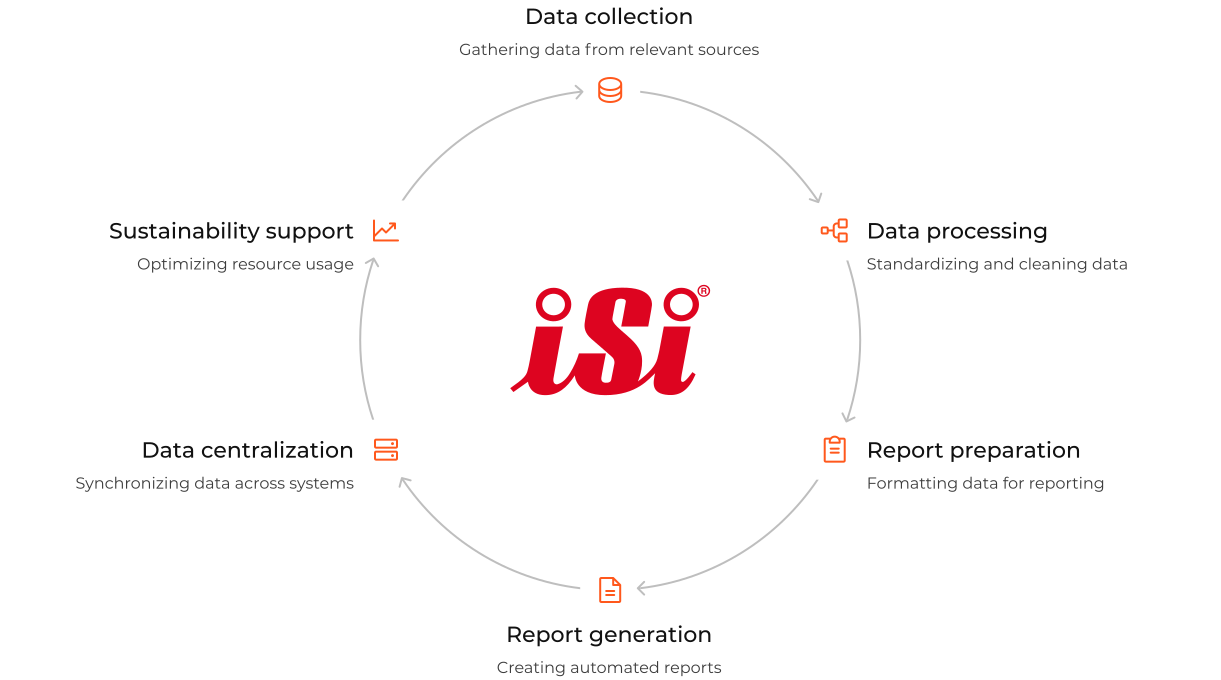
What the data management process looks like
The data management process is built around structured data flows, automated reporting, and consistent data handling across the sales function. Data is collected from relevant sources, processed through standardized pipelines, and prepared for reporting without manual intervention. This ensures that information remains accurate, up to date, and accessible when needed.
Also, instead of relying on fragmented Excel-based workflows, data is centralized and synchronized across systems, reducing duplication and improving transparency. Automated processes handle data preparation, validation, and reporting, allowing teams to access reliable insights faster and with less effort.
Data Management Cycle



Results
of our collaboration
As a result of the project, our client reduced their reliance on Excel-based processes, improved the efficiency of pricing and margin analysis, and accelerated negotiations with potential clients by enabling faster access to consistent and reliable data.
In parallel, the team established additional process sustainability practices and introduced an ESG reporting PoC supported by structured data pipelines and transparent sales processes.
Result
Technical improvements
Impact
Improved data
sustainability practices
-
Reduced redundant data storage
-
Optimized processing workloads
-
Automated data lifecycle management
These improvements lowered infrastructure use and supported more sustainable and efficient data operations.
Reduced reliance
on manual reporting
Automated workflows replaced manual Excel-based processes, enabling faster access to accurate data.
This significantly decreased the time required for pricing and margin analysis and allowed top management to focus on more strategic tasks while also accelerating client negotiations.
Introduction of an
ESG reporting PoC
The company implemented structured data preparation workflows and introduced an ESG reporting PoC.
This laid the foundation for consistent data collection, improved transparency in sales data, and readiness for future sustainability reporting requirements.

As a team, we focused on more than just automating reporting. It was important for us to bring structure to how data is managed across the sales function, reduce manual dependencies, and create a foundation that supports both operational efficiency and ESG reporting.

The Dinarys Team
Preparing your data for ESG reporting but not sure where to start?
Dinarys doesn’t just help you collect ESG data. We design structured data frameworks and pipelines that make reporting consistent, transparent, and easier to manage as requirements evolve.
Preparing your data for ESG reporting but not sure where to start?
Dinarys doesn’t just help you collect ESG data. We design structured data frameworks and pipelines that make reporting consistent, transparent, and easier to manage as requirements evolve.
01
Designing data pipelines that connect ESG inputs across systems → consistent and traceable reporting
02
Structuring data for regulatory requirements → fewer gaps, less manual reconciliation
03
Automating data collection and validation → reduced errors and faster reporting cycles
04
Aligning ESG data with business operations → clearer insights for internal decision-making
05
Building scalable data frameworks → easier adaptation to changing standards and audits
More projects from our teams:

Fractional Shopify development team for a growing ecommerce brand
Dinarys partnered with Untamed to provide a fractional Shopify development team that became a natural extension of their internal engineering structure, supporting continuous platform growth.
-
Built a dedicated team of Shopify developers, DevOps specialists, and QA engineers aligned with the client’s technical and business goals
-
Supported storefront improvements, backend optimization, and subscription-based functionality development
-
Enabled faster feature rollout and improved platform stability through structured delivery processes and DevOps practices


Magento development outstaffing for enterprise digital projects
Dinarys helped an enterprise ecommerce company strengthen its Magento development capacity by providing dedicated outstaffed engineers capable of handling complex, large-scale digital initiatives.
-
Delivered senior Magento developers experienced in building and maintaining scalable ecommerce systems
-
Supported ongoing development, feature delivery, and system improvements across enterprise-level projects
-
Increased operational efficiency by extending the client’s internal team with reliable, long-term engineering support

Enterprise-level outstaffing for SFCC ecommerce projects
Dinarys supported a global ecommerce development company BORN Group by providing senior Salesforce Commerce Cloud (SFCC) engineers through a structured outstaffing model, helping them scale delivery across multiple enterprise projects.
-
Supplied experienced SFCC developers who seamlessly integrated into distributed teams and contributed to complex enterprise implementations
-
Established a stable collaboration model with clear communication flows, ensuring alignment across multiple project stakeholders
-
Enabled flexible team scaling, allowing the client to handle high workloads while maintaining consistent delivery quality