Web, API
Upgrading the technical foundation and features of a wish-listing platform for affiliate integrations with major US marketplaces

About the client
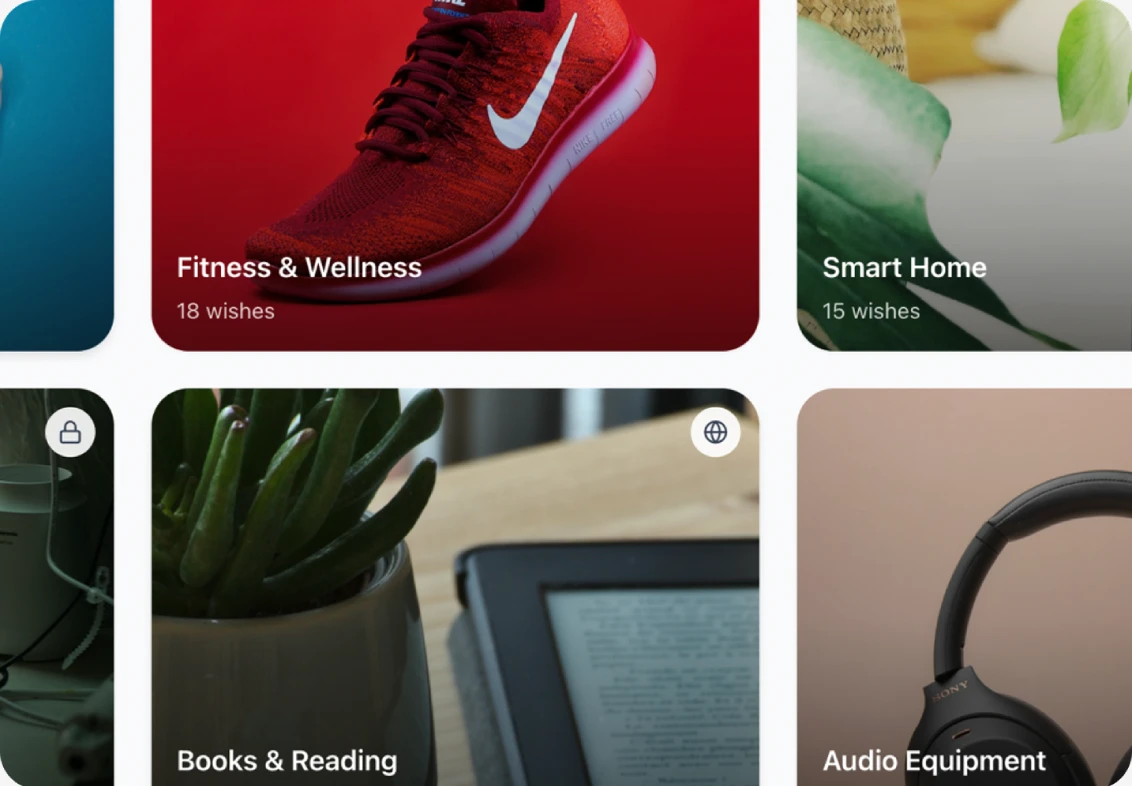
Our client (NDA) is a US-based wish-listing platform that is popular among young and middle-aged adults. Unlike traditional ecommerce services, the platform was never meant to be purely transactional. This vision positioned the platform as a digital space where aspirations and relationships come together.
Existing business growth strategy
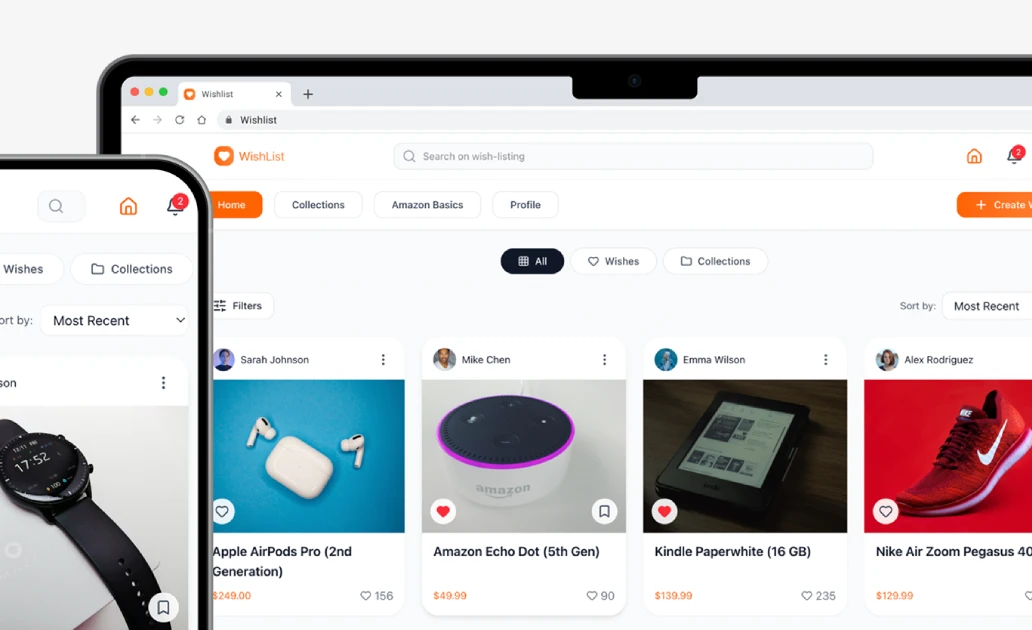
Over the past five years, the client’s platform had been steadily building a loyal user base with minimal advertising as the company focused on keeping the product user-friendly and community-oriented. However, to keep the business stable and profitable, our client decided to start using an affiliate marketing strategy.
This meant building complex API integrations with Amazon and eBay and adding new features to make the affiliate integrations effective and engaging for users.
Business logic and technology behind the client’s first major monetization strategy
The client chose to monetize their platform by joining two well-established affiliate programs:



With these integrations, revenue is generated every time a user clicks an affiliate link on the platform and makes a purchase.
The client needed to design API-based integrations to get accurate product information — including prices, availability, and images — and display it directly within users’ wishlists. This would create a seamless experience:

Users could continue to manage and share their wishlists as before

Users could see auto-fetched data on items in their wishlists, including availability through online stores, images, prices, etc.

Users could buy items directly through affiliate links

New features would enhance the overall user experience
Affiliate marketing flow for the client’s wish-listing platform
01

User adds
items to their wishlist
02
Wishlist platform displays real-time product info via API integrations (Amazon/eBay)
03
User clicks an affiliate
link to buy
04
Amazon/eBay marketplace
processes the purchase
05
Commission is paid back
to the wishlist platform
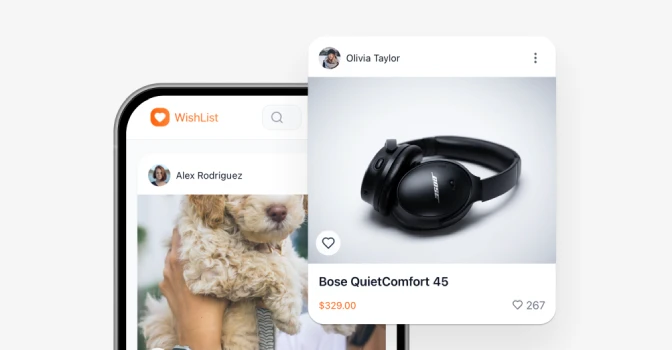

“Introducing affiliate integrations with Amazon and eBay fundamentally changed the platform’s business model. For the first time, user engagement directly translated into measurable revenue. What makes this achievement even more meaningful is that we managed to do it without compromising our community-driven values — we enhanced the user experience and built a sustainable monetization channel at the same time.”

Adam P.
Chief Revenue Officer
Goals for our
development team
The client approached Dinarys because they lacked in-house development resources and needed experienced engineers with expertise in API-based development. To successfully complete this project, we defined the following scope of work:

Optimizing data exchange security practices
under the supervision of the client’s internal security specialists. This was a critical requirement for joining the Amazon Associates Program and eBay Partner Network.

Designing and implementing an API integration roadmap
for Amazon and eBay services to get up-to-date product data (availability, prices, images) for items that users add to their wishlists.

Developing additional user-facing functionality
based on opportunities created by affiliate programs, encouraging users to make purchases. This included product previews, purchase links, and wishlist enhancements that were designed to encourage purchases via affiliate links.


Ensuring quality throughout the entire SDLC and post-release
verifying that the platform performed as intended at every stage.

Releasing new functionality for a limited group of users
in order to validate platform stability under real-world conditions, measure the popularity of new features, and understand how users perceived changes.
The client also wanted us to assist them with support and refinements post-release. This would ensure that affiliate links, API integrations, and new features performed as intended.
Optimizing security for Amazon and eBay platform validation
Affiliate programs, such as Amazon Associates and the eBay Partner Network, have strict requirements for how partner platforms exchange data. Without meeting these requirements, our client couldn’t participate in the programs and monetize their platform through affiliate links.
To address this, our team worked closely with the client’s in-house security specialists to optimize existing practices. Their work included:
01
Reviewing user session handling and ensuring secure authentication flows
02
Strengthening encryption for API requests and responses
03
Setting up secure storage and rotation of affiliate program keys and tokens
04
Implementing strict access controls for external data transfers
05
Adding logging and monitoring to detect unauthorized or suspicious activities

Designing and implementing an API integration roadmap
Once the security foundation was ready,
we focused on designing and implementing API integrations with Amazon and eBay.
Our work at this stage included:
01
Mapping all integration touchpoints between the wishlist platform and Amazon/eBay APIs
02
Planning data synchronization processes to keep product details accurate and up to date
03
Establishing request throttling and retry logic to handle API rate limits and ensure stability
04
Defining error-handling flows to prevent broken links or outdated product information
05
Implementing affiliate link generation and proper attribution so each user purchase could be tracked back to the platform

“We deliberately chose this approach because it gives the product a stronger foundation for the future. It’s not just about how the system works today but how easily it can grow and adapt tomorrow. This architecture allows us to scale to other digital platforms without friction and guarantees the level of technical flexibility the client will need as their ecosystem expands.”

Andrii Bugakov
Deputy CTO at Dinarys
Need help designing and implementing API integrations?
Our engineers specialize in building secure, scalable connections between platforms and third-party services.
Contact us to:
Need help designing and implementing API integrations?
Our engineers specialize in building secure, scalable connections between platforms and third-party services.
Contact us to:

Andrii Bugakov
Deputy CTO at Dinarys
01
Design an API integration roadmap tailored to your business goals
02
Implement affiliate or marketplace integrations that actually scale
03
Strengthen your platform architecture for long-term growth
Developing functionality based on affiliate program opportunities
We expanded functionality to introduce monetization while preserving the platform’s community-oriented nature. New features had to inspire users to interact with wishlists and shop through affiliate links.
Key additions included:

Price display
and comparison:
Each item added to a wishlist is now shown with real-time prices on Amazon and eBay to help users find the best deal.

Discount monitoring
with notifications:
Users can track discounts on wishlisted items. An upgraded notification system alerts them as soon as a lower price becomes available on Amazon or eBay.

Social following and
wishlist updates:
We introduced the option to follow users or specific wishlists. Notifications pop up whenever new items are added to followed wishlists or by followed users, strengthening the platform’s community-driven nature.

Special events
and gift claiming:
A new calendar feature allows users to mark important dates: birthdays, anniversaries, or personal milestones. Followers receive notifications about these events and can gift items from users’ wishlist, promoting a collaborative experience.

Yearly goals
for personal wishes:
We added the ability to set annual goals for specific items. This feature turned wishlists into a mix of aspiration and accountability, encouraging long-term engagement.
Ensuring user-friendly design for a new feature set
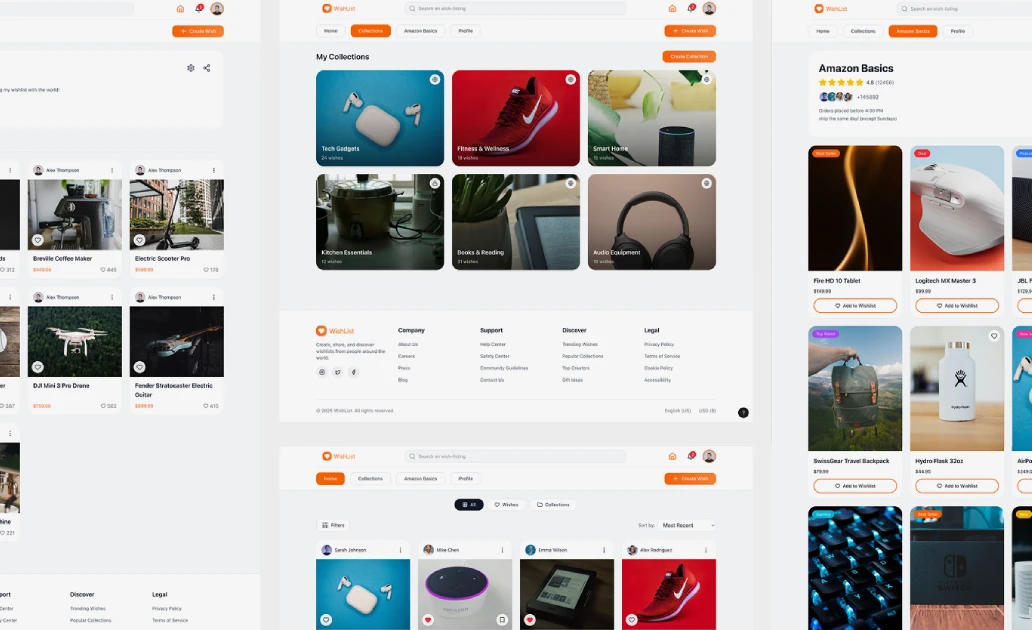
Alongside backend development, our team designed the UI for these new features to ensure they fit naturally into the platform’s existing user experience:

We added clear, simple price comparisons
under each item and designed notifications to be helpful, not distracting

For social and calendar features,
we built intuitive interfaces that made interactions easy and natural
Performing complex testing throughout the whole SDLC
Given the platform’s expanded functionality and reliance on third-party APIs, testing played an important role at every stage of development. Our goal was to ensure not only that all new features worked as intended but also that the platform remained stable, secure, and user-friendly under real-world conditions.
We approached testing as an ongoing process throughout the entire SDLC rather than a final step before release.
Our testing framework included:

Unit and integration testing
for backend services to verify API calls, data synchronization, and affiliate link generation

End-to-end testing
of user flows, including wishlist creation, price display, discount monitoring, and notifications

Performance testing
to check how the system handled high volumes of product requests and concurrent users

Security testing
to confirm compliance with Amazon and eBay program requirements and to validate earlier optimization work

UI/UX testing
to ensure that new features were visually consistent, accessible, and intuitive for end users
Releasing the upgraded platform version for a limited group of users to validate the strategy’s success
The client chose a limited release for 1,000 beta testers to validate the new affiliate marketing strategy and monitor how users interacted with updated features before scaling. To assess how well the affiliate model performed in practice, the client measured:

Business-focused metrics
such as user engagement, click-throughs,
and purchase activity

Technical aspects
such as affiliate link accuracy, API stability, and overall
platform performance under live conditions
We also collected user feedback to identify areas where the experience could be refined, which included:
Adjustments
to the notification system

UI elements
for price display

The calendar
interface
By rolling out the release in a controlled environment, the client minimized risks while gaining clear evidence of the strategy’s effectiveness. Insights gathered during this stage served as the foundation for a full-scale release, which is planned for the first quarter of 2026.
Business results of the beta release and expected outcomes from the full release
The limited release for 1,000 beta users provided valuable insights into how the affiliate marketing strategy performed in practice. Even within a small user group, the platform demonstrated measurable improvements in both engagement and monetization. Users actively tested new features, and early data confirmed that affiliate integrations could serve as a sustainable revenue channel.
Key results from the beta release included:
36% increase in click-through rates on wishlist items that displayed real-time prices and comparisons
High adoption of the discount monitoring feature, with 56% of users turning on notifications
Previously, users received notifications when others liked items from their wishlists. During the limited release, beta users gained access to an advanced notification center, which, according to their feedback, made them more interested in the items they had wishlisted:

“The new notification center feels more organized. It’s easier to track what’s happening with my wishlist and see who’s engaging with it.”
Rachel D.
beta tester from Peoria, IL
“I’ve started revisiting my old wishlist items more often. The reminders and updates make me actually want to check prices.”
William P.
beta tester from Washington, D.C.
“It’s nice to get updates about friends’ activity, not just likes. It makes the platform feel more alive and personal.”
Brian A.
beta tester from Houston, TX

Growth in social activity, as more users began engaging with others’ wishlists and calendar events

Stable technical performance of API integrations and affiliate link attribution under live conditions
Based on these early results, the client expects the full release to drive:
01
A steady new revenue stream from affiliate commissions that will cover platform maintenance and future feature development
02
Stronger user retention through social features, notifications, and goal-setting tools
03
Higher overall engagement, as wishlists evolve from static collections into interactive, community-driven spaces
04
A scalable model that can be extended to additional affiliate partners beyond Amazon and eBay
“We are proud to have been part of this project. Working side by side with the client’s team, we not only built secure and reliable integrations but also helped shape features that genuinely improved the user experience. It’s rewarding to see how our work supports both the platform’s growth and its community.”

The Dinarys Team
Want your platform to grow with a reliable monetization model?
Our team can help you integrate affiliate programs, marketplaces, and APIs that turn engagement into revenue.
Reach out to get:
Want your platform to grow with a reliable monetization model?
Our team can help you integrate affiliate programs, marketplaces, and APIs that turn engagement into revenue.
Reach out to get:

Konstantyn Suhinin
Delivery Director
Andrii Bugakov
Deputy CTO at Dinarys

Roman Fesko
CTO at Dinarys
01
A technical strategy aligned with your business goals
02
A dedicated development team ready to deliver from day one
03
A proven approach to building secure and scalable digital platforms
More API-driven projects from our portfolio

SanMar
Dinarys supported enterprise ERP integration for SanMar by creating API-centric workflows that connected core business systems with their ecommerce engine.
-
Built a custom connector to translate old ERP data formats into modern APIs for Magento platforms
-
Enabled real-time product and order data flow between an ERP system, B2B site, and B2C site, reducing manual updates and mismatches
-
Migrated a B2C site from Magento 1 to Magento 2 as part of the integration plan to ensure future scalability


ConnectPay
Dinarys delivered API-driven modules for major ecommerce platforms (Magento, Shopware) for the fastest-growing electronic money institutions in Lithuania.
-
Built modules that added new payment methods, managed authorization flows, and checked payment statuses through the client’s APIs
-
Integrated store modules with ConnectPay’s payment gateway API, allowing customized checkout options and automated transaction reconciliation
-
Delivered multilingual, mobile-responsive modules available via Magento and Shopware marketplaces, helping merchants collect payments from bank accounts in Germany, the Netherlands, Finland, and Lithuania

Automotive Parts Marketplace (NDA)
Dinarys built an API-first marketplace for an automotive parts platform, enabling seamless vendor integrations and real-time data exchange.
-
Designed APIs and a database architecture to support up to 2 million parts with full cross-reference capability
-
Integrated the TecDoc catalog and built advanced lookup methods including VIN number, license plate, and part number search
-
Launched a fully responsive ecommerce platform with Modules on Shopify Plus to support expansion into new European markets