Before replatforming, trace what happens to a customer's points, a pickup (click and collect) order and an in-store return of an online purchase. A storefront can display the right products while the store cannot find the order—or while a refund leaves the wrong loyalty balance.
Those symptoms do not, by themselves, prove that the commerce platform needs replacing. They can come from mismatched customer IDs, a delayed integration, conflicting rules or an incomplete store procedure. Moving the same ambiguity to a new platform will not resolve it.
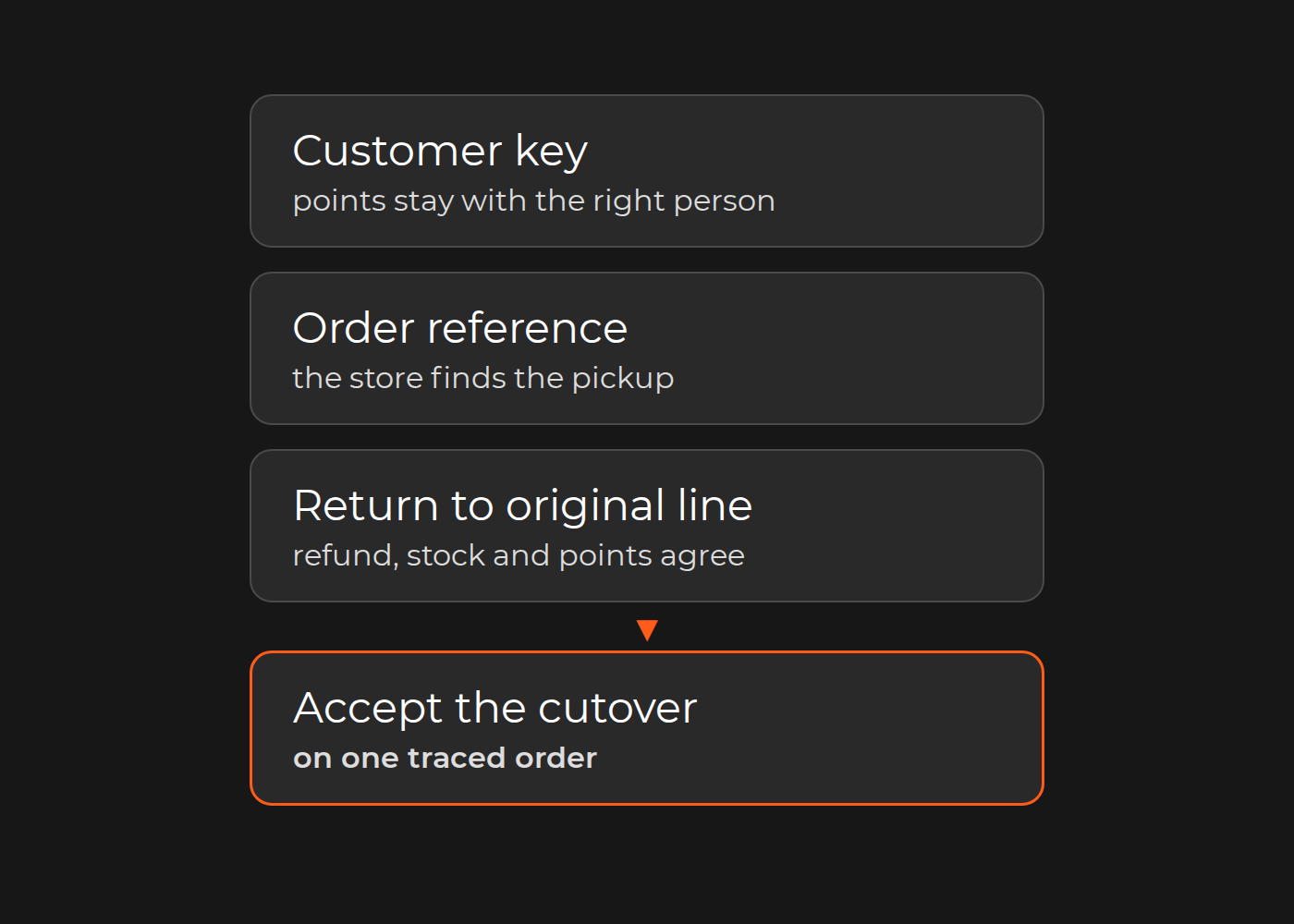
During cutover, check three seams: the customer key that ties points to a person, the order reference a store uses to find an online purchase, and the link from a return to the original order line. Check all three on one order before accepting the transition.
For the ecommerce lead, that protects a customer promise. For the COO and store teams, it protects a procedure they must still execute. IT needs to establish where the records and rules live before the sponsor commits to a replacement. Start with a map of what cannot be lost, not a premature migration brief.
Seam 1: the customer key that ties points to a person
An online account, loyalty membership and store customer record may use different identifiers. They must resolve to the intended person under the merchant's approved rules. Migrating the total number of customers or the sum of all points does not establish that individual balances remain correct.
When points appear on a second profile or a refund changes the wrong balance, compare the customer key in the order, loyalty entry and store lookup. Then investigate the first suspects: an incorrect mapping; an absent, delayed or repeated event; a staff workflow that creates an unlinked transaction; or a requirement the installed platform cannot support. Several causes can coexist. Missing logs mean the cause is unknown, not that an event never happened.
Ask the loyalty owner to define the expected balance and timing. Ask IT to identify the authoritative ledger and the mapping used at each handoff. Order, stock, payment and loyalty can have different authorities; “the ERP is the master” is not a sufficient answer for every field.
Seam 2: the order reference the store uses for pickup
A website confirmation does not prove the store can reserve and issue the purchase. Follow the same order through reservation, preparation, customer identification, handover and the status returned online. Record the correct item, quantity and location as well as the reference.
If the website says “collected” while the store still shows “reserved,” compare the agreed event sequence and timestamps before declaring either system wrong. Include cancellation or non-collection: who releases the hold, what the customer sees and which owner handles an incomplete transition?
The same test must work for a pre-cutover order serviced afterward. Staff need a supported lookup route into its history, whether that is migrated data or an approved retained system—not a vague promise that “old orders are archived.”
Seam 3: the return must resolve to the original order line
Hypothetical example—not a client result or a universal loyalty policy. A merchant's invented rules award points on completed pickup, allocate redeemed points to order lines, and restore redeemed points and reverse earned points when the relevant partial refund completes.
Synthetic customer C-17 starts with 200 points. Earlier completed order O-40 earns 40, taking the balance to 240. A new two-item pickup order, O-41, redeems 100 points. Completing pickup earns another 20. The resulting balance is 160.
The customer then returns item A at another store. In this example only, item A accounts for 40 redeemed points and eight earned points. After the refund and loyalty adjustments complete, the expected balance is 160 + 40 − 8 = 192 points. No currency conversion, tax treatment or refund-tender rule is implied.
Restoring redeemed points and reversing earned points are separate effects under this invented policy.
Moment
Expected state
Evidence to link
Mismatch and verifying owner
O-40 completes
C-17 gains 40; balance 240
Completion and loyalty entry
Second profile; data/loyalty owners
O-41 placed
One 100-point redemption; balance 140
Order, redemption and times
Repeated redemption; integration/loyalty owners
Pickup completes
Correct goods issued; gain 20; balance 160
Hold, handover and loyalty entry
Collected/reserved disagreement; operations
Return requested
Item A links to O-41; no completed effect inferred
Missing or repeated effect; finance/loyalty owners
A return request is not a completed refund. Receipt and inspection establish stock disposition separately. A payment reference and status establish the financial outcome; the loyalty ledger needs its own entries. Compare the same lifecycle point after the agreed processing interval, using pseudonymous references, timestamps and time zones—not an immediate screen against a later export.
As checked on November 5, 2026, Adobe's reward-program documentation distinguishes automatic refunding of redeemed points from voiding points earned on a fully or partially refunded purchase. These are separate settings in Adobe Commerce, not native Magento Open Source features. The documentation does not establish how a retailer's POS or loyalty extension behaves, or validate the invented allocation policy above.
A mapping defect may need a repair, not a rebuild
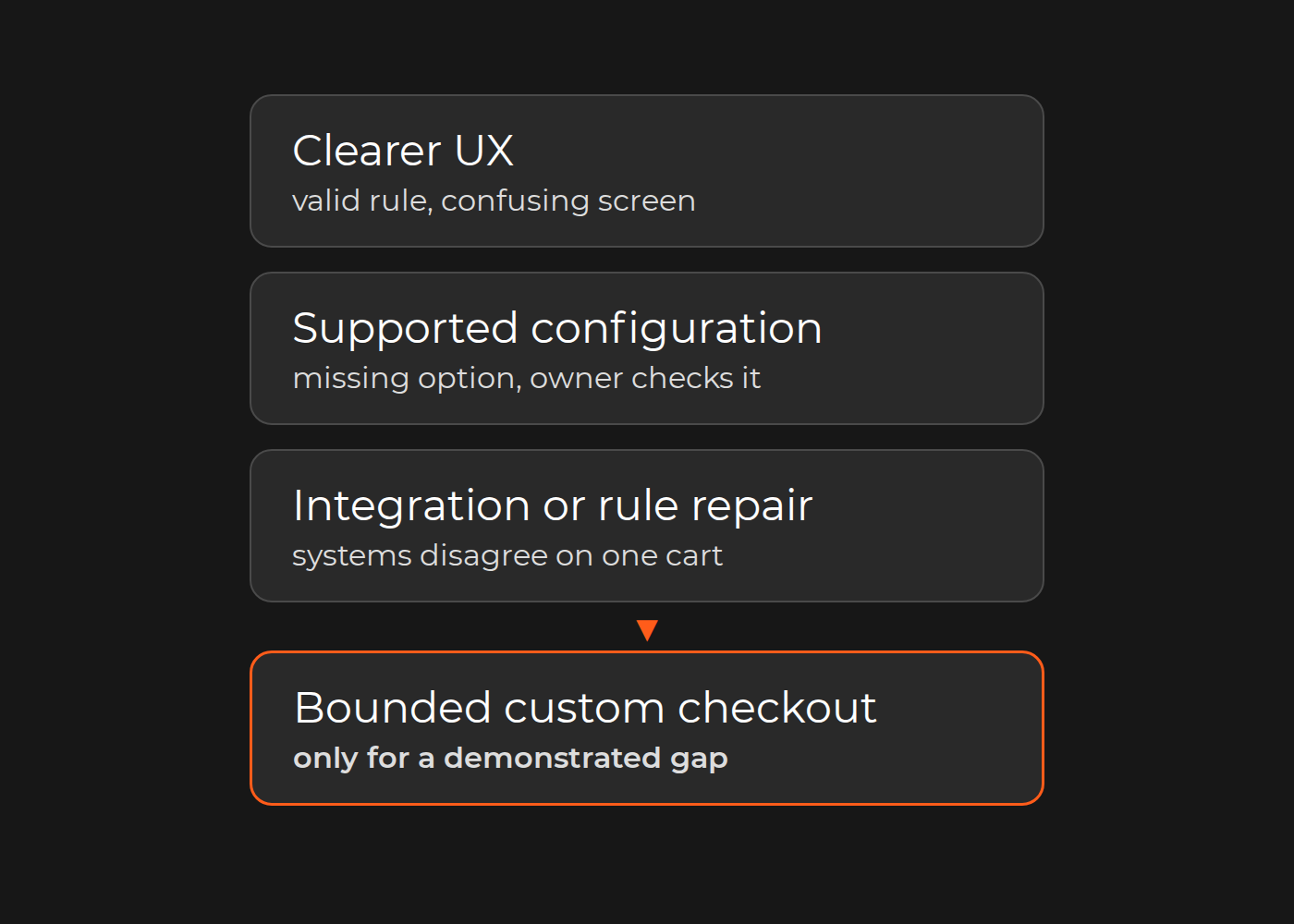
Suppose the online order uses C-17 but the store return attaches to an unlinked profile. The current platform supports the approved rules; the connection uses the wrong customer mapping and staff cannot find the original order reliably. Correcting that mapping and lookup procedure, then testing and reconciling the result, is a bounded response. The incumbent may be able to do it.
Replatforming deserves separate evidence of a limitation that repair cannot resolve. Do not merge profiles, replay financial events or adjust real balances as an editorial diagnostic exercise. Use authorized test data or redacted historical evidence.
Dinarys's public Prostor case describes a Magento 2 migration for an omnichannel drugstore chain with offline pickup, real-time inventory sync across 427+ physical stores and the online storefront, ERP/CRM integrations, and a custom loyalty program that gives customers a unified loyalty balance across online and in-store. Among the options the page says were ruled out is a phased migration with omnichannel deferred to phase 2, because unifying the loyalty program and pickup module retroactively would have needed more rework. It also reports that early ERP inventory-sync inconsistencies required manual reconciliation and were identified and resolved during the first month of post-migration operations by adjusting sync frequency and adding a validation layer. That is a useful reason to include reconciliation and an operations owner in the transition—not evidence that this article's hypothetical loyalty/return flow was tested for Prostor, or that every retailer needs its architecture.
Make the continuity map small enough to use
For each critical operation, record what must remain true → authoritative records → named owner → proposed evidence → unknowns and next action. Start with four entries:
Earn and redeem: preserve customer identity and rule meaning, not only balance totals. Link earn, redemption and return entries; confirm expiry and pending-point behavior with the loyalty owner.
Pickup: preserve the item, quantity, customer and location through reservation and handover. Operations confirms the normal path and cancellation exception.
Cross-channel partial return: retrieve the original line and verify refund, stock disposition and both loyalty effects. Returns and finance confirm eligibility, tender rules and permissions.
Historical lookup: service a pre-cutover order from the post-cutover workflow. Data and integration owners confirm retained-history access, retention and mapping rules.
Add dates, evidence locators and accepting owners. “Test planned,” “test observed” and “accepted with exceptions” are different statuses. Do not fill unknowns with a green check.
Rehearse the operation across the switch
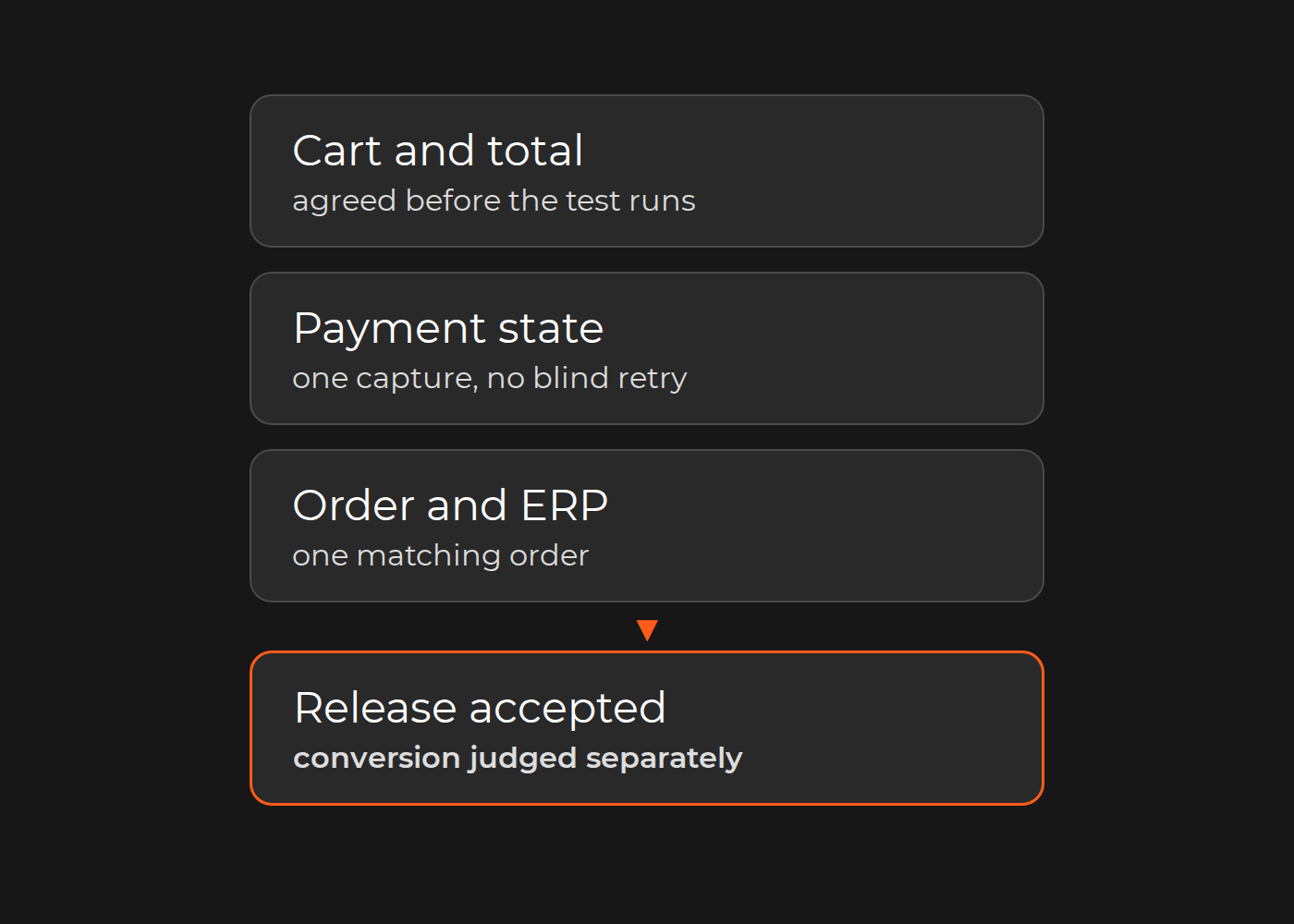
Create an authorized fixture before the trial cutover and collect or return it afterward. Verify the customer, original line and distinction between pending and completed adjustments. Matching customer or order counts does not prove those relationships survived.
Agree a stop condition, who can authorize go/no-go and how to recover if a control fails. Restoring software does not reverse an already completed pickup or refund; reconcile business effects before resuming. Broader URL, peak-load, CMS and cost comparisons are separate workstreams, not reasons to dilute these operation-level checks.
Want a second pair of eyes on one operation?Discuss the mismatch with Dinarys. Bring the expected rule, a redacted description of what diverges, affected channels and the people who own loyalty, store operations and integration. Agree access and data-use rights before sharing records. The first decision is what must remain true—not which platform to buy.