Can you reverse a release without leaving payments and orders in different states?
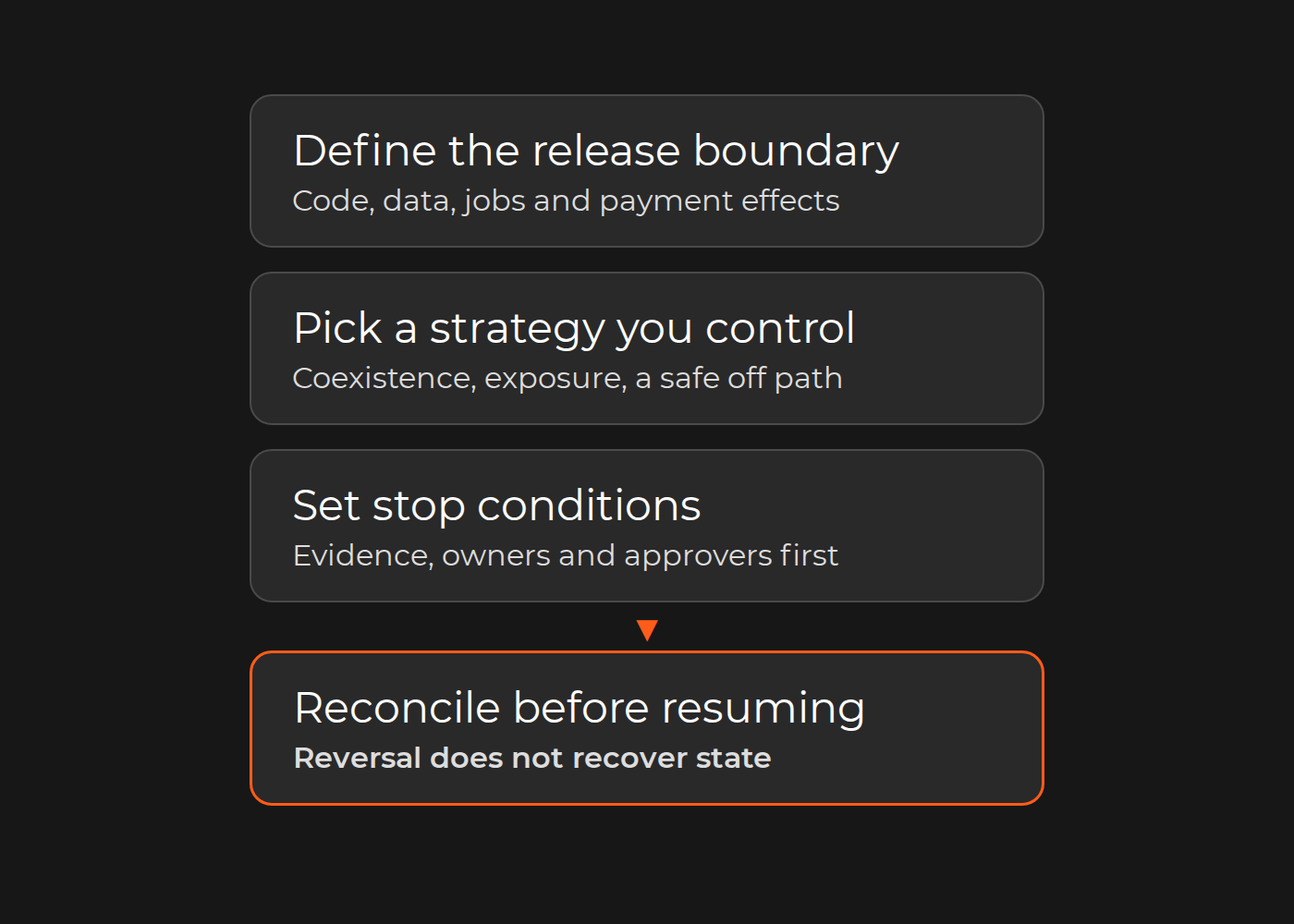
Sending shoppers back to the previous application version may stop a defect from reaching more people. It does not erase a captured payment, recreate a missing order, or recall an instruction already sent to a warehouse. Choose a deployment strategy and a state-recovery plan together.
This guide helps a technical lead or integration engineer plan a commerce release: which versions receive traffic, what evidence permits expansion, who can stop it, and how unfinished transactions will be reconciled. It is a planning aid, not a step-by-step deployment procedure or a zero-downtime guarantee.
Start here: the commerce release and rollback checklist near the end of this guide lists the record each release stage needs. Every check starts as “not yet run” until your team attaches evidence.
What is software deployment—and what does it release?
Software deployment puts a particular application build and its required configuration into a target environment. A release makes changed behavior available to users or other systems. These can be separate events: code can be deployed with a feature disabled, then exposed to a defined cohort later.
In ecommerce, the release boundary can include more than the storefront:
Application instances, APIs, static assets, configuration, and cache behavior.
Database schema, data transformations, search indexes, and stored session/cart formats.
Webhook handlers, queue consumers, scheduled jobs, and downstream integrations.
Payment, inventory, fulfillment, and customer-message effects that outlive the request.
Write down which of those change and which remain shared. Two application environments connected to one production database are not two independent copies of the business.
Compare deployment strategies by their recovery limits
Rolling, blue-green, and canary describe different aspects of instance replacement or traffic exposure. Feature flags control behavior; shadow testing gathers evidence without serving the shadow response to the shopper. They can be combined, but none replaces compatibility testing.
Approach
What changes
Useful when
Commerce limit to resolve before use
Rolling deployment
Replace application instances in batches; old and new versions overlap
A compatible change can tolerate mixed versions and the team can observe each batch
Either version may encounter state written by the other. Replacement batches are not automatically stable customer cohorts or exact traffic percentages.
Blue-green / red-black deployment
Prepare a parallel application environment, validate it, then switch traffic
You need a separately testable target and can retain a usable previous environment
Shared data still changes. Verify old code against post-release state, in-flight requests, connection draining, and background workers before treating a switch back as safe.
Canary release
Expose the new version or behavior to a bounded cohort before expanding
You can identify that cohort across its complete transaction and obtain meaningful evidence
A small share of requests can still affect shared stock, queues, or all orders. A quiet canary is not proof that an unrepresented payment method works.
Feature flags
Enable or disable a guarded behavior independently of deploying the build
A bounded feature has a tested off path and consistent evaluation across relevant services
A flag does not reverse data writes or already-started jobs. Confirm propagation, fallback behavior, and what happens to transactions begun under the on state.
Isolated shadow testing
Copy permitted requests to a non-authoritative candidate; compare results separately
You need evidence about candidate outputs or load behavior before serving them
Discarding responses does not prevent side effects. Isolate writes and external destinations; shadow must not charge customers, send duplicate emails, or reserve production stock.
What each exposure control leaves unresolved in a commerce release.
The terms are not competing product specifications. Spinnaker documents red/black as blue/green, with provider-specific implementation limits. Its documented rollout options apply to ReplicaSets; do not assume the same controls exist for every workload.
For a rolling example, Kubernetes Deployments control replacement using settings such as maxSurge and maxUnavailable. A Deployment rollback restores its Pod template, not the commerce database. The documentation also says that a stalled Deployment reports ProgressDeadlineExceeded; that condition alone does not perform an automatic rollback.
Choose the smallest strategy your team can actually control
Start with the change, not a preferred deployment tool:
Can old and new versions safely coexist? If not, split the change into compatible steps or plan an explicitly approved interruption. Adding a canary does not resolve an incompatible schema.
Can you bound and observe exposure? Use a canary only when the cohort can be followed through checkout, callbacks, and downstream processing. Otherwise, its apparent precision is misleading.
Would a parallel target add useful validation? Blue-green helps separate target preparation from traffic switching, but requires capacity, configuration control, and a still-usable return target.
Can the changed behavior be safely disabled? Add a flag where both branches and in-flight transitions have defined behavior. Do not use it to conceal an irreversible migration.
Can copied requests be made non-authoritative? Use shadow testing only after proving isolation. If that cannot be established, use synthetic inputs in a separate environment instead.
For example, a backward-compatible API correction may suit rolling replacement. A new order-routing behavior may benefit from a stable canary cohort plus a flag. A schema change that breaks the old reader needs redesign or a controlled maintenance boundary—not a stronger “zero downtime” label.
Separate traffic reversal from transaction recovery
Keep four decisions distinct:
Decision
What it can accomplish
What it cannot establish
Stop expansion
Prevent the next rollout step
That the currently exposed cohort is safe
Disable behavior or reverse routing
Limit new exposure, subject to propagation and in-flight work
That writes, payments, or downstream instructions were undone
Roll back the application build
Restore a previous application version if it remains compatible
That schema, data, queue payloads, or external systems reverted with it
Recover business state
Reconcile affected transactions and approve corrective work
That a previous database snapshot is automatically safe to restore over newer orders
Three decisions limit exposure; only the fourth, transaction recovery, reconciles payments, orders, and stock.
A backup is important, but restoring an older database can discard legitimate transactions accepted after the backup and disagree with external systems that did not rewind. Define restoration scope, recovery-point and recovery-time objectives, and reconciliation separately. An objective or an available backup is not evidence of a successful restore rehearsal.
Prove environment parity and old/new compatibility
Parity means matching the properties that matter to this release—not copying production credentials or customer data into testing. Record the differences that remain and what each prevents you from concluding.
Compare the build artifact, runtime and dependency versions, configuration shape, schema, cache/index setup, routing and timeouts, worker topology, and vendor API/event versions. Use authorized synthetic or sanitized data representing relevant cart sizes, currencies, customer types, and failure cases. A sandbox can validate a contract without proving production settlement timing or peak capacity.
Use expand-contract for schema changes
The expand-and-contract pattern separates adding a compatible structure from removing the old one. For a commerce change, the planning sequence is:
Expand: introduce a compatible field or structure without removing what the old application requires. Review database-specific locking, indexing, and migration behavior.
Coexist: define which representation is authoritative and how old and new readers/writers stay consistent. If dual writes are needed, specify failure handling and reconciliation; two writes are not automatically atomic.
Migrate and validate: backfill with a reviewed, restartable approach appropriate to the database, and compare expected and actual records while accounting for concurrent updates.
Contract later: remove the old representation only after its readers, writers, jobs, delayed events, and rollback dependency have been retired under an approved plan.
An additive migration can still create load or locks. “Expand” is not permission to skip testing. Prisma's linked implementation is version-specific; the pattern here is not a recommendation to run its example commands against a store.
Treat asynchronous work as part of the release
Contract
Evidence to collect
Session and cart
A cart created before the change remains readable after routing to either supported version; login, guest-to-account transition, discounts, and payment return preserve agreed state. Define behavior for an unsupported format.
API and cached assets
An older browser bundle can call the supported API during the overlap; response meanings and cache keys remain compatible. Cache invalidation does not hide a broken contract.
Jobs and queues
Old/new producers and consumers accept the agreed payload versions. Identify the owner of each scheduled job, prevent duplicate ownership, and test retries, in-flight work, backlog age, and poison-message handling.
Webhooks
Verify sender authenticity under the provider's contract; test duplicates, delay, out-of-order delivery, handler-version overlap, and recovery after a temporary outage. Separate delivery acknowledgment from completed business processing.
Inventory and downstream systems
Trace the same order/reference through reservation, order export, fulfillment, loyalty, and notification boundaries that the release touches. Record accepted versus unknown external effects.
Stripe's webhook documentation is a concrete example: events can arrive more than once and delivery order is not guaranteed. The integration must handle those conditions; they are not fixed by returning traffic to the previous storefront.
Similarly, Stripe's API idempotency documentation distinguishes API v1 and v2 behavior. An idempotency key is scoped protection under a provider's documented rules—not an end-to-end guarantee of exactly one order, email, or warehouse instruction. Test your own cross-system duplicate handling.
Keep shadow deployment (isolated shadow testing) away from commerce effects
Istio's mirroring guide describes copied traffic as out-of-band, with mirrored responses discarded. That describes response handling, not a sandbox for writes.
Before accepting a shadow setup, require evidence that:
Candidate writes go only to separate test stores and queues; production databases and shared inventory are not writable by the shadow path.
Payment calls use approved non-live substitutes, outbound messages go to test sinks, and fulfillment/stock mutations cannot reach live destinations. Do not rely solely on a request header or application flag to provide isolation.
Copied data is permitted, minimized, and sanitized as required. Request method alone is not proof of safety: even a read path may update sessions or analytics.
Background jobs, retries, analytics, and webhook subscriptions cannot escape the isolated path. Captured inputs and result comparisons have correlation IDs, retention limits, and an owner.
Added traffic cannot silently exhaust shared dependencies. Compare outputs with rules for expected differences such as timestamps; do not equate a matching HTTP status with a matching order outcome.
Shadow testing cannot demonstrate the real completion of effects it deliberately replaces. It supplements controlled flow tests; it is not a substitute for them or a risk-free production load test.
Define acceptance, stop conditions, and owners before exposure
Give each release stage an evidence record: build/configuration versions, cohort rule, flow, expected state, baseline, measurement window, sample requirement, stop condition, owner, and approver. Set numeric thresholds from the store's actual baseline and obligations, not from a universal canary percentage.
Use both infrastructure and business-state evidence. Error rate and latency can reveal a problem quickly. They cannot establish whether every accepted payment has the correct order or whether a warehouse received duplicate work.
Critical flow
Acceptance evidence
Stop or hold signal
Browse → cart → checkout
Correct product, price, currency, discount, shipping, and retained cart across supported versions
Wrong totals, unreadable existing carts, or incompatible API behavior
Payment result → order state
Correlated payment reference and order ID; distinct authorized/captured/failed/pending states; expected amount and currency
Duplicate effect, unexplained mismatch, or an unknown transaction outcome
Order → inventory/fulfillment
Expected reservation and downstream acknowledgment linked to the same order
Missing/duplicate reservation or export; growing unresolved backlog
Temporary dependency failure → recovery
Controlled retry and delayed-event evidence without repeated business effects
Poison messages, lost accepted work, or a retry storm
Disable/reverse → continued service
Previous path reads newly written state; in-flight and asynchronous work have named handling
Old version cannot read new state, or the return path is unverified
Define hold as no further expansion while evidence is insufficient. Define stop as invoking the agreed containment response when a guardrail fails. A missing sample, missing callback, or broken monitor is not a pass. A serious transaction mismatch can justify stopping before enough data exists for a conversion-rate comparison.
Release lead: coordinates the stage record and has named authority to halt expansion; designates a backup.
Platform/application owners: execute authorized traffic/build actions and confirm compatibility and service behavior.
Data/integration owners: own schema, queues, webhook processing, and the affected-transaction ledger.
Commerce/operations approver: accepts business-flow evidence and remaining customer/fulfillment exposure; finance/payment specialists approve any financial correction under existing controls.
Incident lead and support owner: coordinate containment, customer communication, escalation, and post-release handover.
Record who can authorize reversal, forward repair, restoration, and resumption. Do not let “automatic rollback enabled” substitute for those decisions. For example, Amazon ECS's blue-green guide has explicit failure-detection and rollback configuration; the deployment label alone does not describe your configured response.
Worked partial-release example: contain first, reconcile separately
Illustrative scenario: a fictional store, used as a tabletop exercise. No test or action in it has been run.
A fictional store plans a new order-export mapping. Version A and candidate B share an expanded order schema; A is intended to ignore the new optional field. The proposed canary is a stable 5% checkout cohort, with an order-level version marker available to downstream processing. Five percent is an illustration, not a recommended safe share. The new export behavior has a flag; its off path is intended to leave accepted orders available for the existing exporter.
At a hypothetical checkpoint, the scenario supplies four transaction records:
Example record
Supplied evidence
What remains unresolved
Planning decision
SYN-101
Payment captured; order exists; reservation and warehouse acknowledgment reference that order
Nothing within the supplied record; broader checks not yet run
Preserve the completed order and its history. Do not replay it simply because routing changes.
SYN-102
Payment captured; order exists; new export payload rejected
Warehouse acceptance absent
Assign forward repair of the export contract and controlled recovery of this order, with duplicate protection and operations approval.
SYN-103
Browser timed out; payment/order outcome not established
Order exists; export request sent; acknowledgment unavailable
Warehouse acceptance unknown; payment state not supplied
Establish downstream and other required state before approving any replay. An absent acknowledgment is not proof of non-delivery.
The proposed stop condition is an unexplained or rejected critical export in the changed cohort. SYN-102 would therefore stop expansion. The response plan assigns the release lead to invoke containment and the integration owner to identify affected orders by cohort, version, and time boundary—including delayed events and any shared consumers that could affect other orders.
Turning off the new exporter is a candidate containment action only if its tested semantics preserve accepted work and do not launch competing consumers. Routing new checkouts to A is a separate candidate action, conditional on A reading B's state and handling in-flight carts. Neither action resolves SYN-102, SYN-103, or SYN-104.
Recovery would proceed through an approved case list: preserve valid completed effects, establish unknown states from authoritative records, repair the export incompatibility, and reconcile affected orders without duplicating external work. The example does not establish that any of those actions succeeded. Resumption would require new compatibility/flow evidence, an accounted-for affected population, and approval of any remaining exceptions.
Counterexample: suppose B removed a field required by A or wrote a new order state A cannot interpret. Sending all traffic back to A could create a second failure. A flag cannot restore the removed data. Containment may require restricting the affected flow and retaining compatible code while owners approve forward recovery. Restoring a pre-release database over newer paid orders is not a safe default.
Rehearse this example and counterexample with your own team before a real release: for each record, separate known state, unknown state, and the proposed action.
A software deployment checklist that records evidence
Use the checklist for the selected release, not as a generic “DevOps complete” sign-off.
What can be reversed, and what must be reconciled?
Closeout and handover
Delayed work accounted for, exceptions owned, support acceptance, separate contract/cleanup approval
Can the release be closed without hiding unfinished work?
For automated software deployment, encode the approved gates and preserve their evidence. A pipeline can stop when a required check is missing; it should not convert missing telemetry into success. Test the automation's failure path and the authorized human intervention path. In LaunchDarkly's flag documentation, turning targeting off serves the configured off variation; verify that variation and SDK behavior in your application rather than assuming “off” restores the previous transaction state.
Dinarys case pages describe adjacent release engineering. For Untamed, a UK pet-nutrition brand, the case page lists CI/CD and DevOps automation and “stable uninterrupted deployment”, and claims deployment cycles 2x faster and 100% deployment success. For a US Backend-as-a-Service platform, the Backendless case page describes automated deployment of customers' environments and reports 40% faster environment deployment. These are the case pages' own figures, not a forecast for your release. The related service is DevOps support and maintenance.
You may share this article
Let professionals meet your challenge
Our certified specialists will find the most optimal solution for your business.