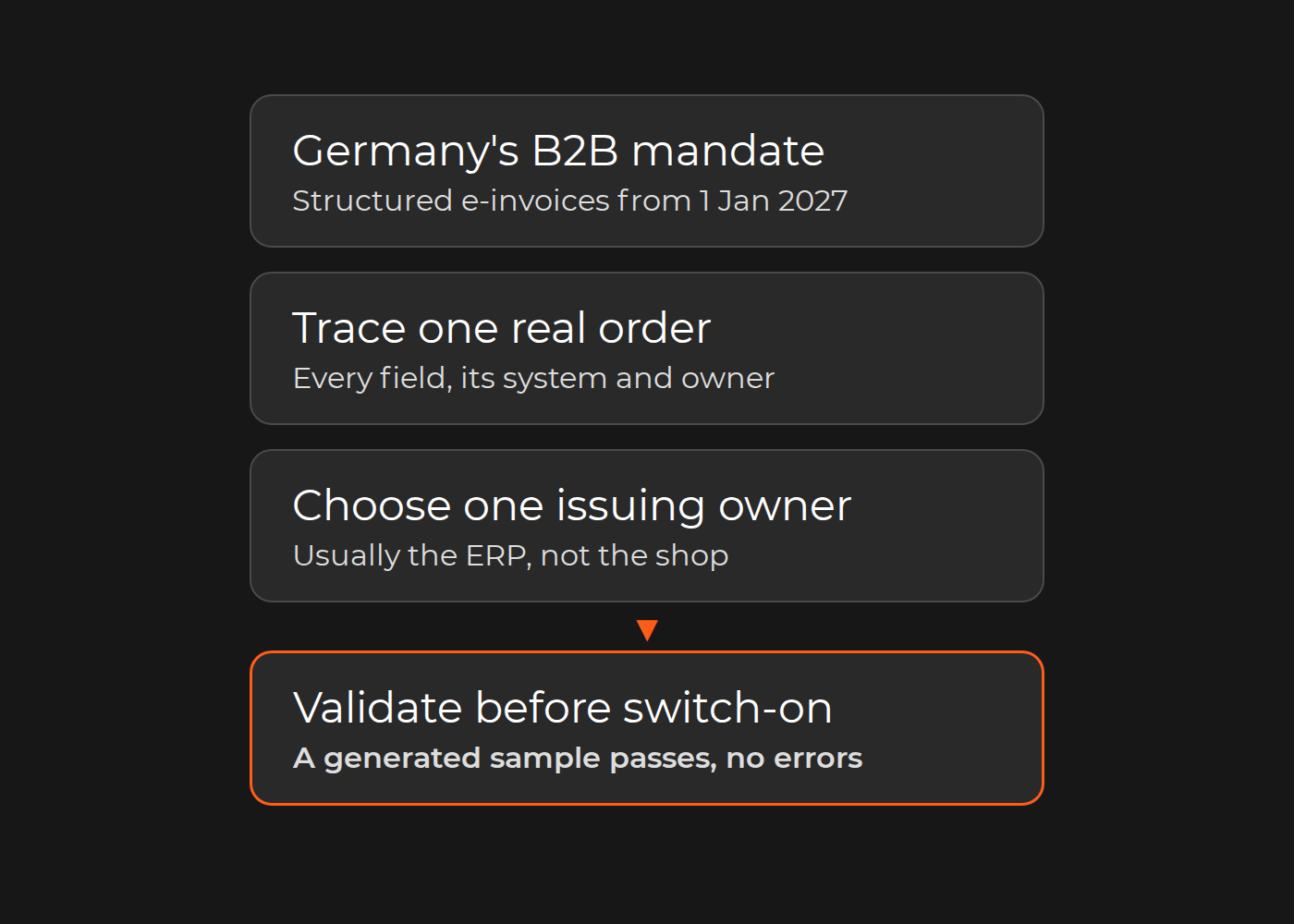
A structured e-invoice for a webshop order should come from one system, and that system can only be as complete as the order data the shop hands it.
In Germany, every business established in the country has had to be able to receive e-invoices since 1 January 2025. From 1 January 2027, domestic B2B invoices must be structured e-invoices. Two exceptions remain until the end of 2027, for supplies made in 2027: paper or PDF for sellers whose total turnover in the previous calendar year was no more than EUR 800,000, and EDI in another agreed format. A plain PDF is not an e-invoice; XRechnung and ZUGFeRD from version 2.0.1 qualify, except the ZUGFeRD profiles MINIMUM and BASIC-WL.
So which system should issue it? For most B2B webshops, not the shop. Choose one issuing owner: usually the ERP that books the invoice, its e-invoicing module, or an e-invoicing service fed by the ERP. The shop's job is to capture the data the invoice needs (purchase-order reference, buyer reference, buyer VAT ID where required, VAT category per line, payment terms), pass it on without loss, and stop sending any document that competes with the real invoice.
This guide gives heads of ecommerce and ERP owners a data trace, an issuing-owner decision and acceptance tests. It is not tax advice: dates and scope come from the German VAT Act (UStG) and the Federal Ministry of Finance (BMF) FAQ as checked on 19 November 2026, and your tax adviser decides how they apply to you.
What changed: Germany's B2B e-invoicing timeline
Under § 14 UStG, an electronic invoice is issued, transmitted and received in a structured electronic format that enables electronic processing. The format must follow the European standard EN 16931, or be agreed between the parties if the required data can be extracted correctly and completely into a format that complies or is interoperable with it. Paper and PDF are "other invoices" (sonstige Rechnung).
Supplies made
What the seller may send
Source
1 Jan 2025 to 31 Dec 2026
E-invoice; paper, or another electronic format such as PDF if the buyer agrees, only if sent by 31 Dec 2026
§ 27(38) no. 1 UStG
1 Jan 2027 to 31 Dec 2027
E-invoice. Paper, or PDF if the buyer agrees, only if sent by 31 Dec 2027 and the seller's prior-year total turnover was no more than EUR 800,000; EDI in another agreed format if issued by 31 Dec 2027
§ 27(38) no. 2 and 3 UStG
From 1 Jan 2028
E-invoice for every domestic B2B supply in scope
BMF FAQ, question 11
Four details matter for a webshop:
Supply date and sending date both count. The date of supply decides which year's rules apply, and the paper or PDF option also requires the invoice to be sent by 31 December of that year (§ 27(38) UStG). A December 2026 delivery invoiced in January 2027, for example in a monthly collective invoice, falls outside the paper and PDF option.
The scope is domestic B2B: supplies to another business for its business when both are established in Germany, by seat, management or a permanent establishment involved in the supply (§ 14(2) UStG).
The exceptions are narrow. The BMF lists invoices to consumers, many tax-exempt supplies, small amounts up to EUR 250 gross, travel tickets, supplies by small businesses (Kleinunternehmer) and supplies to legal persons that are not businesses.
In a hybrid ZUGFeRD file, the XML prevails when it differs from the PDF image, according to the BMF.
Public-sector buyers follow their own e-invoicing rules, and an invoice to an authority needs its Leitweg-ID. In B2B, the BMF says a placeholder such as "-" in the buyer reference field (BT-10) is enough for VAT purposes.
Who issues the invoice for a webshop order today?
Count the documents first: for one recent B2B order, list what the buyer received, which system produced each document and which assigned the invoice number. § 14(4) UStG requires a sequential number that the issuer assigns once. Two systems numbering invoices for the same order is the first defect to remove.
Commerce platforms have their own invoice object. Adobe Commerce's documentation describes its invoice as a record of payment for an order, notes that "Multiple invoices can be created for a single order", and says that with a purchase-order payment method or an Authorize and Capture payment action, "the order is invoiced and payment is captured during checkout." That is not necessarily the VAT invoice your ERP books on shipment, and if both reach the buyer, they hold two documents with two numbers.
Illustrative flow for one B2B order. Today the shop and the ERP each create an invoice (red). The target is one issuing point in the ERP (green), fed by the data the shop captures and sent on by an e-invoicing service or Peppol access point where buyers need one.
Trace one order: the EN 16931 data an invoice needs
Take one real order, ideally with a partial delivery, and fill this trace with each system's owner, writing "unknown" rather than leaving a cell blank. The rows are EN 16931 business terms (BT) most webshop orders touch; the KoSIT and FeRD mapping table of mandatory UStG items gives the full list.
Fictional, illustrative example. A Hamburg fasteners distributor with about EUR 30 million turnover sells through Adobe Commerce B2B, mostly in Germany and partly to other EU countries. A PDF extension emails an invoice when the order is placed; the ERP books the invoice when the goods ship. Its trace:
Business term
Captured at
Stored in
Reaches the issuing system?
Gap and owner
Seller VAT ID (BT-31)
ERP company master
ERP
Yes
None
Buyer VAT ID (BT-48)
Company account form
Shop only
No
Required on its intra-EU supply invoices (§ 14a(3) UStG); map to the ERP customer. Ecommerce lead
Purchase-order reference (BT-13)
Optional checkout field
Shop order comment
No, lost as free text
Make it required for company accounts; map to the ERP order. Ecommerce lead, ERP owner
Buyer reference (BT-10)
Not captured
None
No
Capture where a buyer asks; otherwise "-". ERP owner
Invoice number and date (BT-1, BT-2)
Shop PDF and ERP
Both
Two numbers
ERP only. Finance
Actual delivery date (BT-72)
ERP shipment
ERP
Yes
None
Line net amount, VAT category and rate (BT-131, BT-151, BT-152)
Shop price, ERP tax code
ERP
Yes, but shop and ERP round differently
Calculate in the ERP only. ERP owner
Allowances and charges (BG-20, BG-21)
Shipping fee, account discount
Shop order
Discount only as a reduced price
Agree how each is shown. Finance
Payment terms, IBAN (BT-20, BT-84)
ERP customer and bank master
ERP
Yes
None
Document question
Today
Target
Which system creates the invoice?
Shop (PDF at order) and ERP (on shipment)
ERP only
Format and channel
Plain PDF by email
XRechnung or a qualifying ZUGFeRD profile; email, or Peppol where a buyer requires it
What the shop sends
"Invoice" PDF
Order confirmation, clearly not an invoice
Credit notes
Manual PDF from finance
ERP correction referencing the original invoice
The trace showed that the PO number typed at checkout never reached the ERP, and buyer VAT IDs existed only in shop accounts. Decision: the shop sends an order confirmation, not an invoice; PO reference and VAT ID become required for company accounts and are mapped to the ERP; the ERP's e-invoicing module issues the e-invoice. Where buyers order from their own procurement system, the PO arrives from there instead; PunchOut or a B2B portal covers that flow.
Shop extension, ERP or e-invoicing service: choose one issuing owner
The issuing owner numbers invoices and credit notes, produces the structured file, sends it and keeps it. Under § 14b(1) UStG a copy of every invoice is kept for eight years, and the BMF says an e-invoice's structured part must be kept unaltered in its original form.
Option
Fits when
Watch for
Rules it out
Shop extension
The shop is the system of record for orders, invoices and refunds
Numbering, credit notes and archive all live in the shop
An ERP already books invoices, or partial deliveries are invoiced outside the shop
ERP e-invoicing module
The ERP books invoices and credit notes on shipment
The ERP needs the shop's PO reference, buyer reference and VAT ID
Your ERP version lacks the formats your buyers need
E-invoicing service or Peppol access point fed by the ERP
Several countries, formats or channels
It converts and transmits but cannot add data the ERP never had; agree who fixes rejections
One country, low volume, email delivery the ERP already covers
For most webshops connected to an ERP, the second or third row is the realistic answer. If a marketplace or service issues invoices in your name, which § 14(2) UStG allows a third party to do, it is the issuing owner for those orders and the shop sends nothing that competes.
Partial deliveries, returns and credit notes: the cases that break numbering and totals
Partial deliveries. Invoice what shipped, with its delivery date. The BMF confirms a collective invoice (Sammelrechnung) may give the calendar month as the time of supply.
Corrections. Where the duty applies, a correction must also be an e-invoice, using the invoice type for a correction and referring specifically and unambiguously to the original. The BMF notes that the type for some practices, including the commercial credit note, is not yet technically settled; any workable type is accepted if the original and its corrections together show clearly what was supplied.
The word "Gutschrift". In German VAT law it means a self-billed invoice issued by the buyer (§ 14(2) UStG); the BMF calls a refund document a "kaufmännische Gutschrift". Agree the name and type code with your tax adviser.
Selling into other EU countries: national mandates and ViDA
The German duty covers domestic supplies only; other countries run their own mandates. The European Commission's country factsheets, last updated 19 October 2026, state:
Belgium: B2B e-invoicing mandatory since 1 January 2026, on the Peppol model; intra-community supplies are outside its scope.
France: all businesses must be able to receive e-invoices since 1 September 2026; large and medium-sized companies issue through an approved platform from that date, all others from 1 September 2027.
Poland: mandatory B2B e-invoicing through the national KSeF system began on 1 February 2026 and reaches all remaining businesses on 1 January 2027.
The VAT in the Digital Age (ViDA) package, including Directive (EU) 2025/516, was adopted on 11 March 2025. According to the Commission, member states may introduce mandatory e-invoicing under specific conditions since 14 April 2025, and digital reporting requirements for cross-border B2B transactions apply from 1 July 2030. Pick an issuing owner that can add a format, channel or country without changes to the shop.
Acceptance tests before you switch on structured invoices
Validate every generated file: the BMF recommends validation at creation and dispatch, though it is not a condition for tax recognition. Validate against the rules of the format you issue: for XRechnung, KoSIT's open-source validator with its XRechnung configuration, which checks against EN 16931 and the XRechnung rules; for ZUGFeRD, the EN 16931 rules of the profile you use.
Case
Expected result
Evidence
Complete order, all lines shipped
One e-invoice from the issuing owner, none from the shop; no validator errors
Validator report, ERP invoice list
Two of three lines shipped
Invoice covers shipped lines with their delivery date; totals of both invoices equal the order
Both invoices against the order
One line returned
Correction references the original invoice (BT-25); VAT per rate matches
Correction file, validator report
Company buyer leaves PO empty
Checkout requires it, or the order is flagged before invoicing
Checkout rule or exception log
ZUGFeRD invoice generated
XML and PDF show the same totals
Side-by-side check
Last month's invoice retrieved
Structured file unchanged, found by invoice number
Archive search
How to check your result: fill the trace for one real order with a partial delivery and one credit note, name a single issuing system and every missing field with its owner, and run one generated sample through a validator without errors. If any of the three fails, the trace is your gap list.
Real-time exchange of catalog, order fulfillment and availability data between the B2B and B2C websites and the client's ERP
No invoicing scope stated
None of these pages describes an XRechnung, ZUGFeRD or Peppol integration.
Your next step
Fill the trace for one order with your ERP owner and finance lead, and decide which system issues the invoice. If you offer pay by invoice among your B2B payment methods, include payment terms and IBAN. If the gaps sit between shop and ERP, Dinarys can review the trace with you as part of ecommerce and ERP integration: which fields need mapping, which document the shop should stop sending and which acceptance cases to run before your switch date.
FAQ
Is a PDF invoice still allowed for German B2B orders?
For supplies made and invoiced by 31 December 2026, yes, if the buyer agrees. For supplies made and invoiced in 2027, only if your 2026 total turnover was no more than EUR 800,000, again with the buyer's agreement. From 1 January 2028, domestic B2B invoices in scope must be e-invoices.
Is ZUGFeRD enough, or do we need XRechnung?
For B2B, the BMF names both XRechnung and ZUGFeRD from version 2.0.1 as meeting the requirements, except the ZUGFeRD profiles MINIMUM and BASIC-WL.
Do we need Peppol in Germany?
No channel is prescribed for B2B. The BMF lists email, an electronic interface and portal download among the options, agreed between the parties. Peppol matters where a buyer requires it or another country's mandate uses it.
Can the webshop issue the e-invoice itself?
Yes, if the shop books, numbers, corrects and archives invoices. If an ERP books them on shipment, let the ERP or a service it feeds issue them.