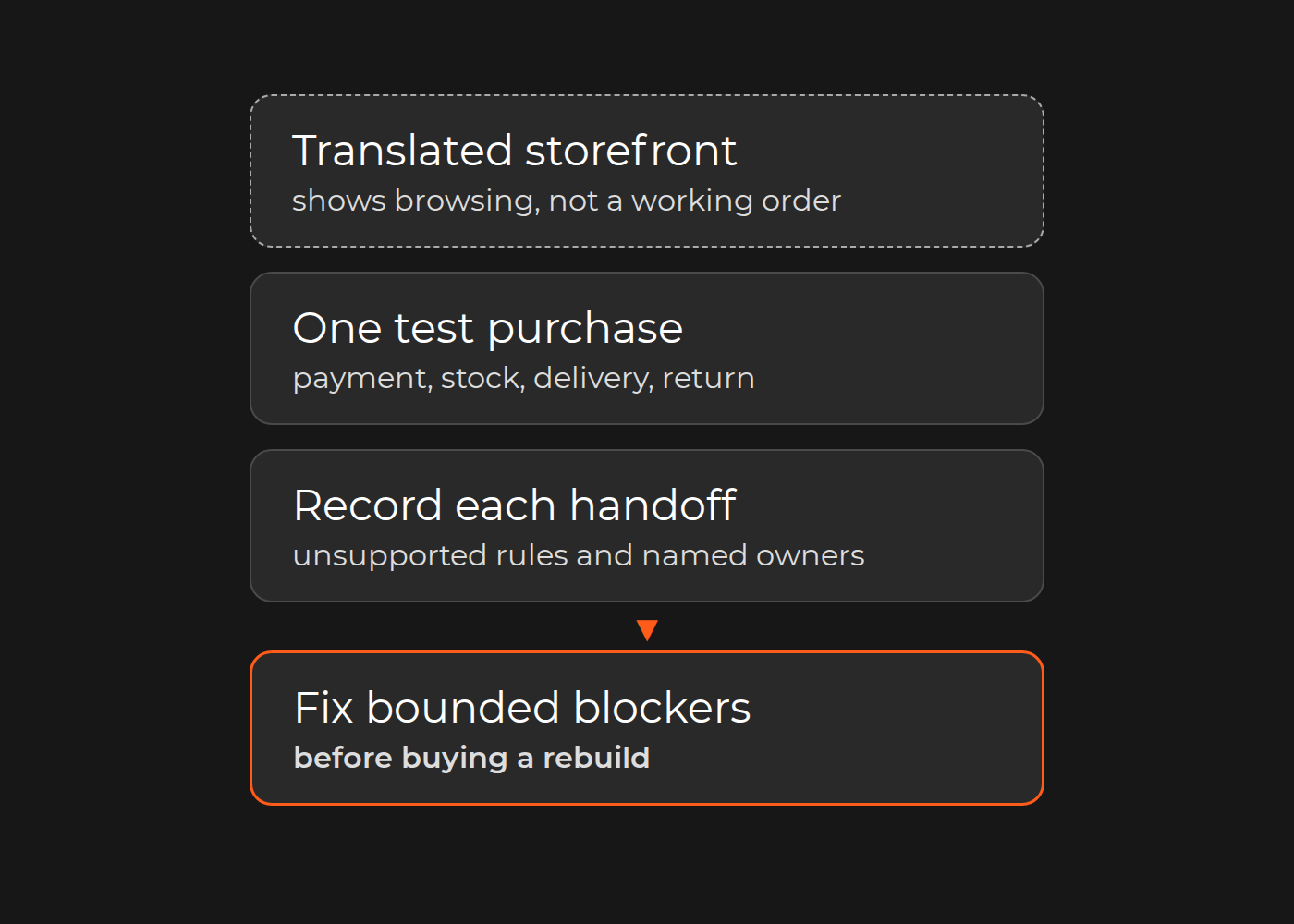
To launch ecommerce in a new country, start with one target-country purchase and follow it through payment, stock, fulfillment, the back office and a return. Record every unsupported rule and manual handoff. A translated storefront shows that a shopper can browse, see a familiar currency and add a product to the cart. It does not show whether that shopper can pay, receive the right goods and return one item without your team repairing the order in a spreadsheet.
For an established manufacturer or D2C seller with an approved market and assortment, that purchase is the practical country-launch test. Payment eligibility, stock locations, carrier services, returns and back-office entries each need country-specific decisions. Wherever the configured flow fails to carry an approved rule through, someone bridges the handoff. Cost grows with the frequency and effort of those manual steps, not simply the number of translated pages.
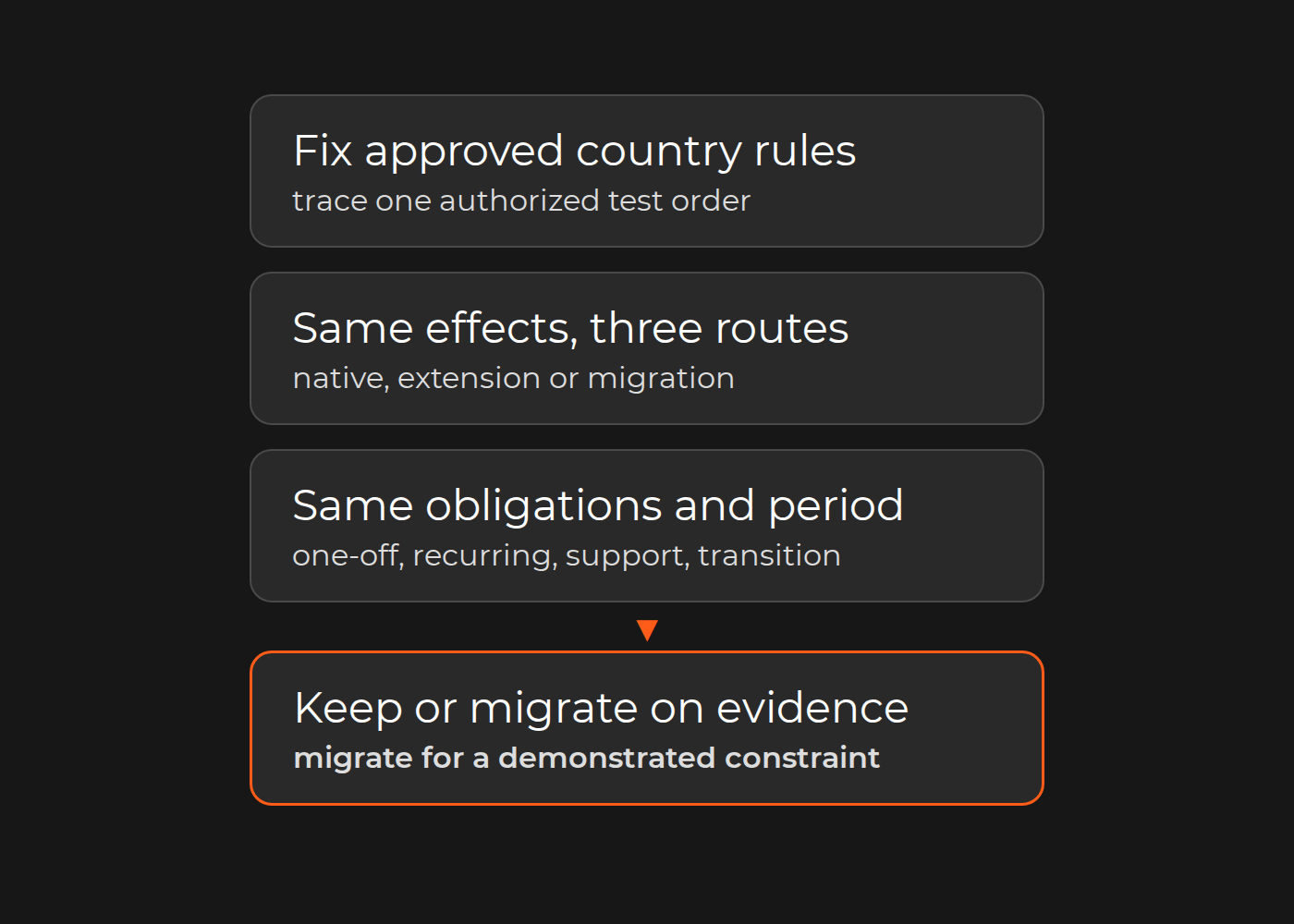
Your existing platform's native market configuration and current team may be enough. None of those gaps is solved simply by adding another language. Nor does any one of them prove you need to migrate.
Agree the first country's payment, shipping, returns and tax rules
Collect the approved assortment, configurations, prices and currencies; payment methods and merchant accounts; destinations, stock locations and delivery promises; and cancellation, return and refund outcomes. Identify who answers the customer and who updates each system.
The customer and qualified advisors supply applicable legal and tax requirements, such as VAT, duties and consumer return rules. Implementation traces approved requirements into configuration and checks; it must not invent them or promise legal compliance.
Keep unknowns visible. “Payment provider eligibility not confirmed” is useful. “Local payments supported” is not, if all anyone has seen is a logo. Ecommerce owns the market promise, operations its execution, finance the economics and payment reconciliation, and IT the technical constraints. The budget approver needs those gaps before funding a wider build.
Test one new-market order: currency, payment, delivery, stock and returns
Hypothetical example—not a client test or a statement of any country's law: a homewares seller launches one mug, SKU M-1, into an approved new country. It needs one local payment method and a different carrier. The approved policy allows a return after inspection, but payment references, carrier instructions and refund status are not connected to the back office. No transaction or shipment has been executed for this example.
1. Assortment, price and currency
Choose the target-country context and inspect M-1 on the product page and in the cart. Verify the approved price, currency, delivery information and messages. Check that excluded products cannot be bought through direct links, not only navigation. Save configuration and page evidence for the ecommerce owner. Translation sign-off is not assortment or commercial-rule approval.
2. Eligible payment and a usable failure path
Confirm provider, merchant eligibility, account setup, platform plan/version, currency and required method. A provider's general country list does not establish availability for this merchant and integration.
Agree payment-requested, authorized/captured where applicable, failed/canceled and reconciled states. A checkout success screen is not evidence that money has settled. Manual handoff 1: finance copies the provider reference into M-1's order before release. Record how a decline or abandoned redirect differs from a completed payment, when stock is released and who investigates an uncertain result.
3. A delivery promise operations can honor
Trace the destination and SKU to the stock location, carrier service and dispatch conditions. Check an unsupported destination too. The warehouse must be able to use the resulting instruction, not just see a shipping option at checkout.
Manual handoff 2: warehouse staff rekey the address and service into the carrier portal, then copy tracking back. Link the order, instruction and tracking reference; record missing-address and unsupported-service paths. A controlled temporary workaround may be acceptable, but operations must accept its workload and error path.
4. Stock authority that matches the shipment
Identify who reserves M-1, which location supplies it and when quantity is released or deducted. Compare warehouse instructions with storefront and inventory records. A displayed available quantity is not proof of a reservation.
For bundles elsewhere in the assortment, check component quantities, substitutions and returned components. A parent-product quantity need not represent usable component stock. The inventory owner defines the rule and accepts the evidence; do not assume the mug fixture proves bundle handling.
5. A back-office order that keeps the purchase's meaning
Follow the same order reference into ERP or order management. Verify country, currency, payment reference, carrier service, SKU and quantity. Support must match the customer's order to warehouse and provider records. Copied payment and tracking references should resolve to M-1's original order—not disconnected spreadsheet rows.
A manually copied order is not automatically a blocker. It is a process with an owner, an error path and recurring workload. Record all three.
6. A return, refund and owner when records disagree
Under the invented policy, support finds the original order and coordinates receipt and inspection. The inventory owner records approved stock disposition; a received mug is not necessarily resellable.
Manual handoff 3: finance initiates a provider-portal refund, follows its status and updates support. That is a task, not proof of a completed refund. Link the refund reference and failure/reconciliation route. If order management says “refunded” while the provider reports a failed request, name who notices, investigates and contacts the customer. If the only answer is “the developer will look,” the country flow is not yet operationally owned.
Record country-launch blockers as you test
Use a compact record rather than another launch presentation. These sample findings belong to the fictional M-1 walkthrough, not a live store.
Required outcome
Evidence and accountable owner
Next decision
Required payment works for this merchant
Eligibility/account evidence and controlled check; ecommerce with finance/provider
Available for this account/integration, approved alternative or blocker?
Carrier receives destination and service
Order, carrier instruction, tracking; operations
Can staff trace dispatch without reconstructing messages?
Is the unit accounted for before shipment and after return?
Refund status reaches the responsible team
Provider reference/status and reconciliation; finance with support
Who closes pending or failed requests?
For each finding add the current workaround, named owner, date, evidence locator and next action. Distinguish documented, observed in an authorized check and unknown. A vendor statement or help page can establish documented scope; it does not establish that your configured flow has been observed working. Separately record whether a finding is a blocker, an accepted workaround or ready for the agreed launch.
For checks involving payments, refunds or shipments, agree the environment, permissions, test data and expected side effects first. Use provider-supported test facilities where suitable. Live transactions and shipments require separate explicit authorization.
Multi-country and cross-border examples from Dinarys cases
Dinarys's public Undrgoods case describes a WooCommerce-to-Shopify migration for a Dubai-born underwear brand with three regional stores—UAE, Saudi Arabia and Kuwait—regional payments, advanced inventory synchronization across all three stores and a custom bundle-management application. Its component list includes automatic inventory adjustments when bundle components change: the kind of rule checkpoint 4 asks the inventory owner to define.
The Flash Style case describes a Magento 2 platform for a Czech print-on-demand provider serving business and consumer buyers across borders, with CZK and EUR currencies, Czech and English content, automated tax and VAT documents, and GoPay, bank-transfer and flexible B2B payment terms. Those are the payment and back-office records checkpoints 2 and 5 follow.
For sellers whose products are customized, myfelt's public case describes multilingual Magento-to-Shopify migration and a custom PDF generator carrying rug selections into an order summary for customers and production. If a new-country order must still produce manufacturing instructions, include that artifact in the launch check; translation alone does not preserve a custom production handoff.
These cases show the operating rules behind localized storefronts. They do not establish payment eligibility, legal requirements, delivery coverage or proven return and refund handling for your merchant, and they are not a claim that your country needs migration.
Measure the cost of manual work in the new market
Collect platform/hosting, apps, custom-code maintenance, integrations, payment services and support costs. Separate shared costs from the new country's incremental payment setup, carrier/location, service-language coverage, returns and reconciliation work. Alongside invoices, observe task frequency, active time, exceptions and rework; do not count the same work again inside a general support allowance. Mark unmeasured effort unknown.
A low-volume, controlled manual step can be more sensible than a new integration. A frequent handoff that hides payment or stock status deserves attention. These observations support the later investment decision; they are not an assumed saving or ROI.
Fix new-country blockers before buying a rebuild
Bring ecommerce, operations, IT and finance around one purchase-and-return record. If the current platform and team cover the rules, complete native configuration and content work, verify the flow and keep the scope small. If a nonstandard payment, product or fulfillment rule leaves a real gap, define that bounded implementation first.
For a Shopify implementation discussion, use Dinarys's Shopify development services; the case examples are not a recommendation to choose Shopify before checking fit.
Discuss your first-country blockers with Dinarys. Bring the approved market and assortment, payment/delivery arrangements, current systems, one redacted order flow and the blocker record. Use observed handoffs to decide what needs implementing and what can remain controlled manual work. Scope, team availability, timing and terms are confirmed for the engagement.
You may share this article
Let professionals meet your challenge
Our certified specialists will find the most optimal solution for your business.