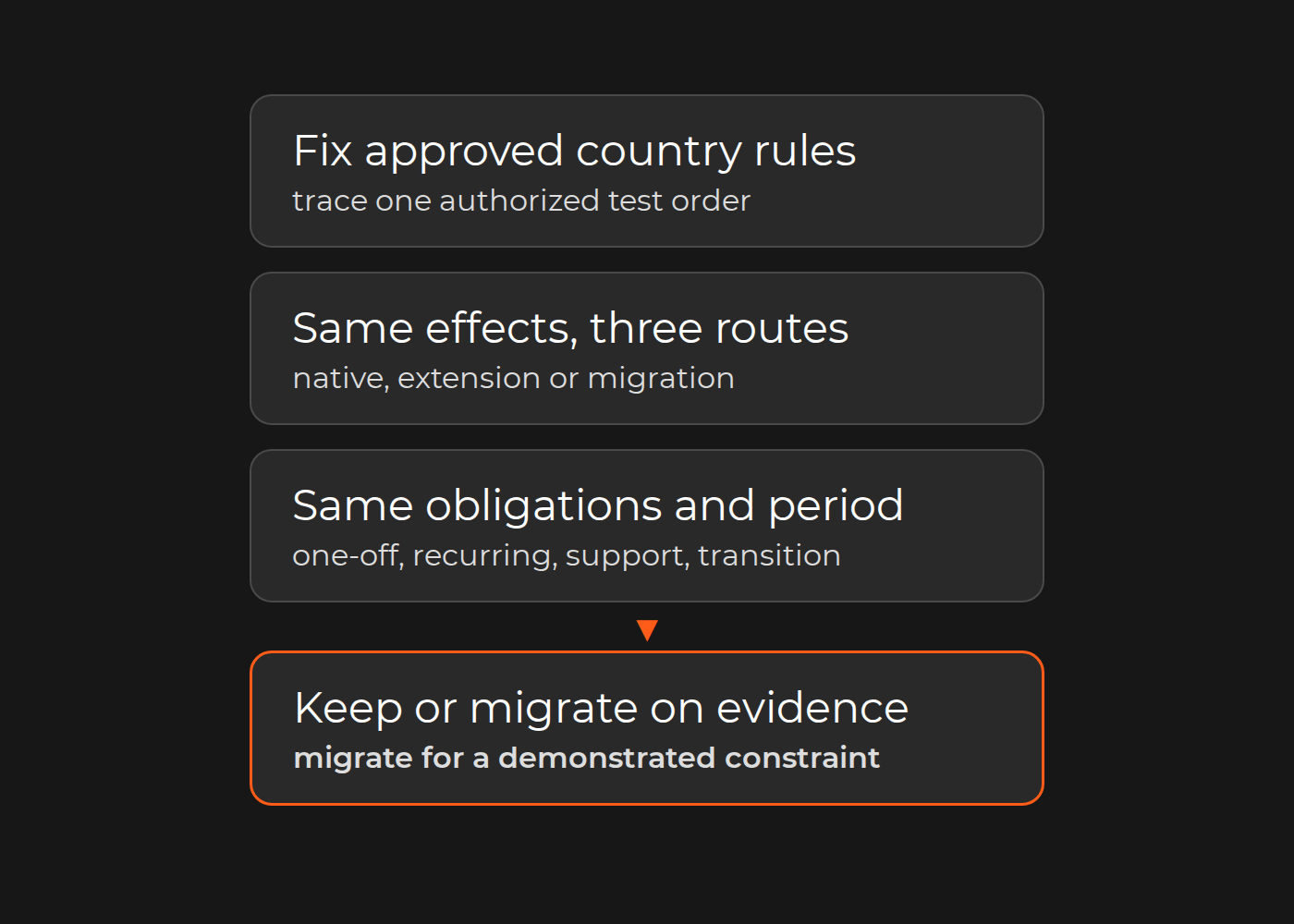
Another country does not automatically require another platform. It may need native market configuration, a local storefront, an application or one bounded integration. Keep the current platform if it can support the next market with manageable integration and operating work; migrate when a demonstrated constraint prevents the launch. Either way, the store is ready only when a local buyer can pay, receive the goods and return them under the approved rules. Migration belongs in the comparison when it addresses a demonstrated gap in your international expansion and the transition is worth taking on.
For an established manufacturer or D2C seller with an approved launch plan, ask: which local rule actually requires rebuilding? Compare native/current, current plus extension and migration against the same country, order and operating requirements. Then compare their support burden over the same period.
If Shopify is a candidate, check the bundle type, payment account and custom functions before treating it as a standard replacement. A shopper-built set is not necessarily the same capability as a fixed pack. Payment availability needs account-specific confirmation. Custom functions need a retain, adapt or replace decision; they do not survive merely because product data imports. This is not a recommendation to keep a platform at any cost—or a blanket endorsement of Shopify.
Shopify documentation referenced below was last read on 27 October 2026. Open the linked pages and re-check them against your own plan and account before relying on them.
Does a new country require a new platform?
Not by default. A platform change is justified only when a specific approved country requirement cannot be met by a cheaper route. First fix the country's approved assortment, prices/currency, payments, delivery, returns and back-office responsibilities, and trace one authorized test order through the target country. The merchant and qualified advisors supply legal and tax rules; the technical comparison shows how those approved rules would work, not a compliance guarantee.
Apply the same discipline to Shopify, WooCommerce, Magento or another system: identify the actual deployment and supported path, not a generic feature list. Then judge the three routes on the same terms:
Route
Fits when
Loses when
Evidence to ask for
Native configuration or local storefront
The installed plan/version, integrations and operating team cover the approved requirements
A mandatory effect is unsupported, or a separate storefront adds configuration and support work out of proportion to the need
Plan/version and configuration for the country; a documented or authorized-check result for each required effect
Current platform plus a bounded extension
It isolates one specific missing effect with defined inputs, outputs, data authority, error handling and maintenance
The gap crosses uncontrolled dependencies, or support becomes impractical
The extension's scope, interfaces, maintenance owner and failure handling
Migration
The destination proves the same required behavior, and its data, custom-feature, continuity and training obligations are included
Those obligations are unestimated, or the case rests on a destination demo
The destination's results on the same required effects; an estimate for each custom function
These routes can combine: a migrated store may still need a bundle app or custom service. If a mandatory effect is unknown, resolve it before committing to the route that depends on it. If unsupported, identify an approved alternative and its cost/owner. Changing the requirement to make a candidate pass needs a business decision.
Filled example: add the market to the current store or open a separate store?
Hypothetical example—sample values, not a client result or a statement of any country's rules. A seller adds one EU country with a new language and EUR prices. Two options are on the table: add the market to the current store, or set up a separate store for it on the same platform. Catalog ownership, local prices, fulfillment and customer records are evaluated in both.
Field
Add the market to the current store
Separate store for the market
Country, language, currency
New language and EUR configured in the existing store
Own language and EUR in the new store
Catalog version and owner
One catalog with market-level exclusions; ecommerce owns it
Copied catalog to keep in step; ecommerce owns both
Price/tax owner
Finance sets local prices; adviser supplies tax rules
Same, maintained in a second price set
Payment method
Same provider account if eligible for the country
New account or settings for the new store
Fulfillment route
Existing warehouse connector, plus the country's carrier service
Connector must read orders from two stores
Customer records
One customer account across markets
Separate accounts unless linked
Return rule and route
Approved returns address for the country
Same, plus refunds traced to the right store
Local acceptance owner
Operations lead
Operations lead
Constraint that changes the decision
None found if a paid order and a return pass
Needed only if the market requires its own catalog, prices or payment account the current store cannot hold
Read across the rows: in this example, nothing yet requires a second store or a new platform. The constraint that would change the decision is a specific failed row, not the novelty of a destination platform. Accept either option only when the same local test passes:
Check
Passes when
Owner
Paid order to a complete local address
Payment reference, carrier instruction and tracking link to one order
Operations with finance
Address or currency exception
Rejected local address format or a wrong currency is caught before the order is accepted
Ecommerce
Refusal or return
Goods, stock disposition and refund are recorded against the original order
Research run in regional English does not establish demand from shoppers in the native language, and none of these checks proves local tax compliance; that stays with the merchant and qualified advisers.
Does Shopify support the bundle type you sell?
Verify it for your bundle type; do not assume it. “Bundles supported” might describe a fixed pack, a shopper-built set or a custom implementation. Shopify's Help Center page on bundle eligibility and considerations, as read on 27 October 2026, distinguished fixed/multipack bundles from mix-and-match and stated that its Bundles app did not support mix-and-match. Treat that dated distinction as a prompt to verify the current app, checkout and required bundle type—not as a current compatibility decision for your store.
Availability is also not the whole stock requirement. A calculated sellable bundle quantity does not prove when components are reserved, how failed payment releases them, what an external warehouse receives or how partial returns are reconciled. Trace component identities and quantities through the actual connector. Another app or custom build does not remove the need to prove those effects.
Are local payment methods available in your target country?
Only conditionally, and only an account-specific answer settles it. Shopify's local payment methods page, as read on 27 October 2026, made availability conditional on customer country and currency, with additional market and business-entity conditions. Confirm the current method, merchant/provider eligibility, account setup, plan and integration separately. A displayed currency or payment logo is not a working payment arrangement.
Obtain that answer before planning authorized success, decline, cancellation and uncertain-outcome checks. Link the result to the correct order and distinguish captured funds from settlement reconciliation. The same payment method name on two platforms does not establish identical account eligibility or commercial terms.
Do custom functions migrate with the data?
Not through import alone. As engineering analysis, make an explicit retain, adapt or replace decision for each function tied to the old platform. Describe its business rule, source data, user interaction, generated artifact and receiving system. Estimate a prototype for the uncertain part before pricing wholesale replacement. “API available” is a possible interface, not a delivered process.
Dinarys's public cases show what the “replace” branch looks like. The Undrgoods case describes three regional stores (UAE, Saudi Arabia, Kuwait) with regional payment methods and custom bundle handling. The myfelt case describes a multilingual Magento-to-Shopify migration with a PDF generator for personalised orders sent to production units. The myfelt PDF captures the customer's color, size, design and material choices; the page documents that production handoff, not a reduction in manufacturing errors. The Undrgoods page does not suggest that its three markets share the same rules. In both, the custom piece appears as delivered work inside a Shopify project—so price it as its own line in the one-off row of the cost table below, not as something the data import brings along. The pages describe those projects, not your bundle, payment account or document.
Lappu's case shows the same custom-app pattern on Shopify—a configurator connected through webhooks and a printer connector as a private app—for a store the page describes as still in pre-launch.
One hard order exposes independent gaps
Hypothetical worked example—not a client result or an executed test: a seller's starter bundle contains two towels and one washcloth. Its invented approved policy permits a partial return of the washcloth. A separate custom function lets shoppers choose a delivery week, blocks merchant-defined blackout weeks and sends the accepted selection to the warehouse. These are teaching requirements, not claimed native features or legal rules.
Use the same six effects for all three routes. The matrix shows what each route has to prove; the second column is the same on every route:
Required effect and owner
Verification to record
Native / local storefront: ask
Current platform plus extension: ask
Migration: ask
Country-specific offer (Ecommerce)
Assortment, price and currency match across product, cart, checkout
Plan/version gives the country its own offer without code?
What the extension adds; source of price data
Destination reproduces the offer; which data moves
Eligible payment and correct order state (Finance with IT)
How the current bundle type reserves and releases components
Does the app or build reserve and release components?
Bundle type matches what you sell; bundle app needed?
Correct warehouse order (Integration owner)
Source order, message, receiving record; failed or repeated message
Connector carries country and component data?
Message contract; failure handling
Connector rebuilt or re-tested; who accepts the record
Partial washcloth return (Operations/finance)
Allocation, receipt, inspection, disposition, refund status
Back office handles a partial component return?
Extension touches returns; maintenance owner
Component lines in returns; staff changes
Delivery-week rule (Fulfillment with IT)
Valid and blocked weeks; accepted week reaches warehouse
Does today's function work in this configuration?
Adaptable as a bounded extension; prototype estimate
Retain, adapt or replace; rebuild estimate; prototype date
For each route and effect, record component/version/plan, dated source, gap, next check and technical owner. Label each result documented, observed in an authorized check or unknown. Product documentation does not turn a check green.
Correct stock does not prove the custom delivery-week rule survived; a valid week does not prove component reservation.
Is the migration quote really cheaper?
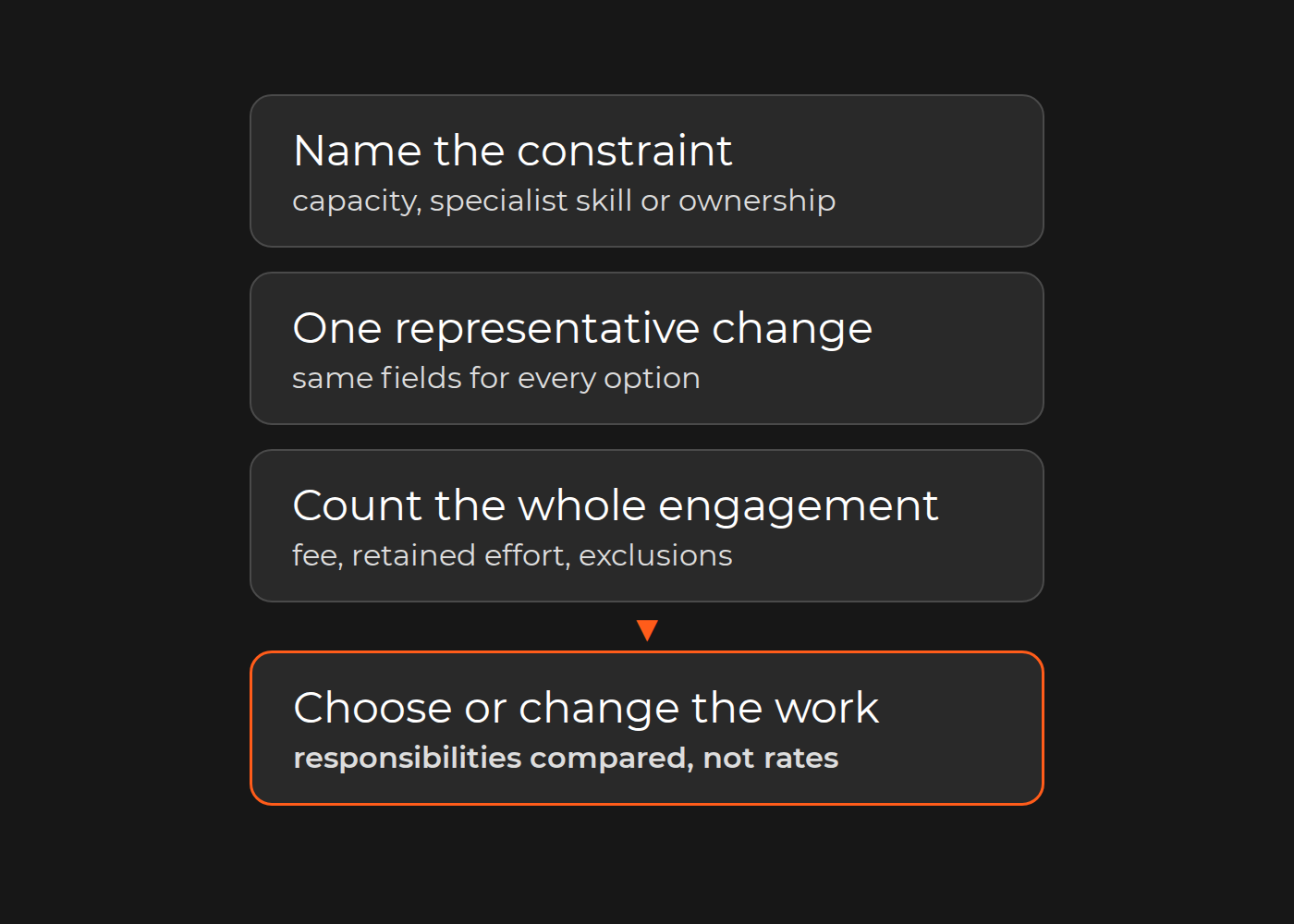
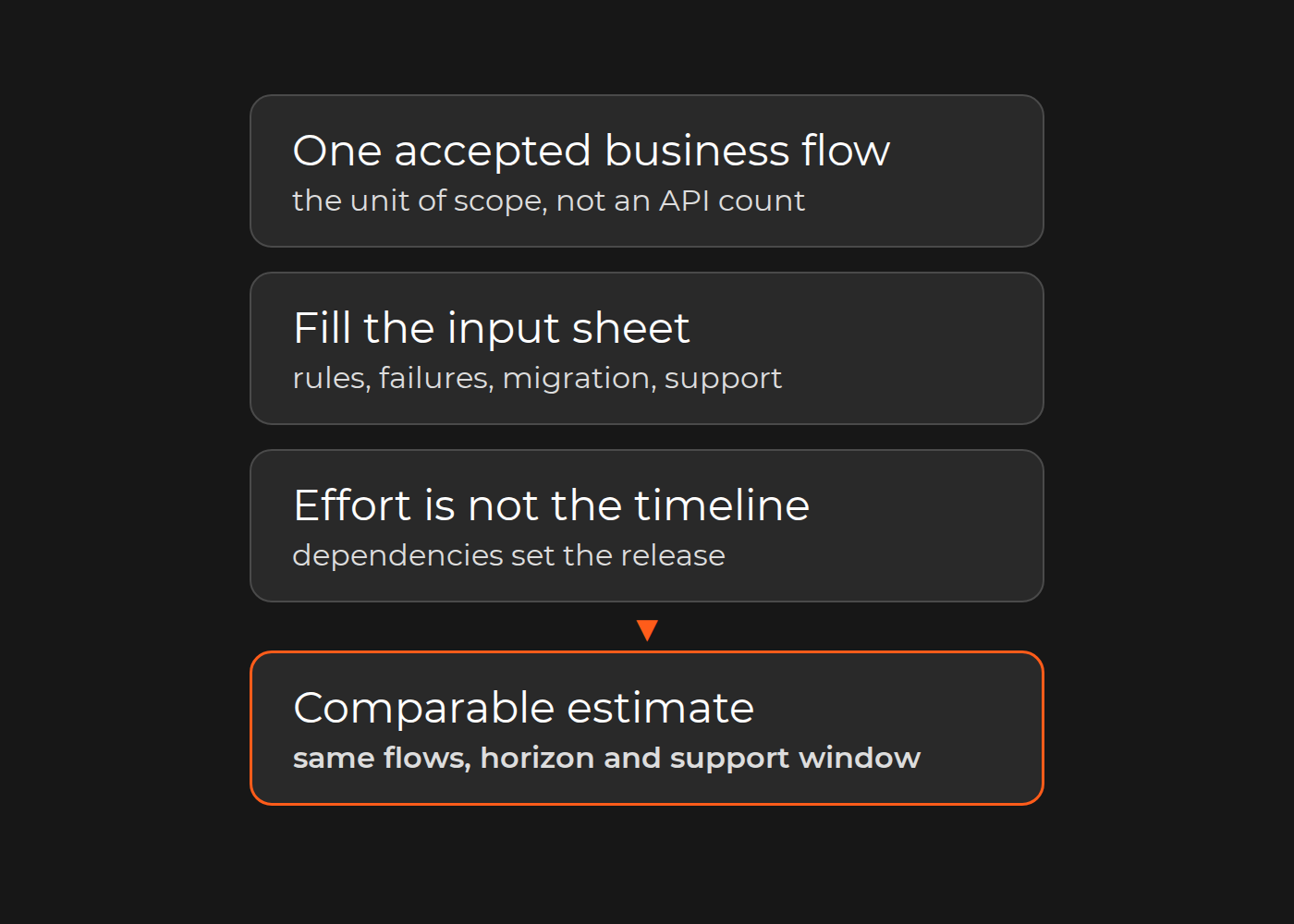
Only if it covers the same four obligations over the same period. Agree one country scope and planning period with finance, then compare obligations rather than subscriptions alone:
Obligation
Native / local storefront
Current platform plus extension
Migration
One-off work
Native configuration and verification
The extension's implementation
Data transfer, feature replacement, URL work and cutover
Retained and new recurring costs
Existing plans, hosting, apps and interfaces, plus anything added for the country
The same, plus the extension's hosting, licences and interfaces
New plans, apps and interfaces; old fees continue until evidenced retirement, so overlap can include both systems
Operating support
Payment/service charges, monitoring, exception handling, reconciliation and measured manual work
The same, plus support for the extension
The same on the new stack; avoid double-counting work already covered
Transition
Training and changed procedures for the country team
Training, changed procedures and rehearsal
Training, changed procedures, rehearsal, recovery preparation and retirement; separate shared costs from the country's incremental cost
Leave every amount cell as unknown until a contract, quote or dated estimate with its assumptions exists. A low subscription cannot settle the decision while custom-function replacement is unestimated. A custom extension is not automatically expensive either: establish its bounded scope and maintenance. Do not convert hypothetical efficiency into savings, and do not treat released staff capacity as a cash reduction.
Build the scope from the countries and their operating dependencies: markets, catalogs, tax and payment integrations, local support, warehouse routes and ownership after launch. This table exposes the country-specific differences; it is not a full finance model. For the full equal-horizon fit-gap and cost ledger, see the repair-versus-replatform comparison.
Include the transition obligations of this country
Keep three items explicit even when the destination demo looks straightforward:
URLs: which country/language paths change, where do they redirect and who checks destinations and canonicals? No ranking guarantee follows.
Analytics: are country/currency definitions and purchase events correct, without missing or duplicated events? An event is not payment evidence.
For a justified move, use Dinarys's migration delivery scope. For a bounded Shopify implementation, use Shopify development services. Neither route is a recommendation to migrate before fit is established. Checks need approved environments, data and permissions; live transactions require separate explicit authorization.
Keep working assets when the evidence supports them
If actual checks show that native configuration covers the offer, eligible payments and delivery rules, while existing bundle and delivery functions work through the back office and return process at an acceptable support cost, keep the platform. Let the incumbent deliver the bounded work if it can own the scope. A new-country launch is not a reason to discard functioning custom assets.
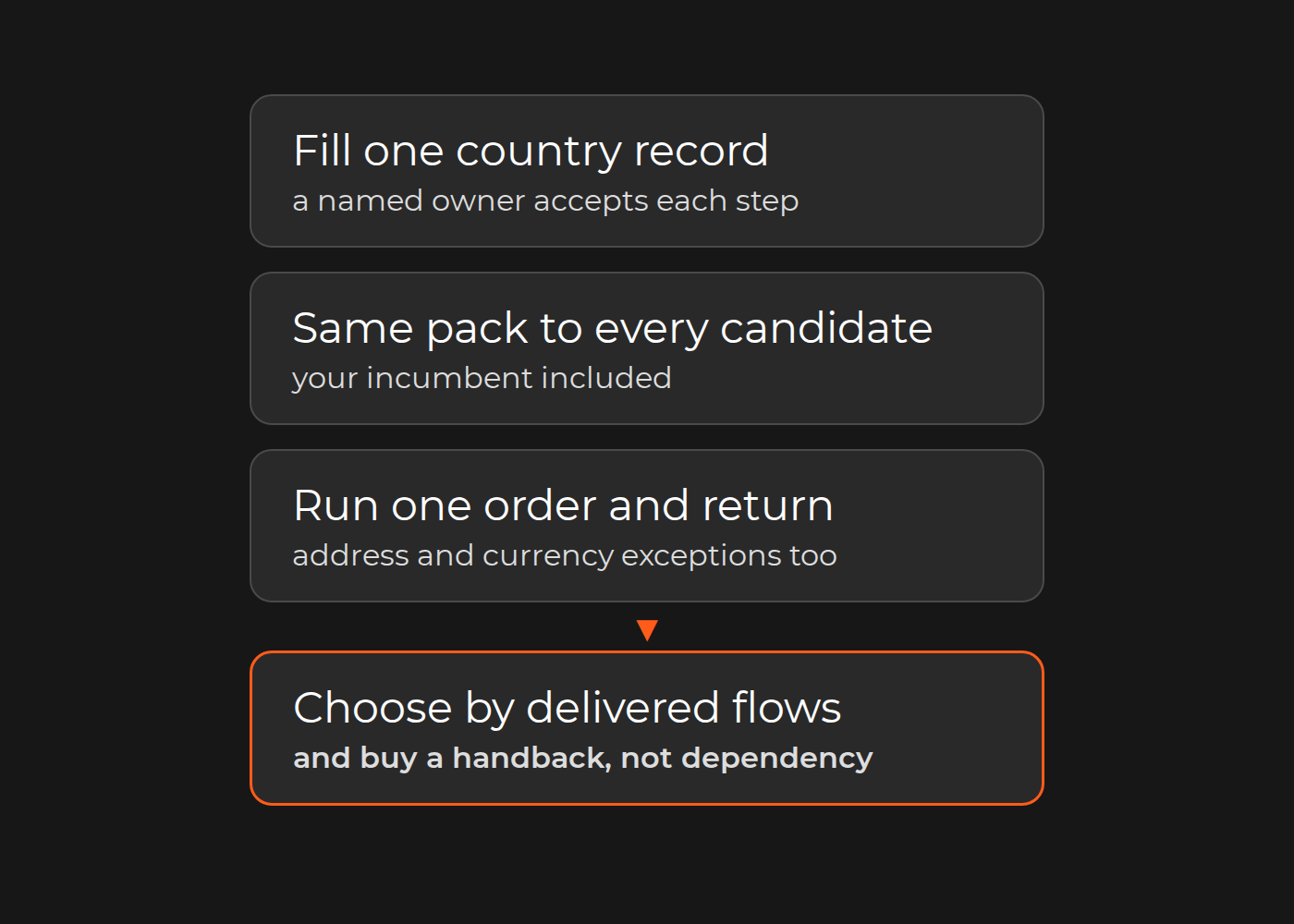
If only the delivery-week function is missing, estimate that gap first. If mandatory behavior remains impractical, compare a destination on those same effects—not a more appealing demo. Ecommerce defines the promise, operations accepts execution, IT identifies implementation boundaries and finance validates assumptions so the authorized sponsor can choose with risks visible. If you then need help executing, choose a partner by the operating flows: ask each to walk through the same paid order, return and reconciliation, to name the constraint that drives its recommendation, and to show which public case covered which flow, with the limit of that evidence.
First practical check: complete a paid local-market order, a refusal or return and its reconciliation, including address and currency exceptions, on the current platform. Discuss a one-country fit-gap with Dinarys. Send the result of that check, the approved country rules, your current systems and costs, the bundle or custom function you most fear losing, and the evidence still missing. Ask for a comparison that retains necessary functions and prices their support—not just a destination subscription.