ERP integration cost and timeline are set by the business flows you must accept and the dependencies around them, not by the number of systems or APIs, so no universal price or duration holds across projects. An estimate based on “three systems and six APIs” leaves out the work that makes the exchange usable: agreeing what the data means, reconciling existing records, recovering uncertain orders and handing exceptions to operations.
Why do ERP integration estimates differ so much? Because two quotes for “storefront plus ERP” can describe very different work. The estimate moves with the systems and versions involved, the business rules the integration must enforce, whether data must migrate, and who owns exceptions once the flow is live. An API count hides exactly those parts.
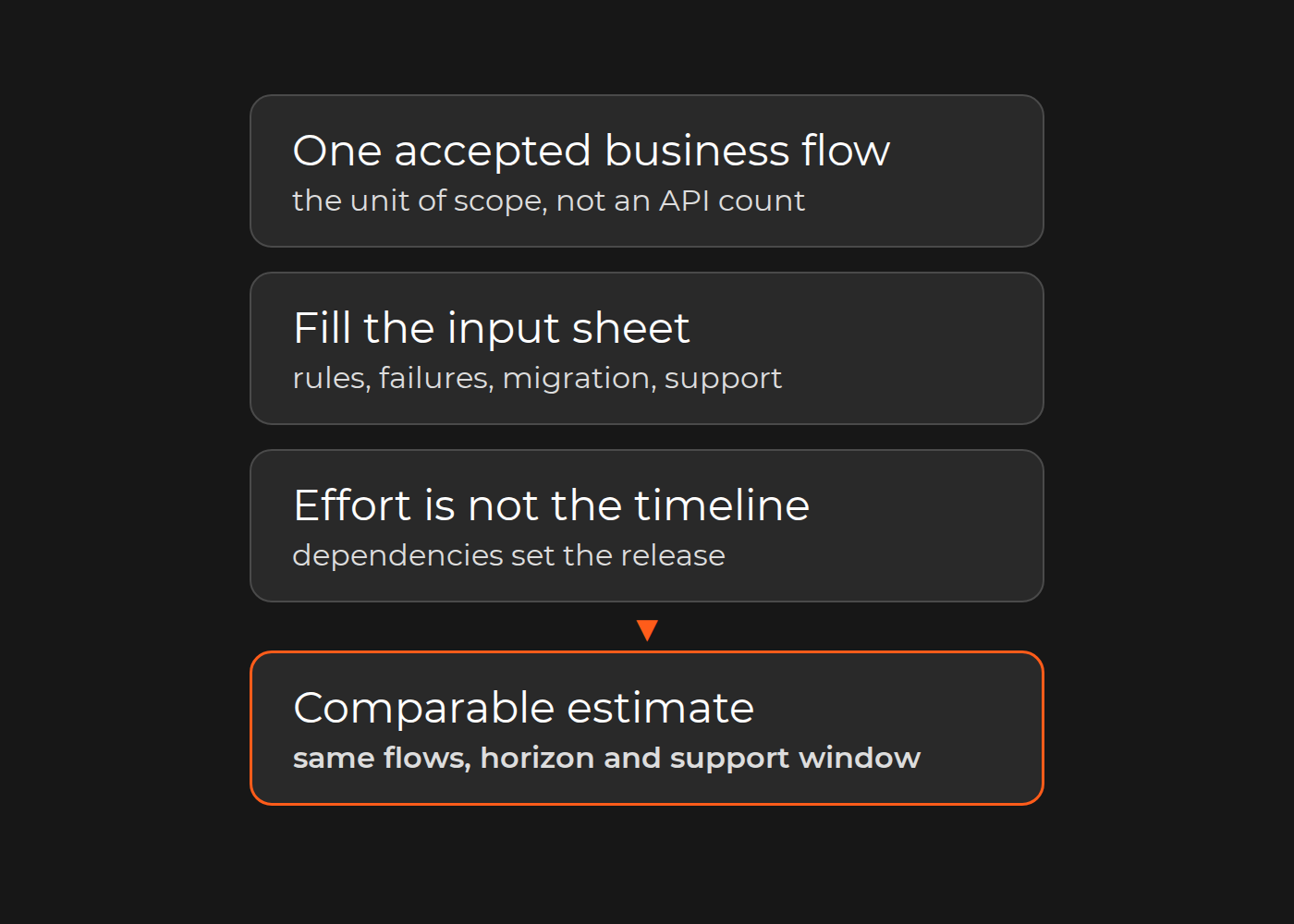
For a CTO or COO preparing a budget with a finance sponsor, the better unit of scope is one accepted business flow. Which buyer gets which price? Where is stock reserved? How does an order reach the ERP once, and what happens when nobody knows whether it arrived?
What you can build is a comparable estimate: separate implementation from operating costs, attach assumptions to each work package, and distinguish engineering effort from elapsed time. This guide focuses on ecommerce connected to ERP, CRM and warehouse systems—not an enterprise ERP replacement or a finance-only consolidation.
Two “two-system” projects: fill the differences before adding prices
Consider two illustrative requests that both read “connect our storefront to our ERP.” Project A publishes stock from ERP to the store, read-only. Project B writes B2B orders with contract prices into ERP, receives partial shipments back and reconciles both sides. Put them through the same input sheet:
Input
Project A: read-only stock publishing
Project B: contract-priced order writes
Who supplies or approves it
ERP and storefront versions
Needed to confirm the stock interface
Needed for order, price and shipment interfaces too
ERP owner; commerce owner
Entities
SKU, location, sellable quantity
Customer account, price list, SKU, unit, order, shipment, cancellation
Data owner for each entity
Custom rules
Which locations count as sellable
Contract price per buyer, unit conversion, partial allocation, line cancellation
Commercial and operations owners approve examples
APIs and direction
One read direction
Order writes to ERP; price lookup; status and shipment events back
ERP owner confirms supported operations
Volumes and freshness
SKU count; allowed stock age
Orders at peak, lines per order; allowed price and stock age at confirmation
Operations; finance for prices
Historical migration
None
Open orders at cut-over; history only if required
Data owner
Failure handling
Stale stock flagged; the next run corrects it
Timeout without knowing whether ERP accepted the order; duplicate protection; reconciliation queue
Integration team builds it; operations owns the queue
Test data
Sample stock export
Buyers with contract prices, split shipments, canceled lines
Business owners supply cases; ERP owner provides a sandbox
Support window
Check of failed runs in business hours
Agreed cover for order-flow failures during trading hours
Support owner; sponsor signs
Both projects connect two systems through a handful of APIs. Project B carries more rules, writes that must happen exactly once, a return path and an operating queue—each a cost driver that an API count leaves out. Fill the sheet for your own flows before asking anyone for a price; a quote on an empty sheet is a guess about these rows.
Illustrative work packages for the two projects above. Box sizes are not effort estimates; the point is which packages appear at all.
The responsibility column is part of the estimate. If nobody can supply contract-price test cases, approve the mapping or take the failed-order queue, effort and elapsed time grow whoever builds the integration. Some inputs can also stop an estimate: legacy API limits, ERP customizations the interface does not support, or the absence of usable test data can change the effort or make the proposed integration infeasible until the ERP side changes.
The SanMar ERP integration case is a published example of scope that goes beyond stock publishing. Before the project, the client's ERP relied on poorly built APIs that could not exchange or update catalog and order data in real time, and the case page says the lack of real-time synchronization led to incorrect pricing displayed on the website. The goal was named per object: real-time data exchange for the product catalog, order fulfillment and product availability. The page does not name the ERP product or disclose a budget or duration, so it shows how a requirement was framed, not what yours will cost.
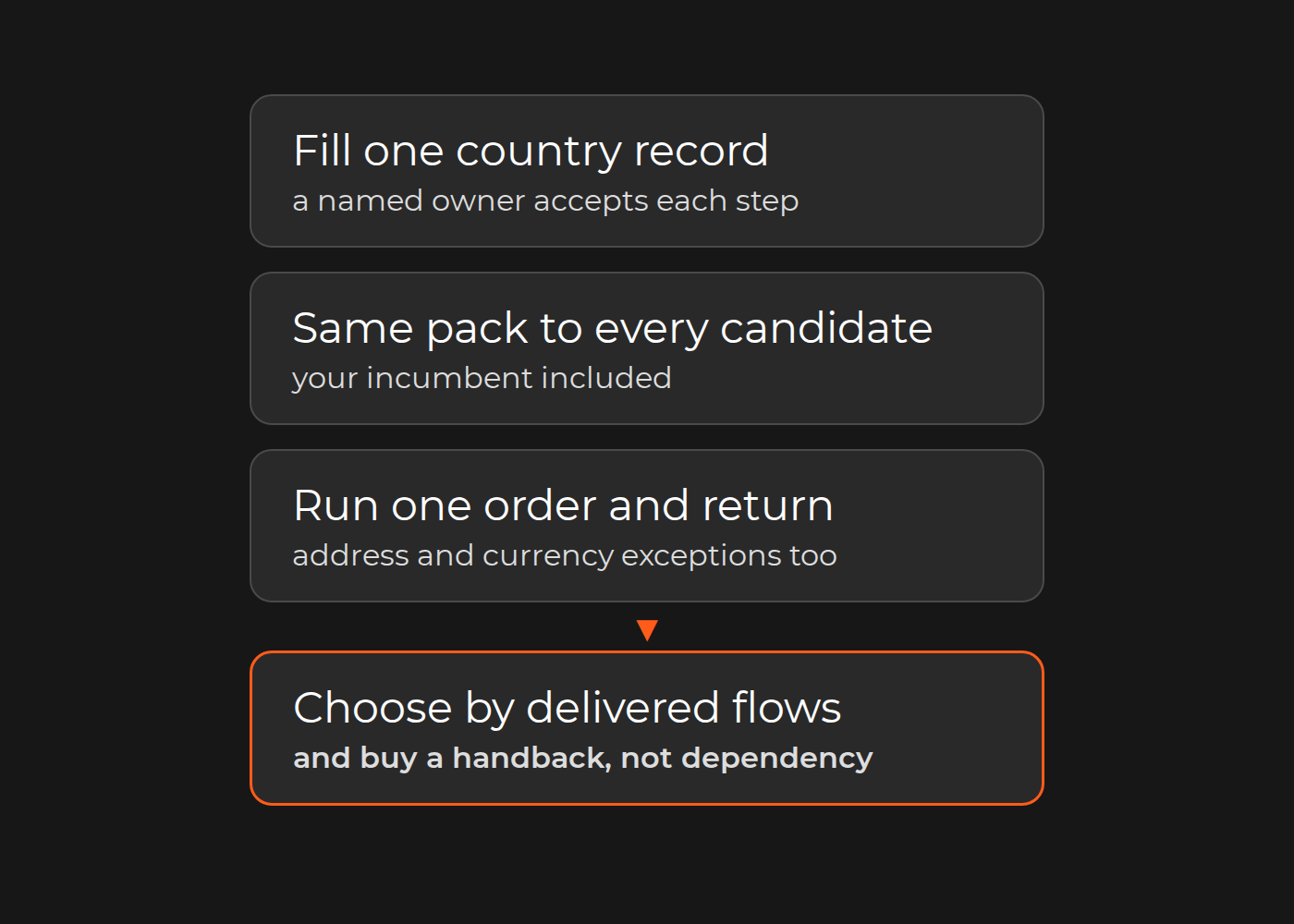
Use the same sheet to compare providers on equal work. A published project range, calculator or fixed-price package assumes an answer for every row; ask which answers, and compare only offers that cover the same flows, failure handling, migration and support window. A lower figure that leaves out reconciliation or the support window is a different scope, not a cheaper one. A practical test of any estimate: you can explain each major cost driver from the sheet and point to who supplies test data, who approves the mapping and who supports failures.
Compare options over the same period. For an illustrative 12-month horizon, the two projects differ by cost category like this, counted in units rather than money:
Cost category (same 12-month horizon)
Project A: read-only stock
Project B: contract-priced order writes
Interfaces to verify
1 read interface
3: order write, status and shipment events, price lookup
Rules for business owners to approve
1: which locations are sellable
4: contract price, unit conversion, partial allocation, line cancellation
Reconciliation queue and failed-order cover in trading hours
Recurring fees
Connector or runtime fee, if any
The same, plus any middleware usage
Upgrade regression tests
1 interface after each ERP or store upgrade
3 interfaces after each upgrade
The counts describe the two fictional projects only; they are not effort or price estimates. Convert each row to effort and cost with the work breakdown and estimate-line table below, and keep the horizon, currency and support window identical for every option you compare.
Define the integration you are actually buying
Start with a flow inventory, not a list of software logos. For each object, record its authoritative source, direction, identity keys, required freshness and exception owner. “ERP is master” is too broad when a PIM owns descriptions, CRM owns a sales relationship and ERP owns the approved customer price.
An initial commerce scope might include customer-account mapping, prices, sellable stock, order creation, reservation and returned status. Returns, credit notes, historical transactions, dealer storefronts and additional warehouses are separate requirements unless explicitly included.
Make one normal order and one difficult order part of the estimate inputs. A difficult order might contain a contract price, a carton-to-unit conversion, a partial allocation or an uncertain response from ERP. The estimator needs the approved rule and supported interface—not just a screenshot of the problem. For the difficult order, trace the business order ID, price authority, stock timestamp, ERP acknowledgement and reconciliation owner; each unknown is an estimate risk.
Separate integration defects from process gaps before pricing. A price that ERP holds correctly but the store displays wrongly is an integration defect. A contract price nobody has entered in ERP is a process gap that no connector fixes; it needs an owner and may have to be resolved first.
The ecommerce lead usually champions the change. Commerce and ERP owners verify interfaces and data responsibilities; operations accepts the resulting flow. A COO, CFO or other authorized sponsor signs the investment. A delivery lead coordinates the cross-vendor dependencies. Do not assume the person requesting a quote can approve every rule or provide ERP access.
Connectors, custom APIs and middleware change different costs
A supported connector can be the least expensive sufficient option when configuration covers the required flow. It still needs installation/version checks, mapping, business tests, rollout and maintenance. A license is not the full implementation price.
Middleware supplies a runtime for transformations, routing and coordination. It may host prebuilt connectors and custom logic together. Budget its subscription or runtime, environment setup, monitoring, deployment and ownership of extensions. Avoid counting connector and middleware licenses twice when one commercial package includes both.
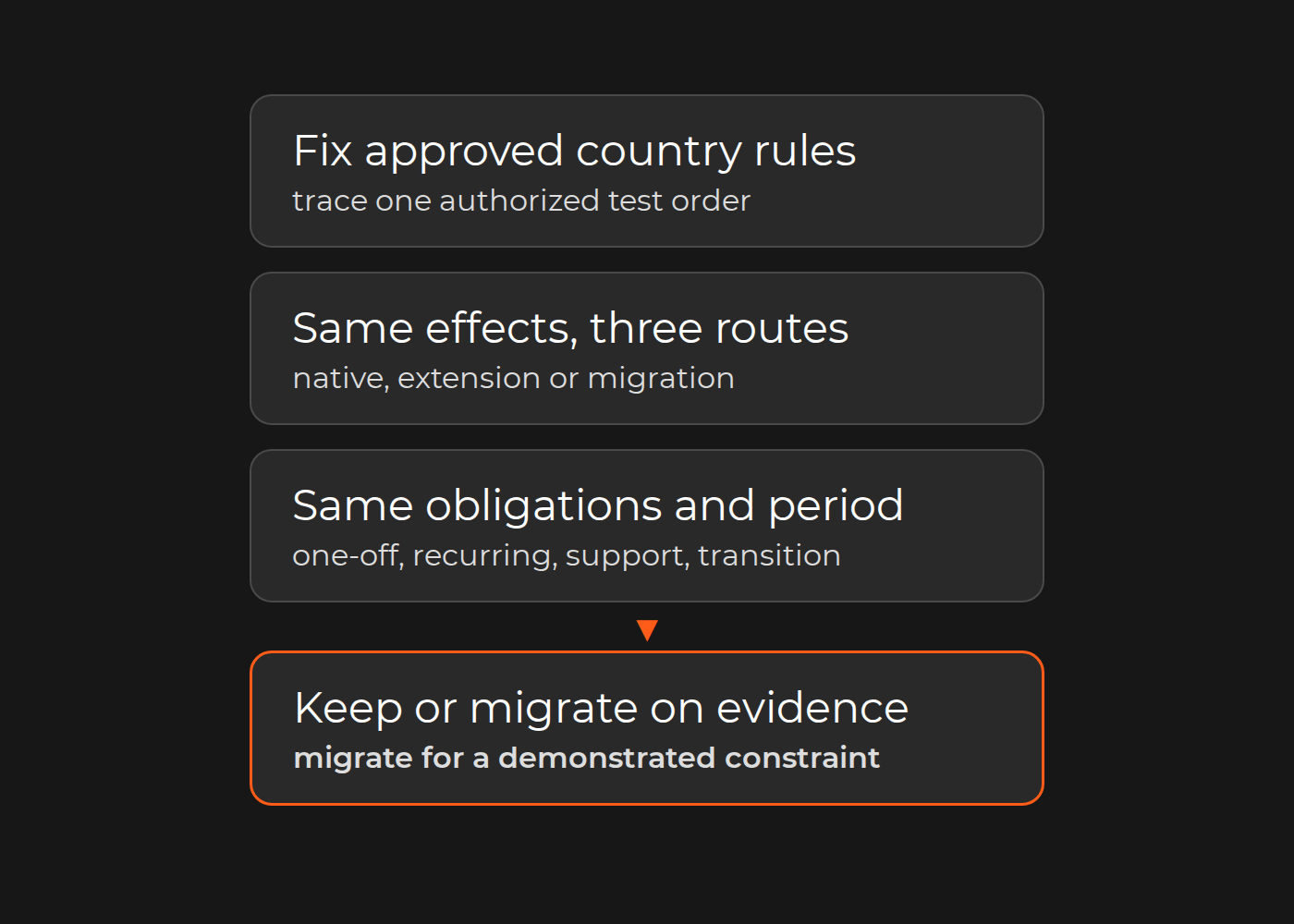
Custom integration fits a verified gap that approved interfaces can support. It brings design, implementation, test, runtime and compatibility work. It is not automatically more reliable, and code ownership does not eliminate support costs. An unsupported ERP operation may require ERP-side work before any integration approach can deliver it.
Compare the routes on the same exception set—the Project B rows above—not on the number of integrations listed on a vendor page. For each route, ask which of those rows it leaves uncovered and who would build and operate the workaround.
Route
Initial work to include
Continuing cost to check
Configure a connector
Fit check, mapping, tests, rollout
License, upgrades, regression tests
Extend a supported flow
Extension design and boundary tests
Runtime plus extension maintenance
Replace a connector
Migration and in-flight reconciliation
New fees and temporary overlap
Build bounded custom
Approved API work and recovery logic
Hosting, monitoring, compatibility
Mapping, migration and testing belong in the work breakdown
Separate these packages even if one team delivers several of them:
Scope and interface verification. Confirm versions, supported operations, sandbox access, authentication responsibilities, quotas and vendor constraints. Reuse valid documentation; investigate only unresolved dependencies.
Business rules and mapping. Align customer IDs, SKU/location keys, units, currencies, price lists, status meanings and permitted write directions. Have business owners approve examples.
Data preparation and initial loading. Decide which reference data and open transactions must move, who cleans rejected records, and how source and target will be reconciled. Historical migration is not automatically required to connect an existing store.
Configuration or development. Include transformations, order identity, duplicate protection, exception visibility and supported recovery behavior—not just successful requests.
End-to-end testing. Cover normal and prohibited cases, missing mappings, stale data, outages and uncertain outcomes. Include operations' acceptance and a retest allowance tied to identified uncertainty.
Rollout and handover. Rehearse switching, monitor the first operating flow, reconcile in-flight records and transfer support instructions.
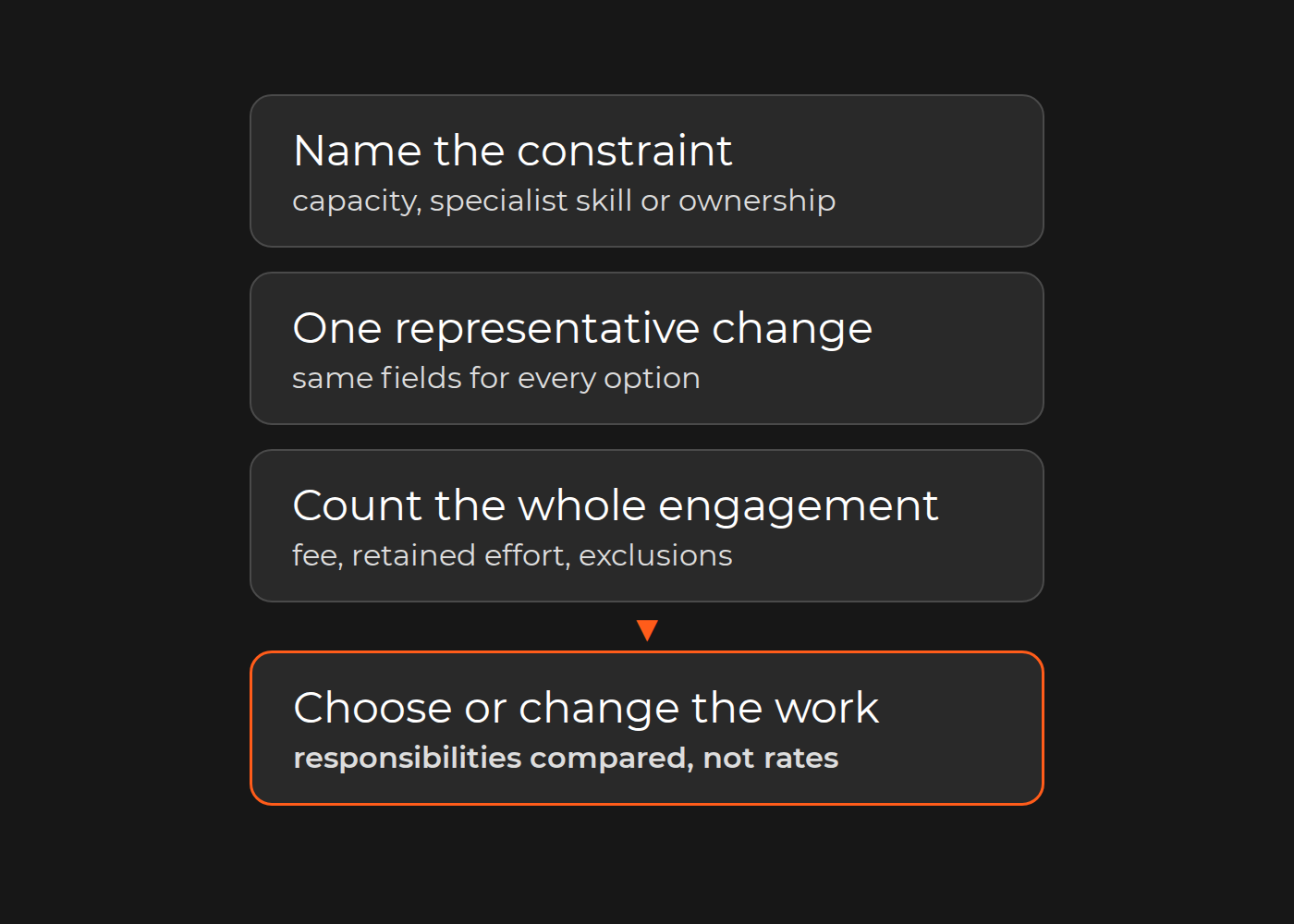
For each package, request an output, an effort basis, a dependency and an acceptance owner. Separate confirmed vendor quotes from estimated labor and unpriced gaps. “Included” should name the included deliverable; any unresolved item should name the person and evidence needed to resolve it.
An editable effort example—not a market benchmark
Suppose a fictional merchant has one ERP, one storefront, usable test data and no historical migration. For arithmetic only, its planning worksheet allocates 24 hours to interface verification, 32 to mapping, 80 to implementation, 64 to testing/reconciliation and 40 to rollout/handover. That totals 240 hours. These invented inputs illustrate a budget calculation; they are not a Dinarys estimate, staffing commitment or typical project size.
If role-specific hours are available, labor cost is the sum of hours × the agreed rate for each role. Do not multiply the total by a blended rate and then add the same specialists again. Add separately quoted ERP-vendor changes, licenses and other nonlabor costs. Keep tax, currency and contingency treatment explicit.
If data cleanup is discovered later, it changes scope rather than proving the original 240-hour sum was wrong. A useful estimate names that exclusion upfront and assigns an owner to establish whether cleanup is needed.
Use these rows as a starting template for the estimate. Replace the fictional effort rows with your own role breakdown and fill the commercial lines from quotes; the table is a checklist, not a quotation tool.
Role-hours × agreed role rates; do not also count the illustrative 240-hour total
ERP vendor changes
One-time
ERP vendor
Separately quoted scope
Data cleanup and initial load
One-time
Data owner
Only the migration actually required
Connector or middleware
Recurring
Commercial owner
Bundled fees and usage tiers
Runtime and monitoring
Recurring
Technical owner
What the support fee already includes
Support and upgrade tests
Recurring
Support owner
No double-counting of included labor
License overlap and exit
Transition
Sponsor
Same planning horizon for every alternative
Contingency
Assumption
Sponsor
Named risks only; remove overlap with committed work
State the planning horizon, currency, taxes, volumes and exclusions beside the table so finance can compare options on the same basis.
Why effort is not the project timeline
A timeline is a dependency sequence with available people, review windows and release constraints. Dividing hours by nominal team size does not establish a launch date.
In the fictional 240-hour example, 48 genuinely available team-hours per week gives five effort-equivalent weeks. That calculation assumes all work can use that capacity. It is not an elapsed-time forecast: mapping approval may block development, implementation blocks some tests, and the ERP vendor or release window may be unavailable. More developers do not remove those dependencies.
Ask for a schedule that shows:
Ready to start: supported interfaces, access, test data and named decision owners available.
Ready to build: agreed rules and mappings; unresolved ERP changes identified.
Ready to accept: integrated environment, test fixtures and operations reviewers available.
Ready to release: completed rehearsal, reconciliation method, monitoring, recovery plan and release approval.
An ERP-vendor change can be the critical path even when commerce work is small. Conversely, a documented mapping correction in a supported connector may need a bounded repair and regression test—not a new integration program. Ask which dependency determines the earliest feasible release and what evidence would change that conclusion.
Do not add a generic waiting-time allowance to every stage if those waits overlap. Record elapsed vendor/review waits separately from paid engineering effort, including whether people must remain reserved during them.
Is real-time integration worth the extra cost?
Choose timing per decision, not for the entire architecture. A product-description refresh may tolerate a scheduled batch. A buyer-specific price may need validation before confirmation. Orders and reservations need agreed sequencing and a clear response when the authoritative system is unavailable.
Faster exchange can add event delivery, queue management, monitoring, replay/recovery and interface-capacity work. Batch exchange still needs reconciliation, error reporting and a way to handle records that change during a run. Neither route removes testing.
Compare the business consequence of delay with the additional implementation and operating cost. For example, if warehouse allocation is the real source of overselling, sending stock updates faster may leave the underlying reservation problem unchanged. If daily content updates meet the business requirement, event-driven updates for every description may add cost without a useful benefit.
Specify the allowed age of each value, where it is measured and what the store does when that limit is exceeded. “Real time” without a measurable freshness rule cannot be priced or accepted consistently.
Budget for failures and support, not just launch
An order timeout does not establish that ERP rejected the order. AWS's timeouts and retries explanation describes how side effects can occur despite a timeout and why retries can worsen overload. For an estimate, this means order lookup, duplicate protection, reconciliation and an owned exception process are real work—not optional polish. The article is not a production replay procedure; recovery must follow the actual interface contract. Price the acceptance tests explicitly: replay a timed-out order, a split shipment and a canceled line, and require no duplicate order and no silent stock mismatch.
Software rollback and transaction recovery are different. Reverting code does not undo an accepted order or release its reservation. Include both technical recovery and business-state reconciliation in release scope.
The Prostor case shows why this belongs in the estimate. ERP data synchronization in the early sprints produced inventory-state inconsistencies that needed manual reconciliation. The case page says they were identified and resolved during the first month of post-migration operations by adjusting sync frequency and adding a validation layer. Plan for that kind of correction after go-live (a changed exchange schedule plus validation) rather than treating launch as the end of integration work.
State what is already included in a support fee. Include internal operations time if manual reconciliation remains. For a hypothetical baseline, 800 monthly orders × a 5% manual-intervention rate × six minutes equals 240 minutes, or four hours per month. That is handling time, not lost revenue or guaranteed savings. A replacement may retain some exceptions and introduce others; measure the new workload before claiming a benefit.
Use the same horizon, currency, channels, volumes and acceptance scope across options. Lower implementation cost does not establish lower TCO. Nor does a high manual workload prove custom integration is preferable to repairing the existing connector.
Control overruns through explicit decisions
Keep an assumption and change log alongside the estimate. When a new warehouse, credit rule or return flow appears, record what changes in mapping, implementation, tests, release and support. Show the sponsor the options: add budget, exchange scope, stage the requirement or stop the affected work pending evidence.
Contingency should cover named uncertainty, not quietly pay for undefined requirements. Do not count a risk allowance again when the same work becomes a committed line item. Reforecast remaining work after a material assumption changes; preserve the original baseline so the difference is explainable.
At acceptance, require business evidence: expected and observed price, quantity and status; linked order references; timing; exception outcomes; and the verifying owner. A green API log is useful evidence of communication, not proof that operations received the right result.
Bring these inputs to an estimate discussion
Prepare a sanitized system map with versions and owners; required objects and directions; one normal and one problematic order; sample mapping/identity issues; agreed price, unit and reservation rules; interface documentation; volume and freshness requirements; initial-load needs; vendor dependencies; and release/support constraints. Mark missing inputs rather than filling them with assumptions nobody approved.
Use Dinarys' ecommerce ERP integration services to discuss implementation scope and responsibilities. For a first conversation, share the system map and two order flows—without credentials or confidential payloads. Bring the input sheet above, even partly filled. The useful next result is a work breakdown with assumptions, owners and acceptance evidence, not a price based on the number of APIs alone.