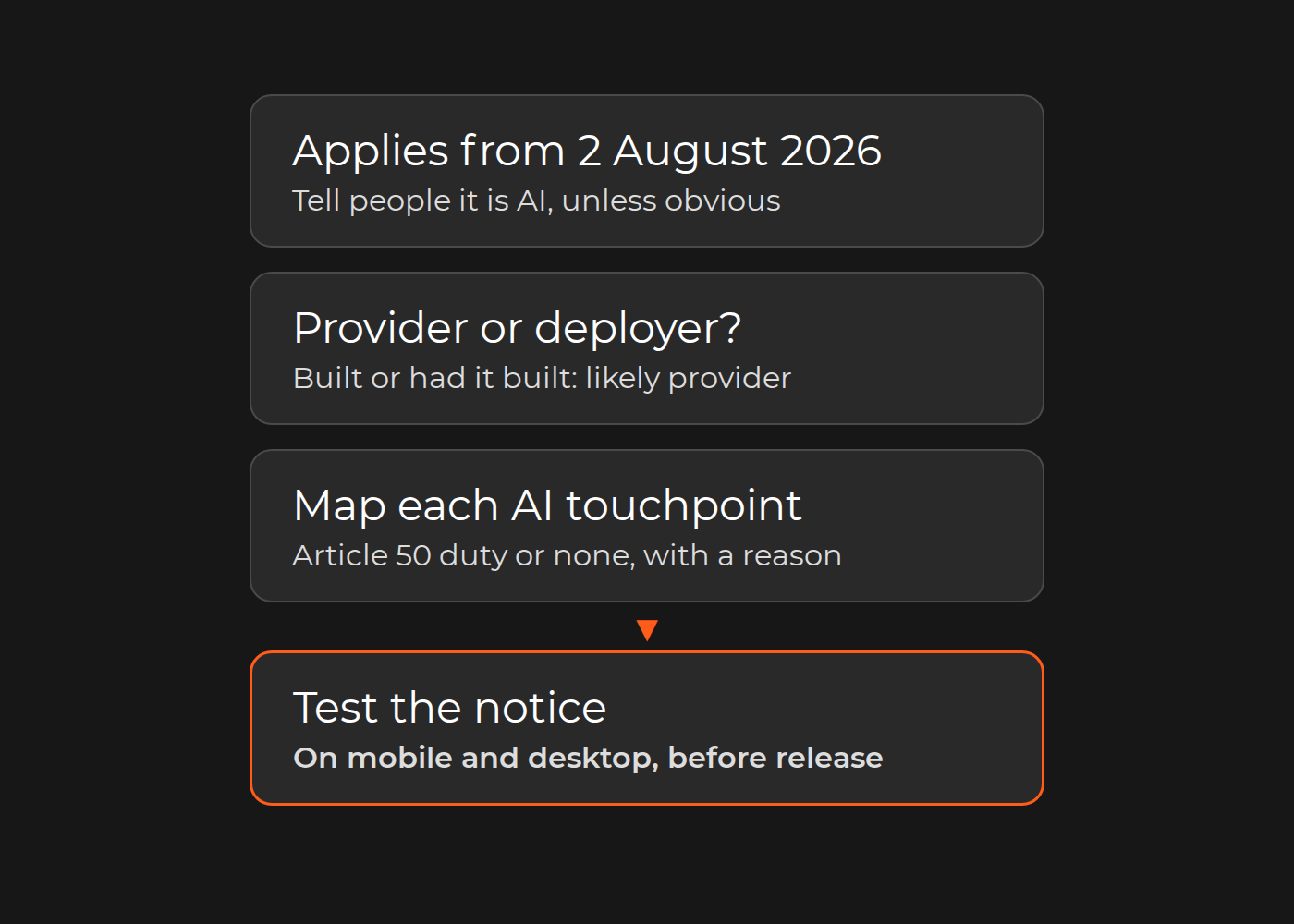
Since 2 August 2026, Article 50 of the EU AI Act requires AI systems that talk directly to people to tell them they are dealing with AI, at the latest at the first interaction, unless that is obvious. That duty sits with the provider: the company that develops the system, or has it developed, and puts it into service under its own name. A store that builds its own assistant on a model API, or has an agency build one, is likely its provider. A store that switches on a vendor's chatbot is usually a deployer: the notice is the vendor's to build, and yours to check. Two more duties reach retail. Providers of tools that generate images, audio, video or text must mark the output in a machine-readable way, and deployers must label deep fakes, which the Commission's guidelines say can include an AI product image that misrepresents the real product. Map every AI feature to a role and a duty, then test the notice on mobile and desktop.
This is plain-language guidance, not legal advice. Confirm your role and obligations with your counsel.
What Article 50 requires, and since when
Article 50 applies from 2 August 2026 (Article 113). The paragraphs that matter in a store:
Paragraph
Whose duty
What the Act says
Store example
50(1)
Provider
Systems "intended to interact directly with natural persons" must inform them "that they are interacting with an AI system, unless this is obvious" to a person "who is reasonably well-informed, observant and circumspect"
Chat assistant, voice bot
50(2)
Provider
Outputs of systems generating "synthetic audio, image, video or text content" must be "marked in a machine-readable format and detectable as artificially generated or manipulated"
Image or text generator
50(4), first subparagraph
Deployer
Deep fakes: "disclose that the content has been artificially generated or manipulated"
Realistic AI people in campaign images
50(4), second subparagraph
Deployer
AI text "published with the purpose of informing the public on matters of public interest" must be disclosed, unless it had "human review or editorial control" and someone "holds editorial responsibility"
Possibly an AI-written guide with health or safety claims
50(5)
Both
Information "in a clear and distinguishable manner at the latest at the time of the first interaction or exposure", conforming to "the applicable accessibility requirements"
Every notice
Article 50(3), on emotion recognition and biometric categorization, rarely fits a shop. One date moved: the Digital Omnibus on AI, Regulation (EU) 2026/1744, published in the Official Journal on 24 July 2026, added Article 111(4). Providers of generative systems "placed on the market before 2 August 2026 shall take the necessary steps in order to comply with Article 50(2) by 2 December 2026." The other Article 50 duties did not move; the Commission's guidelines on Article 50 (C(2026) 7702, 5 November 2026) say a partly interactive, partly generative system must give the 50(1) notice from 2 August 2026. Fines for Article 50 breaches can be up to EUR 15 million or 3% of worldwide annual turnover, whichever is higher; for SMEs and small mid-cap enterprises (SMCs), whichever is lower (Article 99(4), (6) and (6a), the last added by the Digital Omnibus). Article 50 applies alongside, not instead of, the high-risk rules (Article 50(6)), and the guidelines note that a system can fall under Article 50 without being high-risk. Ask counsel if any feature might be on the Annex III list.
The AI feature transparency register
Keep one row per AI touchpoint, with these columns: vendor or custom build; your role (provider or deployer) and why; the Article 50 paragraph triggered, or "none" with the reason; the disclosure design (where, when, wording, accessible format); who handles machine-readable marking; human handover; logging; owner; and the latest test result. Start from this list:
Touchpoint
Usual Article 50 trigger
What to record
Chat assistant (help desk or shopping)
50(1); the guidelines name customer-support and e-commerce chatbots
Who provides it, where the notice shows, the handover
Voice or phone bot
50(1)
The spoken notice at the start of the call
AI product Q&A on product pages
50(1) if customers type questions and get generated answers; 50(2) for its provider
A notice beside the input field
Generated product or lifestyle images and video
50(2) for the tool's provider; 50(4) if realistic and able to pass as real
The vendor's marking answer; your visible label
AI-written product descriptions
50(2) for the tool's provider; 50(4) usually not (see below)
Who reviews claims before publishing
AI email replies
50(1) if the AI sends them; not if staff review and send them
Who presses send
Virtual try-on
Not 50(1): the guidelines list "AI-assisted product visualisation (e.g., virtual try-on, room staging, product rendering)" as outside it
The vendor's 50(2) answer
Record "none" for recommendations and search ranking too: the guidelines list "AI-enabled recommender systems" and "search and retrieval of information without generating or modifying content" outside Article 50(1).
Ask the four questions in order for every AI touchpoint in the register. Each yes adds a duty, and the label says whose it is; only when all four answers are no do you record that these duties do not apply, with the reason. Provider duties sit with you if you built the system, or had it built, and run it under your name; otherwise with the vendor.
Provider or deployer: building vs buying a chatbot
A provider is a person or body "that develops an AI system ... or that has an AI system ... developed and places it on the market or puts the AI system into service under its own name or trademark" (Article 3(3)). A deployer is one "using an AI system under its authority" (Article 3(4)). For a store:
Built in-house on a model API. The guidelines give, as an example of a provider, an organization "that has developed an interactive AI system (e.g. chatbot) in-house and puts it into service in the Union for its own use and under its name or trademark." Article 50 does not explicitly apply to the underlying model.
Built by an agency for you. "Has an AI system ... developed" covers this: you are likely the provider, not the agency.
A vendor's chatbot switched on. The vendor is the provider and you are the deployer. According to the guidelines, if you modify a vendor's generative system, for example with new training data, and put it into service under your own name, you become the provider of the new system. If the bot runs under your brand, ask counsel where the line falls.
Selling from outside the EU. The Act covers providers and deployers in a third country "where the output produced by the AI system is used in the Union" (Article 2(1)(c)).
Fictional, illustrative example. A cosmetics retailer selling to EU consumers runs a vendor help-desk chatbot, a custom "shade finder" assistant an agency built on a model API, AI-generated lifestyle images with realistic people, and product descriptions drafted with AI and edited by staff.
Touchpoint
Role and reason
Article 50
Disclosure, handover, logging
Owner and result
Help-desk chatbot
Deployer: vendor's product under the vendor's name, configured with our FAQ, not retrained
50(1), vendor's duty
Vendor's AI notice switched on; "Talk to a person" button; vendor logs handovers
CX product owner. Mobile notice hidden by the keyboard; fixed in vendor settings, retest passed
Shade finder
Provider: we had it developed and run it under our brand
50(1); 50(2) for its text
"AI assistant" label beside the input, first-message notice, handover to a beauty advisor, handovers logged; model vendor asked what it marks
Ecommerce product owner. Pass on desktop and mobile
Lifestyle images
Deployer of the image tool; the tool vendor is its provider
50(4): realistic people who could pass as real; 50(2) is the vendor's
None under 50(4): descriptions carry no health, safety or sustainability claims; the regulatory team checks every claim before publishing
None needed; review recorded per product
Content lead. Recorded
Designing the disclosure: first interaction, wording and accessibility
From the Commission's guidelines:
Timing. "A single, prominent notification before the first interaction" is "likely to suffice in most instances". Riskier contexts, such as complaints handling, are likely to need periodic reminders, and the system must disclose its nature whenever asked.
Wording and place. Plain-language labels such as "You are interacting with an AI system", first-turn greetings, and disclosures placed "near the input/output field". For voice, a spoken statement at the start, such as "This is an AI-powered assistant".
Not enough on their own. Disclosures "only in terms and conditions, URLs, or documentation"; a generic "assistant" label; a site-wide "Services on this website use AI"; or "this system uses LLMs".
Who replies. Staff using AI to help them write is not direct interaction. Where AI and human replies mix, the AI-generated outputs need disclosure "unless those AI outputs have been properly reviewed and sent by humans as the main interlocutors".
Obviousness. The exception is read restrictively. The guidelines list "AI chatbots embedded in online platforms or assistance support tools (helpdesks)" among the cases where it does not apply, and say it "cannot be relied upon" when the audience includes vulnerable consumers.
Accessibility. Article 50 adds no accessibility rules of its own, but if your store is an e-commerce service under the European Accessibility Act, the notice is part of it: make it real text that a screen reader announces when the chat opens.
Article 50 does not require a route to a person. Add one anyway, and log it. In a multi-phase custom AI chatbot proof of concept for a US performance marketing agency, Dinarys built authentication and access control, fallback, logging, feedback and a validated-response layer; it is an agency PoC, not a consumer store chatbot or an AI Act project. For Oze's lending platform, Dinarys and Oze's internal team built a bank statement processing pipeline with asynchronous AI analysis, retry flows on failure and a manual template fallback for edge cases. Both plan in advance what happens when the AI cannot answer reliably.
Generated images and product content: marking, deep fakes and editorial control
Marking (50(2)) is the generator's provider's job; standard editing, such as grammar correction or minor cropping, is exempt. Ask each vendor how it marks and detects output.
Deep fakes (50(4)) are content that "resembles existing persons, objects, places, entities or events and would falsely appear to a person to be authentic or truthful" (Article 3(60)). For stores, the guidelines count "realistic AI-generated human avatars or personas" as persons and list as a deep fake "An AI-generated image of a product in advertisement or packaging that can affect the audience's perception and mislead as to the actual product appearance, characteristics or use". A real product shown against an AI-generated background is not one "as long as the ad is not likely to mislead". The label must be visible to people; metadata alone does not meet it. Evidently artistic or creative works need only a disclosure that "does not hamper the display or enjoyment of the work".
Text (50(4)) covers publications that inform the public on matters of public interest, which include "public health, environmental protection, consumer safety". The guidelines place "AI-manipulated text that is part of a company's advertisement or product descriptions (not including any claims related to e.g. health, consumer safety or sustainability)" outside it. For buying guides and claims, the review exception needs substantive review: spell-checking does not count, a substantive AI edit after sign-off voids it, and the person or function holding editorial responsibility should be named publicly.
Consumer law applies alongside: the guidelines point to the Unfair Commercial Practices Directive and the Consumer Rights Directive, whose information obligations apply "irrespective of whether the interaction is considered 'obvious'", and data protection law applies too.
What to require from AI vendors
Put these in the contract:
A written statement of who is the provider for Article 50 purposes, and what the vendor's notice does: wording, placement, languages, and whether your theme or settings can hide it.
For generators: how outputs are marked and detected, whether the vendor follows the Code of Practice on Transparency of AI-Generated Content, and, for systems on the market before 2 August 2026, its plan to meet Article 50(2) by 2 December 2026.
Notice of model or feature changes that affect disclosure or marking.
Conversation and handover logs, with retention set by your data protection policy.
Run this for every AI touchpoint before it goes live and after each vendor or model change:
The register row is complete: role with a reason, Article 50 paragraph or "none" with a reason, owner.
In a fresh session on mobile and desktop, the notice appears at or before the first message, stays visible when the on-screen keyboard opens, and a screen reader announces it.
Asked "Am I talking to a person?", the assistant says it is AI.
The handover to a person works and is logged.
Every realistic AI image in use carries a visible label, and the vendor's marking answer is on file.
Public-interest text has a recorded human review and named editorial responsibility, or a disclosure.
One limit: the register records how you reached each decision; it does not settle open questions, such as when a white-label bot makes you its provider. The Commission's guidelines are non-binding, and only the Court of Justice of the EU can interpret the Act authoritatively.
If you want a second view before release, Dinarys' ecommerce consulting team can review your chatbot's disclosure, fallback and logging design. The legal assessment stays with your counsel.
FAQ
We use a vendor's chatbot. Is the notice our problem?
The Article 50(1) duty is the vendor's as provider, but the notice appears in your store. Check it is switched on and visible. If you retrain or rebrand the system, you may become its provider.
Do AI-written product descriptions need an "AI-generated" label?
Usually not under Article 50(4): the guidelines place product descriptions outside it unless they make health, consumer safety or sustainability claims. The tool's provider still marks output under 50(2).
Does a clause in our terms and conditions count?
No. The guidelines say disclosures only in terms and conditions, URLs or documentation are not enough on their own.