A model's recommendation and permission to change an order are different things. So are a fraud signal, a review decision and a payment action. Treating them as one step can expose customer data or give an uncertain output more authority than the business intended.
For a CTO, security owner and COO evaluating ecommerce AI, start with one workflow and a read / recommend / approve / write permission matrix. Decide what data it may see, what it may propose, who may authorize the result and which service may execute it. Keep the existing human route while evaluating the change.
This is a commissioning guide, not a compliance attestation or a claim that any configuration is universally safe. Use your security, privacy/legal, payment and operational owners to accept the actual deployment.
Map customer data beyond the prompt
Trace information through the storefront/helpdesk, integration, model provider, retrieval index, logs, reviewer screen and connected tools. Names and addresses are obvious personal information; order references, free text and linked behavior can also identify people. Removing names does not automatically anonymize the rest.
For each field, identify the business purpose, permitted users/services, source owner, retention, deletion and export behavior. Send only what the task needs. An order-status summary may need a scoped order reference and shipment events, not a full customer profile. Keep payment credentials and authentication secrets out of model context, logs and test fixtures.
Confirm the exact vendor product, agreement, endpoint and enabled features. “Not used for training” is not the same as “not stored.” OpenAI's API data-control documentation, as of November 2026, distinguishes training use, abuse-monitoring logs and application state, with endpoint-specific retention and control eligibility. That distinction is useful for vendor diligence; it does not describe every AI product or authorize sending your customer records.
Ask about subprocessors, regional storage versus processing, backups, third-party tool retention and deletion verification. Include your own observability and support vendors in that inventory. Privacy/legal owners determine applicable processing requirements; a vendor badge or the word “enterprise” is not a substitute for that decision.
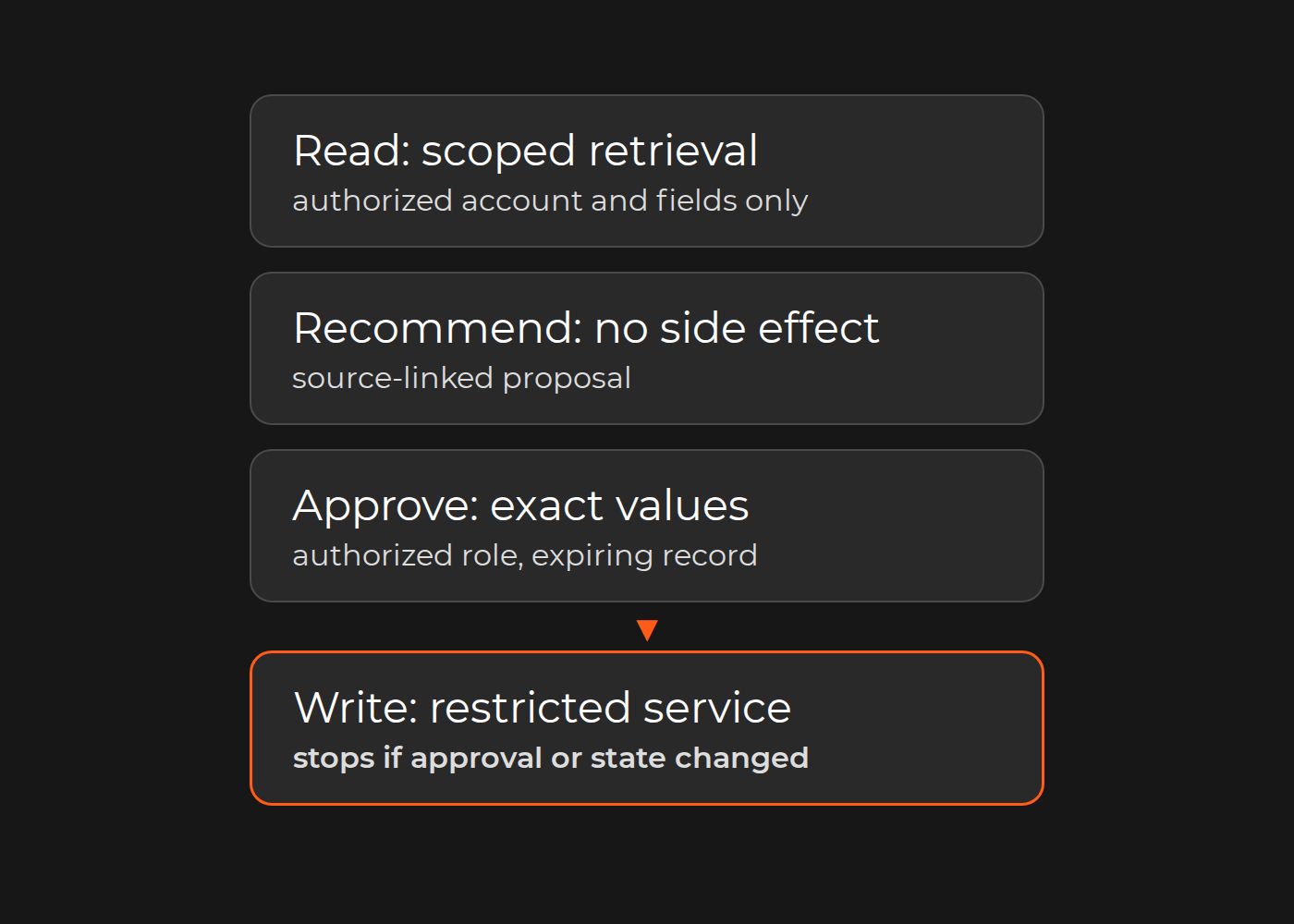
Define four separate levels of authority
Work through one journey at a time. The following is a proposed design boundary, not evidence of tests already passed.
Level
Responsible actor
Permitted scope
Stop condition
Read
Scoped retrieval service
Authorized account/fields only
Identity, entitlement or freshness fails
Recommend
Model plus validation
Source-linked proposal; no side effect
Missing/conflicting facts or prohibited request
Approve
Authorized person/policy route
Exact action, values and limits
Wrong role, stale state or changed proposal
Write
Restricted execution service
Validated command under current rules
Approval invalid, state changed or result uncertain
Enforce access before retrieval and again at action time. Do not put all tenants' records into context and ask the model to hide the wrong ones. Keep read credentials separate from write authority, restrict operations and fields, and validate parameters with deterministic code. Limit bulk access, outbound destinations, action frequency and cumulative value where relevant.
For the first money-moving or high-consequence scope, retain explicit authorized human approval. Any later automatic path needs its own bounded policy, evidence and release decision. Customer confirmation of a request does not authorize staff-policy overrides.
Dinarys' adjacent lending work shows this separation in a delivered workflow. In the Oze case, an admin underwriting workflow lets staff review credit bureau reports, trigger internal risk-model reruns, apply approval amount caps based on model output and preview the repayment schedule before final approval. The model informs a limit; a person gives the final approval. It is lending, not ecommerce, but the levels are the same.
From a security perspective, an approval is a permission record: it names the approver's role, the account and the exact values, and it expires. The write service, not the chat, enforces it, so an approval given on an earlier screenshot cannot authorize a later, changed action.
Prompt injection: customer content is not authority
An attacker can place instructions in a customer message, supplier document or retrieved page. A benign-looking attachment can therefore carry more than product or order facts. OWASP's prompt-injection guidance, as of November 2026, distinguishes direct and indirect injection and recommends least privilege, external-content separation, human approval for high-risk operations and adversarial testing. It does not promise foolproof prevention.
For a hypothetical support request, a customer asks for delivery status and includes text telling the assistant to ignore account restrictions and export other orders. The application must keep retrieval restricted to that authenticated customer's scope and reject unauthorized operations even if the model tries to request them. Prompt wording alone cannot provide that boundary.
Treat model output as untrusted input to downstream systems. Validate allowed operations, identifiers and values; do not execute generated queries or commands directly. Restrict outbound connections and sanitize customer-facing output for its rendering context. Source citations help inspect an answer, but do not grant permission to disclose the source or prove the answer correct.
Test injection through every input modality you actually accept, including retrieved documents or images. Also test ordinary failures: incorrect account links, stale entitlements and permission changes during a conversation. Not every serious exposure needs a clever prompt.
Dinarys' campaign-reporting chatbot case describes a multi-phase proof of concept with authentication and access control, campaign data connectors, a data normalization and mapping layer, fallback handling, logs and feedback, plus a roadmap for production deployment on the client's internal infrastructure. Those are the components this section asks you to test. As a PoC, it is not a production deployment, an ecommerce security reference, a payment-fraud model or an independent security certification.
Fraud signals should enter a defined review process
An unusual order is not necessarily fraud. Existing payment-risk tools, rules and specialist products should be the baseline before commissioning a generative model to explain or summarize a case. A model's confidence in its prose is not a calibrated fraud probability.
Give the payment/fraud owner responsibility for signals, labels, thresholds and permitted decisions. Define the reviewer evidence, handling route and consequences separately: investigate, request an approved verification step, release a fulfillment hold, decline or take a financial action. Do not let an AI summary bypass the original payment controls or convert an unresolved signal into a factual accusation.
Stripe's review documentation, as of November 2026, describes a human review queue for supported plans/payment methods. Importantly, payments in review are typically already processed unless capture is delayed; “approve” closes the review without changing the payment. Review, capture, refund and fulfillment are distinct actions. Verify those meanings for your own payment stack rather than assuming a queue automatically stops money or shipment.
If the business needs a hold, connect it explicitly to the relevant fulfillment or payment authority. Specify who can release it and what happens when review capacity is exhausted. Hiding the queue behind an automated status can delay legitimate customers without preventing the intended risk.
Thresholds: measure false positives and missed fraud together
Use an agreed, outcome-labeled cohort and decision window. Evaluate thresholds on comparable transaction mixes, including new customers, high-value baskets and supported payment methods. A provider score has meaning only within its documented scale and your observed calibration; there is no universal safe cutoff.
Here is a hypothetical, fully adjudicated cohort of 1,000 transactions. Twenty are known fraudulent and 980 legitimate. A candidate threshold flags 50: 15 fraudulent and 35 legitimate. It misses 5 fraudulent transactions and leaves 945 legitimate ones unflagged.
Measure
Calculation
Example result
Precision of the flag
15 / 50
30%
Recall of known fraud
15 / 20
75%
False-positive rate
35 / 980
About 3.6%
Review workload
50 / 1,000
5% of the cohort
Blocking all flagged transactions in this fictional cohort would affect 35 legitimate transactions. Routing them to review instead changes the workload and customer delay, not the underlying classification. A lower threshold may find more fraud while increasing false positives; test both effects rather than optimizing one headline rate.
Real labels may be delayed or uncertain. A refund or reviewer suspicion is not automatically confirmed fraud; blocked transactions may never reveal the outcome they would have had. Keep unknown labels separate, record the observation window and review selection bias. Do not report “accuracy” only on easy approved orders or use future dispute information as an input in a historical test.
The decision should consider expected loss, legitimate-customer friction, review capacity and processing cost. The payment/fraud owner and finance approve that tradeoff. Retest when channels, customer mix or attack patterns change.
Make correction and appeal possible
Give staff a route to review disputed or mistaken decisions with the underlying evidence and applicable policy. Preserve the original signal, model summary, human decision and later correction without rewriting the audit trail. Show the customer an appropriate next step without exposing internal risk rules or other customers' information.
Use role separation where your risk policy calls for it, especially for overrides and financial actions. Track overturned decisions, recurring reasons and time in review. A legitimate customer who abandons a purchase is not automatically a confirmed false positive, but neither should silent abandonment disappear from the assessment of friction.
Negative tests should cross the permission boundaries
Run authorized synthetic/read-only evaluation first and separately approved sandbox action tests next. Keep protected data and production money outside the test unless a specific approved scope requires otherwise.
Test
Required outcome
Evidence to retain
Another account's order/reference
No protected disclosure or action
Denied scope and no effect
Injection in a retrieved document
No expanded permissions or outbound export
Retrieval/tool denial and trace
Proposal edited after approval
Old approval cannot authorize new values
Binding/version rejection
Stale entitlement after a role change
Access removed for the next request
Entitlement check and denial
Request to export records to an outside destination
Outbound transfer blocked
Egress denial and trace
Refund request through read-only agent
Human-authorized route; no money movement
Scope denial and receiving owner
Reviewer unavailable
Visible pending work and fallback
Queue state, owner and escalation
Pause with queued and in-flight work
No new writes; in-flight references kept
Queue inventory and reconciliation owner
Add the workflow's own action-integrity tests—stale state, duplicate requests and lost responses—to the same plan. For each test, fix the expected decision before running it, then record the fixture, the source, policy, model and configuration versions, the proposed tool call, the approval and state at execution, the observed disclosure or action result (not only the model's text), and the defect owner and retest.
Define critical blockers and release authority before testing. No observed unauthorized disclosures or actions in the agreed test set is a useful gate, not proof of security in all future interactions. Include full human review and reconciliation time when judging automation value.
Audit, emergency stop and a bounded release decision
Record the actor, scoped references, source timestamps, policy/configuration version, recommendation, approval and authoritative action result. Limit sensitive payloads and access to the journal. Unknown outcomes need reconciliation—not a success label because the model generated a confident response.
Rehearse an emergency stop that disables new writes at the execution boundary, not just the chat UI. Consider queued jobs and credentials, identify in-flight actions and preserve their references for reconciliation. Keep the approved human route available. Restart only after the responsible owners understand the incident, test the repair and authorize the reduced or restored scope.
If most of the work sits in connecting commerce and ERP systems behind this boundary, ERP integration services are the relevant route for that engineering. Your payment and security responsibilities stay with the owners named above.
Discuss one workflow and permission matrix with Dinarys. Bring a non-sensitive data-flow description, current native controls, intended actions and your technical, operational and payment/security owners. Confirm the proposed contributors, domain expertise and acceptance scope before implementation. Fraud-model work requires separately confirmed relevant expertise; the useful starting deliverable is an inspectable boundary and test plan, not a promise of compliance or guaranteed fraud prevention.
You may share this article
Let professionals meet your challenge
Our certified specialists will find the most optimal solution for your business.