Content
E-Commerce
Nov 10, 2026
Helpdesk Automation or AI Agents? Choose by Resolved Customer Journeys
Time to read: 5 minutes

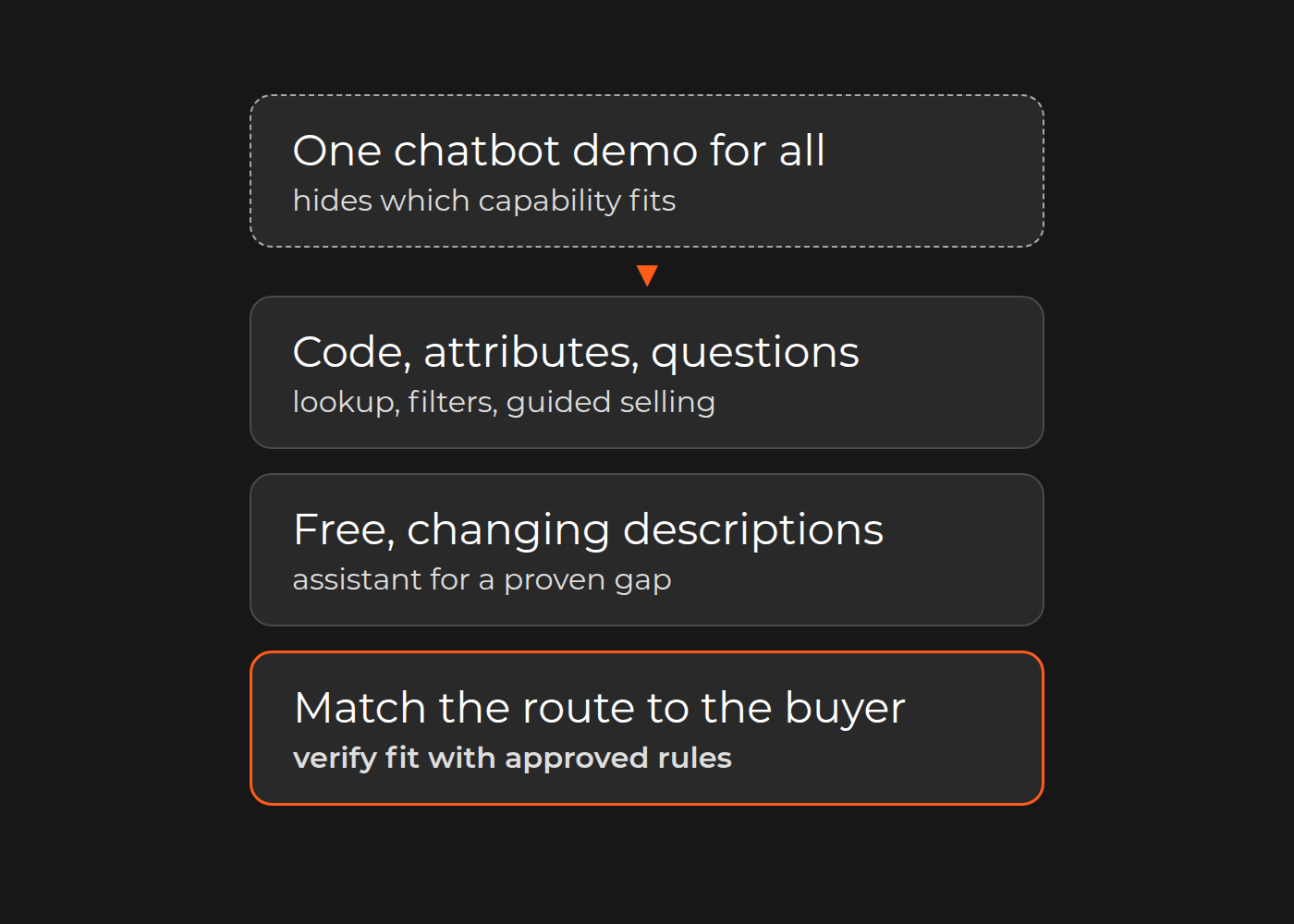
An FAQ answer, an order-status lookup and an address change may all appear as “handled” in a support report. They require different evidence. Choose the simplest option that completes the customer's need: rules for predictable policy questions, an existing integration for current order data, or native AI for varied language and supported actions. Commission custom engineering only for a gap you can name and test. Keep people available for disputes and uncertainty.
For a Head of Support comparing helpdesk automation vs. AI agents, use the same journeys, source data, policies and observation window for each option. Include the current human-assisted workflow as the baseline. IT/security reviews permissions and integration; the COO or ecommerce budget owner reviews the full economics.
A closed ticket is not necessarily a resolved journey
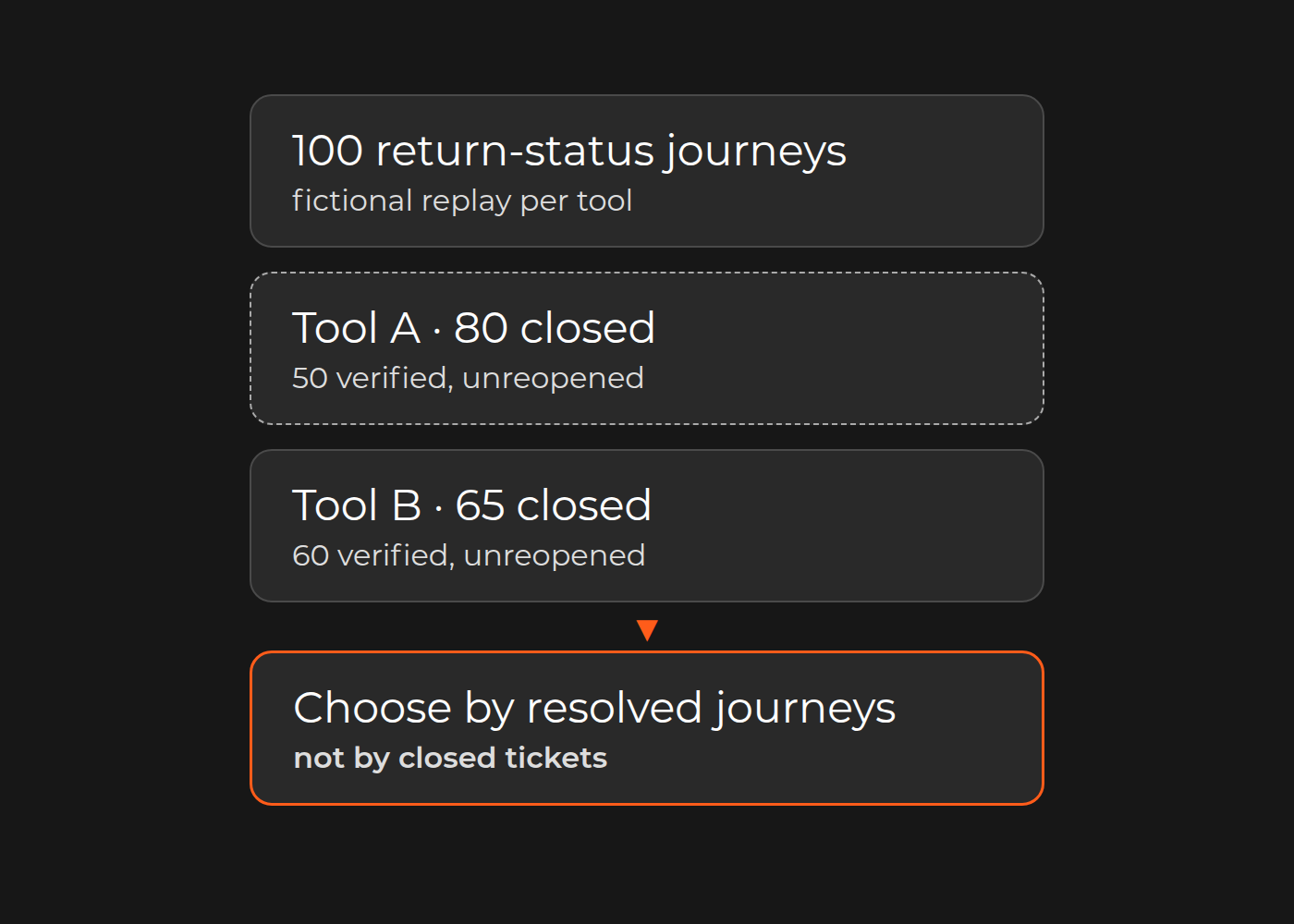
Consider a fictional replay of the same 100 return-status journeys. Tool A marks 80 closed; Tool B marks 65 closed. Reviewers check the answers against the current returns record, including whether they distinguish a parcel received from a refund issued.
After verification and the same illustrative seven-day follow-up window, A has 50 verified completions that remain unreopened; B has 60. Of the closed tickets, A's other 30 and B's other 5 failed verification or reopened. The remaining 20 and 35 journeys, respectively, were not marked closed. Keep all these outcomes in the cohort; none disappears from the evaluation. No money movement is tested.
At an invented $300 operating cost per option, A costs $6 per verified unreopened completion and B costs $5. These are not product prices or forecasts. Closure counts alone can reverse a buying decision. The follow-up window should reflect your service journey, not automatically copy seven days.
This is not simply rules versus AI
Routing rules, connectors, generative responses and configured actions can coexist in one helpdesk. Gorgias' documentation, checked in November 2026, describes opt-in configurable actions and human handover. That does not establish fit for your subscription, connected systems or policies—but it does mean that an action does not automatically require custom development.
| Approach | Test on the same journeys | Where it falls short |
|---|---|---|
| Content, macros and rules | Approved answers and predictable routing | A required lookup or business action is still manual |
| Existing helpdesk integration | Authorized, current order context | Missing fields, stale states or unsupported actions |
| Native AI with configured actions | Varied language plus supported workflows | Permission, exception or outcome tests fail |
| Bounded custom integration | A specific missing data/action capability | Full cost exceeds the value of closing the gap |
| Human-led handling | Investigation and authorized judgment | Repetitive work remains costly or slow |
If repeated contacts come from a broken shipment feed or unclear return policy, repair that cause. A fluent interface cannot supply missing operational facts. Diagnose why ecommerce support grows faster than orders before treating every contact as an automation opportunity.
A prompt is not a permission boundary
Apply backend access restrictions and business checks outside the language model. “The prompt says not to do it” is not sufficient acceptance evidence. A persuasive message must not expand action scope or override an order-state restriction.
Use this small rights, actions and handoff matrix as the starting test set. These are proposed acceptance scenarios, not tests performed on a client system.
| Journey | Permission and completion check | Handoff condition |
|---|---|---|
| Order status | Verified owner; source status and timestamp | Identity fails, facts are stale or sources disagree |
| Address change | Owner and cutoff checked; confirmed once in OMS | Dispatch committed or action outcome unknown |
| Another customer's order | No protected disclosure or change | Failed ownership check |
| Refund request | Identify intent; no money movement in this pilot | Authorized refund owner takes over |
Use the same restrictions for native and custom alternatives. Keep historical replay read-only; authorize action tests separately in a sandbox. For an address change, test a repeated request and a timeout after the backend has accepted the change. The system must retrieve the first result or escalate—not create a second operation simply because the first response was lost.
Replay the whole journey and score the outcome
Give each option the first request and the context it would legitimately receive later: a frustrated follow-up, conflicting OMS/carrier status, a repeated request and an action with an unknown result. Do not discover unsafe order-changing behavior on live customers.
Score three outcomes separately:
- Answered: an appropriate, factually grounded response. This may complete an information journey.
- Action completed: the authorized system confirms the required change and the customer message reflects that result. An address-change answer alone is insufficient.
- Reopened: the same need returns within the agreed window, including through another channel where it can be linked appropriately.
Retain unknown outcomes and correct human escalations. A handoff should include the intent, permitted identity context, source status and timestamp, attempted action, observed result and escalation reason. The receiving role must be authorized to see that context.
Report first-contact completion, reopens, escalations, prohibited-action attempts and data errors beside cost. Include human handling, review, correction, software/inference and maintenance under a common finance-approved definition. Divide the costs of the evaluated cohort by its verified completions; do not quietly exclude failed or escalated attempts from cost. With no verified completions, there is no usable cost-per-completion figure.
Silence can hide abandonment, so an unreopened ticket still needs positive completion evidence. There is no defensible automation percentage for your business without your own evaluation: journey mix, data, permissions and observed quality determine the eligible share.
Where Dinarys fits
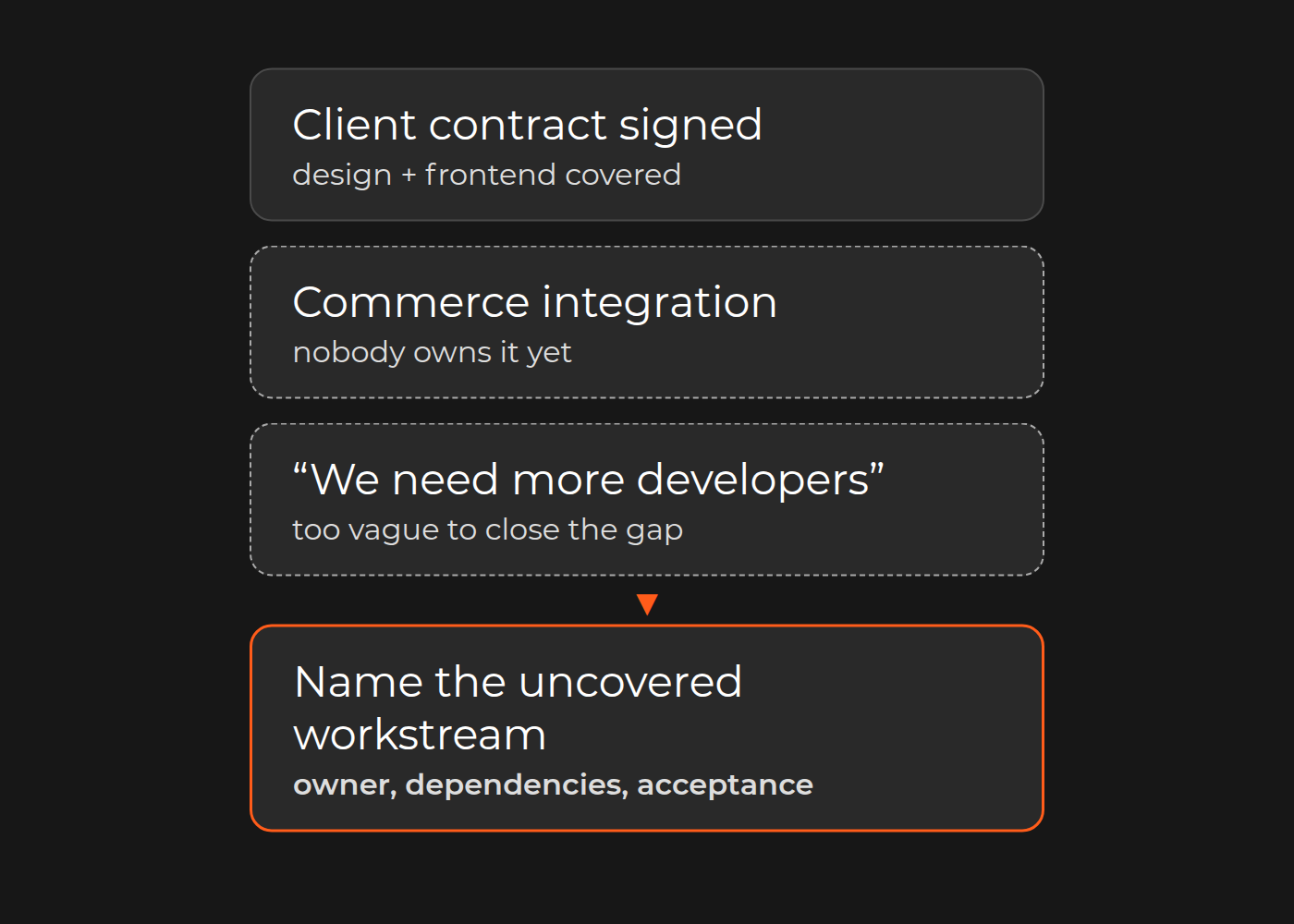
Dinarys sells integration and custom engineering, so we have a commercial interest in that route. The comparison should still stop at native capabilities if they meet the requirements.
The Untamed case describes Dinarys engineers developing the backend and helping integrate a React customer subscription dashboard under the client's CTO. For the data connection itself, the SanMar case describes a custom API connector translating legacy ERP data for Magento B2B/B2C sites. These are relevant self-service and integration components—not evidence of a production AI support agent or a benchmark for deflection.
If your evaluation exposes a missing operational data connection, ERP integration services are a relevant active route. A broader AI customer-service implementation should be scoped around the failed tests, authorized actions and handoff—not a general promise to replace the support team.
Bring comparable journeys to the decision
Discuss a journey comparison with Dinarys. Bring anonymized examples, approved policies, current helpdesk capabilities and your source-system owner. Agree the cohort, completion evidence, follow-up window and cost definition before comparing results. Support should accept the journey, IT/security the access controls, and the budget owner the operating cost and maintenance scope. Accept the verified journey and its limits—not the most impressive conversation.


Let professionals meet your challenge
Our certified specialists will find the most optimal solution for your business.