Content
E-Commerce
How to Scope the BI Workstream in an S/4HANA Program
Time to read: 5 minutes

A separate BI scope sits alongside the ERP integrator. Who verifies the numbers—and who has authority to accept them?
The business report owner accepts the definition, a named BI test lead owns reconciliation evidence, and the authorized program decision maker owns reporting go/no-go. The ERP integrator retains agreed source-side responsibility. Name one accountable owner per deliverable; accepting an assessment does not prove that reporting is ready.
For a manufacturing program sponsor, useful scope closes a named reporting gap without duplicating the main integrator or becoming a full ERP rollout. Dinarys offers reporting support and assessment, so this is guidance from a potential provider—not an independent vendor ranking. Apply the same evidence requirements to Dinarys and any alternative.
First check: is another workstream needed?
Review the main integrator's contracted deliverables for each critical report: current/target dependencies, business definitions, reconciliation tests, evidence ownership, and acceptance. If these are already covered and verifiable, coordinate within the existing program rather than buying a second assessment.
Where a dependency or business reconciliation is unowned, define the gap precisely. “Help with S/4HANA” is not a boundary. “Assess the source and mapping changes affecting this wave's management reports, identify adaptations, and establish validation tests” can be evaluated and assigned.
What a public Dinarys assessment actually covered
The iSi Group SAP case describes Dinarys assessing BW/analytics data flows, integrations, reporting dependencies, and component readiness for a planned ECC-to-S/4HANA transition. Published outputs included an architecture baseline, scope and cost estimation, a risk profile, and a reporting-module roadmap.
That is relevant evidence of an analytical assessment component alongside SAP operations. It is not proof that Dinarys completed iSi Group's S/4HANA migration or delivered the fictional acceptance example below. The earlier BW/BI support and later assessment are scopes for one client, not separate customer references. A public case paragraph also does not grant permission for a private reference call.
Who owns what in the BI workstream?
Use this proposed allocation to negotiate the brief, then replace role labels with named people and organizations from your actual contracts.
| Accountable role | Evidence or decision | Boundary to agree |
|---|---|---|
| ERP source owner | Source-side findings for the wave and objects | BI receives findings and evidence; source responsibility stays assigned |
| BI assessment lead | Reporting dependencies, mapping implications, gaps | Included reports only; no automatic implementation |
| Business report owner | Metric definition and explained changes | Technical teams do not redefine business policy |
| BI test lead | Reconciliation evidence | Source owners contribute; business validators review |
| Program decision maker | Reporting go/no-go | Assessor does not inherit rollout/switching authority |
| Delivery-scope owner | Approved changes and retest | Agree implementation and acceptance separately |
| Dispute-escalation owner | Contested findings and next action | Avoid two closed tickets with one unresolved issue |
Several teams may contribute, but an unresolved decision still needs one accountable owner. “BI says source issue; ERP says report issue” should trigger the agreed dispute route with shared evidence.
Write the brief a provider can accept
Specify the ERP wave, actual current/target landscape and versions, reports and consumers, deadlines, history needs, interfaces and adjustments, incumbent coverage, required access, client inputs, and acceptance owners. Exclude unrelated reports, unagreed warehouse redesign, full ERP rollout, and production switching authority.
Define six outputs with an acceptance question for each:
- Report/dependency register: can every critical report be traced to current and proposed target paths—or an explicit gap?
- Definition/mapping record: are formulas, keys, units, currencies, periods, and changes documented with owners?
- Impact/risk register: does each material finding have evidence, business consequence, an owner, and next action?
- Adaptation roadmap: are retain/adapt/rebuild choices justified, dependencies visible, and work prioritized?
- Reconciliation approach: are control data, comparison grain, discrepancy rules, expected results, and validators agreed?
- Reporting-readiness criteria: what must be demonstrated before use, what blocks acceptance, and who decides?
Do not prescribe an extraction method from a generic article. Version-sensitive behavior needs exact-landscape documentation and responsible specialists. Unknown target objects remain open until verified.
For a fictional wave-2 brief, assess a plant-inventory view and management reporting pack on one agreed closed month. Deliver the six outputs above. The ERP integrator supplies source-side findings; the assessment lead records reporting implications and evidence gaps. ERP rollout, warehouse redesign, production switching, and implementation of adaptations are excluded. Business owners accept definitions and the proposed validation basis; the program sponsor accepts the assessment boundary and findings.
Three states, one finding
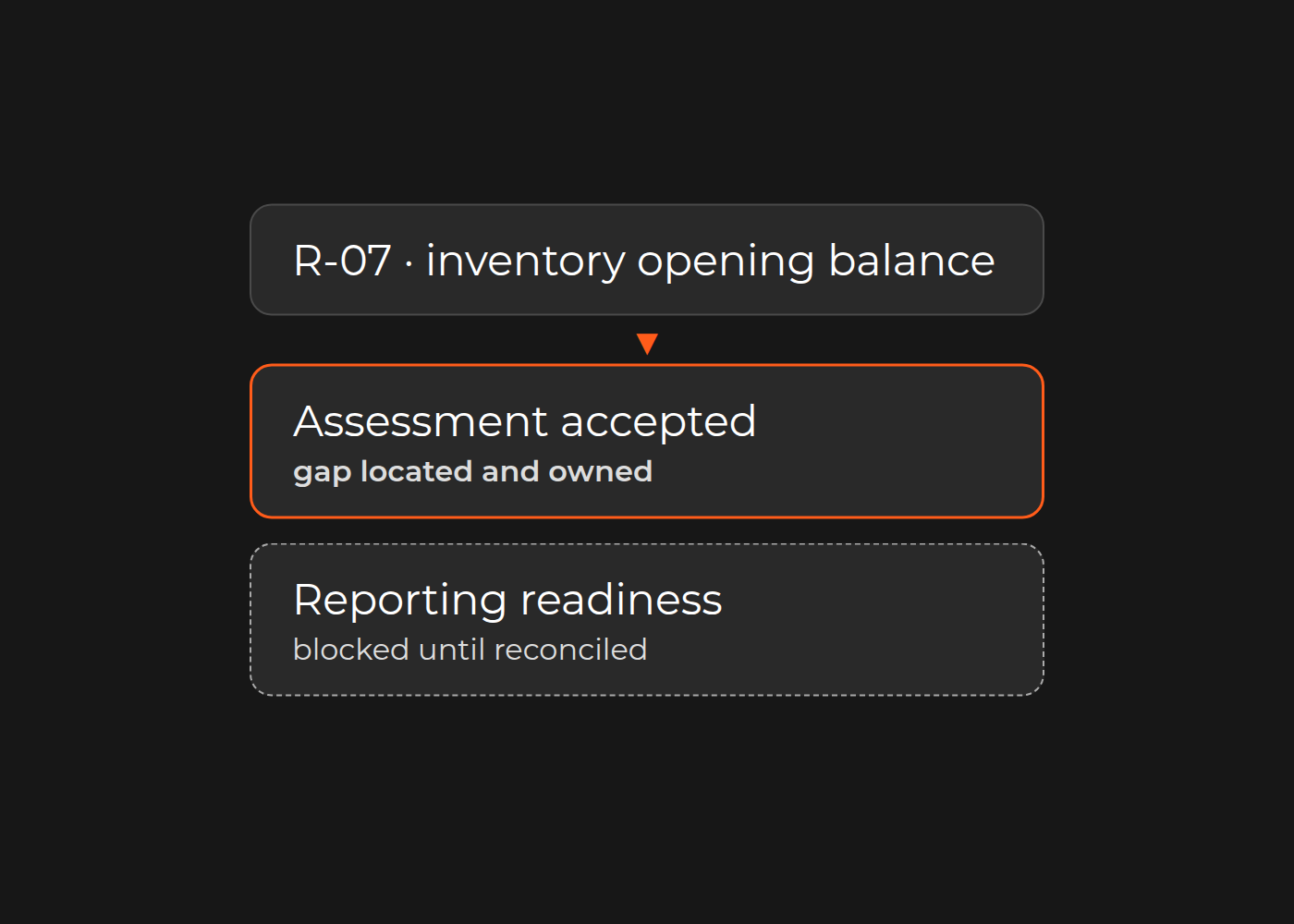
Suppose the fictional plant-inventory report needs a historical opening balance, but its target history boundary has no verified mapping or assigned implementation owner. An actionable finding could read:
R-07: The opening-balance history boundary has not been verified for the inventory control period. The BI test lead owns comparison evidence; the program sponsor assigns the mapping work; the inventory owner validates the balance. Reporting acceptance remains blocked until agreed reconciliation criteria are met.
The assessment can be accepted if it has fulfilled its job: locating the gap, documenting evidence limits, assigning next decisions, and defining the required test. That does not accept the implementation or make the report ready for use. This distinction protects both the business and the assessment supplier from a false readiness verdict.
Connect assessment evidence to the switching decision
Use the mapping and parallel-run test design to agree the control basis. The scope brief names who supplies and accepts evidence; it does not substitute for testing. A comparison proves only the agreed report, period, environment, and mapping version—not every report or a future production state.
The switching plan needs prerequisite evidence, an accountable decision maker, notification, an accepted business fallback, stop conditions, and handover obligations. Actual production actions and rollback stay within authorized operating procedures. These are planning requirements, not instructions to switch sources or replay loads.
Check the provider against the uncovered work
Ask who will perform the assessment and when they are available; “our SAP team” is not a named delivery arrangement. Ask for a trace on an authorized sample report and lawfully shareable register/mapping/test examples. Ask for a written boundary and dispute route with the ERP integrator. A method slide or “we will coordinate” is not enough.
Agree the brief with the integrator, BI lead, and business validators. To discuss Dinarys' fit for that analytical scope, bring a sanitized report list, uncovered responsibilities, versions and ERP wave plan, control period, ownership matrix, acceptance criteria, and exclusions. Confirm expert fit, availability, deliverables, and terms before commissioning an assessment—not a new ERP rollout.


Let professionals meet your challenge
Our certified specialists will find the most optimal solution for your business.