Content
E-Commerce
Keeping BW Reports Consistent During S/4HANA Migration
Time to read: 5 minutes

The report opens. The total looks familiar. But does margin mean the same thing after the source-system transition?
Consistency means unchanged measures reconcile on a comparable basis, intended changes are approved, and unexplained differences are visible before anyone relies on the report. It does not mean every number must remain identical forever.
Decide per report: retain, adapt a mapping, rebuild, retire, or use a time-bound fallback. Prove the choice with a closed-period comparison at the grain used for decisions—for example, period × plant × product—not just a grand total. A new ERP does not by itself require every report to be redesigned.
1. Name the reporting route you are testing
First identify which ECC-dependent reports are affected. Then compare five routes against each report's actual requirements:
- Retain: the definition remains valid and the verified target path supplies equivalent fields, keys, and timing. Familiar output alone is not proof.
- Adapt: address a specific input, key, or interface difference through a bounded mapping or transformation, then reconcile it.
- Rebuild: an approved changed requirement or verified constraint makes retention unsuitable. Agree the target definition, tests, and continuity with history.
- Retire: obtain business-owner approval for an accepted alternative and check downstream consumers. Usage counts can miss a close-period dependency.
- Use a time-bound fallback: agree visible limits, controls, and an exit condition. An interim alternative does not prove the target report ready.
The ERP integrator and BI owner verify source/target versions, customizations, and interface constraints. A source transition and a warehouse-platform migration are separate scope questions. If the main integrator already owns the reporting evidence, retain that ownership rather than duplicating work.
2. Freeze the meaning before comparing numbers
Finance and the business report owner agree the formula and included/excluded transactions; grain; source fields and manual adjustments; currencies, exchange-rate basis, units, rounding, and signs; period/cutoff and late postings; organizational keys; and history boundary. BI records how that definition maps to the data.
Version the definition and mapping used in each test. If a formula deliberately changes, explain the old/new basis and how users will compare it. Do not hide a business decision inside a technical tolerance.
3. Map each source contribution to the measure
Consider a fictional manufacturer comparing one agreed closed month. A01, B01, and X are invented labels, not SAP objects. X is a positive cost adjustment of EUR 5 thousand that belongs to Plant B. The example tests whether it stays there.
| Mapping item | Intended current/target basis | Test and owner |
|---|---|---|
| Net sales | Same population, exclusions, and signs | Compare included records; finance/source owner |
| Cost measure | Standard cost plus X assigned to Plant B | Check X's amount and attribution; finance |
| Plant key | A01 → A; B01 → B; X uses B01 | Reject X mapped to A01; BI/master-data owner |
| Reporting period | Same closed-month cutoff | Isolate later postings; finance/ERP owner |
| Margin | Net sales minus agreed costs | Reconcile components and result; BI/finance |
| History | Accepted baseline and target/history boundary | Explain continuity or restatements; report owner |
Link proposed target inputs to actual identifiers and evidence. An unresolved target field stays open; it is not a completed mapping.
4. Compare the closed period at decision grain
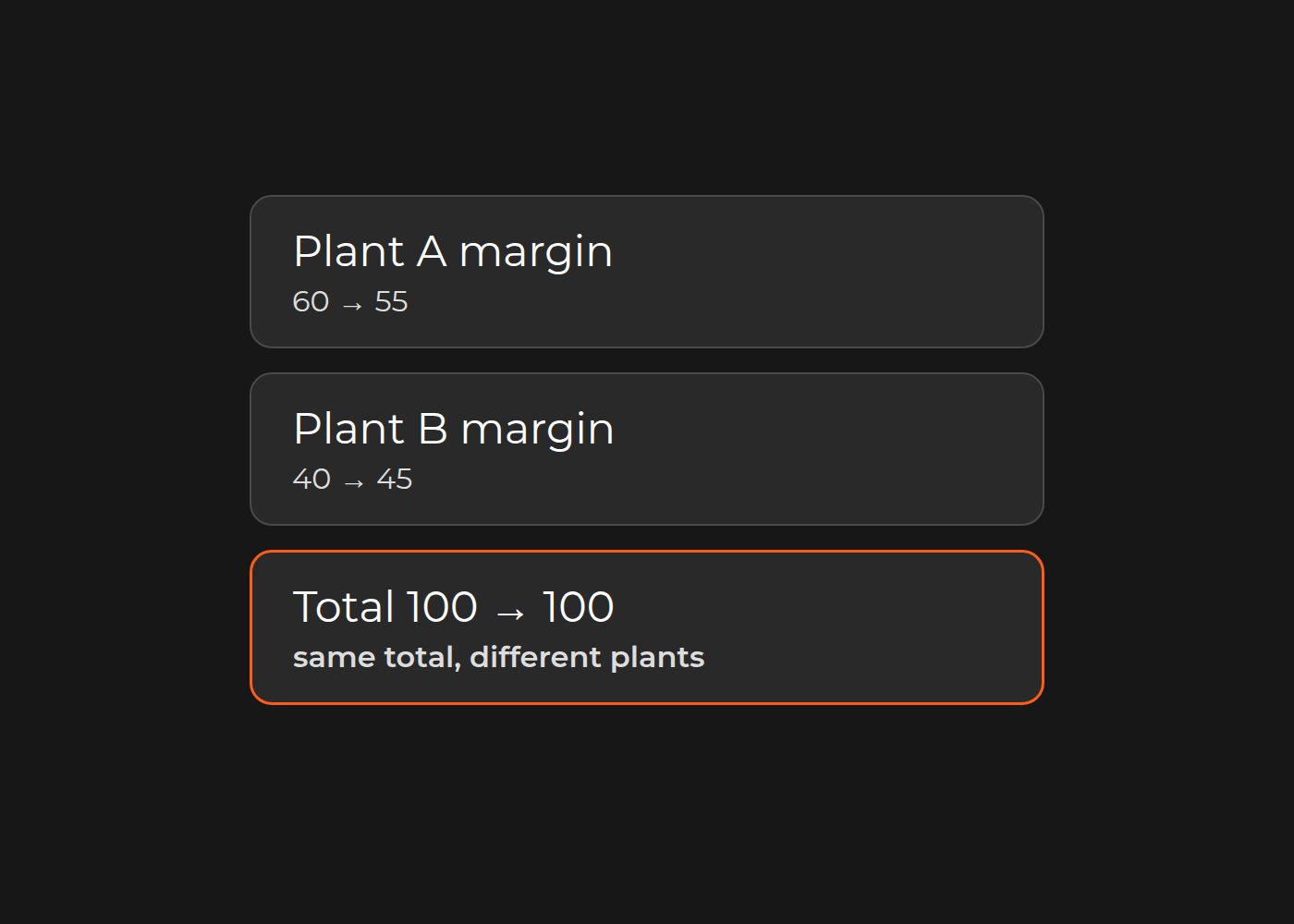
The fictional test returns these margins, in thousands of EUR:
| Slice | Baseline | Target | Difference |
|---|---|---|---|
| Plant A | 60 | 55 | -5 |
| Plant B | 40 | 45 | +5 |
| Total | 100 | 100 | 0 |
Investigation finds X incorrectly mapped to Plant A instead of Plant B. Plant A bears an extra cost of 5, lowering its margin by 5; Plant B loses that cost, raising its margin by 5. This is a fictional mapping defect—not a statement that S/4HANA reallocates margin.
A total-only check would miss it. Compare meaningful slices, calculation components, and selected detail records. Matching counts help check completeness but do not prove correct values or keys. Do not accept a matching total while material slice differences remain unexplained.
A parallel comparison needs comparable business populations, not two screenshots taken on the same day. Agree the period and cutoff. If simultaneous old/new runs are infeasible, use an agreed preserved baseline and controlled target test, documenting what that alternative cannot prove.
5. Record and classify the differences
Keep a reconciliation record for your control period. Each test needs:
- Report, measure, scenario, definition/mapping version, and environment.
- Control period, source coverage, cutoff, currencies, units, and reference-data basis.
- Approved baseline and target values, evidence locations, and comparison grain.
- Completeness, component, slice, boundary-record, and history checks.
- Classification, investigator, explanation, corrective scope, retest, and business decision.
Classify differences as timing, population, mapping, formula, rounding, approved change, or unresolved. Agree tolerances before testing according to the measure and business risk. A tolerance does not explain missing sources, a wrong plant assignment, or an unapproved formula.
For example, a EUR 0.01 unit-price difference may be acceptable under an agreed rounding rule. A EUR 5,000 plant difference that cancels elsewhere is not explained by calling it rounding. Even EUR 0.01 repeated on 40,000 one-unit rows is EUR 400. Check row and aggregate tolerances; small row differences can accumulate.
6. Choose the change and assign its owner
A verified field/key issue may justify bounded adaptation and retest. A business-definition change needs the owner's decision and a revised acceptance basis. If target data cannot supply an essential measure, compare an approved redesign or fallback against that constraint.
Prioritize dependencies and deadlines, not report count alone: one mapping may affect several critical reports. Give each gap one accountable owner and a business validator. In the fictional example, BI corrects X's mapping within approved scope; finance validates plant attribution after retest. The SAP program owner resolves cross-vendor ownership and readiness decisions.
Dinarys' iSi Group SAP assessment case describes reviewing BW/analytics flows, reporting dependencies, component readiness, and risks, then preparing a reporting-module roadmap. It is a relevant assessment component to examine when defining an uncovered analytics scope. It does not document the fictional reconciliation above or prove a completed S/4HANA migration.
Keep evidence planning separate from authority to modify production, replay loads, or switch sources. Operational actions follow the program's approved procedures and authorized owners.
Agree one control period with finance, complete the mapping, and use the comparison to select the report's route. To discuss an uncovered mapping or reconciliation scope with Dinarys, bring a sanitized formula, source/target map, control-period samples, difference log, version summary, and existing ERP/BI ownership boundary. Include the finance validator so the discussion can resolve meaning as well as technical scope.


Let professionals meet your challenge
Our certified specialists will find the most optimal solution for your business.