Selling cosmetics online is not like selling electronics or furniture. Beauty products live at the intersection of desire, identity, and trust. A customer considering a $10 serum or a $200 foundation palette needs to feel the brand before they buy, and that emotional experience has to be engineered into every pixel of your store.
Leading beauty companies have set benchmarks for online presence by prioritizing advanced features, exceptional design, and seamless user experience, shaping how consumers interact with beauty ecommerce platforms.
Online now accounts for over 41% of all beauty and personal care product sales, and the category is growing faster than almost any other consumer vertical. Brands that invest in premium development infrastructure consistently outperform those that treat their store as an afterthought. Building a digital empire with global reach is essential for beauty businesses to capture international markets and expand their customer base.
KEY INSIGHT FOR BUSINESS OWNERS
Beauty brands with high-quality, conversion-optimized stores typically achieve 3–5% conversion rates. Top performers reach 4–6%.
On $698bn in projected annual revenue for 2026, closing that 1–2% gap is worth $10,000–$20,000 per month in additional sales — which is why investing in the right development partner pays back quickly.
Businesses in the beauty sector, especially leading brands, leverage ecommerce to drive growth and maintain a competitive edge.
Beyond conversion, a beauty-specialized partner understands the regulatory landscape (ingredient labeling, claim restrictions, INCI compliance), international expansion challenges, and the influencer and social commerce ecosystem that drives discovery in this industry.
The beauty industry is among the leading sectors actively using Shopify-powered websites. Market forecasts predict the cosmetics sector will hit an $704 billion milestone by 2032, representing a consistent 6% yearly increase from its 2025 valuation of $42.72 billion. In the United States, cosmetics and beauty online sales will grow by 50% in 2022, reaching $18.60 billion. By 2026, online sales will account for roughly a third of all retail sales in the beauty sector.
Introduction to the beauty and cosmetics industry
The beauty and cosmetics industry stands as one of the most dynamic and rapidly expanding sectors in the global marketplace, projected to reach a staggering $704 billion by 2032. With a consistent annual growth rate of 6%, this industry offers unparalleled opportunities for beauty brands to scale their digital presence and connect with a global audience. As ecommerce becomes the primary channel for beauty sales, brands must adapt to the evolving expectations of online shoppers.
Beauty ecommerce websites are no longer just digital catalogs—they are immersive experiences that reflect a brand’s identity, values, and commitment to quality. High-quality visuals, trust-building elements, and educational content are essential to engage discerning beauty customers and drive conversions. In such a competitive landscape, leveraging cutting-edge technology and innovative development solutions is crucial for brands aiming to enhance customer experience, boost sales, and foster long-term growth.
By partnering with top ecommerce development companies, beauty brands can create online stores that not only look stunning but also deliver seamless, high-performance shopping experiences. This strategic investment in development and technology ensures that brands remain at the forefront of the cosmetics industry, ready to capture new customers and build lasting relationships in an ever-evolving digital world.
Choosing the right platform: A business owner's guide
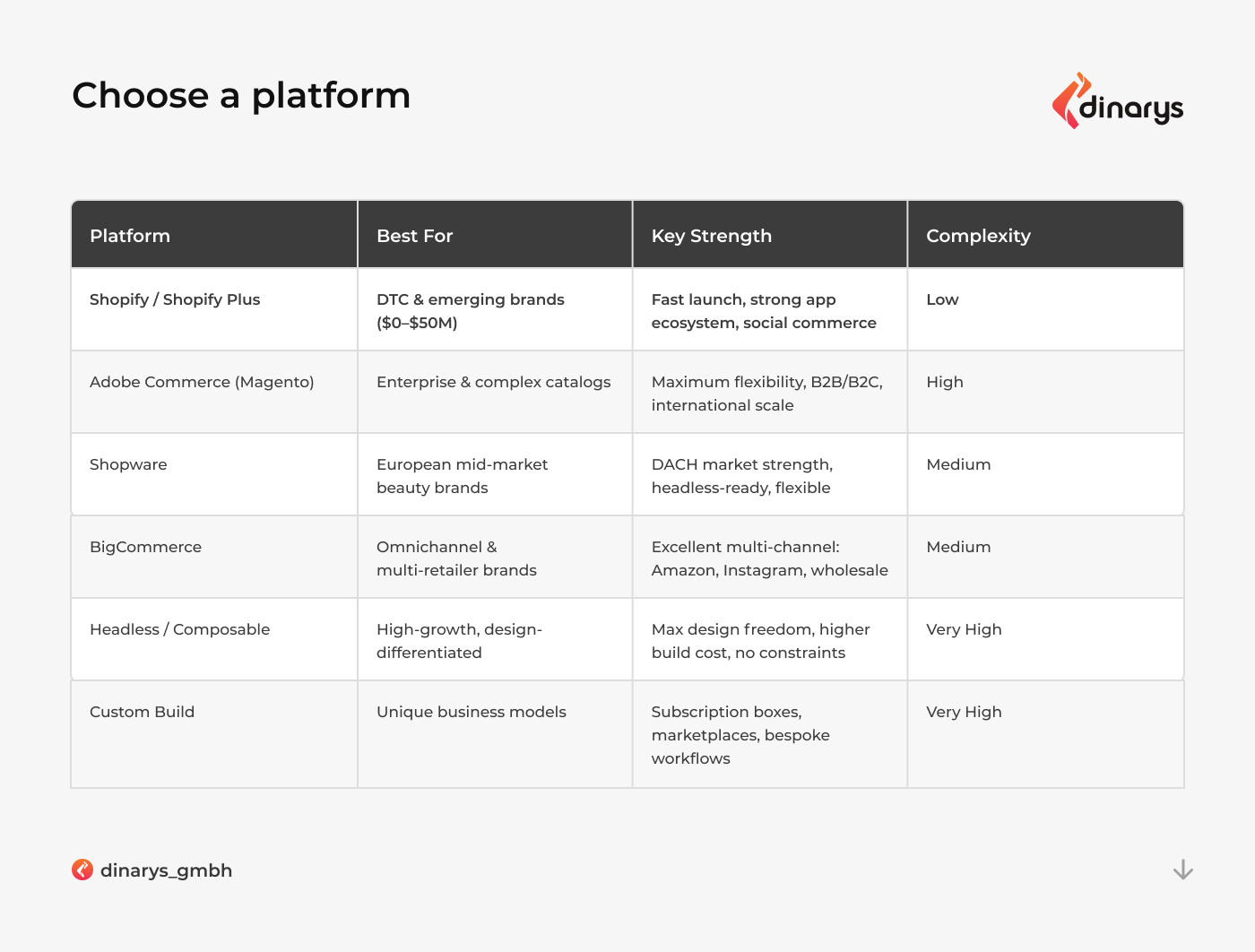
Before engaging any development company you need clarity on your platform requirements. The wrong foundation is extremely costly to fix later, migrations typically run $20,000–$100,000+ depending on complexity. Here is a practical breakdown for beauty brands.
When considering platform selection, note that the Shopify platform and Shopify Plus are especially popular among beauty brands for their ease of use, scalability, and support for custom features tailored to the beauty and cosmetics sector.
A common and expensive mistake is choosing Shopify when you need Magento’s flexibility or choosing Magento when Shopify Plus would launch you twice as fast. A good development partner will recommend the right platform for your specific business model, not the one they prefer to build on. If an agency only specializes in one platform and recommends it to every client, treat that as a warning sign. Choosing the right partner is crucial, they should offer specialized services and the expertise to deliver custom features that align with your brand’s needs and growth goals.
Before you select an ecommerce development agency, keep these best practices in mind:
Define your specific needs and budget to ensure the agency can tailor solutions for your product range and growth objectives.
Review the agency’s portfolio and case studies to assess their experience with similar beauty and cosmetics brands.
Assess their communication style and project management approach to ensure alignment with your workflow.
Request detailed proposals and timelines to understand deliverables and investment requirements upfront.
Check references from past clients to verify the agency’s reliability and quality of work.
Understand ongoing support offerings to ensure your ecommerce store can evolve with your brand over time.
Benefits of partnering with a top ecommerce development company
For beauty brands aiming to stand out in the crowded online marketplace, partnering with a top ecommerce development company is a strategic move that can accelerate growth and elevate brand presence. These specialized agencies bring a deep understanding of the beauty and cosmetics industry, allowing them to craft solutions tailored to the unique needs of cosmetics brands.
Expertise in custom theme development, headless commerce, and performance optimization ensures that every aspect of the online store is designed for maximum impact. Certified Shopify Plus agency partners, for example, offer advanced features such as custom solutions, mobile responsiveness, and ongoing support, empowering brands to create a distinctive visual identity and tell their brand’s story in a way that resonates with customers.
A proven track record of success means these companies know how to drive sales, enhance customer experience, and build loyalty. Their deep industry knowledge allows them to anticipate trends, implement best practices, and deliver results that scale with your business. By choosing the right agency partner, beauty brands can confidently invest in development that supports long-term success, robust performance, and a thriving online presence.
Top ecommerce development companies for beauty & cosmetics
The following companies have demonstrated strong expertise in building, migrating, or scaling eCommerce stores for beauty and cosmetics brands. A top beauty store and beauty website should embody a unique brand identity, tell the brand's story, and make users feel engaged and confident throughout their shopping journey. Leading agencies ensure that every beauty website is designed to boost sales by delivering a seamless, visually compelling experience that attracts loyal customers and showcases new brands.
Custom features, high-quality product pages, and innovative solutions are essential for beauty stores to stand out. Showcasing new brands and offering tailored shopping experiences help attract trend-focused customers and keep the product catalog fresh and engaging.
Key features and best practices implemented by top ecommerce development companies for beauty cosmetics include:
High-quality image galleries and zoom to showcase product textures, finishes, and results, supporting informed purchase decisions.
Mobile-first responsive design is crucial, as mobile traffic accounts for 79% of all Shopify store visits.
Fast loading times for image-heavy pages to prevent drop-offs and maintain performance.
Integration of user-generated content, such as real customer photos and reviews, to provide social proof and validate product performance.
Ingredient transparency and educational sections that clearly explain formulations, benefits, and suitability for different skin needs.
Tutorial and how-to content to educate customers on product usage, routines, and techniques, strengthening brand authority.
Dinarys is a full-cycle ecommerce development agency with a strong and documented track record in the beauty and cosmetics category. Serving both the US market and the DACH region (Germany, Austria, Switzerland), Dinarys brings over nine years of deep platform expertise and has completed 200+ projects for European and American clients.
What sets Dinarys apart for beauty brands is genuine sector depth. The team has built and scaled cosmetics storefronts ranging from single-brand DTC stores to multi-vendor beauty marketplaces. A flagship example is Goddess — a popular European multi-brand cosmetics marketplace — which Dinarys fully redesigned and migrated to Magento 2, delivering custom one-page checkout, improved localization, enhanced admin functionality, and measurably improved conversion rates and recurring revenue.
Dinarys excels at delivering custom features for beauty stores, including advanced product pages with high-quality imagery, virtual try-on integration, shade finders, and beauty quizzes to create tailored shopping experiences and reflect brand identity. Their focus on visual excellence in portfolios is critical for establishing consumer trust in cosmetics, ensuring that product pages feature compelling images, educational content, and user-generated reviews to boost engagement and conversions. The agency understands that cosmetics buyers are emotionally driven. They engineer stores with high-quality visual composition, intuitive navigation, shade-matching capabilities, and personalized product recommendations.
For brands selling across B2B and B2C channels simultaneously (wholesale alongside DTC), Dinarys’s composable commerce and headless capabilities are a strong fit. They also offer outstaffing — allowing beauty brands to embed certified developers directly into their in-house teams for ongoing flexibility. Dinarys supports global reach for beauty brands, offering multilingual and multi-currency solutions to enable international storefronts and expand into new markets.
Key strengths for beauty brands:
Deep beauty & wellness vertical experience with reference clients in US and Europe
Multi-platform certified (Magento, Shopware, Shopify, BigCommerce) — will recommend the right fit
DigitalSuits has spent over seven years building high-performance beauty and cosmetics stores, earning a reputation as a go-to agency for brands that want to leverage Shopify Plus to its fullest potential. Their deep experience with the Shopify platform, including Shopify Plus, allows them to implement custom features tailored for beauty brands—such as bespoke storefronts, unique shopping experiences, and specialized apps that reflect brand identity. DigitalSuits offers specialized services in Shopify development and optimization, addressing specific client needs and enhancing store performance. Their advisory approach means they rigorously vet technology choices before committing to a stack — a philosophy that pays dividends for beauty brands navigating complex integrations. According to industry benchmarks, a strong conversion rate on Shopify beauty stores typically ranges from 2% to 3%, with top-performing stores reaching 4% or higher.
The agency has delivered end-to-end solutions for cosmetics clients, managing everything from UI/UX design and Shopify development to launch, optimization, and ongoing maintenance. Their use of Shopify Hydrogen, Plus, and Oxygen for a recent flagship cosmetics project delivered frontend customization capabilities previously exclusive to headless architectures.
Key strengths for beauty brands:
Official Shopify Plus partner with deep Shopify Hydrogen and headless expertise
End-to-end team covering design, development, QA, launch, and maintenance
Advisory approach: recommends technology based on client needs, not preferences
Experienced with beauty-specific integrations: AR try-ons, AI recommendations, subscription flows
Strong track record migrating beauty brands from legacy platforms to Shopify
Craftberry is a boutique Shopify Plus agency with an in-house team of 30+ experienced eCommerce specialists with a concentrated focus on beauty and cosmetics brands. Unlike generalist agencies that dabble in beauty, Craftberry has built much of its portfolio specifically in this vertical — understanding both the aesthetic expectations and the technical requirements that set cosmetics stores apart.
Their work bridges the gap between visual storytelling and conversion science, creating stores that feel as premium as the products they sell while performing at a measurably high level. Craftberry specializes in complex high-SKU catalogs, subscription models, and conversion rate optimization for makeup and skincare brands. They deliver custom features and advanced product pages tailored for beauty brands, including high-quality images, educational content, product bundling, and user-generated reviews to boost engagement and sales. Notable clients include cosmetics brands across skincare, makeup, and wellness categories.
Key strengths for beauty brands:
Highly concentrated focus on beauty and cosmetics Shopify stores
Strong balance of premium visual design and data-driven CRO
Deep knowledge of the Shopify app ecosystem for beauty (loyalty, reviews, subscriptions, bundles)
Ability to create custom features and feature-rich product pages that reflect brand identity
Continuous maintenance and optimization services post-launch to retain loyal customers and drive ongoing profitability
Ideal for DTC beauty brands prioritizing brand differentiation through design
Barrel
Connected omnichannel experiences · Shopify Plus · Design-first
Platforms: Shopify, Shopify Plus
Barrel specializes in creating connected omnichannel experiences for beauty and skincare brands, with deep expertise in customer research, journey mapping, and UX-led design. Their process is rooted in understanding how beauty consumers move between discovery (often social), research (often content-heavy), and purchase — and designing stores that serve each stage of that journey flawlessly.
Barrel focuses on Shopify Plus development, digital strategy, and high-end UI/UX design to drive beauty brand growth. They help brands express their unique brand identity and tell their brand's story through immersive digital experiences and personalized content. Their design philosophy ensures users feel engaged and connected to the brand, creating a memorable and cohesive shopping experience.
Key strengths for beauty brands:
Rigorous customer research and journey mapping before any design work
Strong omnichannel thinking: connecting in-store, online, and social touchpoints
UX-led design philosophy particularly well-suited for premium and luxury beauty
Custom Shopify Plus development combined with digital strategy services
Proven work with beauty and skincare brands focused on customer lifetime value
MagentoBrain
Global fashion & beauty eCommerce · Magento + Shopify Plus · Multi-market
Platforms: Magento, Adobe Commerce, Shopify Plus
MagentoBrain brings proven global experience in fashion and beauty eCommerce across markets including the US, UK, Germany, France, UAE, and Southeast Asia. Their dual expertise in Magento/Adobe Commerce and Shopify Plus positions them well for beauty brands at different growth stages — using Shopify for fast DTC launches and Magento for enterprise-level complexity. MagentoBrain’s global reach enables beauty and cosmetics businesses to launch international storefronts, support multiple languages, and expand their worldwide customer base. They are also adept at helping new brands enter global markets and scale internationally.
The agency has a strong focus on mobile commerce (with mobile traffic accounting for 79% of all Shopify store visits, underlining the importance of mobile-first responsive design), and builds with a mobile-first methodology including AMP pages, one-click mobile checkout, and social commerce integrations for Instagram and TikTok.
Key strengths for beauty brands:
Deep experience with fashion and beauty brands across 15+ countries
Mobile-first development: AMP, fast-loading pages, one-click mobile checkout
Social commerce integrations: Instagram Shopping, TikTok Shop, Pinterest
Localized payment systems and multi-language SEO for international expansion
Custom AR and AI integrations for virtual try-ons and personalization
End-to-end: development plus SEO, influencer marketing tracking, and paid media
Strategic advice for beauty business owners
Choosing the right development partner is only one piece of the puzzle. The following strategic advice draws on current industry trends and patterns observed across high-performing beauty eCommerce operations.
To effectively boost sales, beauty brands should prioritize custom features and well-designed product pages that deliver a seamless, personalized shopping experience. Bespoke functionalities—such as tailored storefronts, unique checkout flows, and specialized apps—help reflect brand identity and engage customers. Feature-rich product pages with high-quality images, educational content, product bundling, and user-generated reviews are proven to increase engagement and conversion rates.
Ingredient transparency and dedicated education sections are essential for building trust, as they clearly explain product formulations, benefits, and suitability for different skin needs. Incorporating tutorial and how-to content further strengthens brand authority and customer confidence by educating shoppers on product usage, routines, and techniques.
It’s important to note that a strong conversion rate on Shopify typically ranges from 2% to 3%, with top-performing stores reaching 4% or higher, while the abandonment rate in the skincare and beauty category exceeds 81%. This underscores the critical need for an exceptional customer experience to reduce drop-offs and maximize revenue.
Invest in personalization infrastructure from day one
The days of one-size-fits-all beauty marketing are over. AI and machine learning now power tools that recommend customized skincare routines, match shades to selfies, and tailor product bundles based on browsing habits. Brands that invest in personalization infrastructure early — product recommendation engines, skin type quizzes, purchase-based triggers — see measurably higher average order values and repeat purchase rates. Implementing custom features, such as bespoke Shopify apps or unique storefront functionalities, enables even deeper personalized shopping experiences and helps retain loyal customers through automation and data-driven UX enhancements.
Ask your development agency how they plan to implement first-party data capture and how your store will use that data to personalize the shopping experience. If they do not have a clear answer, that is a gap.
BUSINESS OWNER TIP Every click, quiz, and cart tells a story. Lean on first-party data to understand what customers actually want. Use it to guide product development, marketing personalization, and inventory decisions. Stop guessing. Use your data to refine everything.
Build for mobile-first, not mobile-compatible
Most of online beauty purchases happen on mobile devices. This is not a reason to ensure your site "works" on mobile — it is a reason to build your entire experience around mobile users and then extend it to desktop. The difference is significant: responsive layouts, thumb-friendly navigation, streamlined checkout, fast image loading, and social commerce integrations designed for how beauty consumers actually discover products.
Plan your omnichannel strategy before you build
Customers expect seamless experiences across all touchpoints. They might discover your brand on TikTok, research on your website, try a product in-store, and buy via Instagram. Their preferences and purchase history should follow them across channels. Building in proper customer data infrastructure at the outset is far less expensive than retrofitting it later.
This is especially important for beauty brands with both DTC and wholesale (retailer) relationships. A well-architected platform can serve both channels from a single backend, supporting global reach with features like international storefronts and multiple language options, while dramatically reducing operational complexity and enabling multi-channel operations.
Prioritize loyalty and subscription infrastructure
Beauty products are inherently repurchase-driven. Skincare routines, makeup staples, haircare regimens — these are not one-time purchases. Yet many brands underinvest in the infrastructure that converts one-time buyers into loyal customers: loyalty programs, subscription flows, VIP early access, and personalized replenishment reminders. Building advanced, scalable ecommerce infrastructure is essential for supporting and retaining loyal customers, especially through personalized experiences, automation, and data-driven UX enhancements that drive retention.
Do not underestimate international complexity
The beauty market is inherently global. Products developed for one market regularly find audiences in others through social media. But international eCommerce is significantly more complex than domestic: currency conversion, localized payment methods (BNPL options vary by country), regulatory compliance for cosmetic claims, ingredient restrictions by market, localized SEO, and customer service expectations. Achieving true global reach requires technical capabilities such as supporting multiple languages, international storefronts, and compliance with local regulations to serve a worldwide customer base and enable market expansion.
Choose a development partner who has genuinely delivered international beauty storefronts, not one who promises they “can” handle it. Ask for specific references in your target markets.
Sustainability and clean beauty messaging requires technical support
Sustainability is no longer optional for beauty brands targeting Gen Z and millennial consumers. Blockchain-based supply chain transparency, verifiable cruelty-free certifications, carbon-neutral shipping badges, and clean ingredient communication all require technical implementation. Ingredient transparency and clean beauty labeling not only build customer trust but also reinforce a strong brand identity, helping beauty brands differentiate themselves in a crowded market. Platforms like Shopify and Magento support this through integrations, but the architecture needs to be planned from the start.
AR and AI features are competitive differentiators, not gimmicks
Virtual try-on technology, AI-powered shade matching, and skin analysis tools have moved from experimental to expected for mid-to-large beauty brands. Sephora’s virtual try-on app, L’Oréal’s AI-powered personalization engine, and ILIA’s shade finder quiz are examples of how technology directly drives conversion and differentiation. For beauty brands, custom features—such as interactive tools, subscription models, and bespoke storefront functionalities—are essential to deliver high-end digital experiences that reflect brand identity and boost engagement.
The implementation cost has dropped significantly, and a competent development agency can integrate third-party AR/AI services into your existing platform. If you are not offering some version of these tools, you are handing customers reasons to shop with brands that do.
Post-launch optimization and maintenance
Launching a beauty ecommerce website is just the beginning of a brand’s digital journey. To ensure ongoing success, it’s vital to prioritize post-launch optimization and maintenance. This means continuously monitoring website performance, analyzing customer behavior, and making data-driven improvements to enhance the user experience.
Conversion rate optimization, A/B testing, and regular performance optimization help identify opportunities to boost sales and keep the website aligned with evolving customer expectations. Proactive maintenance—including security audits, software updates, and regular backups—protects the site from downtime and security threats, ensuring a safe and reliable shopping environment.
By investing in ongoing optimization and maintenance, beauty brands can maintain a competitive edge, deliver a consistently high-quality online experience, and support long-term business growth. The most successful brands treat their website as a living asset, constantly evolving to meet the needs of their customers and the demands of the beauty industry.
How to choose the right development partner
Selecting a development agency is one of the most consequential decisions a beauty brand makes. Choosing the right partner—one that offers specialized services tailored to the beauty and cosmetics industry—ensures your eCommerce solution is custom-built for high conversion, brand growth, and market expansion. Use the following framework to evaluate candidates.
Questions to ask any development agency:
Can you show me specific beauty or cosmetics stores you have built, and share conversion metrics?
Which platform do you recommend for our specific business model, and why? (If they recommend without fully understanding your model, walk away.)
How do you handle post-launch optimization, and what does ongoing support look like?
Do you have experience with our target markets, including localized payment methods and regulatory requirements?
How do you approach mobile-first development for beauty brands?
What is your experience with integrating AR/AI try-on tools, shade finders, or product recommendation engines?
Can you support both our B2C and B2B/wholesale channels from a single platform?
How do you structure your development process, and how involved will we be?
Red flags to watch for:
Recommends a single platform for every client without deep discovery
Cannot provide beauty-specific case studies with measurable outcomes
No experience in your target geographic markets
Quotes a fixed price for scope that has not been properly defined
Cannot clearly explain how they approach post-launch support and optimization
Does not ask about your business model, competitive landscape, or target customer
Conclusion
The beauty and cosmetics ecommerce market is growing rapidly, increasingly competitive, and richly rewarding for brands that get their digital infrastructure right. Choosing the right partner with global reach and specialized services is not a cost to minimize — it is a strategic investment that compounds over time through better conversion, stronger retention, and the operational agility to move quickly as the market evolves. Top ecommerce development companies for beauty and cosmetics focus on high-conversion Shopify Plus, UI/UX design, and immersive digital experiences, all of which are essential for boosting sales and supporting long-term growth.
Whichever partner you choose, prioritize sector experience, platform fit, and post-launch commitment. The development process is a beginning, not a destination and the best agencies become long-term ecommerce partners in your growth.
You may share this article
Let professionals meet your challenge
Our certified specialists will find the most optimal solution for your business.