The refund request times out. A second support operator opens the case. Meanwhile, the warehouse sends the same receipt twice. Before accepting the integration, can your team show what should happen to the customer's money, the returned item, and any replacement?
Accept returns automation on the authorised payment and stock outcome, not on the API request. Receiving the same return event twice must not create a second refund. Each accepted test should end with one correct refund, the expected stock state and a decision you can attribute to a named person or approved rule.
For an ecommerce or operations sponsor selecting an implementation partner, a successful portal demo is not enough. Accept the linked financial and physical outcomes, including recovery from uncertainty. Agree who can authorize each action, what evidence proves it happened, and who owns an unresolved case after handover.
“No duplicate refunds” is an acceptance goal for the agreed scope and tested scenarios. It is not a universal guarantee of exactly-once effects across every system, payment method, and operator channel.
Return-to-refund acceptance cases, with a worked example
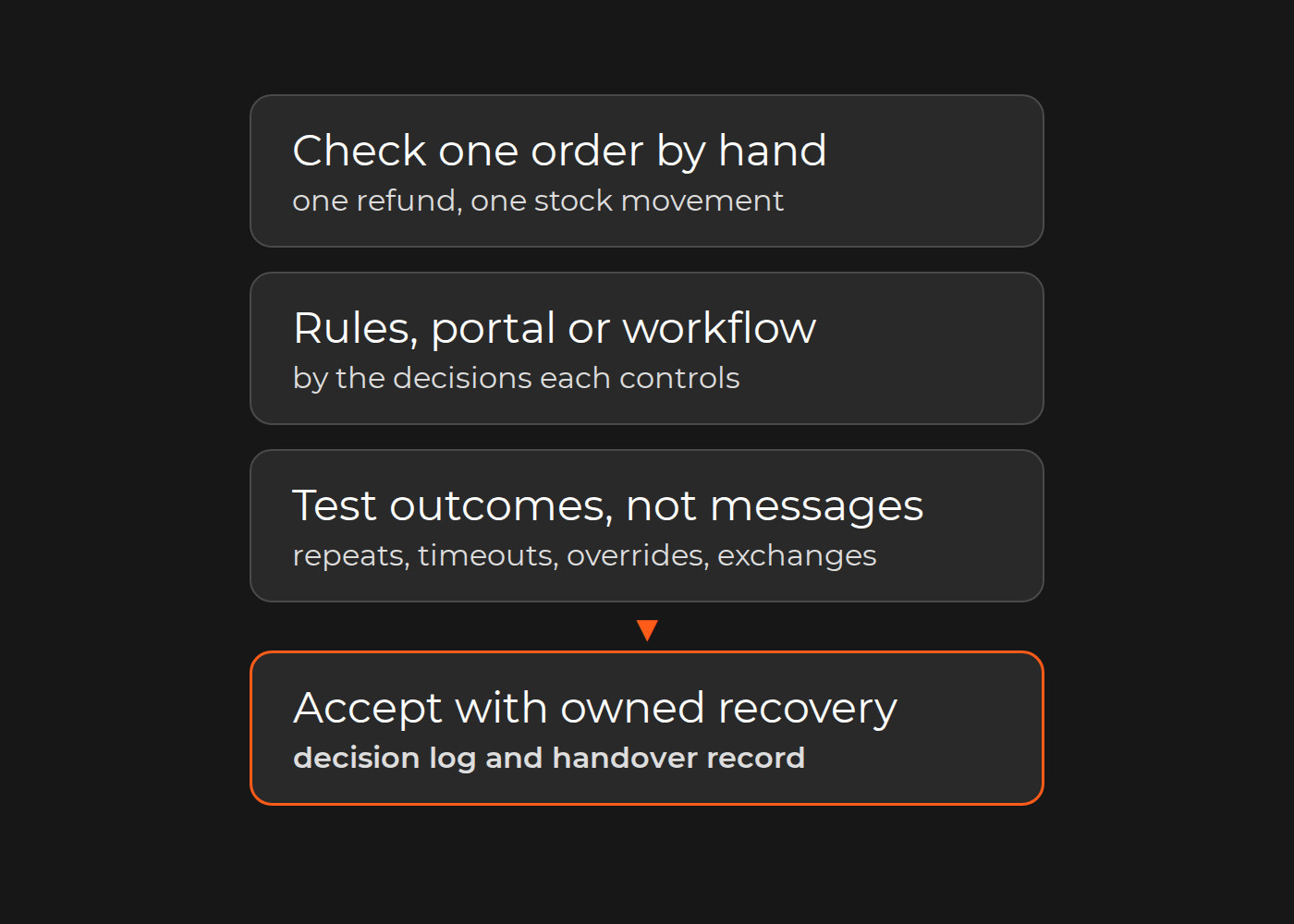
Start with one order your returns lead and finance controller can check by hand. The example is illustrative, not a client result: order O-200 was paid EUR100 for two lines, A at EUR60 and B at EUR40. The customer returns line B, and inspection accepts it.
Step
Event
Refund record
Remaining paid balance
Stock
1
Order O-200 paid
None
EUR100
Both lines shipped
2
Return RMA-7 registered for line B
None yet; nothing approved
EUR100
One unit of B expected
3
Warehouse receipt event evt-31; inspector accepts the unit
Refund operation REF-7 approved for EUR40
EUR100
One unit of B received with the inspected disposition
4
Payment provider confirms REF-7
REF-7 succeeded, EUR40
EUR60
Unchanged
5
The same evt-31 arrives again
Matched to RMA-7; no new refund
EUR60
No second movement
6
A support operator presses “refund” on RMA-7, creating a new request ID
Matched to REF-7, already succeeded; request refused with a link to it
EUR60
Unchanged
The end state is the acceptance test: one EUR40 refund, a remaining paid balance of EUR60, one stock movement for line B, and an inspection decision linked to a named inspector and policy version. Reject the build if the ledger shows EUR80 refunded, a balance of EUR20, a second unit in stock, or a refund nobody can attribute.
Illustrative workflow for order O-200: the repeated event is matched to the existing refund operation, and a payment dispute is handled on its own track.
Then run the same logic against the cases that usually break it. Every value below is a proposed teaching example to adapt with your approvers; none has been executed against a client system or payment account.
Case and starting state
Action
Expected result
Reject if
Evidence
Pass/fail owner
Partial return: O-200, line B accepted
Run the normal flow
One EUR40 refund; EUR60 balance; one stock movement
Full-order refund or a refund before the required inspection
Refund ID, provider status, movement ID, inspector
Finance controller
Repeated event
Deliver evt-31 or the provider's refund notification twice
No new refund or movement; log shows the duplicate matched
A second refund or a second stock unit
Processing log with event ID and operation ID
Technical owner
Same operation, new IDs
Warehouse resends with a new event ID; support and automation act at once
Both matched to REF-7
Two refunds drawing on one entitlement
Operation reference on every attempt
Finance controller
Unknown outcome
The refund call times out
No new refund until REF-7's status is retrieved; case has an owner
A fresh refund created with a new retry key
Retry key, provider lookup, owner
Payment owner
Exchange
Customer swaps line B for another size
One replacement reserved and shipped; no refund unless a price difference applies
Replacement and refund both issued
Reservation, shipment, any price-difference payment
Warehouse and finance
Gift card in the tender
O-200 paid EUR70 by card and EUR30 by gift card
Refund split as the approved policy says, once
Whole EUR40 to the card by default, or gift-card value reissued twice
Tender split, gift-card ledger entry
Finance controller
Partial shipment
Line B never shipped; customer cancels it
Treated as a cancellation: one refund, no receipt or inspection expected
Stock receipt expected for goods never sent; refund paid by both cancellation and return
Fulfilment record, cancellation ID
Warehouse owner
Manual override
Support approves a goodwill refund outside policy
One refund within the delegated limit, with approver and reason
Override without an approver, or override plus the automated refund
Decision log entry
Returns operations lead
Open payment dispute
A chargeback is opened while RMA-7 is in progress
The refund decision checks the dispute; the dispute follows its own deadline
Refund issued and the dispute also lost, so the customer is paid twice
Dispute ID, deadline, refund link
Payment owner
Bring these inputs to the test: order and payment IDs, line-level partial returns, inspection decisions, the stock policy for each disposition, and the support permissions that say who may refund, override or exchange. Two limits apply throughout. A customer photo is evidence input, not conclusive proof of condition. Issuing a refund does not automatically close a payment dispute.
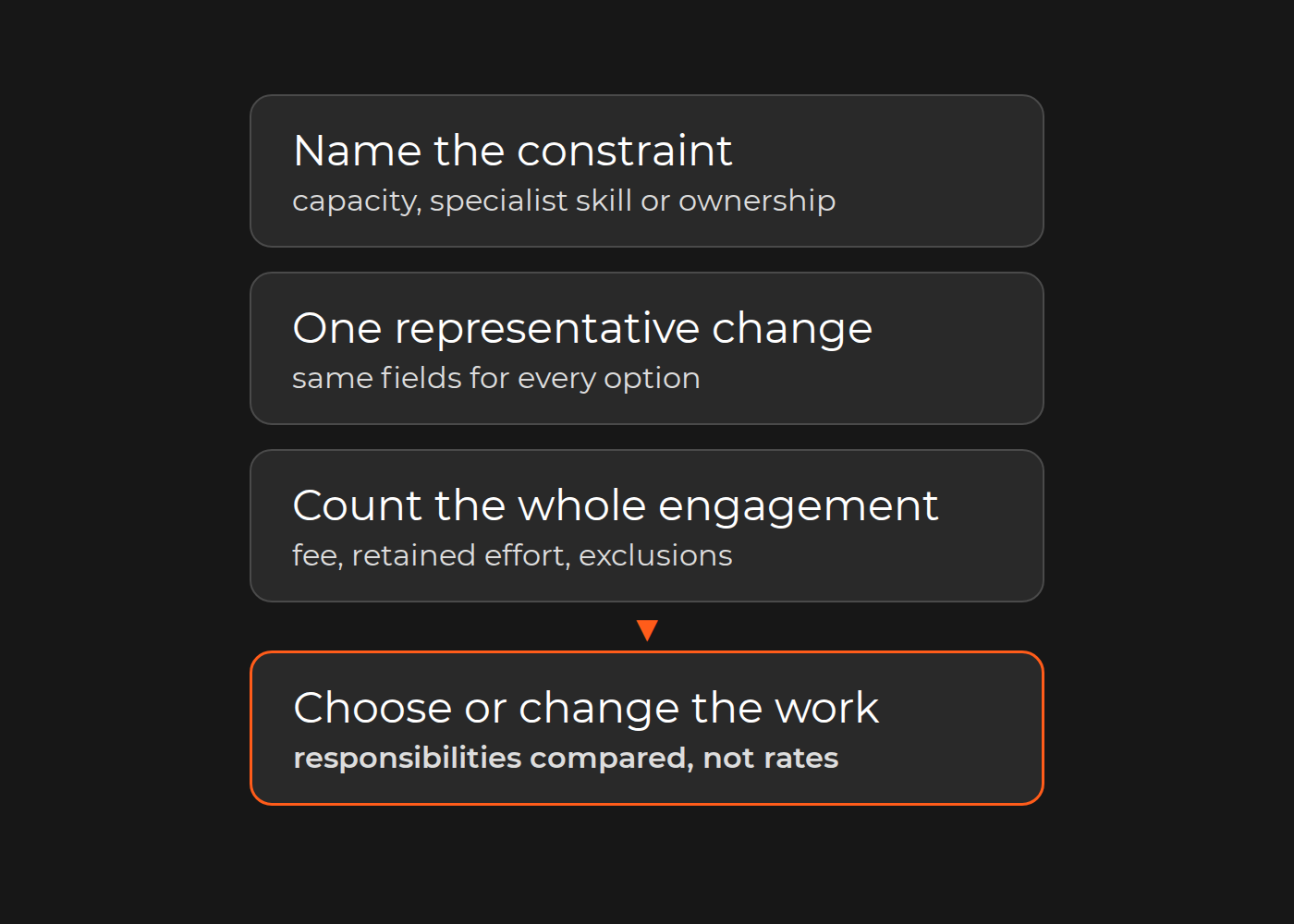
Return rules, a returns portal or workflow automation?
Duplicate refunds do not always need software. Compare the options by the refund and inspection decisions they actually control.
Option
Fits when
Hard constraint
Operating owner
Disqualifying condition
Change policy and permissions
Duplicates come from people: two operators, unclear authority, no refund reference on the case
Your systems already record one refund ID per return
Returns operations lead
Duplicates arise from repeated system events, not people
Returns portal or app as installed
Intake is manual and the portal's refund and stock actions pass the cases above
Supported platform, payment and warehouse connections
Returns operations with the vendor
It cannot show one refund per operation for repeated events or your exceptions
Workflow automation or custom integration
A specific boundary, such as warehouse receipt, ERP, payment provider or gift-card ledger, is not covered
Operation identity and reconciliation must be built and owned
Technical owner with finance
Nobody will own reconciliation and the exception queue after handover
Within any option, compare the resolutions themselves (inspection first, exchange, store credit or refund) by item condition, return logistics cost, who may authorise each one and how it reconciles in the ledger.
Manual intake is a common reason to buy a portal. In Loop's published case study on Tortuga, customers had to contact support agents to start a return, which took agents' time, and the team wanted to automate that intake; the case also describes using return-reason data to plan a contrasting product. It is the supplier's own case, not a Dinarys project, and it does not describe refund permissions, duplicate-refund controls or a change in return rates. A faster intake still has to pass the acceptance cases above.
Who owns the correct financial and warehouse outcome?
Ask the proposed partner to walk one return through the commerce platform, returns product, warehouse management system (WMS), payment service provider (PSP), and finance records. The delivery lead coordinates the demonstration; the merchant's approvers decide whether the outcomes are correct.
Approver
What they must be able to accept
Evidence to inspect
Operations sponsor
The bounded customer journey, exception ownership, and customer updates
Scope, case states, decision log, escalation and handover procedure
Finance/payment owner
Authorized compensation, prior compensation, payment outcomes, and reconciliation
Item-level approval, all linked compensation references, provider records, finance mapping
Warehouse/fulfillment owner
Received quantity, inspected disposition, stock movements, and replacement obligations
Receipt and inspection references, movement records, reservation and fulfillment records
Technical/access owner
Supported versions, authenticated events, permissions, retries, recovery, and monitoring
Version inventory, entitlement tests, operation references, failure/replay evidence
Policy owner, with legal/tax specialists where needed
Applicable eligibility, calculation rules, exceptions, and customer-rights requirements
Approved policy version and delegated-authority matrix
Replace role labels with named people and backups in the project agreement. One person may hold several roles, but a developer's “done” cannot substitute for finance or warehouse acceptance.
Ask for integration experience that matches the reconciliation problem. Dinarys' public Prostor case, a Magento 2 migration with a custom ERP API layer, describes ERP data synchronization that relied on manual reconciliation of inconsistencies in early sprints and later added a validation layer. That is adjacent commerce-integration evidence, not proof of an end-to-end returns rollout. Request evidence matched to the actual work being commissioned.
Freeze a scope the approvers can actually test
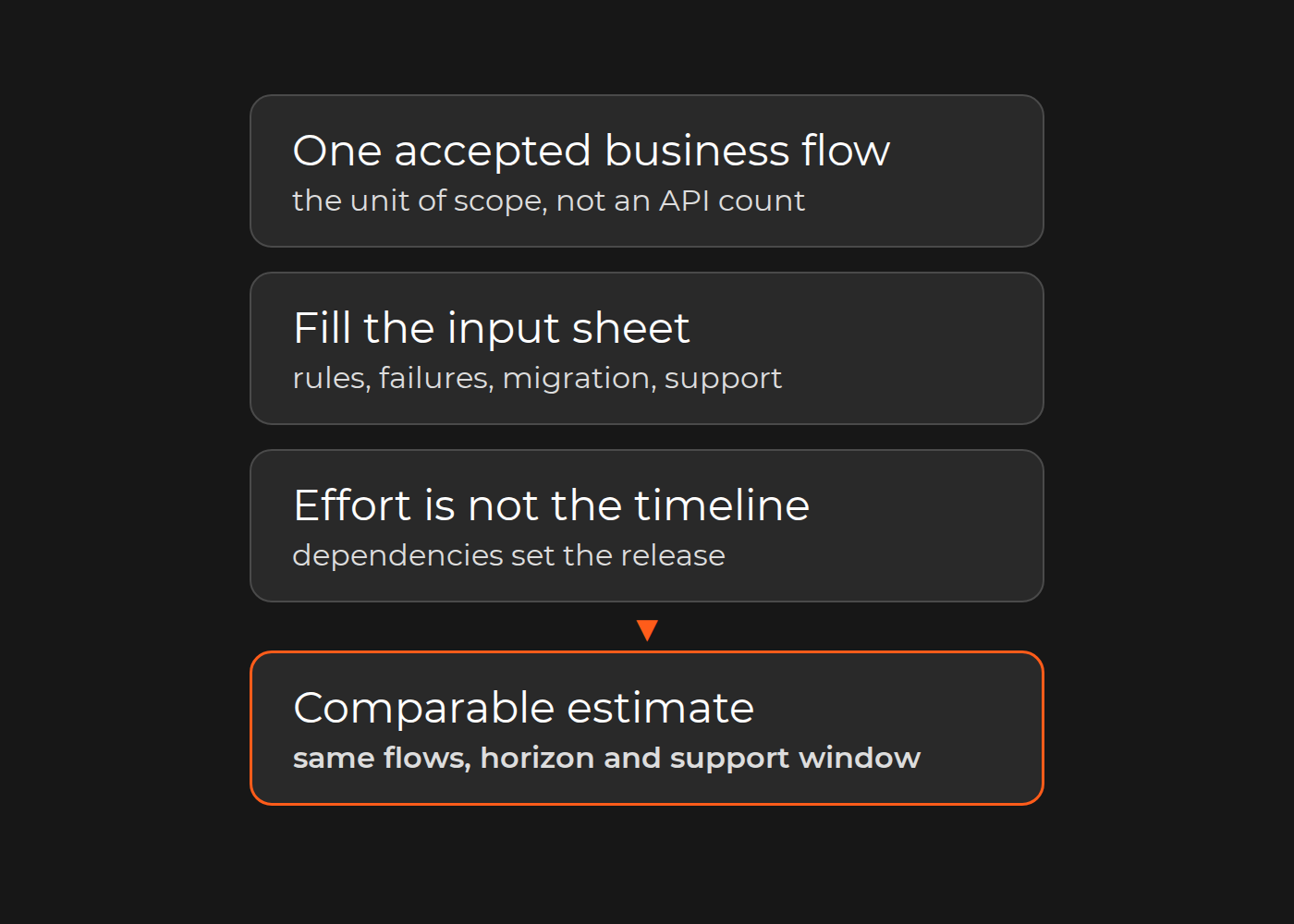
Define the category, market, sales channel, warehouse route, currency, payment methods, and included resolutions. Identify the authoritative source for policy, item entitlement, inspected condition, available stock, refund outcome, and finance reconciliation.
Record the installed platform, app, connector, API, webhook-payload, and SDK versions, plus actual permissions. Those facts are unknown until checked. Do not infer them from a vendor's current documentation or the name of an installed product.
Start with the sufficient native or installed workflow. If the incumbent product and team can meet the acceptance matrix, a replacement platform is not a prerequisite. Commission only the uncovered process or integration boundary. Expanding to other markets, warehouses, payment methods, or risk models requires a new scope decision.
How to accept the result: test outcomes, not message counts
The acceptance cases above are the summary. The walkthroughs below are harder fictional fixtures the same matrix has to survive: prior compensation, unknown provider outcomes, early refunds and exchanges. They are proposed expected outcomes to adapt and approve, not a production algorithm or security certification. They are separate fixtures priced in US dollars, so their amounts do not continue the EUR example above.
Keep three identities separate:
Event identity: which message delivery is this? Repeating the same event ID should not repeat the effect.
Business-operation identity: which approved refund, receipt, stock movement, or replacement action does it describe? Different event IDs can still refer to the same operation.
Provider request identity: which retry key and provider reference belong to that particular outgoing request? A new key is not new business authority.
These identities serve different purposes; a new request key does not create new business authority.
One return can legitimately require multiple partial refunds or separate exchange-payment legs. Do not deduplicate everything by order ID or return ID and suppress a valid later action. Conversely, two requests with different IDs must not consume the same entitlement twice. Require the partner to demonstrate coordinated updates when automated workers and authorized people act concurrently; a check performed before both submit is not sufficient evidence of coordination.
Different event IDs can converge on one authorized business operation. Reconcile the financial outcome, the physical disposition, and the replacement obligation separately before closing the case.
Count authorized effects, not successful messages. A replacement obligation and expected returned goods can remain open after a refund succeeds.
Walkthrough 1: a partial return with prior compensation
Use a resettable fictional fixture: order O-100 has two units of line A at $50 each and one retained unit of line B at $50. The original charge is $150 USD. One unit of A is returning. For this exercise only, the approved total compensation for that unit is $50; a completed $10 correction already counts toward it. There are no taxes, shipping adjustments, credits, disputes, or replacements in this fixture. Required inspection must confirm the unit before the remaining $40 refund is authorized.
Ask the team to demonstrate these variations against the same approved facts:
Scenario
Expected financial result
Expected physical result and evidence
Receipt and accepted inspection arrive normally
One additional $40 provider-confirmed refund; $50 total compensation for that unit
One accepted unit enters saleable stock once at the specified location; receipt, grade, and movement linked
The same receipt or refund event repeats
No additional compensation
No second stock movement; retained processing and operation references explain why
Different event IDs describe the same approved operation
Still no additional compensation
Still one movement for that business action—not one per event ID
Inspection notification arrives before a delayed receipt notification
No refund solely because of message order; establish authoritative prerequisites, then at most the approved $40
No regression from inspected to merely received; no duplicate movement
Support and automation attempt the remaining refund concurrently
One authorized $40 operation, not two
Physical records unchanged by the payment race; both operator and automation histories link to the resolution
Another distinct, approved return later covers the second unit of A
Its separate approved entitlement remains available
Its own receipt and disposition are required; order-level deduplication must not erase it
Reconcile the item approval, the earlier $10, the new refund reference and status, and the stock movement. The other two retained units stay unchanged in the first five scenarios. A $150 payment-level ceiling would not prove that this particular unit received the right compensation. Stripe permits multiple refunds up to the original charge amount; the merchant still needs the correct item-level authority.
Add an inspection correction after the refund has completed. The expected response is an owned discrepancy review and an authorized stock correction where justified—not an automatic second refund, clawback, or deletion of the original grade. Preserve the old and corrected evidence.
Walkthrough 2: a timeout is an unknown outcome, not a failed refund
In a separate fictional no-return case, support approves a $12 correction on an $80 item. The customer keeps it. Receipt, inspection, and stock recovery are NOT APPLICABLE, not UNKNOWN or overdue.
The request times out. A legitimate second operator must be able to investigate within their permissions without creating another refund. Preserve the operation reference, request parameters, first-attempt time, retry key, and available provider identifiers. Retrieve or reconcile the existing operation before authorizing any replacement request.
For a concrete provider constraint, Stripe's API v1 documentation says keys are retained for at least 24 hours and may be removed afterward; reusing a pruned key can create a new request. It compares parameters and returns the saved result after execution begins, including cached 500 responses. Its error-handling guidance limits retries of an unresolved operation to the first 24 hours, with the same key and parameters. After that, stop retrying and reconcile; do not try either an old or a fresh key while the outcome remains unknown.
These are API v1 constraints, not a promise about every Stripe API family or other PSP. Freeze the actual endpoint, API/SDK versions, retry behavior, and provider account context in the acceptance record. Persist business-operation evidence for the agreed audit/recovery period independently of the provider's retry-key cache. The same recovery boundary applies when software initiates a charge; see agentic payments readiness for the payment-side controls.
Test separate outcomes rather than treating all errors alike:
Request acknowledged; refund pending: record the provider refund ID and pending state. Keep the obligation open; do not submit another refund to make the screen look complete.
Provider reports succeeded: reconcile the exact amount, currency, payment reference, and finance entry. Provider success is not independent proof that a customer has seen a bank-statement credit.
Provider reports failed: retain the failed operation and failure evidence. Finance/payment operations own an approved recovery route and customer update; a failed refund is not a successful resolution or automatic permission to issue another payment.
Timeout or server error; outcome unknown: stop a new operation, use supported recovery, and escalate if authoritative evidence remains unavailable.
Stripe's Refund object distinguishes pending, requires_action, succeeded, failed, and canceled. Your acceptance record needs the actual provider state, not just “API call successful.” Payment methods with dispute or double-credit risks need their own reviewed scenarios before inclusion.
Walkthrough 3: early refunds and exchanges leave obligations behind
Early refund, goods still expected. In a fictional early-resolution fixture, an authorized $50 refund may precede receipt. Accept the payment leg only within that explicit delegation. Keep receipt and inspection open, with no saleable-stock increase before the required evidence. If goods do not arrive or differ from the request, assign a time-bounded review and customer update under the approved policy; do not automatically charge the customer again. This is not a no-return case.
Exchange, replacement available. A separate fixture exchanges an accepted $50 original for an agreed $60 replacement, with no tax, shipping, or other price adjustments in this example. Its proposed rules require a confirmed stock reservation and a confirmed $10 additional payment before release. Demonstrate the original's disposition, the replacement obligation, reservation, payment leg, and one fulfillment release. A repeated event must not reserve or ship another replacement. These are fictional policy gates, not defaults asserted for any platform.
Exchange, stock unavailable or payment unresolved. Do not silently mark the exchange fulfilled, ship a substitute, issue both a replacement and a full refund, or convert the customer's choice to credit. Keep the obligation visible. The fulfillment owner checks the reservation; the returns owner obtains an authorized customer choice. If the customer chooses a refund, close or cancel the unreleased replacement commitment under the approved process before executing that resolution. If an additional payment was already collected, finance must account for that leg too. Add that variation to your acceptance cases.
Check policy, access, and human control without inventing authority
The matrix proposes entitlement and approval tests, not a return policy. The merchant's policy, legal obligations, tax treatment, and delegated limits remain decisions for the relevant owners. Missing applicable inspection evidence should route the disputed action to review; it must not become a permanent refusal or a fabricated zero-value result.
Control scenarios must follow the approved policy
Every review stop needs the affected action, named owner and backup, due time, customer communication, escalation, and evidence required for release. A technical outage cannot create an indefinite hold on customer rights. Independent authorized receiving work may continue while a disputed payment action is paused.
Test legitimate access as well as unauthorized attempts
Agree an entitlement matrix for customer self-service, support operators, warehouse staff, finance, administrators, and integration services. Then test both permitted and forbidden operations on synthetic records.
An unrelated, unentitled customer must not read or change another customer's return. But “a different account” is not automatically an attacker: an authorized second support operator, delegated B2B buyer, or approved service account may legitimately act on the same case. Validate the relationship, role, merchant/tenant boundary, and action authority—not just whether the login matches the first actor. A warehouse role may record an inspection without being entitled to issue refunds or edit policy.
For event inputs, test invalid signatures, altered bodies, wrong environment/account context, and stale signed deliveries under the installed provider's rules. Stripe documents duplicate deliveries, unordered events, and signature/replay checks. A legitimate provider redelivery can carry a fresh signature, so authenticity and business-level duplicate protection are separate checks. Test authorized recovery replays too; never disable authenticity checks merely to replay a queue.
Use synthetic fixtures first, then only permitted, minimized records for any agreed merchant validation. Document who can access personally identifiable information (PII), which fields are necessary, what is redacted from logs, and the approved retention/deletion and audit-access periods. Do not put card details, credentials, full customer messages, or unnecessary customer identifiers into test fixtures, logs or retry keys.
A reviewer must be able to change a decision safely
Demonstrate an authorized reviewer correcting an unsupported reason or disputed condition while preserving the original evidence, policy version, prior decision, rationale, and resulting authorized actions. Separate permission to change policy from permission to approve an exception or execute compensation. A policy change needs an effective-date basis, approval, affected-scenario reruns, and an explicit decision about open cases—not an unrecorded retroactive rewrite.
If AI assistance is included, keep it to a separately evaluated suggestion or summary using permitted data. Treat customer text as evidence, not instructions. No LLM may move money, adjudicate fraud, or acquire action authority from a note. Test that an incorrect risk flag can be reviewed and overridden by the authorized person, without creating an additional financial or stock action. Record legitimate cases delayed, complaints, overrides, and review effort; a risk score is not a fraud finding or a saving.
Agree the finance baseline and hand over control
Handover evidence is scoped to the executed scenarios and agreed exclusions.
Have finance approve the comparison before claiming improvement
Acceptance should establish that the workflow records the agreed cost and outcome measures correctly. It does not, by itself, demonstrate lower costs or better margin.
Finance should approve the cohort, observation cutoff, open-case count, currency, cost inclusions, labor valuation, and inventory-recovery basis. Include inspection, support, exception review, reconciliation, software, and integration operation where relevant. Keep refund principal, operating cost, supported recovered value, and payment timing distinct; do not count the same refund or stock adjustment twice.
Agree the correctness criteria, reconciliation tolerances, observation window, and handling of unresolved cases before the pilot. Unknown recovery value remains unknown; physical evidence for a confirmed no-return case remains not applicable. Released staff time is not automatically payroll savings. A synthetic walkthrough can validate a calculation or event linkage, not establish a measured ROI, a project budget, or a delivery timeline.
Accept the matrix, decision log, and recovery procedure together
For each executed row, retain the fixture/version, input sequence, observed financial and physical effects, authoritative references, exceptions, reviewer, and result. A simulated provider outcome proves only that simulated path; merchant sandbox and any separately authorized operational validation need their own evidence and limits.
Record unresolved scope and authority choices in the decision log. A technical assumption is not merchant approval. The sponsor should reject a blanket signoff while required versions, access, policy decisions, or recovery owners are unknown; narrow the release scope or resolve the blocker instead.
Before operational handover, require:
A matched resolution record: approved compensation, provider outcome, original-item disposition, and replacement obligations linked and reconciled—or explicitly open with an owner.
A rehearsed stop-and-recover procedure: pause the affected automation, preserve evidence, reconcile in-flight work, coordinate manual action, and resume only under named authority. Code rollback does not undo completed refunds, stock movements, or shipped replacements.
Operational ownership: alerts, reconciliation frequency, review deadlines, support escalation, permitted recovery/replay window, audit access, and change approval assigned to named people and backups.
A bounded acceptance record: executed scenarios and evidence, exclusions, unresolved defects, agreed release conditions, and the approvers' decisions. No broader guarantee inferred from a passing scenario.
Choose a returns partner by reconciliation and exception ownership
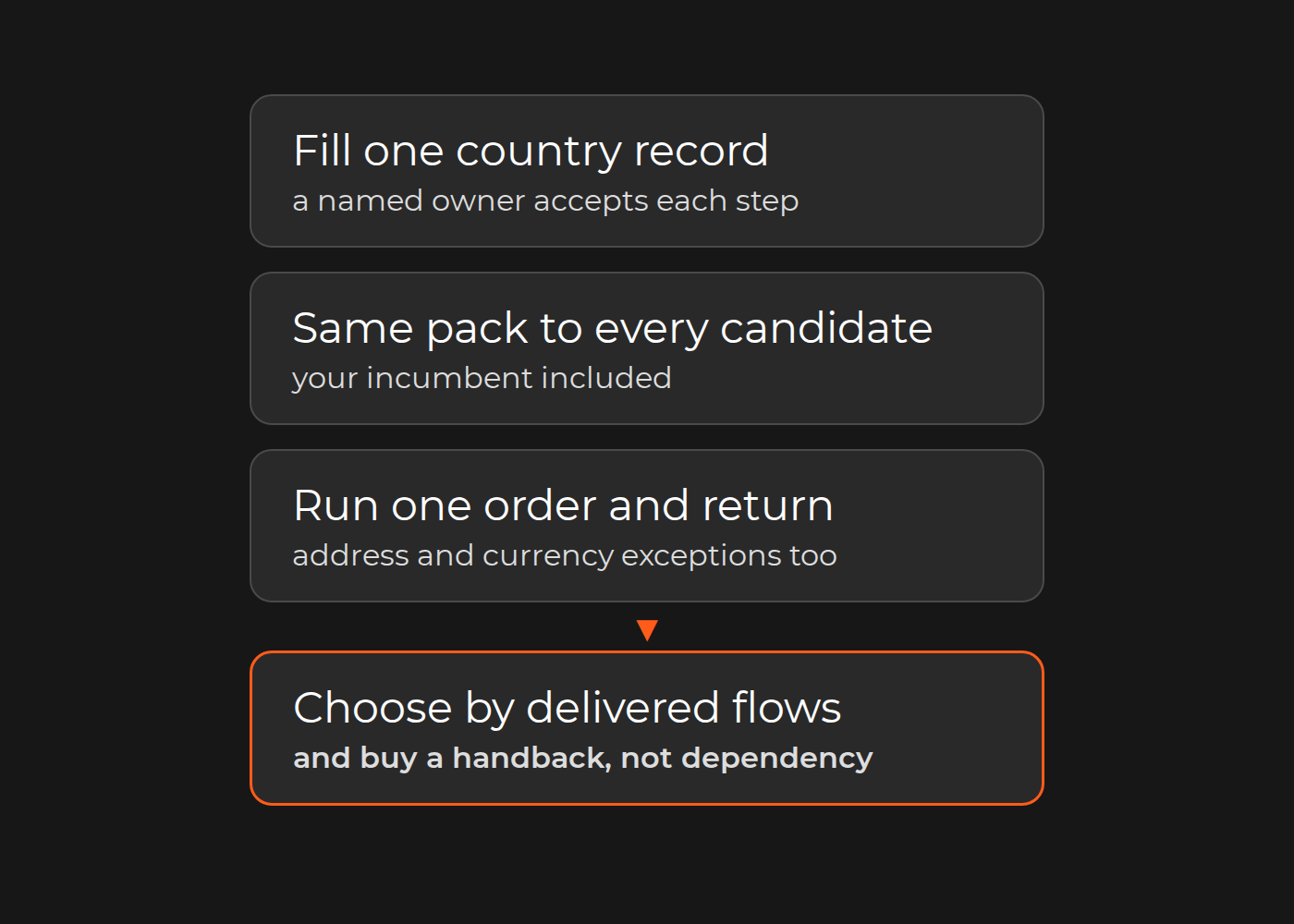
Ask each candidate partner to run the acceptance cases above in a sandbox with your approvers present, starting with the repeated event, the timeout and the manual override. Then ask who owns the exception queue and the routine reconciliation after handover, and what their own contribution was in any case they cite. Record each claim with its source, the partner's contribution, how the result was defined, its limit and its date. A portal demo, a list of connectors or a headline metric does not answer those questions. Where the return flow also writes to an ERP, see how Dinarys approaches ERP integration.
For that session, bring an anonymized workflow, approved policy and compensation examples, system/version inventory, permitted event samples, and the named operations, finance, warehouse, and technical approvers.
If Dinarys is that partner, its proposed role is the integration and acceptance work this page describes: facilitating the walkthrough with your approvers, building the integration boundary the installed workflow does not cover, keeping the decision log, and preparing the handover record with the stop-and-recover procedure. Your operations, finance, and warehouse approvers keep the acceptance decisions. Contact Dinarys to agree the process scope, input evidence, acceptance responsibilities, and exclusions. Share detailed records only after access and data-use permissions are agreed.
First practical check: replay the repeated-event case on a sandbox copy of an order like O-200. It passes only if it ends with one correct refund, the expected stock state and an attributable decision.
The buying decision is not who promises that duplicates can never happen. It is who will make the scoped outcome demonstrable—and leave your team able to control what happens when it is not yet known.