The order looked profitable when it shipped. Then came the return label, inspection, support contacts, a refund, and an item that could no longer be sold as new. Which part actually erased the contribution—and which part is still unresolved?
Can returns, refunds and payment disputes stay consistent without duplicate payments or lost margin? Yes, but only if you stop treating “returns cost” as one number. Returns leak margin in three places: the policy (what you agree to refund or exchange), inspection (what actually came back and in what condition) and payment coordination (refunds, store credit and chargebacks recorded once and reconciled). Separate avoidable product problems, which need a product or content fix, from mistakes in refund execution, which need a process or systems fix.
For an ecommerce or operations leader working with finance, the first decision is not which returns platform to buy. It is which category and return process deserve a closer baseline diagnosis. A high return rate alone cannot answer that question. Neither can a report that treats every refunded dollar as an additional operating expense.
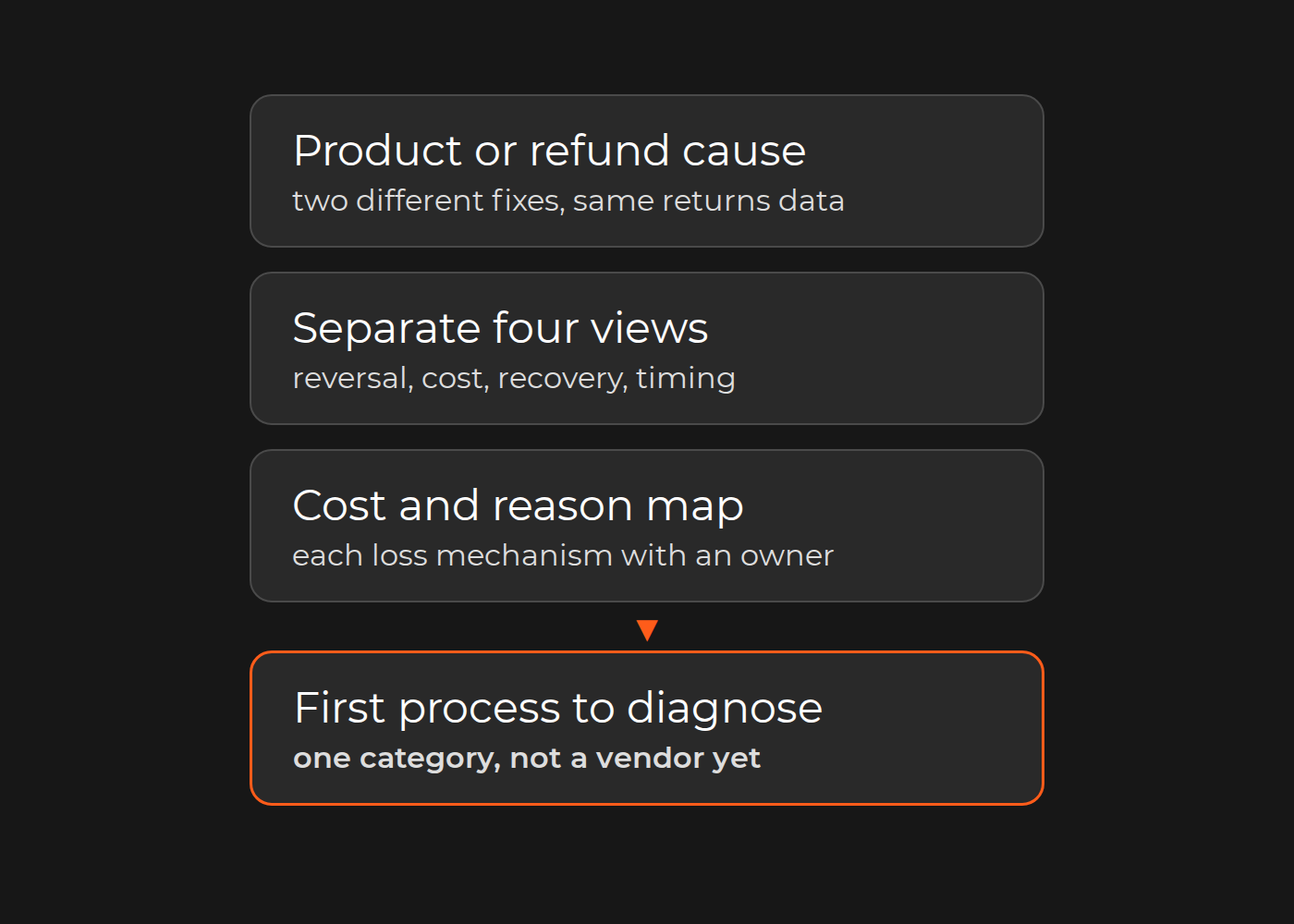
Start with a return-cost and reason map linking the order item, physical goods, authorized compensation, and payment-provider outcome. Keep four things separate: revenue reversed, work performed, inventory value recovered, and settlement timing. That separation makes the next operational decision more defensible.
Where returns create costs—and where refunds go wrong
Two different fixes: the product or the refund
A real operating example shows why the split matters. Loop's Tortuga case study describes a backpack brand whose customers originally had to contact support agents to start a return, which took agent time away from other customer questions. After moving to a self-service returns workflow, the team also analysed customers' return reasons and used them in product development: some customers found the flagship travel backpack too technical, so the brand designed a lighter, cheaper contrasting product. That is a supplier-reported case. It does not report a measured return-rate reduction, and it is not Dinarys work. What it illustrates is the distinction this diagnosis depends on: faster refunds address the handling burden, while a recurring return reason may need a product change.
The same returns data can therefore lead to two different decisions. A filled problem-to-decision note for each, using fictional cases:
Field
Product cause
Refund execution
Symptom
One jacket model returned repeatedly with the reason “heavier than expected”
A returned $100 item on a $160 order received two refunds, $60 and $50
Affected user
Customers choosing between models
Finance and the payment owner
Business consequence
Shipping, handling and lower recovery value on a recurring reason
$10 paid above the approved entitlement, plus investigation time
Evidence
Original reason text by SKU/variant, inspected condition
Approved entitlement, both refund IDs, provider outcomes
Accountable owner
Category or product owner
Finance/payment owner with the returns owner
Next decision
Change product content, sizing guidance or the range
Find where the second refund was triggered and stop it recurring
The refund-execution case is worked through in detail below. A faster returns portal would help neither: it would not change the product, and it could repeat the wrong refund more quickly.
What you observe and what it may mean
A legitimate refund is not automatically an error. A return can be processed correctly and still be expensive. Conversely, an inexpensive return can expose a serious compensation mismatch.
Look for the mechanism behind the symptom:
What you observe
Possible loss mechanism to investigate
Evidence that could distinguish it
More return-shipping spend
More parcels, costly routes, or repeated labels
Carrier invoice lines linked to returns; used, voided, and credited labels distinguished
Items sit after receipt
Inspection, grading, or restocking handoffs remain unresolved
Receipt, inspection, disposition, and available-stock timestamps
Customers contact support repeatedly
The customer message and the known physical/payment states disagree
Contact records linked to the same return and refund references
Compensation exceeds the approved amount
Wrong quantity, discount allocation, duplicated compensation, or an authorized exception
Approved entitlement and exception record compared with all payment and credit records
Reported stock recovery looks unusually strong
Receipt was mistaken for saleability, or the recovered value lacks support
Inspection evidence, disposition, stock movement, and finance-approved value basis
Refunds remain open
Provider processing, failed refunds, missing reconciliation, or internal approval delay
Separate approval, submission, provider-status, and reconciliation records
A chargeback arrives on an order that was already partly refunded
The dispute and the refund are handled by different people or systems
Refund IDs and amounts, dispute ID, disputed amount, reason and response deadline
These are hypotheses, not findings. A repeated event in a system log is not proof of a second payment. A returned item in a warehouse is not proof that it is sellable. A risk flag is not proof of fraud.
Separate four views of the same return
Diagnostic views, not additive loss categories; a pending refund is not another principal amount to subtract.
1. Commercial reversal. Record what was sold after discounts and what was authorized for refund or other compensation. Separate merchandise, customer-paid shipping, and other components. Finance determines revenue, tax, and accounting treatment; the diagnostic map does not create that policy.
2. Operational cost. Record the actual carrier charges, handling, inspection, reconditioning, support work, and nonreturned fees relevant to the chosen scope. Distinguish incremental spending from allocated staff time. Time released is not automatically a payroll saving.
3. Inventory recovery. Record what came back, its inspected condition, final disposition, and supported recoverable value. Recovery value is not the original retail price or a guaranteed future resale. Keep estimates separate from confirmed amounts.
4. Payment timing and reconciliation. Approval, provider submission, provider outcome, and customer receipt are not interchangeable milestones. A pending refund is an unresolved obligation and service issue—not, by itself, another margin-loss amount to add to the refund principal.
For example, Stripe documents pending and failed refund states, including card refunds held pending when the available balance is insufficient. Use the actual provider state and payment method; do not apply one generic refund timeline to every customer.
Payment disputes need their own record. Issuing a refund does not automatically close a dispute, and a dispute does not wait for your returns process. Stripe's description of how disputes work notes that the disputed amount can differ from the original payment—for example when only one damaged item is disputed, or when a customer disputes the full amount of a payment that was already partly refunded. It also states that, while a dispute is open, a refund cannot be issued outside the dispute process, and that the response window is usually 7 to 21 days depending on the card network. Keep the paid, refunded and disputed amounts separate on the order line, and give the dispute deadline an owner. A customer photo submitted with a return is evidence to assess, not conclusive proof of the item's condition.
What data do you need to check the problem?
Baseline-design requirements; unknown applicable evidence stays unresolved, and the article’s economics examples are fictional, not accounting policy or measured losses.
Choose one category, market, channel, and return route first—for example, warehouse-received apparel returns from the online store. Name an operations owner and a finance counterpart. Add the warehouse, support, and system owners who can explain the records; their actual responsibilities matter more than their titles.
Set a window that does not hide unfinished returns
Use simple cohort rules:
Count returns from a fixed period. Include return requests opened between explicit start and end dates, follow them to a stated cutoff, and report how many are still open at that cutoff.
Keep no-return compensation separate. Price corrections and other cases with no goods coming back form their own group, dated by when the case or ticket was opened—not by the later refund date. Link each one to the affected order line.
Compare returns with the sales they came from. For a return rate, count returned units from items sold in a defined period, observed to a stated cutoff. Do not divide this month's return requests by this month's unrelated sales.
Record each case's type, inclusion date and source. Mark the physical-return fields (return ID, receipt, inspection, disposition, recovery) NOT APPLICABLE when no goods are due back; that is different from UNKNOWN evidence for an expected return. If a case has no reliable inclusion date, keep it on a separate list for reconciliation rather than dropping it or inventing a date.
Choose the follow-up period from your policy and observed completion pattern, not an assumed industry duration. A fictional exercise might follow requests opened September 1–30 through October 29. That date range is an illustration, not a recommended completion time or a claim that all September cases should be closed.
If a full permitted extract is unavailable, use a bounded sample. Record how it was selected, its size, exclusions, and coverage of ordinary and exception paths. A selection of complaints can explain failure mechanisms; it cannot establish the overall error rate. Keep older open cases visible in a separate backlog view so the cohort does not conceal them.
Connect identities before calculating averages
At minimum, request:
Records
Fields to connect
Owner to confirm
Case and cohort inclusion
Source case/ticket ID, case type, affected order line, inclusion event and timestamp/timezone, source reference
Operations with finance
Sale and entitlement
Order ID, order-line ID, SKU/variant, quantity, currency, discounted line value, prior returns, applicable policy version
Ecommerce with finance
Return request, where applicable
Return and return-line IDs, requested quantity, original reason, channel, request date; NOT APPLICABLE for confirmed no-return cases
Returns operations
Physical recovery, where applicable
Parcel/receipt reference, location, inspected quantity and condition, condition source (customer photo, carrier note or warehouse inspection), disposition, stock-movement reference, recovery value and basis; NOT APPLICABLE for confirmed no-return cases
Warehouse with finance
Compensation
Approved amount and components, approver, exception reference, refund/payment IDs, credit or exchange references, actual outcome
Dispute ID, linked payment and order lines, disputed amount, reason, response deadline, evidence submitted, outcome
Finance/payment owner
Timing
Request, approval, receipt, inspection, submission, provider update, and reconciliation timestamps as available
Each source-system owner
Use pseudonymous case references and only data you are authorized to analyze. A baseline worksheet does not need card details, full customer profiles, or unrestricted customer messages.
Avoid a common spreadsheet trap: joining three support contacts to two refund events can produce six rows and multiply both totals. Keep unique cost and payment events in a separate ledger, then allocate each event once to the relevant case or items. Document how shared parcel costs are allocated. Reconcile totals back to the source before comparing categories.
Missing applicable data deserves a count of its own: unlinked refunds, unknown disposition for an expected return, missing applicable carrier invoices, and unverified amounts. NOT APPLICABLE physical fields in a confirmed no-return case are not evidence gaps. Excluding cases with genuine missing evidence silently makes the process look cheaper and more complete than the evidence supports.
Build a return-cost and reason map with owners
Keep the customer's stated reason, the inspected condition, and the process failure as separate fields. “Too small” describes the reported experience; it does not establish whether the cause was sizing guidance, a mislabeled item, picking, or something else.
Preserve the original reason and add a normalized category for comparison. Allow “unknown” and “not yet reviewed.” For photographs or descriptions, record what is missing rather than inventing a condition or intent.
This is not just a reporting preference. Shopify's refund documentation says that a refund without a return does not record a return reason, and that the staff-facing “Reason for refund” note is not a return reason. A blank reason report can reflect the workflow used, not an absence of customer explanations.
Use a map like this to turn costs into owned questions:
Reason or process group
Cost/value to examine
Evidence needed before assigning a cause
Accountable owner and next baseline question
Fit or product expectation
Shipping, inspection, support, recovery value
Original reason, SKU/variant, relevant product information, inspected item
Ecommerce/category owner: is the pattern concentrated in a product or variant?
Wrong item or quantity
Repeat transport, handling, compensation
Ordered, picked, shipped, and received item/quantity references
Fulfillment owner: where do the records first diverge?
Finance/payment owner: is this a real excess, an approved exception, or a timing mismatch?
Unknown or unlinked
Known costs plus explicitly unresolved amounts/value
Missing IDs or evidence and a reconciliation task
Named data/process owner: which missing link prevents a reliable comparison?
Do not add every column into one “returns loss” total. The map contains overlapping views of the same events. A refund mismatch, for example, may already be included in the actual compensation amount.
A worked example: from a $52 contribution to a $30 loss
Fictional illustration, not a client case or an accounting policy. Consider one fully returned item. All amounts are USD. There is no tax, customer shipping revenue, store credit, exchange, acquisition cost, or overhead in this simplified example. The authorized $100 merchandise refund has completed. For this exercise, the inspected item has an accepted $30 recovery value on the same cost basis as its original $40 cost—not resale revenue. That $30 does not already deduct the transport or labor costs listed below.
Component
Amount
How it enters this operational bridge
Original merchandise sale, after discounts
$100
Start with the sale once
Completed merchandise refund
$100
Subtract once as the commercial reversal
Original item cost
$40
Subtract once
Supported recovered inventory value
$30
Add back once against the item cost
Original outbound fulfillment cost
$8
Subtract once
Return shipping
$7
Subtract once
Inspection labor
$3
Subtract once; fictional 6 minutes at an agreed $30/hour valuation
Support labor
$2
Subtract once; fictional 4 minutes at the same valuation
Before the return, the simplified contribution was $100 − $40 − $8 = $52.
After the return, the operational bridge is $100 − $100 − $40 + $30 − $8 − $7 − $3 − $2 = −$30.
The deterioration from the original $52 is $82: $100 reversed revenue, less $30 recovered value, plus $12 of additional return work and shipping. Of the final $30 loss, $10 is unrecovered item cost and $20 is outbound plus return-related operating cost.
Do not subtract the $100 refund again as an operating cost. Do not add a separate $10 inventory write-down on top of $40 cost less $30 recovery. Both would count the same effect twice. If an actual finance extract already includes the inventory adjustment, use that treatment instead of adding a second recovery adjustment.
This bridge explains the included economics; it is neither a cash-flow statement nor a savings forecast. The labor valuation describes consumed capacity, not a promise that eliminating those minutes will reduce payroll.
Where this example stops working
Recovery is unknown: without the $30 assumption, the result is −$60 plus an unknown recovery value. Report that unresolved component, not a confirmed $60 loss. “Not inspected” does not mean zero value.
Partial return: if a two-item order contains this $100 item and a $60 item the customer keeps, do not reverse the whole $160 sale. Match the returned quantity and approved discounted value to the correct line. Allocate shared costs once using a documented basis.
Partial refund without returned goods: a $15 price correction on a $100 sale leaves $85 of merchandise revenue in this simplified view. It does not create recovered stock or return shipping merely because the order says “refunded.”
Exchange: an even exchange may create no new cash refund, but the replacement item and its fulfillment still have economics. Link the replacement's cost, the returned item's recovery, and any price difference. Zero cash refunded does not mean zero cost. Shopify's returns and exchanges documentation explicitly distinguishes refund, additional-payment, and even-exchange outcomes.
Store credit or mixed compensation: record the credit obligation and any cash refund separately under finance's rules. Do not call issued credit retained profit, or count it again as cash already refunded.
Pending or failed refund: keep authorized compensation and actual payment outcome visible separately. Do not mark an unfinished case complete or add the pending principal as a second loss. Finance decides how the obligation appears in its reporting.
For a separate fictional refund-error example, take that $160 order with only the $100 item returned. Suppose $100 is the full approved entitlement, but two completed refunds of $60 and $50 total $110, with no other approved adjustment. The confirmed excess is $110 − $100 = $10. A payment-level ceiling alone would not catch this: $110 is still below the original $160 charge. Investigate all related compensation records. If you already use the actual $110 reversal in the economic bridge, label the $10 excess within it; do not subtract another $10 as a separate cost.
Two checks turn these examples into a test of the current process. First, if the same return or refund event is delivered twice, does the process still produce exactly one authorized refund? Second, on a partial return, do the records keep the paid, refunded and disputed amounts correct per line—for instance, $100 refunded for the returned item and $60 retained for the kept item when a customer later disputes the full $160? If the answer to either is unknown, that is a finding in itself. Detailed acceptance tests for an automation project are covered in accepting a returns automation project without duplicate refunds.
Choose the first process to diagnose—not a vendor yet
Review the baseline with finance in three passes.
First, check coverage. How many cases link sale, item, compensation, and—where applicable—return and disposition? Keep confirmed no-return cases separate from cases missing expected physical evidence. Which costs are actual, allocated, estimated, or missing? Compare like-for-like routes and currencies. Do not rank a fully observed category against a mostly uninspected one as though both totals were complete.
Second, compare dollars and mechanisms. For each process/reason group, show the case count, confirmed operating spend, supported unrecovered item value, confirmed compensation mismatches, and unresolved cases. Show refund principal separately. A high-volume, low-cost group can consume more money than a rare expensive case; examine total spend as well as cost per observed case. Use the same included costs and denominator, and label any closed-case average with its open-case count.
Confirm whether an apparent error is an approved exception before calling it leakage. Likewise, an under-refund is a customer obligation to resolve—not margin improvement. Known duplicate or incorrect payments need immediate authorized investigation; gathering a baseline is not a reason to leave them unattended.
Third, assign one bounded question. For example: “In this category's warehouse-return route, are repeated inspection touches or compensation mismatches the larger confirmed burden, and what remains unmeasured?” Choose the largest substantiated loss mechanism you can investigate with permitted data and a responsible owner. If missing recovery or refund links could change the answer, repairing that evidence gap is the first diagnosis.
Match the next action to what the evidence shows
Baseline finding
Smallest sufficient next action to consider
An isolated setting, permission, or refund bug
Current platform/provider support or the incumbent team
Clear process, but inconsistent reason capture or ownership
Manual controls, shared definitions, and an owned reconciliation routine
Repetitive steps already covered by installed tools
Where that integration boundary is the problem, Dinarys' Authentic T-Shirt Company case is an adjacent example: a new Magento 2 retail store for a branded apparel distributor, connected to its ERP for orders, refunds and stock. It shows that kind of integration scope, not a returns-cost result.
Faster processing is not the same as fewer returns or better margin. Automating an unclear rule can repeat the wrong compensation faster, obscure reason capture, or move the burden into exception review. Check correctness and total handling work before claiming a benefit. No AI model should independently issue money movements or turn a risk signal into an automatic refusal.
Pick one category and collect a permitted baseline
Start with a return-cost event ledger: one row per unique cost or payment event, recording the case, order-line and (where applicable) return-line references, event ID and date, currency, record kind (such as sale, item cost, refund, return shipping or inspection time), amount, valuation status, quantity, source reference, allocation note, owner and verification status. Keep the event ledger separate from the case/reason map so repeated contacts cannot multiply payment or shipping totals.
Bring one category and route to a joint operations–finance review with:
The cohort rules, cutoff and open-case count.
The linked references—or the explicit list of missing links.
Actual costs, supported recovery values, and confirmed mismatches, with estimates and unknowns clearly labeled.
One candidate loss mechanism, its accountable owner, and the evidence needed to confirm or reject it.
The useful outcome is a decision about which process merits diagnosis first, not a speculative ROI number. If the unresolved problem crosses commerce, warehouse, and payment systems, you can contact Dinarys with an anonymized process summary and the missing handoff. Share detailed records only after access and data-use permissions are agreed.