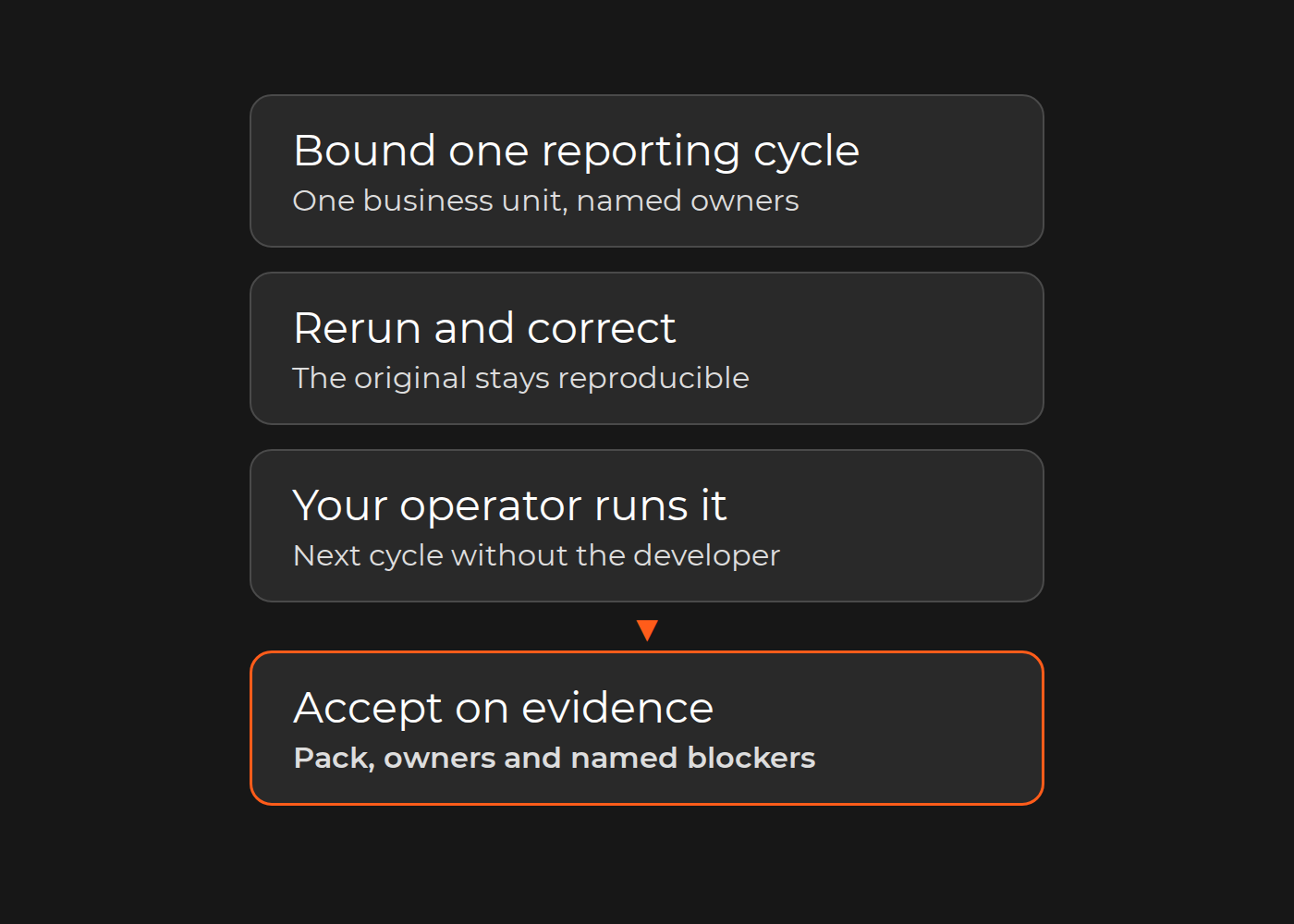
Could finance verify next month's margin report without its original Excel author or the external developer? That is a more useful commissioning question than whether the dashboard looks finished.
A profitability pipeline is ready for business acceptance when agreed calculations can be reproduced, differences explained, and an authorized operating team can run the next cycle. A successful scheduled job proves only that a job ran. Reproducible means the same retained inputs and rule version give the same result, and the original result remains reproducible after a later correction.
What you are buying: one reporting cycle with a boundary
Specify one business unit and the product/customer decisions the report supports. List included SAP or other ERP extracts, retained BW models/reports, finance adjustments, master data, currencies, periods, and outputs. Full ERP migration, an enterprise warehouse, automated pricing decisions, and unrelated reports need separate scope.
Two owners are essential: finance for the meaning of the number; BI/data operations for the flow that produces it. IT controls authorized access; commercial confirms the decision context; the authorized sponsor approves purchase and scope. The engineering partner implements and demonstrates approved behavior, not financial policy invented to fill specification gaps.
Use the iSi Group PoC to ask precise supplier questions
Dinarys' iSi Group ESG reporting PoC page presents the whole case as a proof of concept, including its pricing/margin reporting. Within that PoC, it describes data-preparation pipelines in the sales department, a pricing/margin report previously prepared manually in Excel, and a “data simulation mode” on historical data.
Those components are relevant to definition, transformation, and scenario discussions. They do not establish that iSi Group used this article's acceptance pack, that a production reporting platform or a separate multi-ERP enterprise warehouse was delivered, or that the work changed margins. Use the actual scope to ask for comparable contributions from the proposed delivery roles.
Use the following questions in a supplier discussion. Record whether each essential answer is demonstrated, described only, or unknown; a convincing description is not executed evidence.
1. Can you rerun and correct without losing the original result?
Ask for a demonstration on an authorized control fixture, not just successful job status. A strong answer shows no extra amount on an identical rerun, a traceable approved correction, and reproduction of the original report. A weak answer offers only the latest number or requires an operator to delete duplicate rows manually.
Fictional test fixture, not a client result: a November invoice has 10 individual units, €1,200 net revenue, and €780 included actual cost. Retain INV-T1-v1, COST-T1-v1, and the formula version. The expected margin is €420, or 35%. Finance then approves a €50 cost increase in ADJ-T1-v1, including its November treatment: revised cost €830, margin €370, or 30.8% rounded to one decimal place.
All amounts are EUR. No FX, tax, rebate, freight, or allocation is included in the fixture; actual treatment needs finance approval. Use this demonstration script:
Load original inputs. Locate the source line and compare it with the approved expected result.
Rerun identical input. Confirm no transaction or amount is added.
Apply the approved correction. Inspect its ID, approval, and new report version; do not silently overwrite the explanation.
Reproduce the original. Use retained inputs and rules to recover the original calculation, not a manually retyped value.
Run a price scenario separately. Label assumptions and verify accepted actual revenue/cost remain unchanged.
Record the fictional expected results for each step before the demonstration. This is a demonstration script, not executed evidence or a production import file:
Test
Fictional input
Expected result
Original load
INV-T1-v1 and COST-T1-v1
Revenue €1,200; cost €780; margin €420; 35%
Identical rerun
Same inputs and rule version
No added transaction or amount; original result unchanged
Approved correction
ADJ-T1-v1: +€50 cost; November treatment approved
New v2: cost €830; margin €370; 30.8% rounded
Reproduce original
Retained original inputs and rule version
Original v1: margin €420; 35%
Separate price scenario
Labeled hypothetical price assumption
Scenario result kept separate; accepted actual revenue and cost unchanged
Add execution references and accepting owners in your controlled test record. Add returns, FX, units, allocations, and unmapped keys if they occur in scope. Expected answers should come from accountable business owners, not the same code being tested. This fixture cannot establish whole-report completeness.
2. Who interprets the extracts and challenges unclear definitions?
Request named proposed roles and task-matched contributions: who understands the SAP/BW or other ERP extract, who owns transformation/reconciliation, and who resolves a disputed financial definition?
A strong answer separates those responsibilities and shows relevant work. Finance still approves policy. “Our team will work it out” is insufficient when neither formula nor accepting owner is known. Ask who would be available, for what allocation, and for how long; record the agreed responsibilities in the proposal. A case's historical team does not establish current availability.
3. What is handed over, and who on our side runs the next cycle?
Ask a client operator to run the cycle from the operating guide with the implementation team observing. In a nonproduction environment, include a missing input or unmapped key. The operator should find the issue, route it to an owner, and avoid presenting an incomplete report as final.
A strong handover demonstrates draft-versus-accepted status, correction authority, treatment of inputs changing after close, and recovery of the last accepted report or agreed prior state. “Rollback supported” without a procedure is a weak answer.
Put access, code/documentation locations, deployment/configuration, monitoring, support coverage, and escalation in writing. Distinguish defects from new financial requirements. Receiving documents is not the same as being able to operate the cycle.
Ask what operating evidence the team will produce after handover. For example, the case page for Dinarys' SAP BW/BI support work for iSi Group reports daily health checks, worklogs and time reports by activity, and post-incident summaries covering what happened, root cause, resolution, and prevention; it also reports 0 escalations from operational managers. That engagement is support and transition analysis, not a completed migration.
4. Which unresolved item would stop you recommending acceptance?
Ask for a concrete blocker and its resolving owner: an unexplained balance, untraceable cost, unknown input completeness, or an operator unable to recover the accepted report. A supplier that cannot name a blocker has not explained its acceptance standard.
Agree tolerances and stop conditions before testing. There is no universal acceptable margin discrepancy. A rounding difference and an unknown missing cost need different treatment; a tolerance must not hide an unexplained balance. Accepted exceptions need an authorized decision and an operating consequence, not merely a closed ticket.
What the acceptance pack must contain
The pack should let another authorized analyst reproduce the number and another operator run the cycle. Keep the underlying records, not just screenshots of totals.
Access, code/docs, training, support, known issues
Technical owner and sponsor
Each acceptance decision needs the tested version and environment, evidence reference, reviewer, date, exceptions, and disposition. “Reviewed” is not necessarily “accepted”; preserve that distinction when the report can be used for a real pricing decision.
Record the answers, then agree completion
A clear backlog can go directly to implementation estimation; investigate uncertainty blocking it. Before signing, identify demonstrated answers, unknown essentials, client dependencies, and evidence still required. For source connections, see ERP integration services.
Agree the reporting cycle with Dinarys. Bring a sanitized report definition, named finance/technical owners, system list, transformation-map excerpt, control results, and the handover gaps you need to close. Do not send extracts through the contact form; agree an authorized exchange route first.
The purchasing decision is whether the proposed team can leave you with a verifiable reporting cycle—not whether it can promise better profitability.
You may share this article
Let professionals meet your challenge
Our certified specialists will find the most optimal solution for your business.