Content
E-Commerce
Nov 19, 2026
Why ESG Data Collection Starts From Scratch Every Month
Time to read: 6 minutes

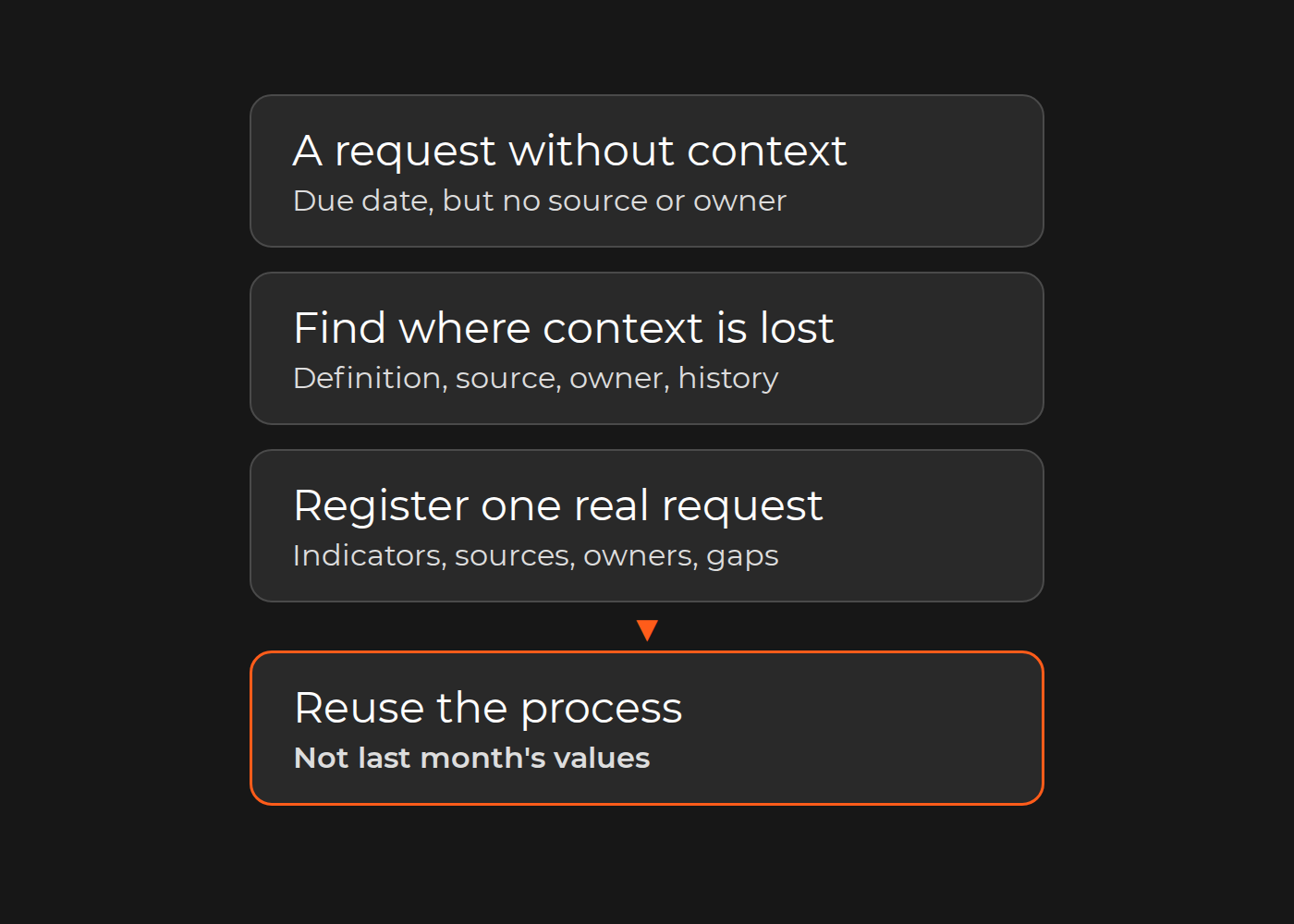
The ESG request already has a due date. Its source, unit, and accountable owner do not. Sustainability sends another questionnaire; departments collect data manually and return spreadsheets; someone reconstructs what last month's figures meant.
Look for a retained final figure without its definition, source, owner, and correction history. The next cycle starts from scratch because the collection process—not just the previous value—was never preserved.
For sustainability and finance owners at a manufacturer, a register linking indicators to sources, owners, and gaps is a useful first repair. It restores collection context; it does not replace an ESG adviser's methodology or determine legal reporting obligations.
Five places collection loses its context
Check these possible breakpoints against one real request rather than assuming they all apply. They can coexist; automating an ambiguity only makes it recur faster.
1. The request is a label, not a definition
“Energy use” does not identify facilities, period, units, boundary, or treatment of estimates. Can the owner state those details for one indicator from its approved definition, without reconstructing last month's file? Route an unclear definition to the sustainability owner or qualified adviser before collection becomes calculation.
2. The source is a person's inbox
The submitted value survives, but supporting records and extraction steps do not. Can another authorized person retrieve the record and repeat extraction? Record its locator, version, relevant identifiers, and access owner—not merely who emailed the spreadsheet.
3. The owner is implicit
The person entering a value may have no authority to approve its source or method. Name the source approver and method approver for one indicator, not only the person filling the cell. Finance/BI and operational owners establish the collection route; subject-matter owners approve what it means.
4. A corrected file loses its history
A replacement spreadsheet can erase the explanation of an earlier submission. Can the reviewer compare first and corrected versions and list changes and reasons? Keep source versions, correction reasons, and review decisions so an earlier figure remains explainable.
5. Missing data becomes a complete-looking total
A blank becomes zero, or last month's value is carried forward without an approved estimate label. Inspect blanks and carried-forward values for an explicit missing or approved-estimate status before they enter a total. Missing is not zero.
Fictional example, not client data or an ESG methodology: Facility A's meter export A-SEP-v1 records 12,000 kWh for September, pending date-range review. Facility B has no accepted September source. A's received reading is not yet an accepted subtotal; even after review, it can describe A only—not both facilities, zero consumption at B, or an emissions result.
If an estimate is allowed, record its method, approver, version, and replacement plan. Engineering preserves that status and evidence; it does not decide that August's value is a suitable substitute. Energy conversion or an emissions calculation also needs an approved basis and factors.
The collection task is now specific: obtain B's September source, confirm period/unit/boundary, and route any estimation decision to the reviewer. That is more useful than asking a department to “complete the spreadsheet.”
Build a register for one actual request
Choose a requested set with a named reviewer and response date. Ask each supplying department to identify its evidence and source owner; have the sustainability owner or adviser confirm indicator definitions. Do not begin by cataloging every ESG-related field in the company.
The fictional September request might produce this register:
| Requested input | Evidence/status | Owner and next action |
|---|---|---|
| Facility A electricity | A-SEP-v1: 12,000 kWh; received | Facilities: resolve supplier-bill date-range mismatch |
| Facility B electricity | September source missing | B data owner: obtain source; do not copy August |
| Facility A gas | G-SEP-v1: invoice in m³ | Facilities/adviser: approve conversion basis to kWh |
| Report calculation | Method definition/approval pending | Sustainability/adviser: supply approved specification |
All four example records are fictional. Replace fictional identifiers with authorized locators and confirm exact facility boundaries, periods, and units. Extend your working register with source version, evidence location, transformation rule, reviewer, correction history, and acceptance status. A register row is a tracking aid, not evidence that a source or methodology has been accepted.
For A's electricity comparison, retain the meter ID, export timestamp, and supplier bill; the reviewer must resolve the different date range before accepting the comparison. For gas, preserve received m³ rather than silently relabeling it kWh. The adviser approves conversion factors and basis. For the report calculation, engineering cannot infer a method from the requested title.
Keep evidence in an authorized repository with appropriate access; every register reader need not see confidential raw documents. A traceable locator and named access owner let a permitted reviewer retrieve the evidence without copying it into every worksheet.
The sustainability owner champions the request and approves meaning with the adviser. Source owners and finance/BI resolve evidence and access. The cycle operator preserves collection and correction steps; the authorized sponsor approves any automation or PoC boundary. A due date does not transfer those decisions to whoever can fill a cell fastest.
Reuse the process next month, not last month's values
Keep approved definitions, source locators, responsible roles, collection route, expected periods, units, checks, and evidence-retention location. At the next cycle, apply those rules to new period data. Log changes in meters, facilities, source formats, owners, and methodology before treating comparisons as like-for-like.
Measure your own time spent finding sources, correcting formats, chasing missing inputs, and reviewing definitions. Use that baseline to judge whether automation is worth assessing. Check what your existing ESG platform already collects; a controlled manual register may be enough for a small one-off request. Compare collection routes after approved sources and gaps are visible.
Where a data pipeline can help—and what the PoC shows
Dinarys' iSi Group ESG reporting PoC is a proof of concept, and that framing applies to the whole case page, including its pricing/margin report work. Within the PoC, the page describes data-preparation pipelines in the sales department and “traceable data transformations.” That is relevant when the recurring problem is collecting and preparing known data consistently.
The PoC is narrower than a production ESG platform, reporting methodology, compliance guarantee, or assurance opinion. A pipeline can preserve versions, apply approved checks, and expose missing inputs; it cannot approve an undefined indicator. Dinarys' sustainability data integration services provide a route for discussing that engineering boundary. Agree the sources, controls, and acceptance separately from methodology or assurance work.
Choose the first reporting set
Take one incoming request to sustainability, finance/BI, and its source owners. Identify what can be collected repeatedly and what still needs approval. If you need help defining the data boundary, share the request and known gaps with Dinarys: the due date, indicator list, sanitized register excerpt, source-system list, and owner/reviewer roles. Do not attach confidential evidence to the form.


Let professionals meet your challenge
Our certified specialists will find the most optimal solution for your business.