Content
E-Commerce
Nov 18, 2026
Your Dealer Network Cannot Scale With Manually Built Online Stores
Time to read: 6 minutes

Consider a dealer-launch pattern in which every store becomes a separate IT project: a developer copies the catalog, adjusts a theme, connects an order feed, and hands over another site someone must maintain. If that describes your network, the next launch will repeat work you may be able to standardize.
The scaling problem is not separate storefronts. It is repeating shared work while leaving ownership unresolved. A common template will not help if nobody can say who sets the selling price, accepts the order or handles a return.
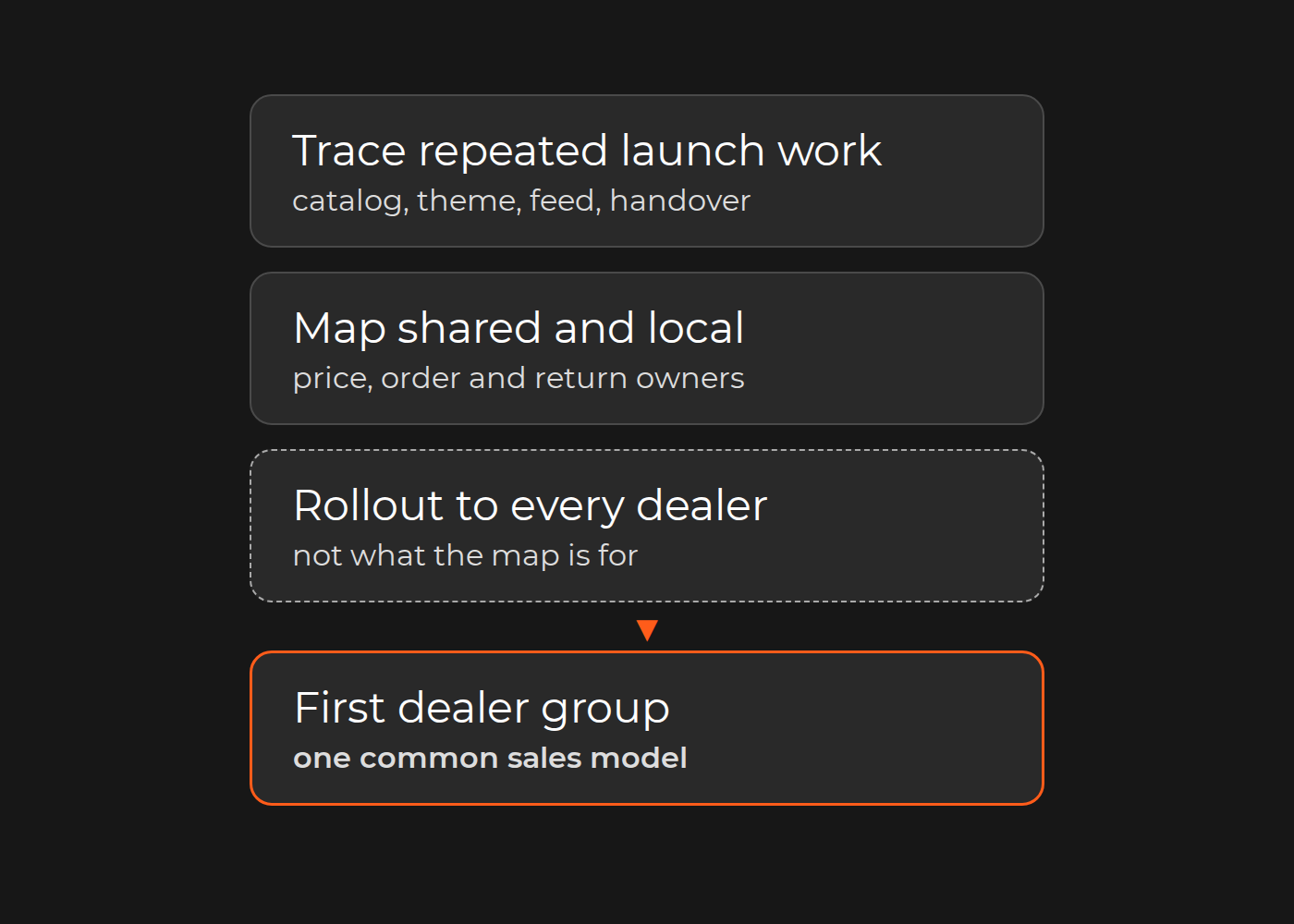
For a Head of Partnerships or commercial leader at a supplier with an established network, begin with a map of what should be shared and what must remain local. Use it to identify a first dealer group—not justify an immediate rollout to everyone.
Trace where the next launch repeats the last one
Look for repeated operational work rather than an arbitrary dealer-count threshold:
- Copy the catalog: a product correction needs separate requests to several sites. Inspect source version, permitted dealer subset and observed storefront version.
- Adjust the theme: local code changes block a common update. Separate supported settings from code forks.
- Connect the order feed: each launch reopens the same mapping questions. Check what was reusable and what genuinely differed.
- Hand over the store: a central order lacks a reliable dealer reference. Trace a permitted order across local and central records.
- Maintain it: support cannot identify the owner of an exception. Follow an unresolved case to its receiving owner and runbook.
Verify these signals with launch records, support tickets and authorized order traces. A dealer locator or expansion announcement suggests a network exists; it does not prove demand for a shared commerce service.
For comparable launches, record calendar days from request to first accepted order, people involved and manual touches per shared product correction. Separate waiting for content or commercial decisions from engineering. Repeated catalog editing and order-feed setup across otherwise similar launches are stronger evidence of work worth standardizing than a long launch alone.
Put shared and local decisions on one map
Make the map specific enough that a dealer and central operator can use it to resolve a change request. The following is a discussion framework, not a prescribed channel policy.
| Object | Candidate shared capability | Local decision to resolve |
|---|---|---|
| Product | Controlled identity and common data | Permitted assortment and local additions |
| Store | Versioned template and standard provisioning | Branding, domain and supported content settings |
| Price | Named source and update mechanism | Who may set retail price under the channel agreement |
| Order | Stable routing and linked references | Seller, acceptance and exception owner |
| Service | Common support/runbook route | Returns, local services and customer communication |
Channel leadership should resolve the operating model with dealers. IT validates isolation and integrations. Finance/legal review seller, payment, tax and data responsibilities; the authorized budget owner approves the investment and continuing support cost. A shared technical capability does not authorize shared commercial control.
Find the ownership boundary in a mixed basket
Consider a fictional workwear supplier whose dealers sell a core range, while one also offers local embroidery. Product identity and stock data may be reusable centrally; service availability and customer contact may remain local. Selling-price authority depends on the reviewed channel policy.
A central product order and a local service may require different fulfillment and service owners. Do not hide that difference in a free-text note and call the whole basket centrally fulfilled. Define a supported route for each line or exclude that mixed basket from the first pilot. Once that boundary is clear, settle the catalog, local-control and order-routing rules object by object.
Replace repeated builds with a repeatable launch path
For the agreed dealer model, make an ordinary launch a supported sequence rather than a fresh implementation brief:
- The dealer accepts a versioned template and supplies permitted branding/content.
- The dealer selects its allowed assortment; local additions follow identity and approval rules.
- Named price and availability sources connect through standard configuration, including stale-feed behavior.
- An authorized test order reaches the center with dealer identity, expected lines and an observable receiving outcome—without a real customer transaction.
- The channel owner accepts the launch checklist, including seller/service responsibilities, support and recovery ownership.
If an ordinary launch still needs a developer to copy code, edit shared products or rebuild the same mapping, the manual project has been renamed, not removed. Genuine exceptions may need specialist work; keep them outside the standard path until scope and ownership are explicit.
A published partner-storefront example
The SanMar website-builder case starts from this problem: before the project, many SanMar partners struggled to manage products and deploy online platforms. Dinarys developed a custom site builder for non-technical users on WordPress/WooCommerce. A distributor creates a store in a few steps—select a template, add products, customize the layout—choosing which SanMar products to sell, adding a limited number of its own products (initially up to 10) and branding the store with its own marketing content and visuals. Event-driven integration with SanMar's existing Magento B2B system syncs product updates, inventory and pricing in real time, and orders placed on a partner microsite are routed automatically to SanMar's central B2B panel. To support this, Dinarys extended the core WordPress codebase with custom components and modified standard plugins.
Read it as an example of the partner-storefront model, not as a launch-time, cost or channel-economics benchmark for your network. Company-specific purchasing approvals belong to a different product—an authenticated buyer portal with its own rules.
Avoid replacing repeated builds with repeated exceptions
First evaluate whether a supported multi-store or partner-commerce product covers the agreed model. If dealers only need feeds for existing sites, a feed and onboarding standard may be enough. If one dealer wants a simple shop, a network platform may be disproportionate.
Custom orchestration becomes relevant when repeatable provisioning, assortment permissions, updates, dealer identity and central order routing must work together in a way supported products cannot cover. Include template updates, rollback, support and offboarding in the product—not future housekeeping. A later pilot should show a template update and rollback that keep dealer settings, separated stores and an order reaching the center.
Dinarys' retail software development services include distributor/B2B2C workflows and back-office integration. That is a relevant service route for a verified cross-system gap, not a reason to skip the supported-product comparison.
Choose a first group with a common sales model
Select dealers who want the service, can supply branding and assortment decisions, and share a manageable order route. Include enough variation to test the template, but do not combine unrelated countries, commission structures, local services and logistics models just to make the pilot appear comprehensive.
Record store creation, a shared correction reaching the store, a centrally traced order and an exception reaching its owner. Use that evidence to decide whether the launch path is ready for another group. When you later compare delivery partners, ask every candidate to demonstrate those same operations, including handover to your own operator.
Review your shared/local map with Dinarys. Bring that map, sanitized examples of work repeated across launches, a willing first dealer group and the catalog/order/support owners. The next step is a testable common sales model—not another storefront design brief.


Let professionals meet your challenge
Our certified specialists will find the most optimal solution for your business.