Content
E-Commerce
Nov 18, 2026
Dealer Storefronts: Shared Catalog, Local Control and Central Order Routing
Time to read: 6 minutes

A shared dealer storefront platform can centralize product identity and order routing while allowing agreed local branding, assortment and selling decisions. It works only when each permission and source of truth is explicit. “Multi-store” alone does not define the operating model.
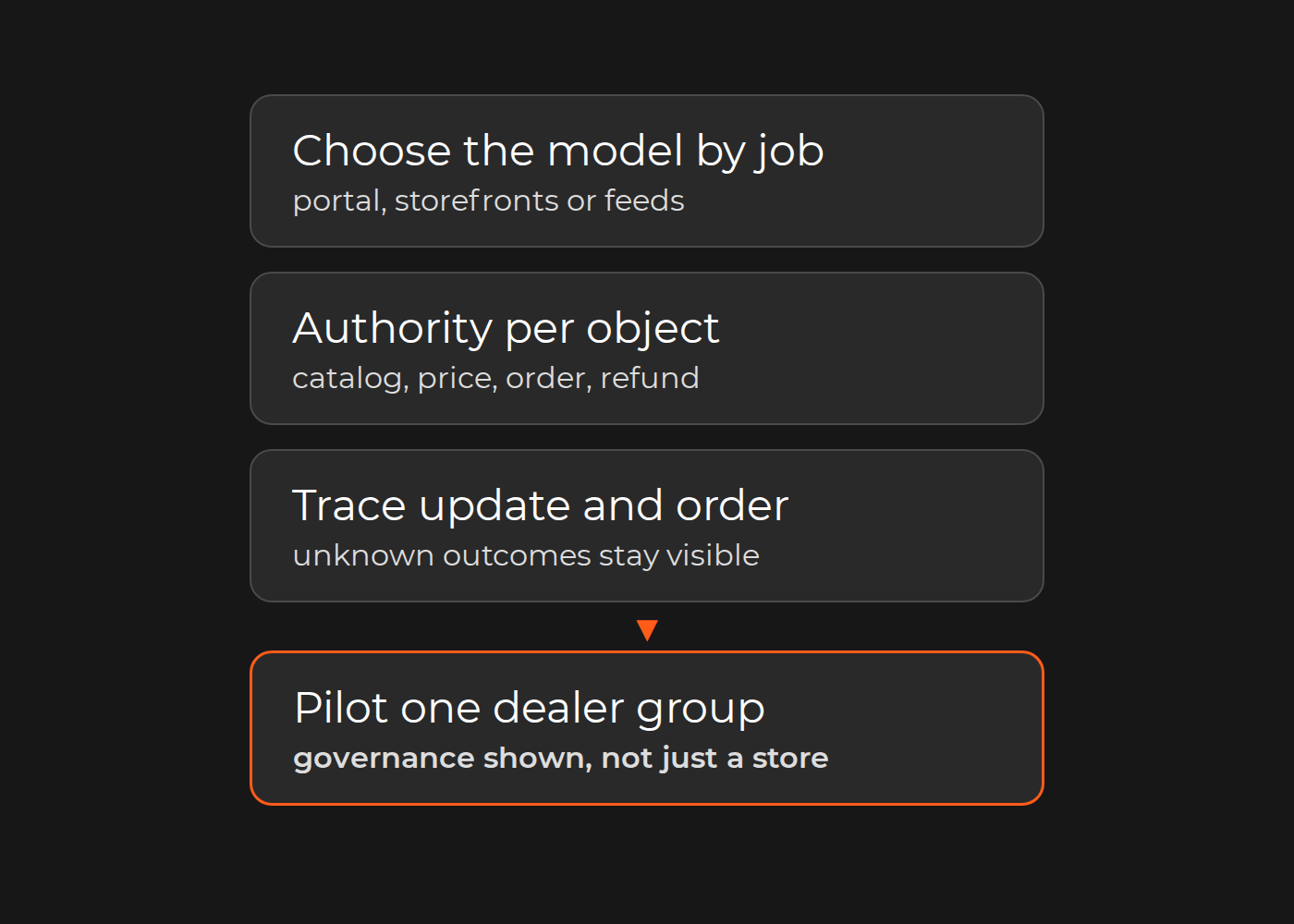
For a channel director and ecommerce/IT team, the choice depends on the job. If dealers only need to buy supplier stock, start with an ordering portal. If they need branded selling sites but lack a commerce team, evaluate shared storefronts. If they already operate capable sites, evaluate product/order feeds before asking them to adopt your template. Validate demand and supported workflows before choosing.
When each model fits—and where it stops
Compare the models on what the dealer does, who controls the site and how orders reach the supplier. They can coexist across different dealer groups; a single architecture need not serve every partner.
Ordering portal: a dealer buys from the supplier
Choose this for authorized supplier purchases under agreed terms. Demonstrate the correct account, price, order and acknowledgment. It does not create a consumer-facing selling site for every dealer. Company-specific purchasing and approval rules need their own requirements check before you commit to a portal.
Shared storefronts: a dealer needs a selling site
Evaluate a common template, controlled catalog distribution and central order route when dealers need help creating and maintaining branded stores. An ordinary store should be provisioned and operated without a separate code fork. Unsupported local services, countries or sales models remain separate scope decisions.
The SanMar website-builder case shows how such a split can look. In the partner-store builder Dinarys developed on WordPress/WooCommerce, the center supplies product updates, inventory and pricing through real-time, event-driven sync with SanMar's existing Magento B2B system; each microsite comes preconfigured with standard payment methods and shipping options; and orders are routed automatically to SanMar's central B2B panel. Partners decide locally which SanMar products to sell, can add a limited number of custom products (initially up to 10), and personalize colors, blocks and banners with their own marketing content and visuals, working through Administrator, Seller, Editor and Subscriber roles. It is one network's working answer, not a template for your selling-price authority, ERP mapping or store-separation design.
Independent sites with feeds: a dealer already has commerce capability
Retain the dealer's stack when the need is connectivity rather than a common site. Test product identity, dealer attribution and order references across each integration. This does not provide common administration or uniform release control.
Do not force capable independent dealers onto a template solely to simplify central reporting. Conversely, a feed does not build a store for a dealer without a commerce team. One simple shop may not justify a network platform. If the immediate problem is that every dealer launch is built by hand, first trace which work repeats from launch to launch and who owns it.
Dinarys sells retail software development and B2B2C integration, so we have a commercial interest in the shared-storefront route. Evaluate supported partner-commerce products before custom orchestration; use B2B portal development when the actual need is dealers buying supplier stock.
Define shared and local authority object by object
Record these decisions with channel leadership and dealer representatives. This governance framework is a requirements artifact, not a validated security design or legal allocation.
Core catalog. The central product owner maintains authoritative identity; dealers select permitted products. Agree how removal stops new orders without silently changing existing ones.
Local products. Dealers maintain only allowed local items. Define their identifiers and order route or exclude them. Never map an unknown item to a similar supplier SKU.
Branding. Dealers control supported logos, colors, banners and content within template constraints. A release preserves those settings or surfaces a conflict—not a silent overwrite.
Selling price. Decide supplier-set, bounded dealer edits or dealer-set pricing per product group under the reviewed channel policy. Grant corresponding edit/promotion rights. Commercial/legal owners approve authority, freshness and conflict handling.
Availability. Name central stock, dealer stock or both as the source governing each line. Separately sourced local availability needs an authorized maintainer. Specify what the store shows when a feed is stale or unavailable.
Order and customer references. Identify the system of record and data owner for each order type. Preserve dealer ID, local order ID, central reference and event history. Restrict access to authorized store records; a shared database does not imply universal access.
Cancellation, return and refund. Name operations, service and finance owners. Dealers may initiate only permitted requests. Distinguish a cancellation request, physical return receipt and authorized financial outcome.
Finance, legal and privacy owners must settle seller of record, payment, tax, data use and retention; IT/security validates separation and administration. The channel director champions the model, while the authorized budget owner approves the investment and ongoing support obligations.
Trace one product update and one order
In a fictional pilot, central SKU J-42 appears in Store A's and Store B's permitted subsets. Its update carries the authoritative identifier and version. Check what each receiver applied; a failed or unknown update stays visible for investigation and controlled retry.
Now Store A submits local order A-104. Preserve dealer and local identity while seeking the central acknowledgment. A useful exception record separates known from unknown facts:
Store: A · Local order: A-104
Central acknowledgment: unknown after timeout
Next evidence: original submission, event history and receiving-system result
Next owner: assigned integration/support owner
Determine whether the original submission was accepted before initiating another. Local confirmation is not itself ERP acceptance, a reservation or a delivery promise. An authorized receiving record should link back to A-104 so operations can explain the result to the dealer.
Whether updates use queued events, scheduled synchronization or both, agree freshness, version handling, retry ownership and reconciliation. A queue does not prove current data. Test delayed, duplicate, missing and out-of-order messages against the integration contract; retain unknown outcomes rather than silently count them as synchronized.
Include change operations in the choice
Some operations change which model fits. Settle these before you choose:
- Store creation: if your own operator must launch stores without developers, you need a shared template with standard provisioning, not a build per dealer.
- Template updates: if dealer settings must survive common releases, the model needs supported settings rather than per-store code changes.
- Store isolation: if dealers must not see each other's catalog settings, orders or administration, separation is a design requirement, not a hosting detail.
- Offboarding: if dealers can leave the program, decide who disables a store and what happens to open orders and data.
Test these with one dealer group, one sales model and one central back-office boundary. A pilot with your chosen delivery partner should then demonstrate each operation in detail, including rollback and exception handling. Expansion requires evidence that governance works, not merely a correct-looking storefront.
Take a testable model into the pilot decision
Validate catalog, branding, price and routing authority with dealer representatives and central owners. When you compare delivery partners, require the same store-creation, update, order and recovery demonstrations from every candidate. Have your operator repeat the work before accepting handover.
Review your dealer governance map with Dinarys. Bring a sanitized governance map, permitted catalog examples, price-authority rules, an order-reference trace and willing pilot dealers. The useful next step is a model you can test on one dealer group—including the exceptions you deliberately leave out—not an architecture commitment based on the word “multi-store.”


Let professionals meet your challenge
Our certified specialists will find the most optimal solution for your business.