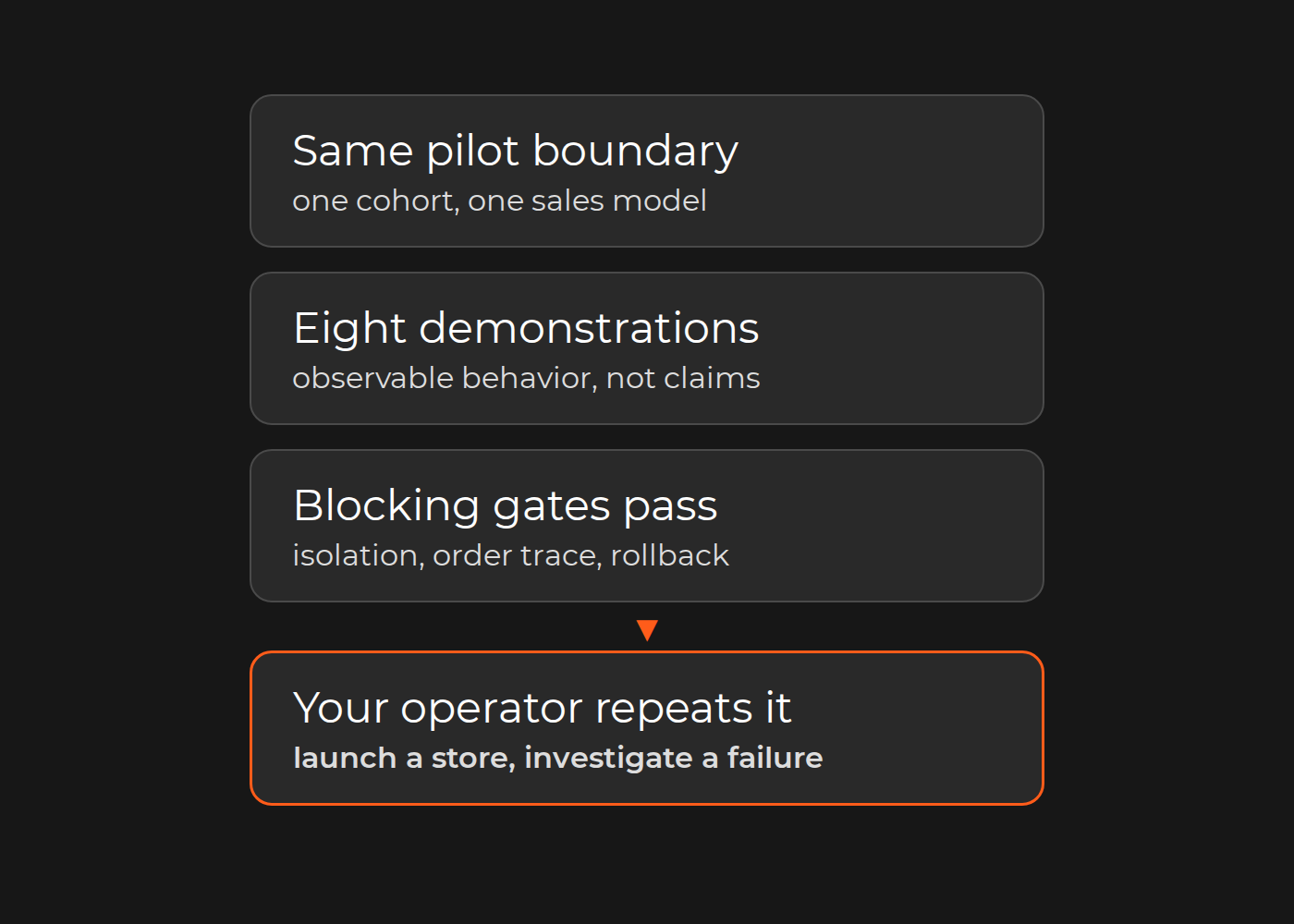
Ask a prospective delivery partner to demonstrate a simple business outcome: a new dealer creates a store from the agreed template, uses its permitted catalog, and submits a traceable order to the central system. Then ask your own operator to repeat the process.
That second demonstration matters. A polished storefront does not show whether your team can run the platform after handover—or resolve an order whose status is uncertain.
This guide is for channel and ecommerce leaders at suppliers with an existing dealer network. It uses operational acceptance criteria, not a ranked agency list. Dinarys offers B2B ecommerce development and is a potential supplier; apply the same tests to us as to other candidates.
Give candidates the same pilot boundary
Prepare a short procurement brief with a willing dealer cohort, one sales model, one template family, permitted local edits, authoritative catalog and price sources, and a central order-processing boundary. State whether local products and services are included. If the model is still undecided, first settle whether dealers need an ordering portal, shared storefronts, or feeds into the sites they already run.
Name who owns the end customer, selling price, order acceptance, fulfillment, cancellation, physical returns, refund authorization, and first-line support. The channel leader champions the pilot; IT and operations accept the working flow. Finance, legal, and privacy owners approve their respective responsibilities, and the authorized executive approves the investment.
Keep unsupported countries, commission models, marketplace behavior, and unrelated order-to-cash work out of the first-wave estimate. If an existing partner-commerce product covers the scope, ask candidates to show that route before proposing custom infrastructure. Compare estimates only after candidates receive the same boundaries, including recurring licenses, support, dealer onboarding, and template maintenance.
Run the candidate interview around eight demonstrations
Use these questions to request observable behavior, not yes/no feature claims. Store C, Store D, and order C-208 below are fictional test fixtures. Run demonstrations with authorized data in an agreed environment.
1. Can our operator launch the next dealer store?
A strong answer demonstrates Store C being provisioned from the approved template without copying source code. “We can build another site for you” is weaker evidence of repeatability. Channel operations should retain the configuration record, template version, and steps, then repeat them.
2. What can the dealer change without breaking shared product identity?
Ask the dealer representative to change a banner and permitted assortment. A strong demonstration preserves central product identifiers and shows the settings and catalog mapping before and after. “Each dealer can edit everything” leaves the boundary unanswered. The dealer representative and product owner accept the permitted controls.
3. How will you demonstrate separation between stores?
The security owner defines authorized positive and negative tests: Store C can access its permitted records but cannot retrieve Store D’s restricted records through the tested routes. Retain the test record and unresolved risks. A role list alone does not demonstrate separation.
4. What happens when a catalog update fails?
Look for a visible failed or delayed update, its source version, observed delay, and reconciliation or retry trace. “It synchronizes automatically” does not explain recovery. Product-data and integration owners should be able to locate and resolve the exception against an agreed freshness threshold.
5. Can you trace the same order into central processing?
Ask for order C-208’s dealer ID, local reference, processing trace, and central acknowledgment. The order operations/ERP owner accepts the mapping. A storefront confirmation or an “ERP integration complete” check mark is not enough without the receiving record.
6. What will our team do after an unknown response?
Simulate a timeout. A strong answer shows an investigation procedure and duplicate-handling evidence before another submission is attempted. “Just submit again” leaves a business-order risk unresolved. The integration/support owner must be able to use the procedure.
7. Can a template change be reversed without losing dealer settings?
Request an update and rollback rehearsal, a release record, recovery evidence, and a comparison of supported settings. A screenshot of the updated home page is insufficient. Platform operations accepts the recovery procedure, including what happens to orders created during the release.
8. Where does a return exception go?
Ask the operator to find the accountable service and finance owners in the runbook. A strong answer distinguishes receiving a returned item from authorizing its refund. “Support handles returns” leaves the financial decision unclear. Service and finance accept their respective routes.
Keep blocking gates outside a weighted scorecard
Agree what constitutes a blocking defect, the environment and test scope, acceptable update delay, and who can accept residual risk. Put access isolation, order tracing, and rollback in separate pass/fail gates. A good-looking storefront cannot compensate for a failed gate. Its owner must require repair, accept a documented limitation within their authority, or stop the pilot.
For each demonstration, record the fixture, expected result, actual result, evidence reference, accountable acceptor, and unresolved defect. For example: “C-208 / one central order with dealer C identity / receiving record absent / trace T-208 / ERP owner / blocked.” This is a usable acceptance entry, not an executed test. Use weighted scores for preferences only after blocking gates are addressed.
Verify comparable delivery, not just a company logo
Ask each candidate for a comparable dealer-store program, the functions delivered, and what the client’s own team operated after handover. Ask which people on the proposed team actually did that work. Request a client reference only where contact is permitted; otherwise ask what technical evidence can be shared.
Dinarys’ own example is the SanMar website-builder case. Before the project, many SanMar partners struggled to manage products and deploy online platforms. Dinarys built a custom site builder for non-technical users on WordPress/WooCommerce, connected to SanMar’s existing Magento B2B system: a distributor creates a site in a few steps (“Select a template”, “Add products”, “Customize the layout without technical knowledge”) and manages it through Administrator, Seller, Editor, and Subscriber roles. Event-driven integration syncs product updates, inventory, and pricing in real time, and orders placed on a microsite are routed automatically to SanMar’s central B2B panel.
That maps onto demonstrations 1 and 5: ask every candidate, Dinarys included, to show your operator launching a store through equivalent steps and to trace a test order into your central system. The case shows delivered partner-store components; your ERP mapping, credit and approval rules still need their own demonstrations.
Worked selection: compare evidence, not check marks
Suppose fictional Candidate A shows a branded storefront and marks “ERP integration” complete, but cannot trace the same test order into the central system. Candidate B identifies an incomplete acknowledgment gap and includes a reproducible test plus a named owner in its proposed scope.
Prefer a candidate whose gaps are named, testable, and owned over one whose checklist is green but whose test order cannot be traced end to end. That is not permission to accept an unresolved blocking defect. Ask both candidates to address the same gap, assumptions, support boundaries, and ownership terms before comparing estimates. Missing reference access alone does not establish inexperience; missing verifiable comparable work does leave delivery less proven.
Inspect what remains after handover
Request a versioned configuration inventory, integration contracts and identifier mapping, source/configuration access under agreed terms, dependency/license responsibilities, monitoring, reconciliation tools, release/rollback instructions, and a support escalation matrix. Have your operator launch a store and investigate a simulated failure using that documentation.
Ask how changes are requested and estimated, who maintains supported extensions, and how exit/export works. Legal and procurement owners approve IP and contract terms. The budget decision should cover ongoing operation, not just the first storefront.
To discuss a first wave, bring Dinarys a sanitized dealer-pilot brief: willing pilot partners, shared versus local controls, catalog/API boundaries, order ownership, an example exception, and the people authorized to accept the result. Use the eight demonstrations above as the starting acceptance scope.