A configurator is not just a 3D viewer. When staff retype orders for production, the important question is whether selected options, price, and production specification describe the same valid product.
Choose the least complex route that passes the same difficult-product test: selection rules, reproducible price, and accepted production output. Existing variants and a better document template may suffice. Artwork-heavy ordering may need web-to-print. Custom rules or integration should address a gap that the test actually demonstrates.
Compare candidates from selection through production review. Do not compare one vendor's polished preview with another vendor's unfinished integration.
Match the route to the gap—not the most impressive demo
Product configuration governs dimensions, components, materials, finishes, and allowed combinations. Web-to-print centers on artwork or templates and print-ordering outputs. Custom work supplies the validation, calculation, approval, or transfer an otherwise suitable solution cannot cover. These layers can coexist; name which owns each rule so restrictions do not diverge between storefront and production.
Existing variants and document templates may be enough
Test the current commerce platform when its standard options represent the family. Prove valid combinations, agreed pricing, and the complete order document. Move beyond it only when required dependencies or outputs cannot be expressed reliably, or comparable ownership costs justify another route.
This route loses when a dependency between options cannot be enforced or the production document repeatedly loses accepted data. More variants alone may merely hide the gap in a larger option list.
Use web-to-print when artwork and print ordering dominate
Require the actual artwork workflow, output, approval, and difficult B2B/B2C paths. Print-oriented software is not automatically the right tool for non-print assembly or a simple specification.
For replacement, inventory templates, rules, artwork references, open orders, and custom extensions before choosing what to retain. Replacing web-to-print does not automatically require replacing the whole commerce platform. The route loses when its template or output model cannot express the required work without excessive exceptions.
Test a ready-made configurator for selection and compatibility
Ask it to demonstrate your difficult rules, later edits, export, and maintainable rule administration. If a required combination needs an unsupported script, that is an evidenced gap—not a reason to treat the preview as a complete solution. Check the actual edition and version rather than assuming a product-family feature is included.
Use bounded custom rules or integration for a demonstrated gap
Name the rule a tested candidate cannot enforce or the field it cannot export. Agree rule ownership, reproducible calculation, interface behavior, and exceptions. Custom work loses when an existing product meets the requirement with less maintenance burden or when nobody owns the rules after launch.
Retain expert quotation for genuinely new engineering decisions
Keep intake and review ownership where each order requires new judgment. Separate repeatable cases that can be standardized instead of forcing everything into a configurator or manual quotation.
Shortlists may include platform extensions, dedicated configurators, web-to-print platforms, and CPQ systems. CPQ—configure, price, quote—may add sales quotation and approval beyond a cart price. This is a workflow comparison, not a current named-product ranking: require the same demonstration, then verify licensing, interfaces, and maintenance responsibility.
Choose visualization separately
Start without 3D if labels, dimensions, swatches, and a summary enable correct selection. Consider 2D when placement or artwork layout is the decision. Consider interactive 3D when shape or spatial relationships materially affect the choice.
WebGL is a rendering technology, not a substitute for production rules. A WebGL-based experience still needs validation, pricing, and accepted output. Include asset creation, mobile usability, accessibility, loading behavior, and maintenance in the comparison. Provide text-based selection and a summary; critical information should not exist only inside a canvas.
Conversion uplift is a hypothesis to test, not an automatic consequence of adding visualization.
Use one difficult product as the test fixture
Continue the fictional panel family from the manual re-entry diagnosis: widths of 400–1,200 mm, adhesive mounting for light fabric, and a sleeve for heavy fabric. These are invented rules, not manufacturing guidance. No implementation or production test is reported.
Give each candidate the same difficult-product test brief, with these expected outcomes:
Test
Fictional input
Required evidence
Valid selection
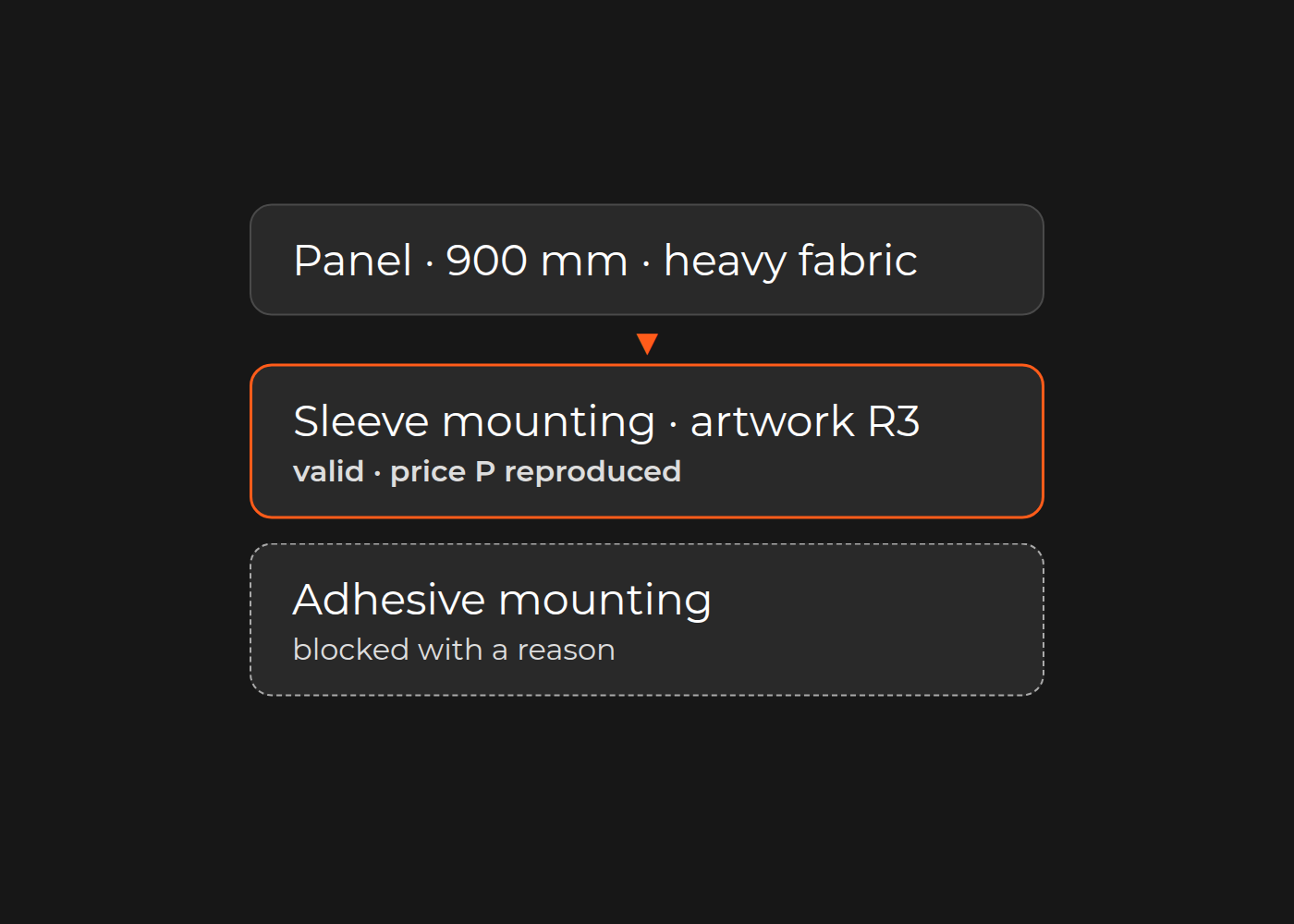
900 mm, heavy fabric, sleeve, artwork R3
Structured values reach agreed price
Forbidden combination
Heavy fabric + adhesive
Blocked with reason and correction path
Width boundary
1,200 mm; then 1,201 mm
Limit accepted; excess rejected or sent to quote
Missing artwork
Required file unavailable
Visible hold and assigned review owner
For pricing, supply an approved test price P for the valid fixture. The same accepted inputs and calculation version must reproduce P, with tax and currency basis explained. R3 identifies an artwork revision, not a paper size.
Then change the width after approval. Require revised price and specification; old approval must not silently cover a changed selection. The output must carry order ID, option codes, dimensions and units, artwork revision, and approval reference. Have production supply an expected document or data sample before the demonstration so the vendor cannot omit an operator's essential field.
Record each requirement as demonstrated, configuration required, custom work required, or unknown, with tested version and evidence. An unknown essential requirement needs a bounded follow-up before acceptance.
What Dinarys's examples establish for this choice
The myfelt case describes a Shopify custom PDF generator that captured rug configuration and sent detailed order documents to production units. It illustrates a bounded document bridge rather than a reason to build an entirely new commerce platform.
The Flash Style case describes replacing an approaching-retirement web-to-print arrangement with a Magento platform integrated with PrintQ, alongside commercial-document and payment work. It illustrates a product-plus-integration route with broader dependencies than a preview component.
These are different project scopes, not a head-to-head evaluation proving one tool superior. Neither case establishes compatibility with your equipment, a general conversion uplift, or an end-to-end manufacturing outcome.
A production document is not a machine connector
A PDF suitable for human review and a file accepted by a particular device are different deliverables. If machine transfer is needed, specify the exact receiver, format, acknowledgment, error visibility, and operator authority.
Assess duplicate-submission and recovery behavior in an authorized test environment; do not resend production jobs simply to complete a demonstration. Generating a document establishes neither device acceptance nor permission to manufacture.
Compare ownership cost and test the business hypothesis
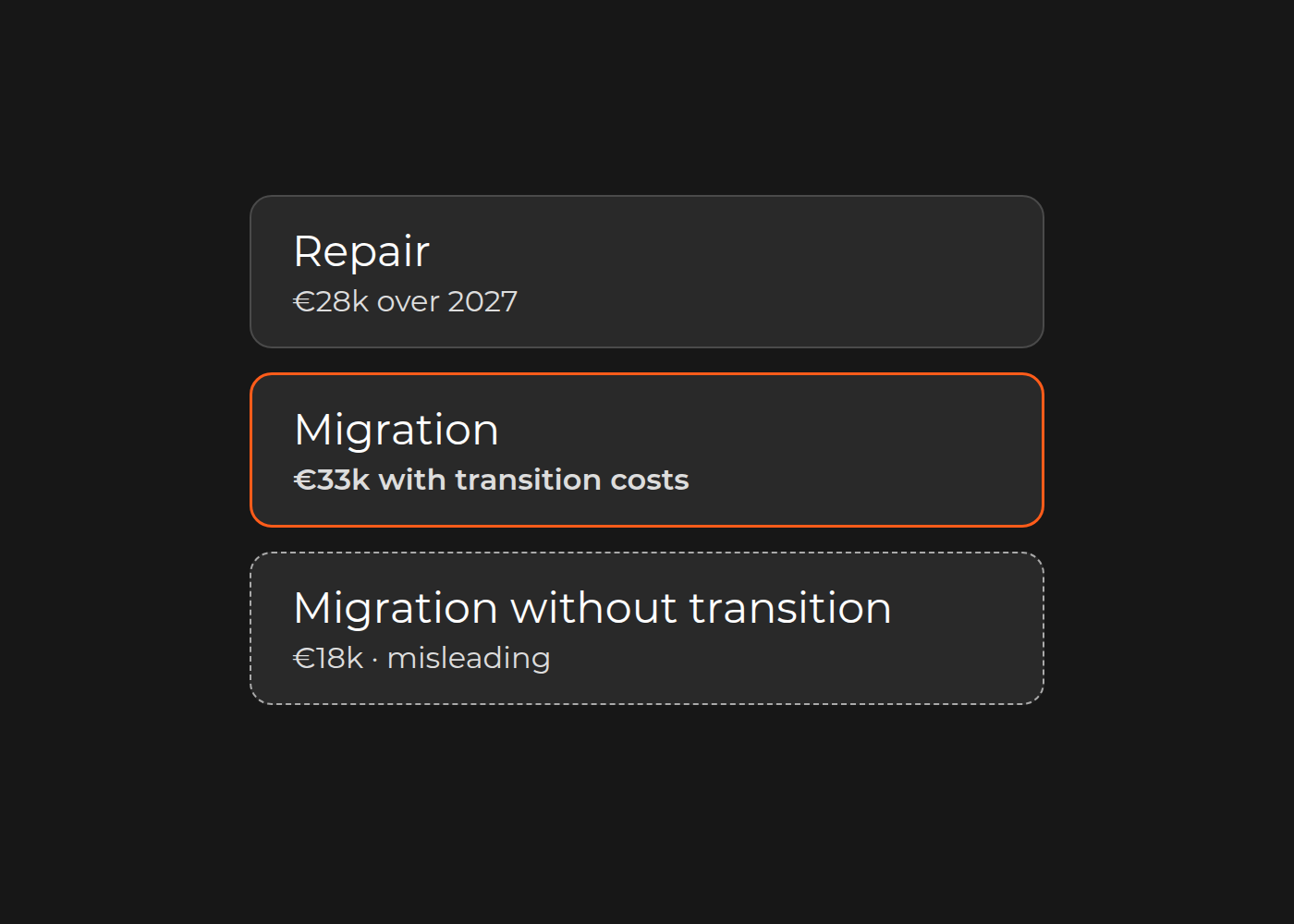
Put setup, licensing, rule and output-template maintenance, integration changes, test coverage, and operator handling on the same planning horizon. Use observed volume and handling effort. Do not compare all custom-development costs with only the first subscription payment of an alternative.
The commercial or ecommerce lead should judge customer task completion; production should accept rules and outputs; IT should accept interfaces and recovery. The COO or budget owner needs the common-horizon cost and residual manual workload.
After technical fit, test customer completion with comparable products and traffic. The measure is completed valid orders, not preview interactions. A properly designed controlled conversion test can examine the sales hypothesis where traffic permits it. At lower volume, moderated task tests and an operational pilot can expose defects but cannot establish reliable uplift.
There is no universal minimum traffic or fixed test duration. Ask an analyst to size the comparison from baseline completion, effect size, uncertainty requirements, and available traffic. Also track rejected invalid combinations, clarification requests, active handling, and document corrections. More checkouts with more unmakeable orders is not success.
Carry the tested requirement into implementation
Complete the fixture with production and IT, then ask your supplier and plausible alternatives to demonstrate it. Carry the supported route, unresolved gaps, expected output, rule-maintenance responsibilities, and acceptance owners into implementation rather than restarting feature shopping.
Dinarys's Shopify development services cover custom apps and integrations. To discuss your specific configuration or output gap, contact Dinarys with a sanitized completed test brief, current platform/module versions, rule examples, and expected production files. Identify who can approve commercial behavior and who can accept the output.
You may share this article
Let professionals meet your challenge
Our certified specialists will find the most optimal solution for your business.