Shopware is rarely chosen by accident. Businesses favor its open-source architecture and the flexibility it enables, especially in setups with complex catalogs, multiple markets, and integrations that keep growing after launch.
This positioning is reflected in adoption data. Industry leaders like Toyota, STABILO, and ARMEDANGELS trust Shopware for their digital commerce success. According to an EHI study cited by Shopware, 11.5% of the 1,000 highest-grossing B2C online stores in Germany run on the platform. StoreLeads’ category breakdown also suggests strong adoption in segments like Home & Garden, Apparel, and Food & Drink,where, as catalog and order volume grow, clean product data structure and operational workflows become critical.
The adaptability the platform gives you is also why Shopware development isn't forgiving. While it allows you to build a system around your operations, it also makes you responsible for keeping that system stable. Poor implementation decisions such as uncontrolled extensions, version-dependent customizations, and delayed performance optimization and QA can accumulate over time. This leads to operational friction:
Updates become risky when custom code and extensions aren't upgrade-safe, leading to compatibility work with every release.
Extension sprawl creates conflicts and hidden dependencies that become harder to debug and maintain over time.
Performance drops at scale when catalogs, search/filtering, and promotions grow beyond the initial setup's capacity.
Integrations drift when retries, failures, and out-of-order updates aren't handled, causing order/inventory/refund mismatches.
Edge cases break workflows without clear ownership rules and recovery logic.
The difference between a stable, scalable Shopware store and one that generates ongoing problems comes down to delivery quality. Weak execution creates technical debt, so choosing the right development partner is often the most important decision in a Shopware project. You need specialists who can prevent upgrades from breaking customizations, control extensions, protect performance as you scale, make integrations reliable, and take clear ownership after launch.
Based on our Shopware project experience at Dinarys and broader industry shifts, we’ve outlined the decision points that tend to matter most when teams choose Shopware and scale on it.
Today, we’ll walk you through the full set of factors you need to consider when making a solid Shopware development partner choice:
Shopware’s adoption and maturity
A clear breakdown of Shopware versions and plans
Shopware enterprise-ready capabilities that drive growth
A framework to evaluate agencies based on delivery quality and post-launch ownership
A shortlist of Shopware development companies worth considering
Why Shopware Remains a Strong Platform Choice in 2026
Shopware's adoption is heavily concentrated in the DACH region, with 67.5% of stores located in Germany, followed by Switzerland, Austria, and the Netherlands. However, Shopware is increasingly expanding further into Southern Europe. The platform is positioned for upper mid-market and enterprise companies across both B2B and B2C sectors.
Different sources report different active Shopware store numbers:
Shopware itself reports 45,000+ active shops, alongside 1,600 certified agency and technology partners and 6,000+ verified extensions in their store.
Even though these figures don’t match — because they’re based on different measurement methods (detectable websites vs. estimated stores vs. the vendor’s installed base) — they all lead to the same conclusion: Shopware isn’t niche. It is well established in the market with a mature ecosystem of partners and extensions, which matters when you’re seeking a platform you expect to run, maintain, and evolve for years.
Shopware Versions and Plans: How Different Versions Support Different Business Needs
When businesses pick Shopware for a long-term, scalable setup, they usually pick Shopware 6, which is the current product line. The previous Shopware 5 version was discontinued in July 2024, though some stores remain on it since migrating from 5 to 6 is essentially a rebuild to a completely different architecture. Most serious new builds with long-term roadmaps are now centered on Shopware 6.
When it comes to editions of the newer version of the platform, Shopware 6 comes as:
Shopware 6 plan
What it includes
Best fit for
Shopware Core (Community Edition)
Free base of Shopware 6 with core commerce features. Self-managed setup. Commercial plans add more features and support
SMB to mid-market teams with technical ownership (in-house or via a partner) who want maximum flexibility
Shopware Rise
Entry commercial plan. Includes unlimited sales channels, Shopware Intelligence, 3D capabilities, and Basic Support with defined reaction times
Growing mid-market brands that want commercial capabilities and vendor support, but don’t need advanced enterprise layers yet
Shopware Evolve
Includes everything in Rise plus Advanced Search, B2B Components, CMS rules and extensions, Dynamic Access, Publisher, and additional Flow Builder actions. Higher support coverage than Rise
Upper mid-market businesses with more operational complexity: multi-market, integrations, and expanding workflows
Shopware Beyond
Top tier. Includes everything in Rise and Evolve, plus Beyond-only features and highest support level (24/7 availability, fastest reaction times)
Enterprise or high-complexity operations where uptime, support coverage, and advanced capabilities are critical
Deployment can also differ. Businesses may run Shopware as self-hosted, or use cloud options like Shopware SaaS or Shopware PaaS, depending on how much infrastructure responsibility they want to own.
NEED CLARITY ON SHOPWARE 6 PLANS AND WHAT THEY MEAN FOR YOUR STORE?
Dinarys can review your current Shopware version, explain what Core vs Rise/Evolve/Beyond changes in practice, and map a realistic upgrade or migration path.
Why Shopware Makes Sense for Your Store If You Expect Growth
The current version of the platform supports growth without forcing everything into custom code or making day-to-day changes dependent on developers. Shopware 6 balances user-friendly admin tools with a developer-centric, API-first backend. That’s why business teams can handle content and merchandising directly in the admin (building campaign pages, updating category layouts, scheduling content blocks, and adjusting promotions). At the same time, developers can build the custom logic and integrations required by complex, enterprise-level ecommerce businesses. Shopware 6 key technical capabilities that enable this include:
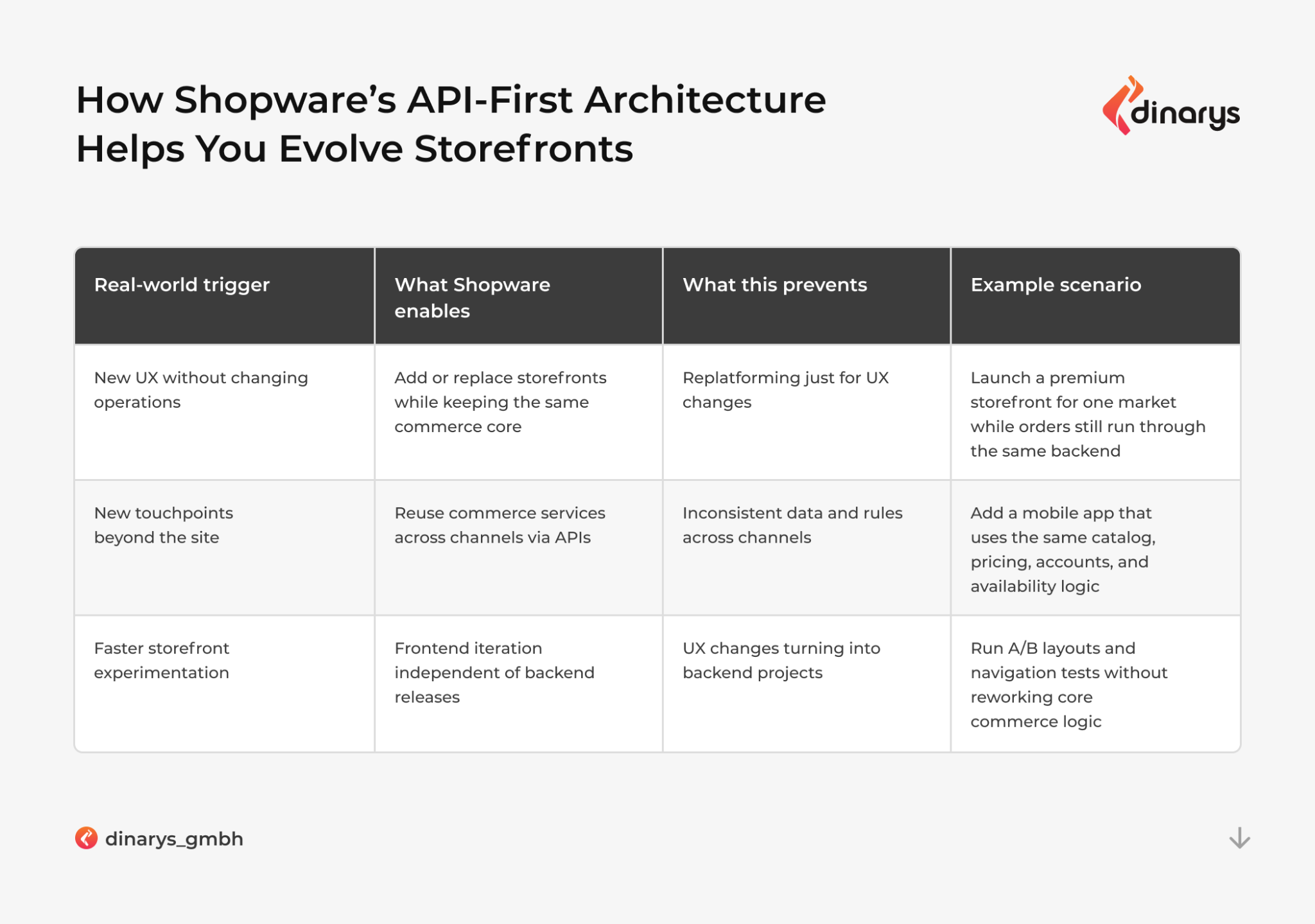
API-first architecture for evolving storefronts
Shopware 6 is built around an API-first approach and supports headless commerce architectures. This makes it easier to evolve storefronts, add new touchpoints (mobile apps, POS systems, marketplaces), or serve multiple storefronts from a single backend without replatforming.
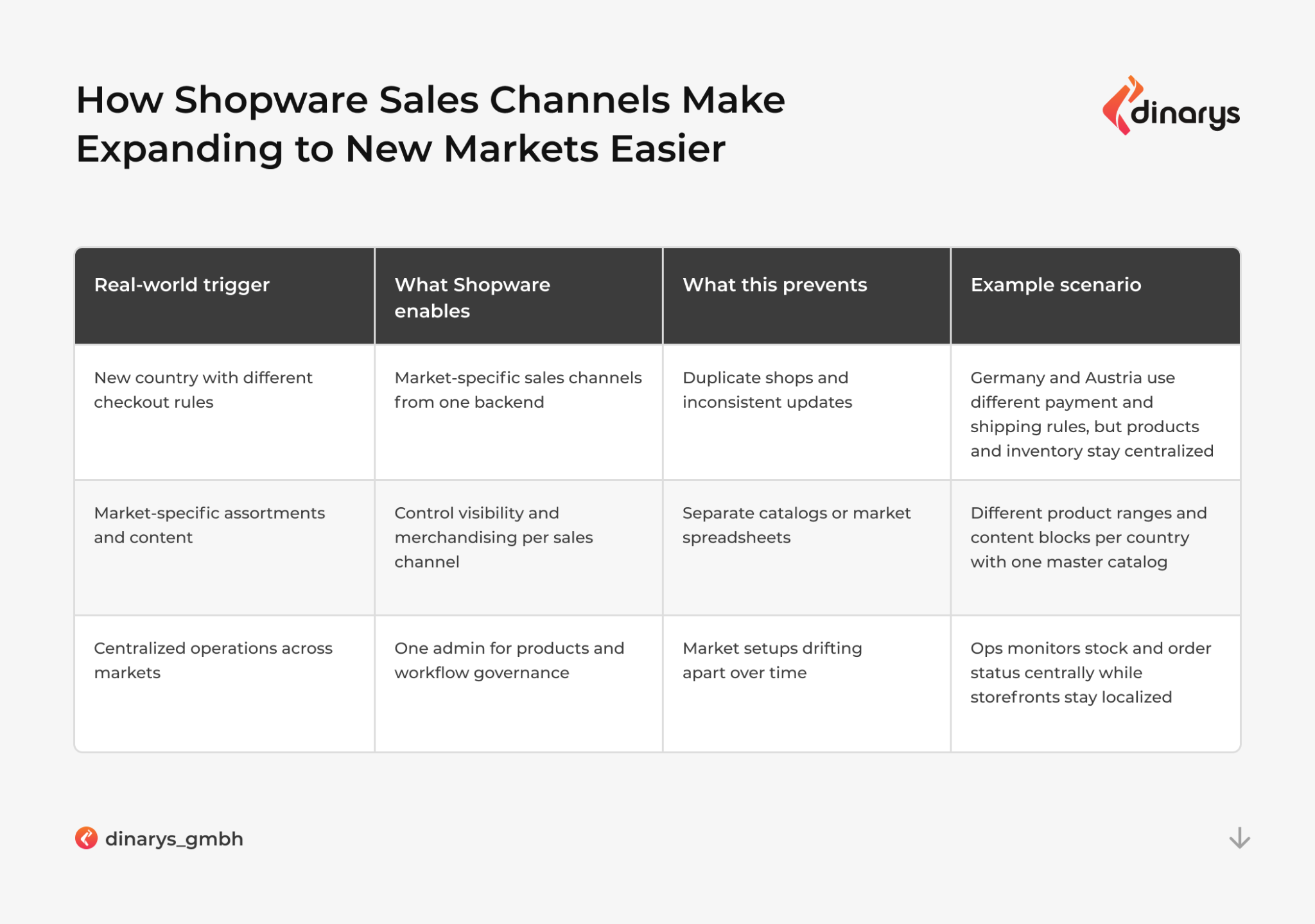
Multi-market operations without store duplication
Shopware’s sales channel concept lets you run multiple storefronts from a single Shopware installation (one backend admin and one core data layer). Each storefront sales channel (for example, a country-specific storefront or a B2B portal) can have its own configuration for language, currency, taxes, payment and shipping methods, domains, and navigation. This matters when international expansion means each market has its own rules but you need centralized operations and inventory visibility.
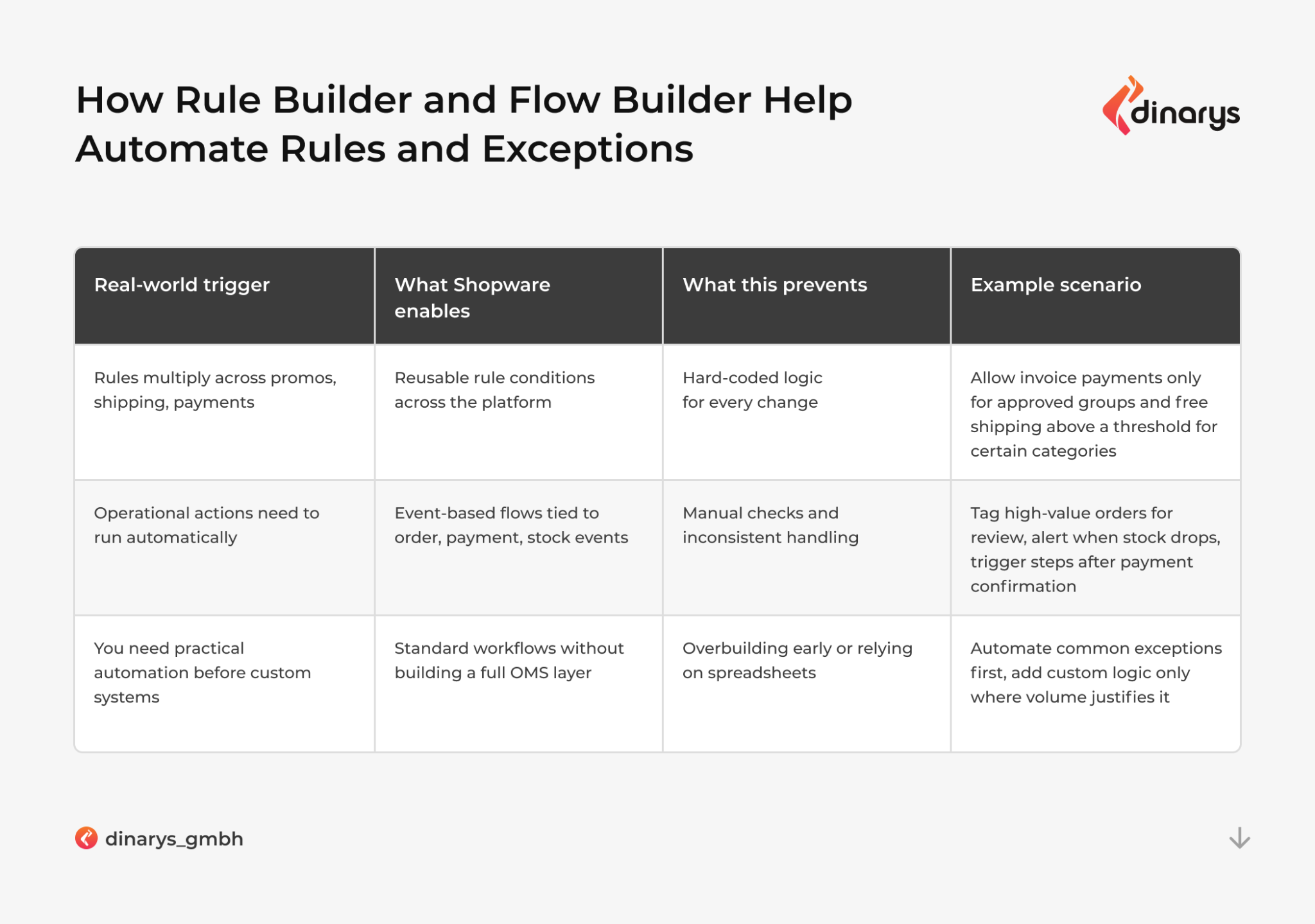
Workflow automation without constant development work
Shopware 6 includes tooling that helps businesses scale workflows without turning every operational change into a development ticket. For example:
The Rule Builder lets teams define conditions (customer groups, cart values, product categories) that can be applied across promotions, shipping, and payments.
Flow Builder automates processes by triggering actions based on events like order placement, payment confirmation, or stock level changes, without requiring custom code for standard scenarios.
When custom logic is needed, these capabilities can be extended through Shopware extensions or plugins for self-hosted setups.
AI-powered operations and content creation
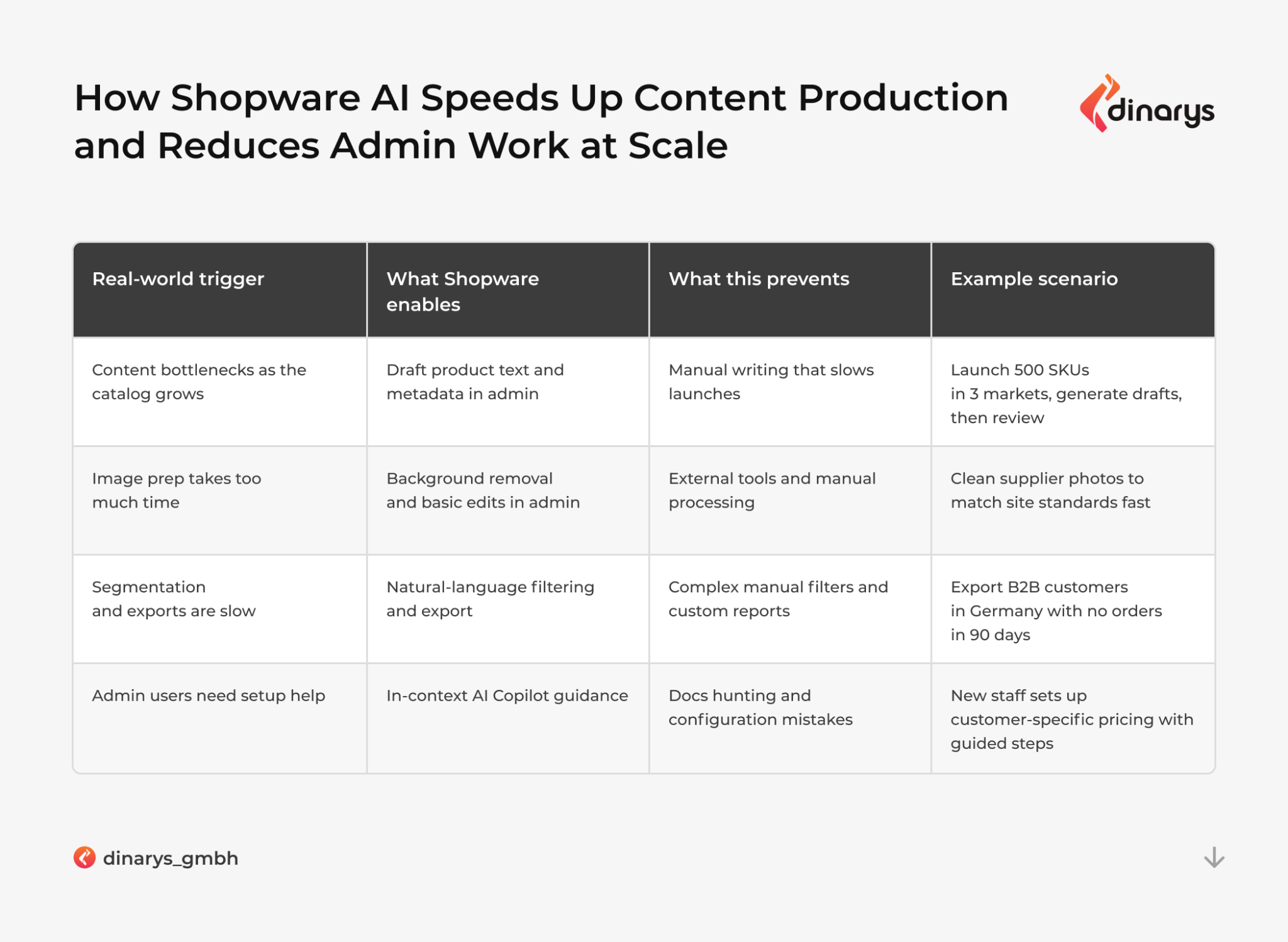
Shopware AI can reduce the amount of routine work that slows teams down as catalogs and markets expand. It helps speed up product content production (descriptions, metadata, marketing copy), supports basic image preparation, and assists admin-side work such as finding and filtering data faster. The practical impact is higher content velocity and less manual effort when launching new products or expanding into new markets. Availability depends on plan and version, so it’s worth confirming early if you expect to rely on it.
Merchandising and content changes without release cycles
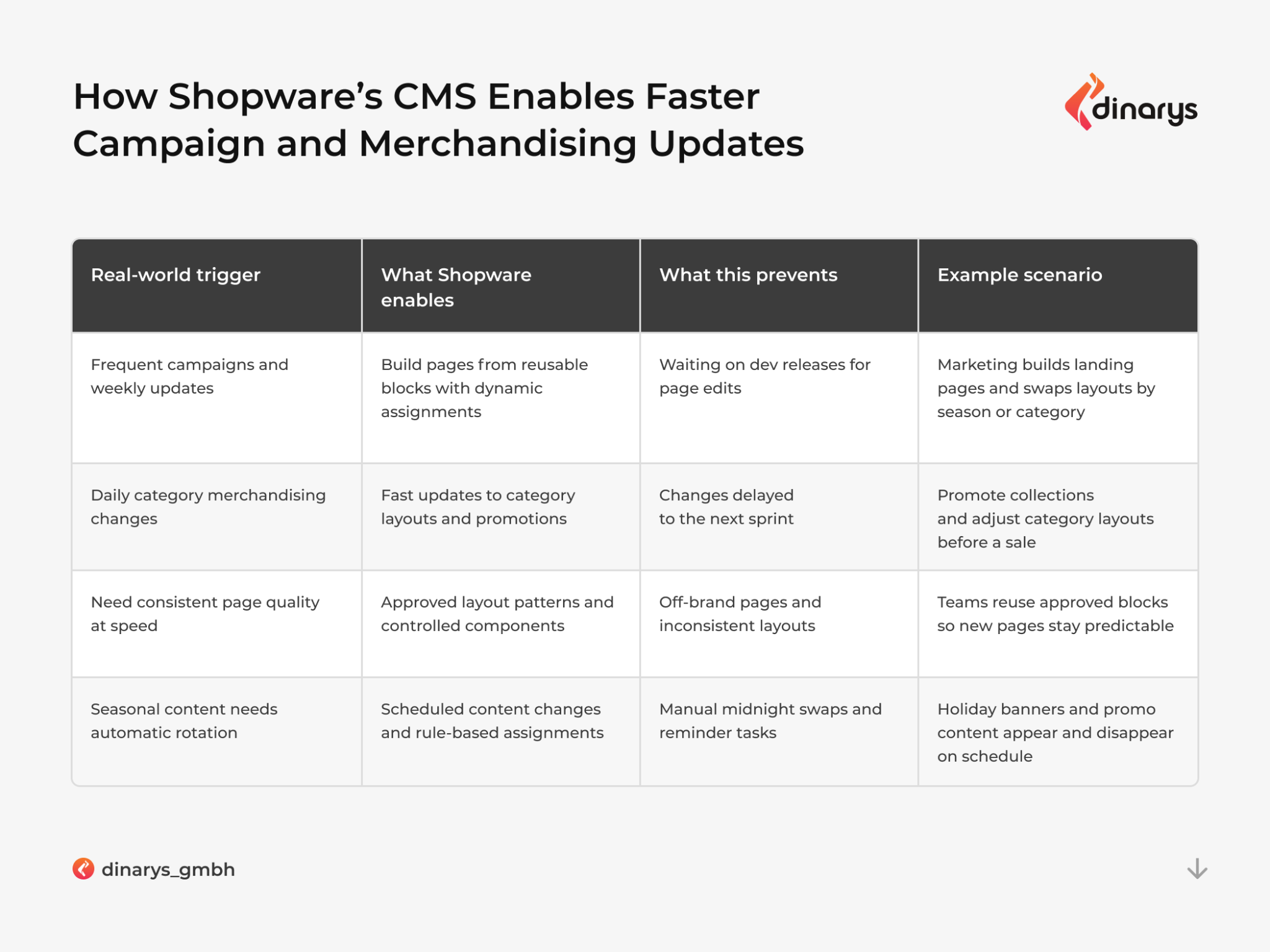
On the content side, Shopware’s CMS is built around reusable layouts and dynamic assignments. This is useful when the store relies on frequent landing page updates, category merchandising, and content-driven campaigns that can’t always wait for a development release cycle.
Recurring revenue through subscription capabilities
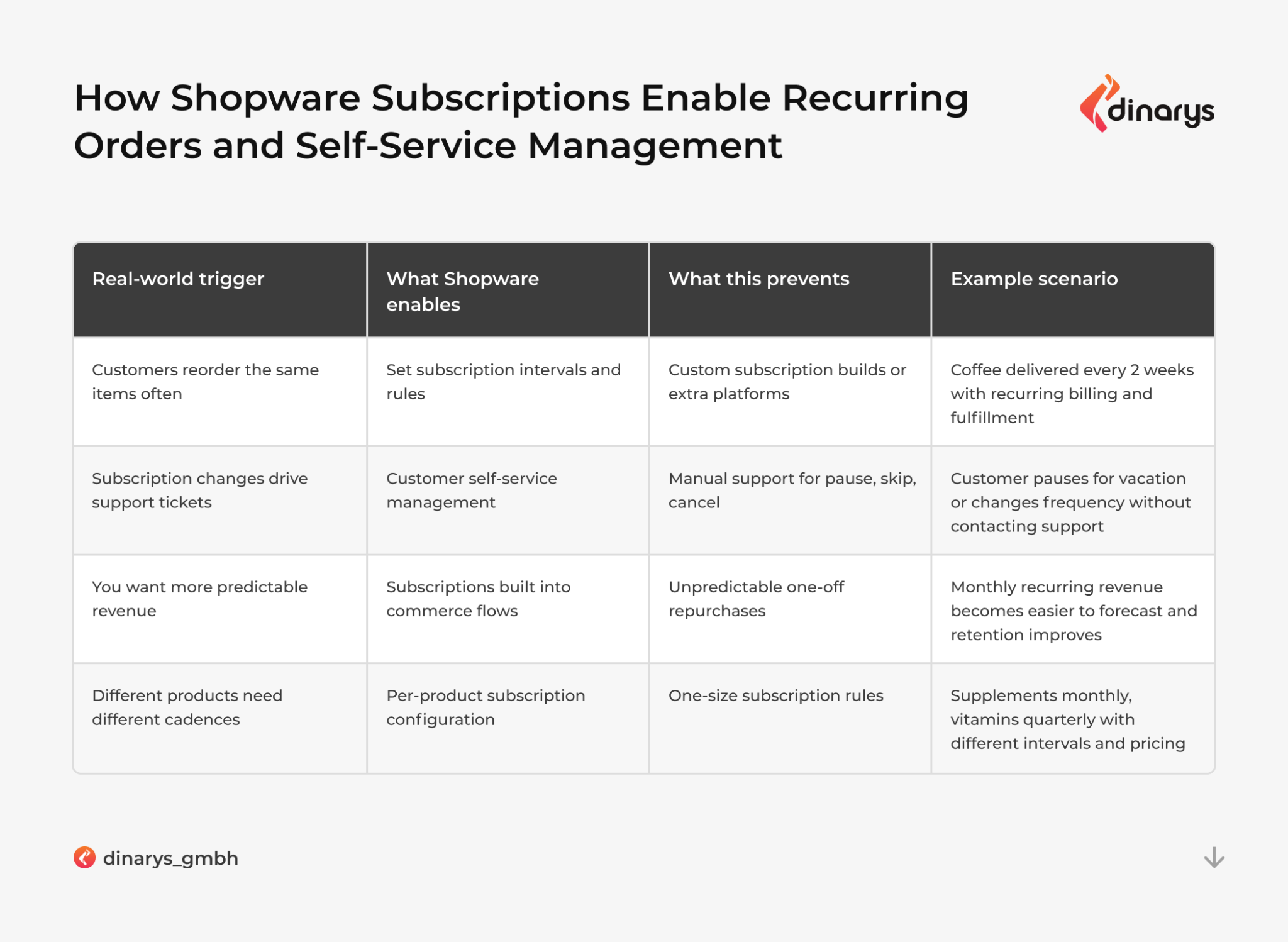
Shopware subscriptions let you sell recurring orders without building a custom system. You set the schedule and rules, and customers can pause or change subscriptions themselves. This reduces support work and helps retention. Since subscription functionality depends on your plan and setup, confirm what’s included before you rely on it.
B2B capabilities when wholesale becomes part of the model
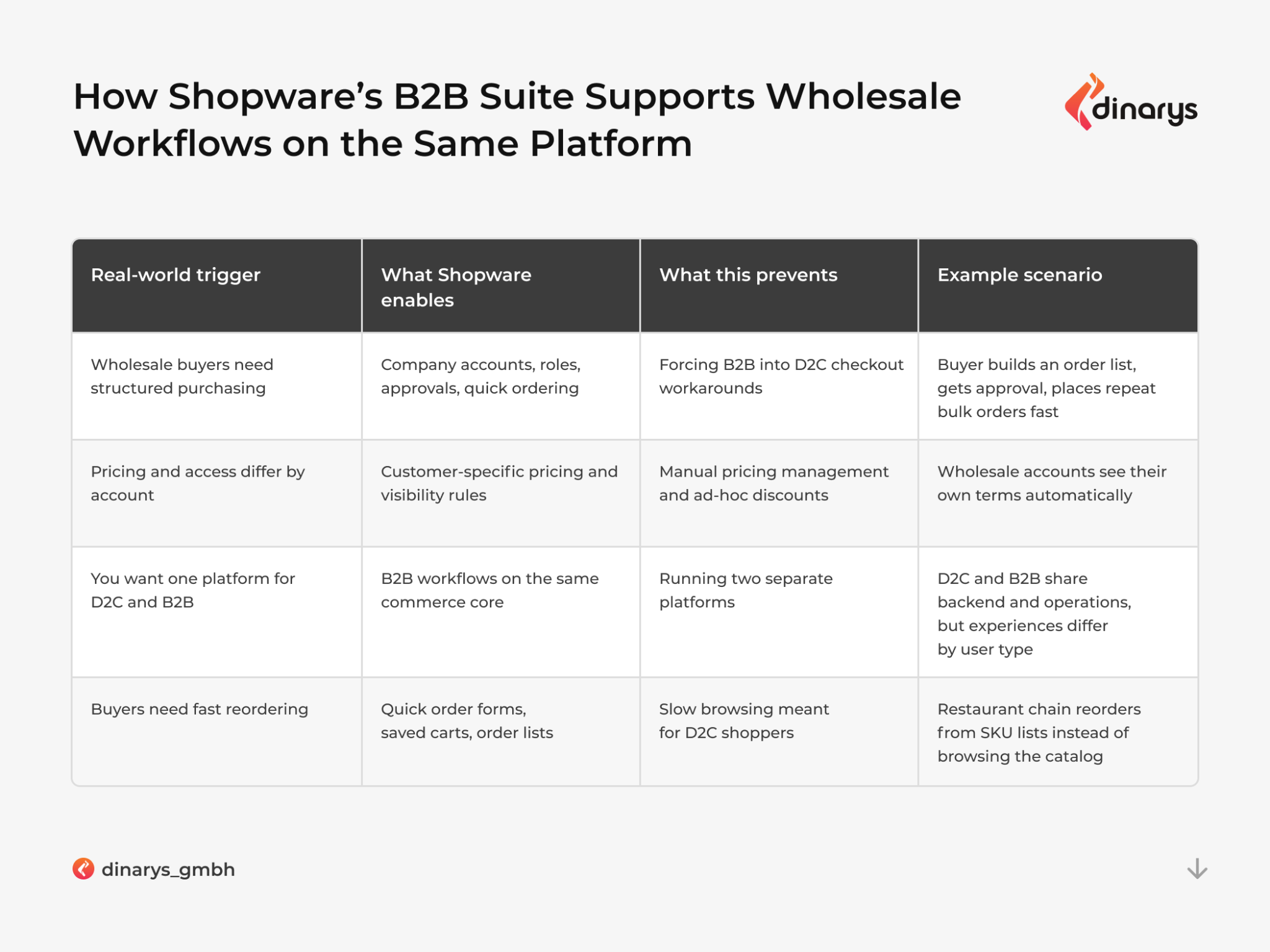
For businesses that add B2B sales channels, Shopware supports B2B-oriented workflows through its B2B Suite extension, which adds customer-specific pricing, approval workflows, quick order entry, and company account structures. This matters when your business model expands beyond direct-to-consumer sales and you need to support procurement teams, contract pricing, and bulk ordering patterns.
Shopware’s flexibility can become overwhelming once you move beyond standard setups and start reaching for advanced features or deeper customizations. To get the benefits without the maintenance debt, you need the right Shopware partner who can implement, integrate, and support it responsibly.
How to Evaluate Top Shopware Development Companies
The right development team becomes a long-term technical backbone that helps you scale without constant rework. Let's break down the signals that separate mature Shopware partners from vendors that rely on generic claims.
#1: Clear fit and positioning [research stage]
A strong Shopware partner is clear about what they do and what they don’t do. You should be able to understand:
What kinds of Shopware projects they deliver most often
What their typical client looks like
What they take ownership of beyond the storefront
This is one of the few criteria you can validate largely before a call. Their website, service pages, and case studies (portfolio) should make it obvious that Shopware is a real specialty, not an occasional project compared to a much larger volume on other ecommerce platforms.
If the vendor has a Shopware partner tier and certified developers, it can support credibility, but it isn't proof on its own. It only matters when the agency can also show real project evidence and define what it owns end-to-end clearly.
#2: Shopware service coverage: What the vendor actually delivers [research and evaluation stage]
Shopware work can mean very different things depending on the version you run and the complexity of your operation. Before you go deep on process maturity, make sure the agency can actually cover the work you require.
Look for proof they can handle the relevant scope areas:
Data work (mapping, cleanup, validation, redirects and SEO-critical structure)
Integration and operations:
Integration-heavy delivery (connecting inventory, orders, and fulfillment across ERP/PIM/3PL systems)
Support (updates, extension compatibility, incident response, release management after launch)
Shopware 5 stabilization and support (if you're still on legacy and planning a future migration)
Don't rely on service lists entirely. In the research stage, look for case studies that match your scenario. During evaluation calls, ask them to walk you through a comparable project.
WANT TO SEE WHAT WE CAN DO FOR SHOPWARE — OR NOT SURE WHAT YOU NEED?
Explore what Dinarys provides across Shopware builds and optimization. If your scope is still unclear, we can audit your needs and define it upfront.
#3: Foundations thinking: Catalog, markets, and operational basics [evaluation stage]
Shopware’s flexibility only pays off when the foundations are designed properly. If product structure, market setup, and admin workflows are treated as something to adjust later, the store may still launch, but scaling becomes painful.
This is best validated during the first call, because it shows up in what the vendor focuses on before they talk about design or features. Mature teams naturally start from your operating reality:
How the catalog is structured
How products vary across markets
What rules affect checkout
Who on your team owns day-to-day updates
They should also be able to explain how they approach catalog modeling and market configuration in a way that will still work when SKUs, variants, and markets increase. If everything stays abstract, foundations are likely being improvised.
#4: Judgment and pushback: Ability to offer alternatives [evaluation stage]
A strong Shopware partner should challenge decisions that create long-term risk and explain trade-offs clearly, especially when timelines are tight. This matters because many of the most expensive Shopware problems come from decisions that speed up launch in the short term but create issues later: upgrade risk, plugin conflicts, performance bottlenecks, or integration drift that compounds as the store grows.
Look for a team that:
Asks why a requirement matters before committing to a solution
Flags hidden dependencies and long-term maintenance impact early
Offers lower-risk alternatives and phased options instead of defaulting to the most complex build
Is willing to say a feature should be deferred if it increases risk without clear value
If a vendor agrees to everything without pushback, it may feel smooth in the moment, but it often leads to unstable scope, rushed decisions, and technical debt that shows up after launch.
#5: Scoping and phasing judgement: Now, next, later [evaluation stage]
Strong Shopware partners scope for a stable launch, then layer complexity in phases. This is one of the clearest signs of delivery maturity, because it shows whether the team can balance business urgency with long-term stability.
A capable vendor should be able to separate three things clearly:
Now: What must exist to launch safely (core catalog setup, checkout, essential operational workflows, basic performance baseline)
Next: What typically comes after stabilization (refining workflows, improving automation, performance tuning, adding more structured merchandising)
Later: What belongs in a later phase once the business proves the need (integrations with enterprise resource planning (ERP) systems, product information management (PIM) tools, and third-party logistics (3PL) providers, advanced automation, heavy B2B complexity, multi-warehouse rules)
They should also explain why those boundaries exist. The goal is to avoid two expensive failure modes: pushing enterprise-level complexity into an initial release that doesn’t need it yet, or shipping a quick build that works at launch but blocks growth because the foundation wasn’t designed for change.
#6: Delivery process and risk handling [evaluation stage]
Shopware projects rarely go in a straight line: requirements change, edge cases appear, integrations behave differently in production, and timelines get pressured. A mature partner builds and adapts the delivery process around the project’s constraints (deadline, budget, org structure). This keeps the project predictable and handles the risk before it turns into downtime and rework.
Look for a team that:
Runs a structured discovery phase
Translates findings into clear scope and acceptance criteria
Uses QA gates so issues are caught before they reach production
Has a clear change-control process so new requirements don’t quietly destabilize the build or blow up timelines
Weak delivery processes usually show up as unclear scope, shallow testing, and decisions that live only in chats and calls. Over time, that creates the same outcome: slower progress, repeated fixes, and a store that becomes harder to maintain because nobody can trace why key decisions were made.
#7: Update and compatibility discipline: Core and extensions [evaluation stage]
Shopware ships regular updates, including security patches and feature releases. Updates stay routine only if the store is built and maintained with upgrade safety in mind.
Mature partners treat updates as operations:
Separate core and extension updates
Validate changes in staging
Test critical flows before production
Maintain regular patch cadence
Have documented rollback procedures
Can explain their testing workflow clearly
If custom code and extensions are added without discipline, updates become risky. Teams start postponing them to avoid breaking checkout or integrations, security exposure grows, and upgrade debt piles up until the next update turns into a large, expensive project.
#8: Extension strategy: Build vs buy [evaluation stage]
Shopware's extension ecosystem is a real advantage, but it can also become the fastest way to create long-term maintenance debt. When extensions are added without a clear strategy, the store accumulates hidden dependencies, conflicts, and upgrade blockers.
Mature Shopware developers treat extensions as part of the architecture and take ownership of keeping them upgrade-safe over time:
Clear build-versus-buy decision framework
Evaluates extension quality based on maintenance history and vendor reliability
Keeps extension count controlled to reduce conflict risk
Takes ownership of compatibility checks and conflict resolution after launch
Has a plan for replacing risky or abandoned extensions
#9: Performance discipline: Proof over promises [evaluation stage]
Performance issues usually show up after launch. If the build wasn’t designed for a clean data model, proper caching and indexing, search setup, and infrastructure that matches demand, fixing performance later turns into rework.
A strong Shopware partner plans performance upfront: they set clear targets, test against realistic catalog and traffic conditions, and monitor key flows so regressions are caught early instead of hurting conversion.
#10: Integration readiness: Future-proofing without overbuilding [evaluation stage]
Most Shopware stores end up integrating with systems like ERP, PIM, fulfillment, payments, tax, analytics, and marketing tools. Whether those integrations stay stable or become a recurring source of issues depends on decisions made early — data ownership, sync approach, and how failures are handled once the store is live.
When this is done poorly, you’ll see order status mismatches across systems and inventory drift that leads to oversells or stockouts. Refunds won’t reconcile cleanly, and manual cleanup becomes part of daily operations.
#11: Ownership model after launch [evaluation stage]
Launch isn't the finish line. The first weeks in production surface real edge cases, and the months after launch usually involve updates, extension maintenance, performance tuning, and integration issues that need fast, consistent ownership. A strong partner has a clear operating model for what happens when something breaks and how changes are delivered safely. That means:
A clear hypercare period after go-live
Defined responsibilities for incidents, fixes, and releases
Documented response expectations and escalation paths
Monitoring and alerting as part of support, not only manual reporting
A repeatable process for updates and regression checks so changes stay safe
If ownership is vague, support becomes reactive and slow, and small issues turn into recurring disruptions because nobody is clearly responsible for preventing them from happening again.
Top Ecommerce Shopware Development Companies 2026: Analyzed and Profiled
Now that we’ve outlined how to evaluate Shopware agencies based on real delivery signals, the next step is comparing specific vendors. The shortlist below profiles Shopware development partners with proven experience so you can match their strengths to your operating model and growth plans.
Dinarys
Dinarys is an ecommerce development and consulting company, specializing in Shopware 6 implementation for businesses ready to scale. Our focus is on mid-market and enterprise clients who need long-term technical partners.
NEED A SHOPWARE PARTNER WHO CAN BUILD AND OWN IT LONG-TERM?
Dinarys does Shopware 6 builds, migrations, integration-heavy delivery, and provides long-term support, so updates stay routine, extensions stay controlled, and operations stay consistent across systems after launch.
Innowise is a full-cycle software development company that supports ecommerce delivery alongside broader engineering capabilities.
Company profile:
Location: Warsaw, Poland
Operating since: 2007
Shopware Certification: Not publicly listed
Shopware services: Shopware builds and modernization with custom storefront work (including headless patterns), migrations to Shopware, custom plugin/feature development, integrations, performance and QA support, and continuous support and maintenance
Selected clients: NTT DATA, Commercial Bank of Qatar, SPAR, Familux Resorts
Atwix
Atwix is a commerce-focused development agency that delivers ecommerce builds, modernization work, and offers long-term support.
Company profile:
Location: Chicago, Illinois, USA
Operating since: 2006
Shopware Certification: Shopware Platinum Partner with 111+ certifications across all Shopware 6 roles (Developer, Advanced Developer, Template Designer, Solutions Specialist, PaaS Specialist)
Shopware services: Enterprise-grade Shopware 6 implementations, custom web development across storefront and backend, integrations (ERP/PIM/fulfillment/payments), performance and scalability work, upgrade and extension compatibility management, and long-term operational support
Selected clients: Sony Biotechnology, Graphic Solutions Group, Wyze, Reinders, Wilson Sporting Goods
webmatch
webmatch is an ecommerce agency focused on building and optimizing digital commerce solutions.
Shopware services: Shopware 6 implementations for B2C and B2B, migration projects, multi-market sales channel setups, custom website development, integrations, and ongoing optimization and support
Selected clients: Deiters, AIDA Cruises, TAMRON
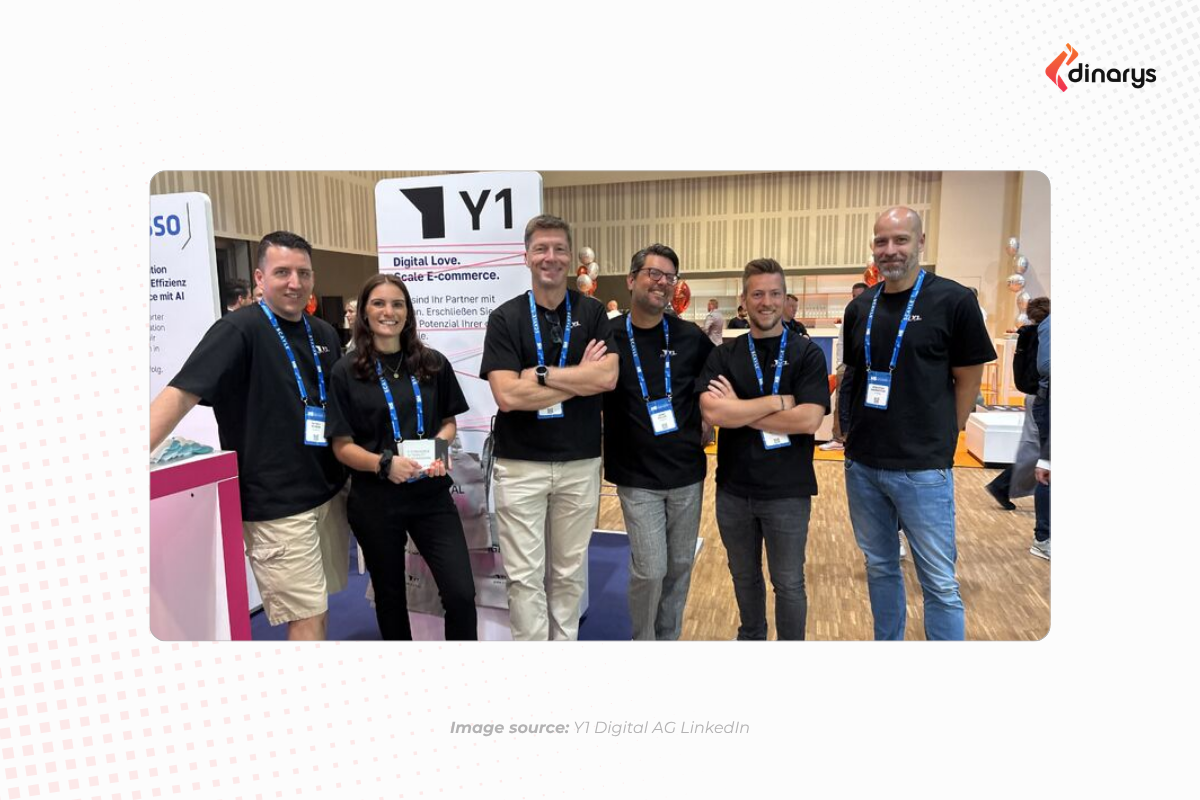
Y1
Y1 Digital AG is a digital commerce agency that delivers ecommerce strategy, design, and implementation work.
Shopware services: End-to-end Shopware delivery from build to ongoing operations, including Shopware implementations, migrations, integrations, custom website development, and long-term support
Selected clients: SPIETH Gymnastics, schlafgut, Bosch, Krug & Priester, IDEAL
solution25
solution25 is a Shopware-focused ecommerce agency. They’re positioned for projects where Shopware needs to handle real operational complexity, including multi-store setups, ongoing releases, and integration-heavy workflows.
Shopware services: Shopware 6 implementations and migrations, multi-store and integration-heavy delivery, custom web development, data work including mapping, cleanup, and redirects, and long-term support with structured updates and ongoing releases
Selected clients: Cartoucheclub, Miniature Market, VaporFi, South Beach Smoke, VaporBeast
basecom
basecom is a digital commerce and software company that supports complex ecommerce delivery across B2B and B2C.
Shopware services: Shopware implementations and integrations for complex B2B/B2C setups, cloud/PaaS-ready delivery, custom development, performance and scalability work, and ongoing support for upgrades and operational continuity
Selected clients: Fleurop, Pöppelmann TEKU, Bohnenkamp SE
elio-systems
elio is a digital commerce and IT services provider with deep Shopware delivery focus for complex B2B and B2C setups.
Shopware services: Shopware implementations for B2B and B2C operations, migration and modernization work, custom development, integrations, performance and reliability improvements, and continuous support
Selected clients: Cube, TeeGschwendner, Volvo Trucks, memo, Bohle AG
A Final Word on Shopware Ecommerce Development Companies
Shopware is a strong platform choice for businesses that expect to grow. Its API-first architecture, multi-market features, and ecosystem support long-term evolution, but that flexibility makes execution quality non-negotiable. Many of the costs businesses associate with Shopware are really costs of upgrade-unsafe customizations, uncontrolled extensions, or rushed integration and performance decisions.
That’s why picking among Shopware ecommerce development companies is less about finding the most visible vendor and more about choosing an experienced dedicated team with disciplined delivery. There’s no universal best partner — it depends on your operating model, whether you’re multi-market, B2B-heavy, integration-driven, or moving fast with frequent merchandising changes.
Use the evaluation criteria to shortlist partners based on proof and operating maturity, and treat the vendor list as a starting point for comparison. Done right, you get a Shopware setup you can run, update, and improve for years without constant rework.
FAQ
Start with your business goals and the key factors that will drive long term success: catalog complexity, multi-market needs, integrations, and required ongoing support. Then shortlist firms where the company specializes in Shopware and can prove deep technical expertise and a proven track record delivering scalable ecommerce solutions. A trusted Shopware development company will offer clear ownership after launch and also show how it protects business success through stable upgrades and operations.
Top Shopware vendors cover end-to-end delivery: custom Shopware store builds, complex integrations with ERP/PIM/fulfillment systems and marketplace solutions, advanced features like B2B pricing or subscriptions, performance optimization, platform migrations, and structured post-launch support.
The best teams connect technical delivery to business outcomes — stronger user engagement, reliable day-to-day operations, and sustainable growth.
Open Source is the self-managed Shopware core for teams that want maximum flexibility and control. Enterprise tiers add more capabilities and services for complex requirements and bigger business goals, often paired with a more structured support model. Cloud shifts more responsibility to the platform provider, which can simplify operations, but may limit how far you can push custom development depending on the model and edition.
The main benefits are lower risk and better outcomes over time: a good partner builds upgrade-safe foundations, avoids extension debt, delivers performance optimization, and supports stable integrations. This way your store keeps improving instead of accumulating maintenance drag.
Yes. A trusted Shopware development company often handles full migrations and replatforming projects, including: auditing your current store and defining what needs to be rebuilt vs. improved; migrating products, customers, orders, and content with data cleanup and mapping; preserving URLs, redirects, metadata, and SEO-critical structures; rebuilding custom functionality and replacing legacy modules where needed; reworking integrations with systems like ERP, PIM, WMS/3PL, and payments; running staged testing, cutover planning, and post-launch stabilization so the switch doesn’t break operations.
You may share this article
Let professionals meet your challenge
Our certified specialists will find the most optimal solution for your business.