In 2026, WooCommerce remains one of the most widely used ecommerce platforms, even with many more packaged and feature-heavy alternatives on the market. Many businesses still choose WooCommerce as the engine behind their online growth, with some even migrating to it from other platforms. That naturally raises the question: why?
Even though it doesn’t offer the strongest built-in support for large-scale operations, WooCommerce’s appeal lies in how customizable it is. As part of the WordPress ecosystem, WooCommerce lets businesses start with a free open-source core plugin and their own choice of extensions. At the same time, the brands keep total control over checkout, data, costs, and infrastructure.
That combination of low entry cost, flexibility, and control has helped WooCommerce stay highly relevant. W3Techs reports WooCommerce on 49.6% of ecommerce systems in its surveys, while StoreLeads tracks more than 4.26 million live WooCommerce stores. StoreLeads also shows strong usage across categories such as Home & Garden, Apparel, Business & Industrial, and Food & Drink.
The Woo company itself presents the platform as easy to install and start with, while highlighting it as a good fit for businesses that want more control over their store setup and more flexibility than many out-of-the-box platforms allow.
At the same time, while WooCommerce makes it relatively easy to launch a basic store setup (with standard product pages, a typical checkout flow, a small set of plugins, and no major integrations or custom business logic), it becomes much harder to manage once the store needs more than that:
Complex integrations with ERPs, CRMs, shipping tools, accounting systems, or other external platforms
Custom business logic such as custom checkout flows, pricing rules, subscriptions, or product configuration
Performance improvements to support faster load times and a better user experience
Update-safe customization that doesn’t break after WooCommerce, plugin, or theme updates
Capacity to grow into a larger catalog, with more traffic, more orders, and more integrations over time
Also, the more control WooCommerce gives businesses over infrastructure, features, and architecture, the more responsibility falls on the internal teams:
Features beyond standard plugins need careful implementation to avoid conflicts, performance issues, and long-term maintenance problems
Integrations with ERPs, CRMs, accounting, shipping, and other systems need to be built carefully to avoid disruptions to core business processes
A brand-aligned storefront often requires more than theme settings, including custom CSS, template edits, and deeper code changes
Too much depends on how the store is built. Code quality, plugin choices, theme structure, hosting decisions, and the way integrations are implemented all shape how stable and maintainable the setup will be over time.
For many internal teams, managing this level of technical complexity is difficult and sometimes not fully realistic without outside support. Even when it is possible, it can take significant time, pull attention away from the store itself, and lead to mistakes that create more work later. That is why growing WooCommerce businesses usually reach a point where they need a development partner who understands the platform’s strengths and limits, can implement the right technical ecommerce solutions, and can support growth without turning the store into a maintenance problem.
With a clear understanding of today’s ecommerce realities, the Dinarys team prepared this guide for businesses that are considering WooCommerce or already working with it and looking for a development partner. In this article, we look at:
Why WooCommerce remains so widely used
For which types of business it works well
Where technical expertise starts to matter when building a store
Why businesses would benefit from working with a development partner
How to evaluate WooCommerce development companies
Which agencies stand out
For Which Business Types WooCommerce Makes the Most Sense
While it lacks the built-in operational depth of certain platforms (Shopify Plus, Adobe Commerce, Shopware), Woocommerce’s flexibility, WordPress-native content management, and lower entry costs can make it a better fit for some business types:
Business type
Why WooCommerce works well
Where it often wins over other platforms
Content-led brands already using WordPress
Fits businesses where blogs, landing pages, SEO, and editorial content matter as much as the store itself. WooCommerce works naturally here because it extends WordPress instead of separating content and commerce.
Stronger fit for brands that rely heavily on content marketing, organic search, and WordPress-based site management. Easier to keep content and ecommerce in one system.
SMBs that need a lower-cost starting point
Works for businesses that don’t need a heavy commerce stack. For example, Dinarys developed an online store for Lucidera, which sold a limited number of products and only needed a custom theme and basic ecommerce features.
Lower entry cost, more gradual rollout of functionality, and less platform commitment early on than with more packaged alternatives.
Established businesses that want more control
Fits businesses that want more control over checkout, hosting, data, extensions, and technical decisions instead of a more rigid platform setup.
Better fit when ownership and flexibility matter more than stronger built-in operational structure.
Stores with unusual business logic
Supports businesses that need non-standard checkout flows, pricing rules, account structures, subscriptions, or product logic.
Gives more freedom to shape the store around business requirements instead of fitting the business into stricter platform limits.
Businesses migrating from more rigid or more expensive setups
Can make sense for businesses that want more flexibility, more control over costs, or a closer fit with a WordPress-based ecosystem.
Stronger option when the goal is to reduce platform rigidity or simplify a content-and-commerce setup.
Businesses expecting gradual growth
Works well when the store is expected to evolve step by step rather than support deep operational complexity from the start.
Better fit when staged growth and incremental investment matter more than heavier built-in features from day one.
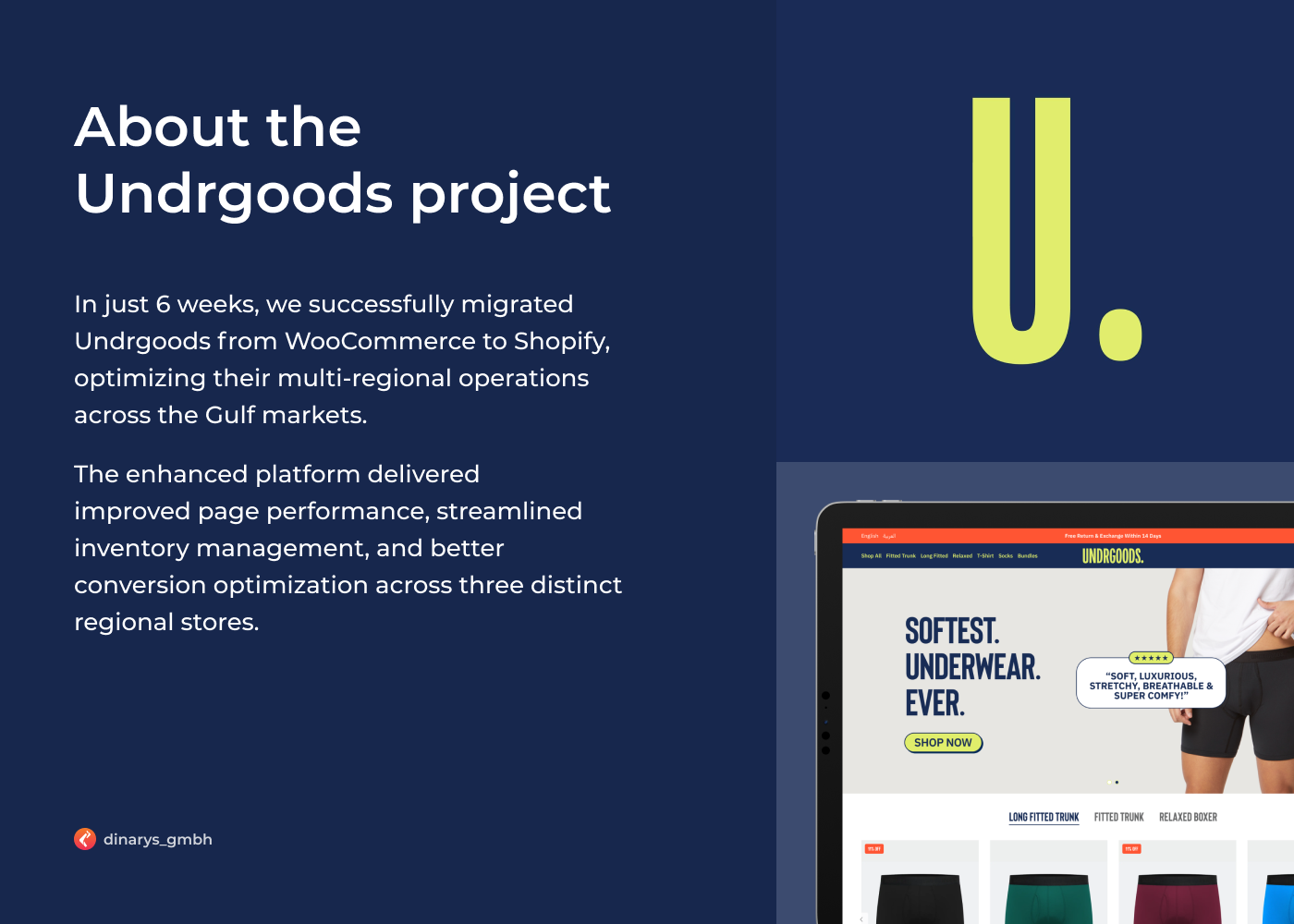
Even though WooCommerce is so flexible and can support many different goals and workflows, building the store the wrong way from the start can still lead to an avoidable migration later. Dinarys saw that in our Undrgoods project, where the store was eventually moved from WooCommerce to Shopify because the platform setup could no longer scale well enough to support its increasing business requirements.
That is exactly why building a store on WooCommerce requires care from the beginning. Poor decisions around plugin structure, custom code, integrations, or theme-level changes can create a range of challenges that slow down growth or even make further development much harder, especially if the internal team doesn’t have enough technical knowledge and expertise to fix them properly.
WooCommerce Pros and Cons: Why Businesses Use It and Where Challenges Surface
Many of WooCommerce’s strengths depend on the quality of the technical decisions. That is why the platform can work very well for some businesses and become difficult to handle for others.
Here’s why WooCommerce remains so widely used, what store development challenges tend to appear over time, and how the right, reliable partner can help businesses avoid or solve them:
Area
Where WooCommerce works well
Where limitations appear
How developers can help
Getting started
Easy to install, familiar to WordPress users, and flexible enough to launch with only the core plugin and selected extensions.
Poor early choices around themes, plugins, hosting, or store structure can create problems later.
Build the store on a cleaner foundation from the start.
Customizability
Supports many store types, custom features, and business workflows.
Quick fixes, overlapping plugins, and weak custom code can turn flexibility into technical debt.
Implement features in a stable, update-safe way.
WordPress ecosystem
Benefits from WordPress’s large ecosystem of tools, themes, and content capabilities.
Ecosystem size also brings uneven code quality and higher compatibility risk.
Choose reliable tools and avoid combinations that create long-term issues.
Content and SEO
Strong fit for stores that rely on content, landing pages, blogging, and search visibility.
Ecommerce logic, theme structure, and technical SEO requirements become harder to coordinate as the ecommerce site grows.
Keep the store technically clean while supporting content and search performance.
Plugin ecosystem
Large extension marketplace makes it possible to add functionality quickly.
Too many plugins can slow the store down, cause conflicts, and complicate support.
Decide what should be handled by plugins, custom code, or not added at all.
Design flexibility
Allows businesses to shape the storefront around the brand rather than follow a rigid template.
Brand-specific design often requires more than theme settings, including CSS, template edits, and custom frontend work.
Implement design changes without creating maintenance problems later.
Integrations
Can connect with ERPs, CRMs, shipping tools, accounting systems, and other external platforms.
Weak logic, limited testing, or poor support can make integrations fragile.
Protect core workflows and reduce the risk of broken sync, bad data, and operational disruption.
Performance
Can perform well with the right hosting, architecture, and code quality.
Bloated themes, too many plugins, or weak infrastructure can quickly reduce speed and stability.
Optimize performance before slowdowns affect user experience and conversion.
Scalability
Can support growth in catalog size, traffic, orders, and feature complexity.
Growth exposes weak architecture, plugin overload, and fragile integrations.
Prepare the store for growth instead of relying on short-term fixes.
Updates and maintenance
Active ecosystem allows for regular improvements to WooCommerce, plugins, and themes.
Updates can break custom features or integrations when the store isn’t built carefully.
Keep the store update-safe and reduce repeated rework.
Infrastructure and control
Businesses keep control over hosting, data, costs, and technical decisions.
More control also means more responsibility for uptime, security, backups, and long-term maintainability.
Make infrastructure decisions that support stability rather than limit it.
Complex business logic
Can support subscriptions, custom pricing, product configuration, and more advanced workflows.
Added logic can make the setup fragile and harder to maintain.
Implement advanced requirements in a structured way.
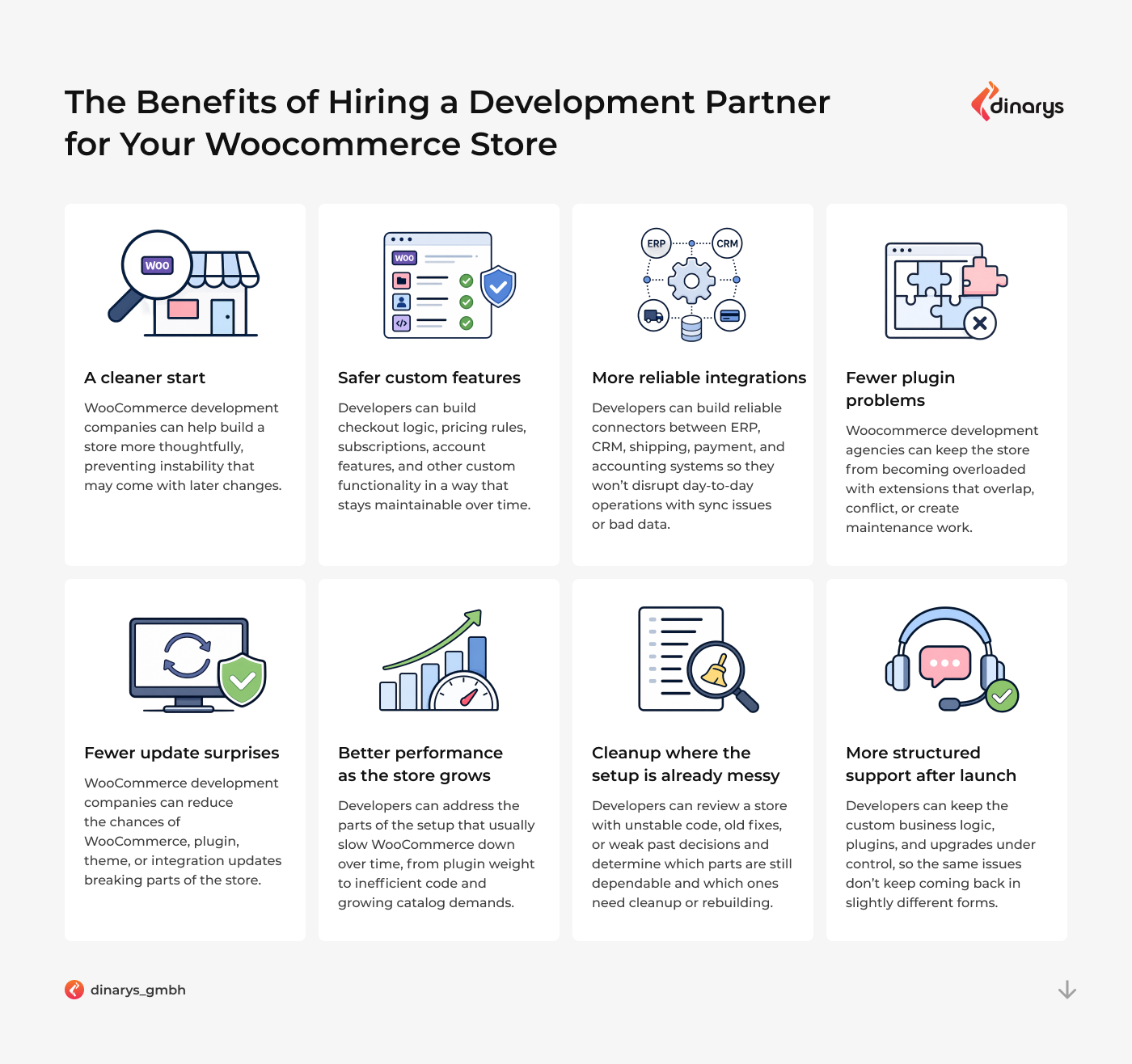
In practice, WooCommerce works well for many businesses, but its flexibility also means that store quality depends heavily on implementation. This is where most businesses are often better off hiring a development specialist.
IS YOUR WOOCOMMERCE STORE GETTING HARDER TO MANAGE?
Dinarys helps businesses fix weak customizations, improve integrations, optimize performance, and support WooCommerce stores as technical and operational demands grow.
WooCommerce is easy to start with. However, running it well requires deeper knowledge of code, custom CSS, and template edits, especially when your business is growing quickly and needs a store that can grow with it. It often makes more sense to let internal teams focus on how well the store meets customer needs and leave the technical side to the specialists who can help avoid costly mistakes and the time lost fixing them later.
If you need a developer, whether for launching a store, managing a migration, or improving its technical performance, we have prepared a framework to make that search easier.
How to Evaluate WooCommerce Software Development Companies
When evaluating WooCommerce development companies, look past general experience and focus on technical and architectural decisions that shape the long-term stability of the store. The points below will help you assess the areas that matter most.
#1: Evidence of real WooCommerce experience [research stage]
When starting your research, look for evidence (service pages, case studies, and portfolio descriptions) the vendor has experience working with different implementation challenges common for WooCommerce:
Plugin-heavy stores with growing conflict and maintenance risk
Custom checkout or pricing logic that goes beyond standard WooCommerce behavior
Subscription functionality that becomes harder to maintain as the store evolves
Fragile integrations that can disrupt core business workflows
Update-related breakage caused by weak customization or plugin dependency
Performance problems that require cleanup, optimization, or architectural fixes
This way you avoid potentially hiring a store development partner whose experience lies mainly in dealing with theme work, content-led WooCommerce websites or lighter storefront changes and not in the technical problems that affect store stability over time.
#2: The vendor’s actual WooCommerce service coverage [research and evaluation stage]
WooCommerce projects involve very different work depending on how far the store has moved beyond a basic setup. Before evaluating how mature the vendor’s process is, look for proof they can handle the relevant scope areas:
Build and customization:
WooCommerce store setup and custom implementation across storefront, checkout, product logic, and account flows
Theme and frontend work beyond basic template adjustments
Custom functionality that goes beyond standard plugins
Extensions and maintenance-heavy setups:
Plugin-heavy stores with conflict risk, update pressure, or overlapping functionality
Cleanup and refactoring of unstable custom code or patchwork customizations
Update-safe development that can hold up through WooCommerce, plugin, and theme changes
Integrations and operations:
Integration-heavy delivery involving ERP, CRM, shipping, accounting, payment, or other operational systems
Reliable handling of sync logic, data consistency, and workflow continuity across systems
Support work after launch, including updates, compatibility checks, issue resolution, and release management
Performance and growth:
Performance optimization for stores affected by theme bloat, plugin overload, weak hosting, or poor code quality
Scalability work for growing catalogs, higher traffic, more orders, and more complex store logic
Stabilization of existing stores that are already under technical pressure
Don’t rely on service lists alone. During research, check whether their case studies reflect the kind of WooCommerce work you actually need. During evaluation calls, ask them to walk you through a comparable project and explain what parts they handled directly.
#3: How the vendor assesses an existing WooCommerce setup [evaluation stage]
Many WooCommerce projects don’t start from a clean build. The store may already have years of accumulated plugins, unstable custom code, update-related breakage, performance issues, or unclear architecture.
Make sure the vendor explains how they assess the current setup before recommending changes or scoping new work. That should include:
The current plugin stack and overlapping functionality
Existing custom code, snippets, and theme-level changes
Integration points and possible dependency risks
Performance bottlenecks and update-related fragility
Ways to enhance user engagement and client satisfaction
The overall condition of the store before new work is estimated or prioritized
Weak assessment often leads to weak delivery. That, in turn, usually causes more conflicts, patchwork, and additional rework.
NEED A CLEARER VIEW OF WHAT IS ALREADY GOING WRONG IN YOUR WOOCOMMERCE STORE?
The Dinarys team can assess your setup, identify technical debt, and scope the right next steps before more changes create more instability.
#4: How the vendor handles WooCommerce customization [evaluation stage]
WooCommerce can be customized in several ways: plugins, snippets, template overrides, theme-level edits, or custom code. These approaches create different risks around updates, compatibility, performance, and future development.
This is worth discussing through real examples. Strong WooCommerce development companies should be able to explain:
Which implementation approaches they usually consider for custom WooCommerce requirements
How they decide between plugins, theme-level changes, template overrides, and custom code
How they reduce the risk of breakage during WooCommerce, plugin, and theme updates
How they assess possible conflicts with existing plugins, integrations, or custom code
How they think about new plugin dependencies and what those add to future maintenance
How they account for future changes to the feature after launch
You’d want your development partner to be able to explain their tradeoffs clearly and show that custom work is being planned with long-term stability in mind. This would help prevent hard maintenance, breaks during updates or redesigns, and conflicting with other parts of the store.
#5: How the vendor approaches WooCommerce performance and scale [evaluation stage]
WooCommerce performance depends on early build decisions. A store may launch without visible issues, then slow down as more plugins, features, integrations, products, and traffic are added. By that stage, the problem is usually spread across the setup rather than tied to one obvious cause.
It should be clear from the vendor’s answers whether they understand how WooCommerce performance problems build up over time. This should be reflected in how they talk about:
Plugin count and how much weight each extension adds to the store
Heavy themes and unnecessary frontend load
Hosting and infrastructure choices
Database-heavy features and query load
The effect of custom code and integrations on site speed
How catalog growth, traffic growth, and higher order volume change the load on the store over time
#6: Integration reliability in WooCommerce operations [evaluation stage]
Experience in syncing with third-party tools such as CRMs, ERPs, and payment gateways is important for complex integrations in WooCommerce. Integrations are part of the operational backbone, directly affecting critical business processes, from how orders and inventory are updated to how fulfillment is coordinated and customer data stays consistent across systems.
You should evaluate how WooCommerce development companies handle integrations that support day-to-day operations. Their answers should make clear:
How they usually structure data sync between WooCommerce and external systems
How they approach data consistency across orders, inventory, and customer records
What kinds of failure cases they plan for, such as delayed updates, retries, or mismatches
How they assess the operational impact when one connected system changes
How they reduce the risk of manual correction later
What support, monitoring, and issue handling look like after launch
#7: How the vendor handles updates, support, and ownership after launch [evaluation stage]
A WooCommerce store keeps changing after launch. WordPress, WooCommerce, themes, and plugins keep updating. Connected systems change too. The business adds new features, pricing rules, shipping options, promotions, products, and workflows. Traffic, orders, and catalog size grow. All of that makes the setup harder to keep stable.
This part of the evaluation is about whether the vendor has a clear way of supporting the store through those changes. Ask the vendor:
How they test updates before they go live
How they check compatibility across plugins, themes, custom code, and integrations
How they handle bugs, regressions, and urgent issues
How smaller fixes, releases, and ongoing changes are managed
What support they provide after handoff and where their responsibility ends
Without clear ownership, support tends to become slower and more reactive. Small issues get fixed in the moment, then return later because long-term responsibility is unclear.
Top WooCommerce Development Companies in 2026: Analyzed and Profiled
Now that we’ve covered the evaluation criteria, the next step is looking at WooCommerce development companies through the same lens. The shortlist below profiles WooCommerce development partners with relevant experience so you can match their strengths to your store’s technical needs, operating model, and growth plans.
IT Monks
IT Monks is a digital development agency focused on delivering custom ecommerce solutions based on WordPress. They offer WooCommerce builds, API integrations, custom plugin and subscription-related work, and ongoing support once the store starts becoming more demanding to run.
Location: New York, USA
Operating since: 2010
Team size: 50+
Related services: WooCommerce development services and custom functionality, API and third-party integrations, mobile app development, UI/UX design, maintenance and support, performance optimization, website migration, hosting, SEO
Selected clients: Daily Nourish, Only Options Trades
Dinarys
Dinarys is an ecommerce development company with strong WooCommerce experience in store setup, custom implementation, integrations, and technical support for businesses in various industries. We can help your business with migrations, performance optimization, and the broader technical work needed to support a more complex store.
Location: Berlin, Germany
Operating since: 2014
Team size: 80+
Related services: WooCommerce development services and custom functionality, integrations, migration and replatforming, performance optimization, mobile app development, UI/UX design, maintenance and technical support, ecommerce consulting
Selected clients: Undrgoods, Lucidera, ALEXASCHA
Neuralab
Neuralab is a web design and development agency specializing in visually strong, user-friendly ecommerce stores and scalable WooCommerce builds. The company creates setups that stay flexible and ready to grow with the business.
Location: Zagreb, Croatia
Operating since: 2008
Team size: 50+
Related services: WooCommerce development services and custom functionality, APIs and integrations, UI/UX design, QA, hosting and DevOps, maintenance and support
OSOM Studio is a WordPress and WooCommerce development agency working with businesses that need stable ongoing development, especially when the setup was inherited from another agency and requires cleanup, stabilization, and long-term support.
Location: Łódź, Poland
Operating since: 2012
Team size: 50+
Related services: WooCommerce development and custom functionality, APIs and integrations, UI/UX design, mobile app development, code audits, maintenance and support, hosting
Vova Creative is a WordPress web design agency that also works extensively with WooCommerce. They focus on building custom stores with equal attention to design and functionality.
Location: Kenilworth, UK
Operating since: 2015
Team size: 11
Related services: WooCommerce development services and custom functionality, plugin and theme development, UI/UX design, performance optimization, maintenance and support, hosting
Selected clients: Lyme Bay Winery, Dasune
Digital Silk
Digital Silk is a web design company offering a wide range of WooCommerce services. Their expertise is in combining web design and development, branding, and digital marketing to support business growth.
Location: Miami, USA
Operating since: 2015
Team size: 150+
Related services: WooCommerce development and custom functionality, UI/UX design, ecommerce strategy, frontend implementation, plugin development, QA and launch support, maintenance and support, branding, digital marketing
Selected clients: Rollink, Paul Stuart, Buddha Brands, Babies R Us
A Final Word on WooCommerce Development Companies
WooCommerce is an easy and justifiable pick for a starting brand, yet the platform gets increasingly harder to manage once your business requirements grow. Too many plugins that conflict with each other, old custom code that didn't age well and causes performance issues, and fragile integrations that break under the operational load are some of the examples of those technical limitations that growing businesses face.
Hence, the importance of having a reliable WooCommerce web development agency, even early on, becomes quite obvious. If you’re planning for growth, you’d only benefit from having a team to build a store that stays stable with updates and increasing requirements. Use the shortlist as a starting point and the evaluation criteria to narrow the field. The goal should be a WooCommerce store that can grow together with your business without piling up avoidable maintenance.
NEED A WOOCOMMERCE PARTNER FOR THE NEXT STAGE OF GROWTH?
Dinarys can help your business reduce technical debt, improve store stability, and support WooCommerce setup as requirements and complexity grow.
A top-tier development company should demonstrate deep knowledge of WooCommerce's unique architecture beyond basic WordPress setup. Use the shortlist we assembled as the starting point. You can go through each company's portfolio and case studies, then check whether their work actually matches your business goals. Moreover, reputable WooCommerce developers are often verified as WooExperts, a certification granted by WooCommerce to agencies with a proven track record. Also, platforms like Codeable pre-screen developers through technical exams and live coding tests to provide vetted networks for WooCommerce, so you can check them too.
Typical custom development work includes custom checkout flows, product logic, account features, integrations, and subscription or B2B functionality. It can also cover theme customization, especially when the store needs to reflect a specific brand or support workflows that standard templates do not handle well.
It is very important as WooCommerce stores keep changing constantly. Many of the best WooCommerce development agencies provide ongoing support and maintenance services to ensure that online stores remain secure and functional after launch. Good maintenance services should cover routine updates, security, and compatibility checks. Effective post-launch support should also include the ability to address unexpected issues (update-related breakage, custom plugin compatibility failures, custom code regressions, and integration failure) quickly, which is essential for keeping ecommerce operations running smoothly.
A reliable partner should build for growth early. That usually means cleaner architecture, careful plugin choices, and a setup that can handle more products, traffic, and integrations without losing operational efficiency. Choosing an agency with a proven track record of speed optimization and database tuning is crucial for handling thousands of SKUs in WooCommerce. Regular performance audits and optimizations are recommended for WooCommerce stores to ensure they remain competitive, as ecommerce platforms evolve and user expectations increase.
Yes, but not in the same way. WooCommerce is an open-source plugin that allows developers full freedom and responsibility for a store's security, hosting, and database optimization. The platform works well for smaller businesses that need a flexible online store without a heavy platform commitment. It can also support larger operations, but only when the setup is built for scale with enterprise WooCommerce solutions like custom integrations, stronger hosting, and update-safe custom development. Moreover, complex projects like B2B wholesale stores require different logic than high-volume retail or subscription-based services due to bulk pricing and password-protected portals.
You may share this article
Let professionals meet your challenge
Our certified specialists will find the most optimal solution for your business.