Shopify is often seen as an easy-to-use ecommerce platform that’s suitable for quick launches and lightweight online stores. But this reputation is outdated. Over time, Shopify has evolved into a sophisticated commerce platform that supports:
complex business models
high transaction volumes
international operations
deeply integrated technical ecosystems
As Shopify has expanded its capabilities (in recent years, the platform has introduced Shopify Plus, native B2B features, advanced APIs, checkout extensibility, and support for headless and composable architectures), the nature of Shopify development has changed as well. Building and maintaining a Shopify-based business nowrequires architectural thinking, integration expertise, performance planning, and long-term technical stewardship.
Given this, it’s more important than ever to work with an experienced Shopify development company. Surface-level familiarity with the platform is no longer sufficient. Thus, a logical question arises:
What Shopify development company is suitable for my project?
In this article, we answer this question along with others:
How should I choose a Shopify development partner?
Why do modern Shopify projects require experienced teams, and which core areas of expertise matter?
How can I shortlist vendors effectively based on proven Shopify experience rather than marketing claims?
Shopify’s evolution from simple storefronts to complex commerce systems: Why more expertise is required
In its early stages, Shopify enabled businesses to launch online stores with minimal technical effort. Shopify-driven online stores — built on standard themes, basic checkout flows, and a growing app ecosystem — made it possible to get to market quickly. For small catalogs, single-region operations, and straightforward fulfillment models, this approach worked well.
But Shopify implementations became more complex as brands:
expanded into multiple markets
introduced new sales channels
adopted subscription or B2B models
integrated ecommerce into their broader operational infrastructure
Shopify responded by expanding the platform’s capabilities instead of keeping their scope limited.
As a result, Shopify is no longer just a storefront layer. In many cases, it functions as a core component of a company’s digital commerce stack, interacting with ERPs, CRMs, PIMs, inventory management systems, payment providers, and analytics platforms. Decisions made during Shopify implementation can have long-term consequences for scalability, performance, and operational efficiency.
This is why experienced technical assistance has become essential for many Shopify projects.The challenge is not simply to build on Shopify but to design comprehensive solutions that remain stable and adaptable as the business evolves.
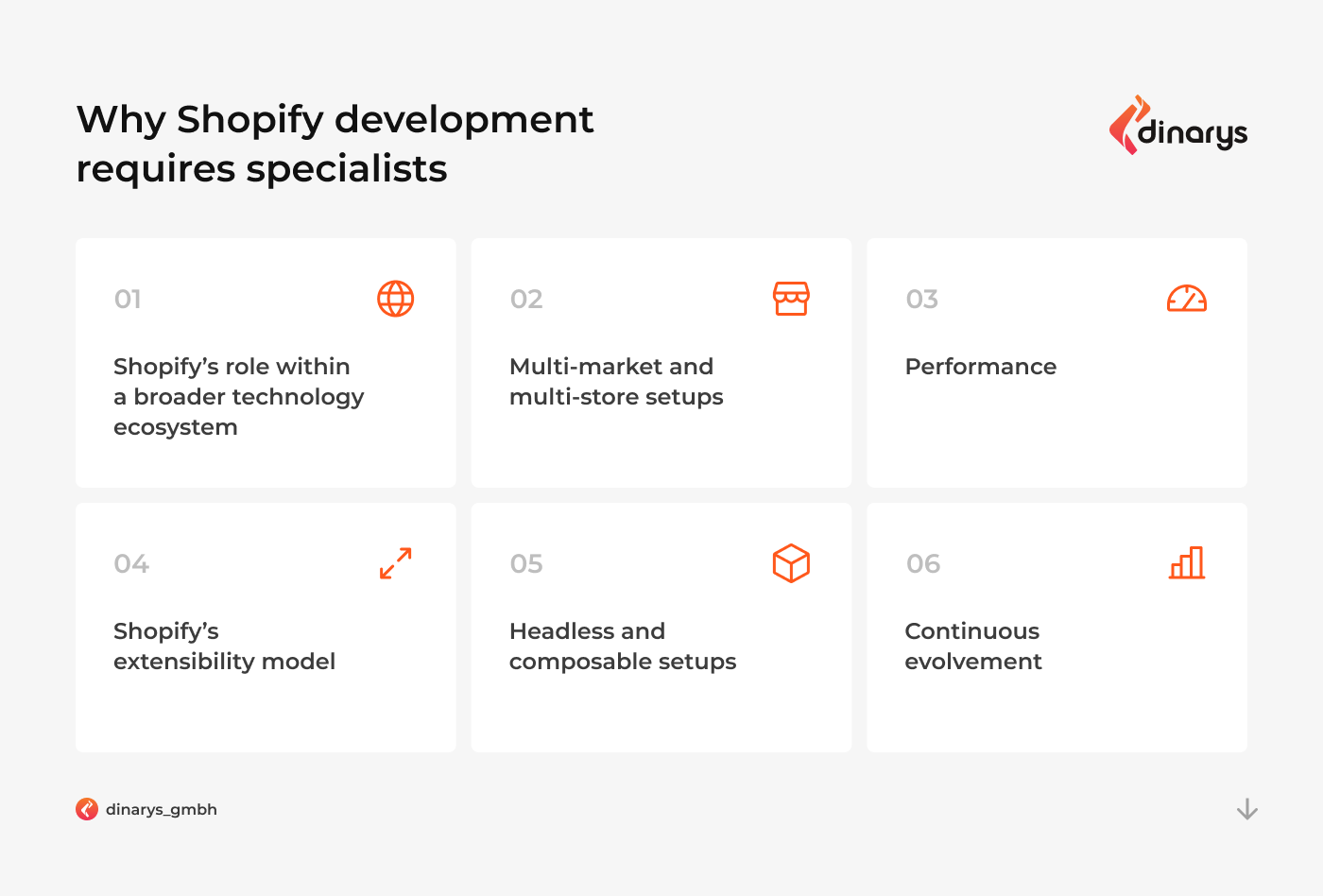
6 reasons why you need to look for experienced Shopify agencies
As soon as you grow beyond a single-market, low-volume store, setting up Shopify will involve architectural decisions and technical trade-offs. Here are five key reasons why you need an experienced Shopify development partner by your side:
Reason #1: Shopify’s role within a broader technology ecosystem
One of the primary sources of complexity is Shopify’s role within a broader technology ecosystem. Modern Shopify stores rarely operate in isolation. They are typically connected to ERPs, inventory and warehouse systems, PIMs, CRM platforms, analytics tools, and payment providers.
Designing these integrations requires a clear understanding of Shopify’s APIs, webhook behavior, data consistency limitations, and failure scenarios.
Risks: Poorly designed integrations often lead to sync issues, operational bottlenecks, and fragile dependencies that surface only after launch.
Reason #2: Complexity of multi-market and multi-store setups
Supporting different regions, currencies, tax rules, pricing models, and content variations within Shopify requires careful planning of store architecture and data structures. Decisions regarding multi-store management setup, market expansion, or adopting a hybrid approach to developing your store directly affect operational overhead, reporting, and long-term scalability. These aren’t purely configuration choices; they have lasting technical and organizational implications.
Reason #3: Performance degradation over time
As stores grow, they accumulate third-party apps, custom scripts, tracking tools, and integrations that all require resources. Even small frontend or app-level decisions can significantly affect load times and conversion rates.
Shopify experts understand how performance gradually degrades and how to prevent it through architectural discipline, selective app use, and ongoing monitoring.
Reason #4: Shopify’s extensibility model
Features such as checkout customization, Functions, Scripts, and custom apps provide powerful ways to adapt the Shopify platform, but they also introduce constraints around execution order, scope, and maintainability. When extension points are used carelessly, businesses end up with setups that are hard to maintain — and even harder to debug.
Knowing when to extend Shopify (and when not to) is a key marker of technical maturity.
Reason #5: Challenges of headless and composable commerce setups
While Shopify supports headless architectures, adopting them affects frontend responsibility, deployment workflows, team structure, and cost.
The best Shopify development companies can explain not only how to implement headless Shopify but also when its complexity outweighs its benefits and what intermediate or hybrid approaches may be more appropriate.
Reason #6: Continual evolution
APIs change, features are deprecated, and new capabilities are introduced regularly. Stores that are not built with maintainability in mind struggle to adapt to these changes without disruptive rework. Experienced Shopify website development companies design custom solutions that anticipate platform evolution, allowing businesses to adjust over time without constant architectural resets.
These factors mean that modern Shopify development is less about fast delivery and more about sustained technical ownership. Top Shopify developers understand that complex projects will need to be supported for a long time, and they structure their work accordingly.
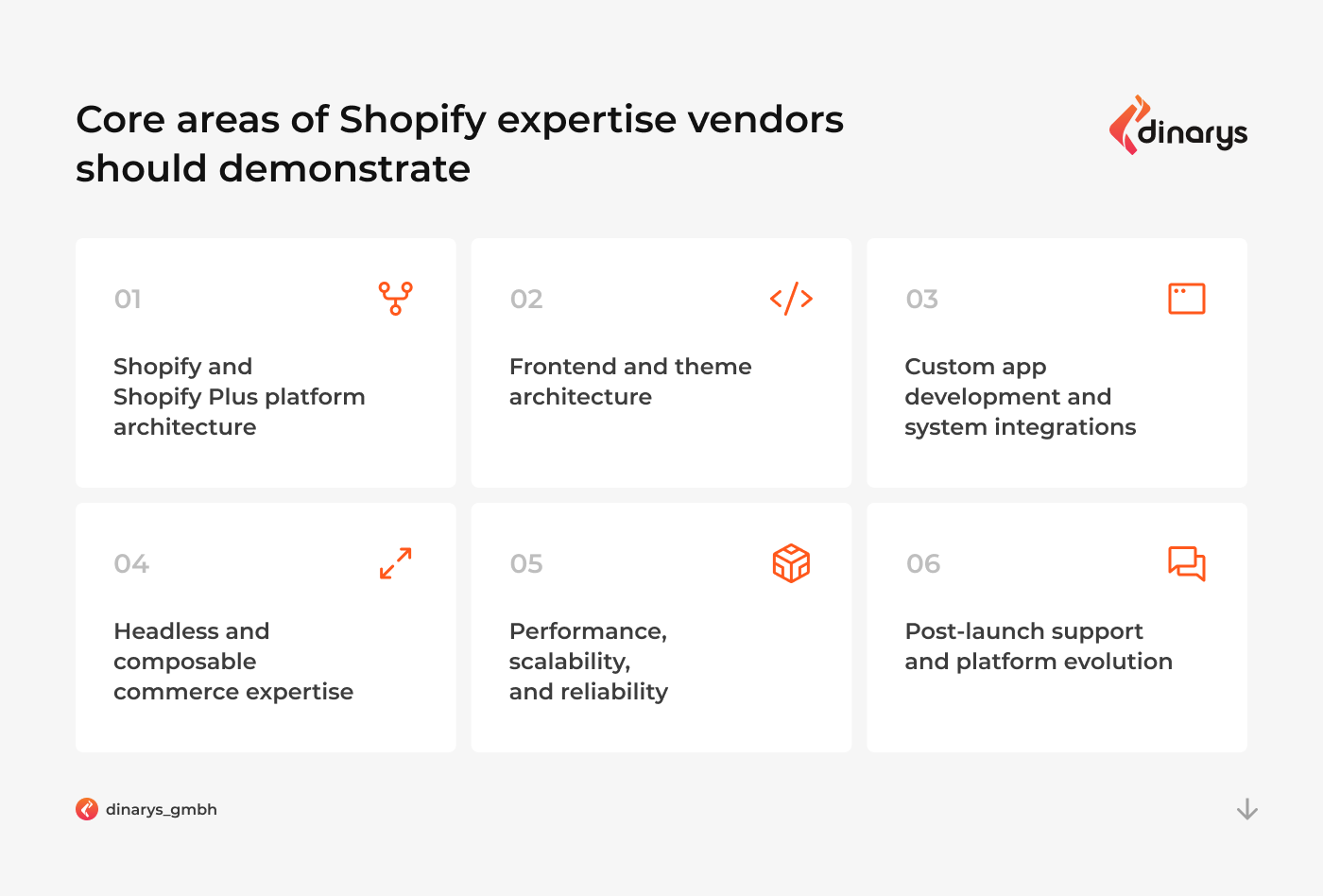
Core expertise that Shopify development agencies should demonstrate
Your Shopify development partner should have practical experience in these areas:
Shopify and Shopify Plus platform architecture
Experienced Shopify ecommerce development companies see Shopify not only as a feature set but as a platform with specific architectural constraints. They are well-versed in Shopify Plus capabilities, native B2B features, checkout extensibility, Functions, and platform governance mechanisms. More importantly, mature teams can explain how these elements interact and where limitations exist.
This expertise shows up in decisions around data modeling, extensibility boundaries, and long-term maintainability. Vendors with real platform experience are also comfortable explaining when Shopify is a strong fit and when it can’t accommodate certain requirements.
Front-end and theme architecture
Front-end work on Shopify sites goes beyond visual implementation. Vendors should demonstrate an understanding of how theme structure, Liquid use, asset loading, and third-party scripts affect performance, accessibility, and SEO optimization. As stores grow, these aspects become critical to maintaining conversion rates and user experience.
Experienced teams design themes for ecommerce stores with maintainability in mind, avoiding shortcuts that lead to fragile codebases. They also understand how front-end decisions impact future changes, testing, and ongoing optimization.
Custom app development and system integrations
Many Shopify implementations depend on custom apps and integrations to support core business processes. Shopify firms should have hands-on experience building private or public apps, working with Shopify APIs, handling webhooks reliably, and designing integration layers that can tolerate failures and retries.
This area reveals whether a vendor understands operational realities. Poorly designed integrations tend to break silently, cause data inconsistencies, or require constant manual intervention. Experienced e-commerce development companies plan for these scenarios up front instead of reacting to them after launch.
Headless and composable commerce expertise
Headless Shopify is often presented as a universal upgrade, but in practice it introduces additional complexity. Mature Shopify store development companies can explain the trade-offs involved: increased front-end responsibility, deployment complexity, coordination between teams, and higher ongoing costs.
True technical expertise shows in the ability to recommend headless approaches selectively, explain hybrid alternatives, and align architectural choices with business maturity, internal capabilities, and long-term goals.
Performance, scalability, and reliability
Performance issues in Shopify rarely appear all at once. They tend to accumulate through traffic growth, app use, and incremental customization. Vendors with real experience understand how performance degrades over time and how to prevent it through architectural discipline and continuous monitoring.
Scalability also includes operational scalability: how easily teams can introduce changes, onboard new regions, or support growth without destabilizing the platform. These capabilities separate experienced vendors from those focused only on initial delivery.
Post-launch support and platform evolution
Shopify projects aren’t static. New features, API changes, and evolving business needs require ongoing technical involvement. Vendors should be able to explain how they support stores after launch, manage updates, and help clients adapt without constant rewrites.
A vendor’s approach to post-launch support and platform evolution reveals their mindset. Teams that think in terms of long-term platform stewardship tend to build more resilient solutions than those focused solely on launch milestones.
What distinguishes top Shopify agencies is not the number of services they list but their ability to understand, work with, and discuss trade-offs, risks, and long-term implications.
How to shortlist Shopify app development companies and assess fit
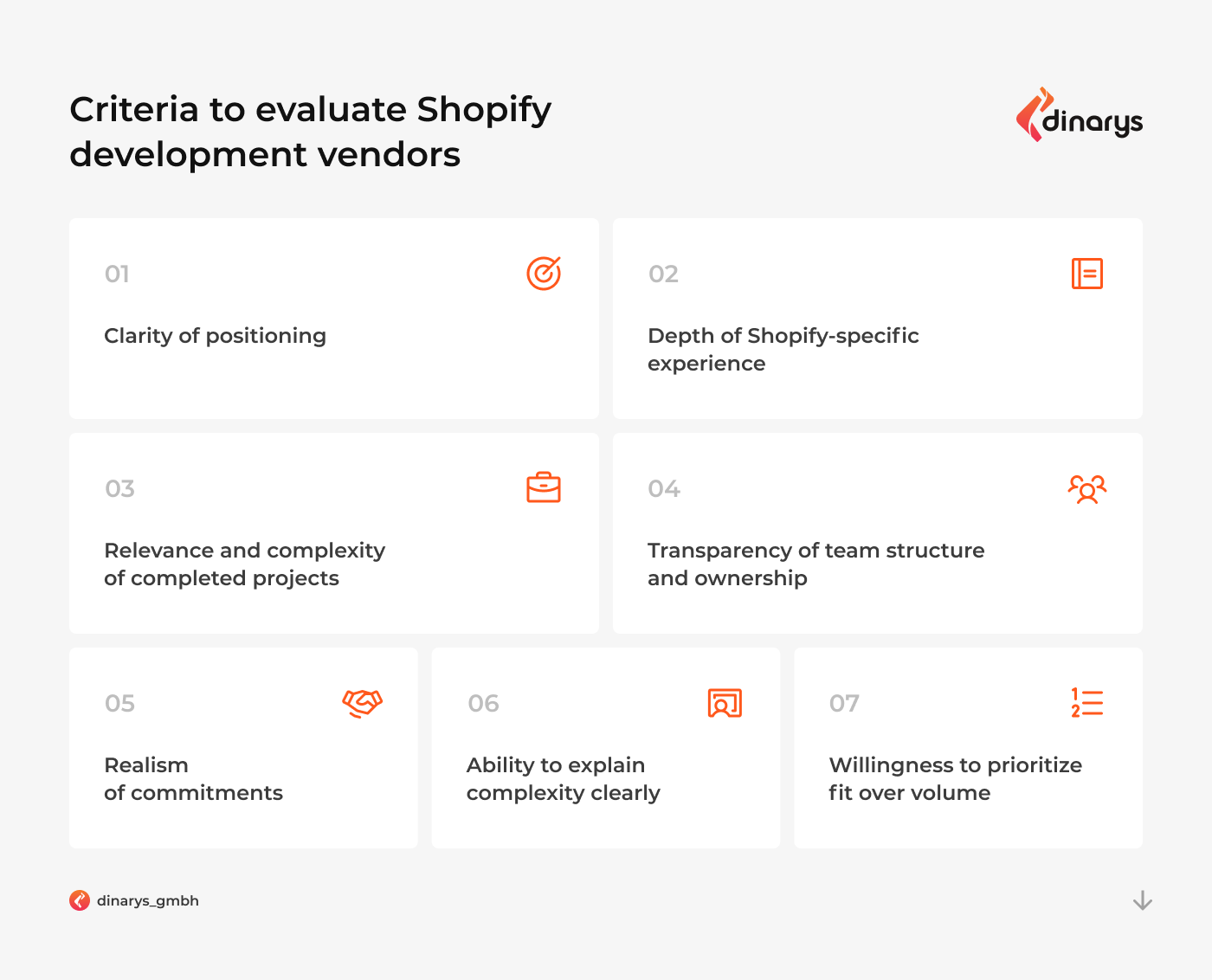
At the research stage, your goal is not to select a vendor immediately but to narrow the field to Shopify web development companies whose experience aligns with your business needs. The following criteria will help you assess Shopify development companies and their Shopify development expertise.
Clarity of positioning
Top Shopify development companies are clear about who they work with. They openly describe the types of ecommerce businesses, industries, and projects they support. This clarity helps you quickly assess relevance and avoids misalignment after the contract is signed.
Vendors that claim to work equally well with businesses of all sizes and with all engagement models often lack focus.
Depth of Shopify-specific experience
Pay attention to how vendors talk about Shopify. Practical experience shows up in discussions of real operational challenges — performance under load, integration limitations, maintenance overhead — not just in lists of features or tools. Expertise can also be shown through participation in the Shopify Development Partners network.
Relevance and complexity of completed projects
Case studies in the company’s portfolio should provide context: business problems, constraints involved, decisions made. Projects involving multi-store setups, complex integrations, or long-term platform evolution are usually informative.
Transparency of team structure and ownership
Understanding who is responsible for delivery matters. Vendors that openly show their team structure, leadership roles, and technical ownership tend to provide more stable and accountable delivery.
Realistic commitments
Experienced Shopify vendors avoid absolute promises. Instead, they explain assumptions, dependencies, and factors that influence scope, timelines, and outcomes. This realism is a strong indicator of delivery maturity.
Ability to clearly explain complexity
How a vendor explains Shopify architecture, integrations, and performance issues is often more telling than what they claim to deliver. Calm, structured explanations focused on reasoning and business impact signal real expertise.
Willingness to prioritize fit over volume
Mature vendors are selective. They are willing not to deliver projects that fall outside their expertise or capacity. This selectivity usually reflects confidence in their delivery model and respect for long-term outcomes.
Not sure which of these areas matter most for your Shopify setup?
A short expert review from Dinarys can help you understand where complexity is likely to appear in your project and what kind of Shopify expertise you actually need before moving forward.
The Shopify website design agencies listed below were selected based on their experience with Shopify and Shopify Plus and their well-defined approach to ecommerce delivery. This is not a ranking. It is a curated selection of vendors whose work reflects practical Shopify expertise, technical maturity, and an understanding of real operational requirements.
Superco
Superco is an award-winning Shopify agency that specializes in complex, high-growth ecommerce projects. They help brands design, build, and scale Shopify-based platforms, with a strong focus on performance, UX, and advanced Shopify Plus capabilities.
Company profile
Headquarters: London, United Kingdom
Operating since: 2019
Top clients: Represent, Allbirds, Ursa Major, Puresport, Tileflair, Myomaster
Shopify services: Shopify Plus store design & development, migration services, customizing Shopify themes, UX & conversion optimization, subscription & retention strategy, growth & optimization support
Lumina Commerce is a Shopify-focused ecommerce agency that helps brands launch and improve Shopify stores. Their work is centered on custom Shopify development, optimizing storefronts, and supporting day-to-day ecommerce operations for growing businesses.
Company profile
Headquarters: Dubai, United Arab Emirates
Operating since: 2018
Top clients: Keto Kartel, Vivent, House of Pops, Nira Store, Zmilelee
Shopify services: Shopify ecommerce website development, custom store builds, theme customization, UX/UI and performance optimization, web design, analytics setup, payment gateway integration, ongoing support
Dinarys is an ecommerce software development company that works with Shopify and Shopify Plus for B2B and B2C businesses. The Dinarys team helps companies build, modernize, and scale Shopify platforms that support real operational and integration requirements.
Company profile
Headquarters: Berlin, Germany
Operating since: 2014
Top clients: Toyota, Accenture, BORN, Panodyssey, Vaimo, Prostor, SanMar Canada
Shopify services: Shopify & Shopify Plus development, Shopify-based mobile app development, Shopify store setup, Shopify migration, custom store builds, consulting, performance optimization, integrations, UX audits, Shopify store design, cross-platform solutions, custom theme development
Innowise is a full-cycle software development company that provides Shopify development as part of broader ecommerce and system integration projects. Their Shopify work is typically embedded in larger digital ecosystems rather than standalone storefront builds.
Company profile
Headquarters: Warsaw, Poland
Operating since: 2007
Top clients: LVMH, Nike, Siemens, The Walt Disney Company, Costco, Accenture, Nvidia, Mastercard, Nestlé
Shopify services: Innowise is primarily a full-cycle software development company; Shopify capability is not a core focus, but they can support ecommerce and integrations as part of broader software services.
Certified Shopify partner? Yes
VALMAX
VALMAX is an ecommerce development agency that works with Shopify and Shopify Plus for brands at different growth stages. The team focuses on custom Shopify builds, design-driven storefronts, and integrations that support both marketing and operational needs.
Company profile
Headquarters: Chicago, USA
Operating since: 2019
Top clients: FewOfUs, Lotus Leggings, Fartum, NewMind, SnoopGame
Shopify services: Custom Shopify store development, Shopify Plus projects, omnichannel ecommerce design & development, integrations, B2C/B2B/Marketplace/Subscription commerce implementation
Certified Shopify partner? Not stated
Voodoo Digital
Voodoo Digital is a Shopify development agency that works primarily with direct-to-consumer (DTC) and growing ecommerce brands. The team delivers Shopify and Shopify Plus solutions with an emphasis on custom development, integrations, and long-term store performance.
Company profile
Headquarters: Kyiv, Ukraine
Operating since: 2019
Top clients: Magdych, Katsurina, GudFood, U-R-SO
Shopify services: Full Shopify development (store creation & customization), Shopify Plus support, Shopify app development, headless/B2B builds, integrations, performance optimization, migrations, technical SEO & marketing strategy support (Meta/TikTok/Google)
Certified Shopify partner? Yes
Vaimo
Vaimo is a global ecommerce development partner with strong expertise in Shopify and Shopify Plus. The company supports mid-market and enterprise businesses with complex Shopify implementations, integrations, and long-term platform evolution.
Company profile
Headquarters: Stockholm, Sweden
Operating since: 2008
Top clients: WEG, Diptyque, JDE Peet’s, BAUHAUS, Tarkett, Runnings
Shopify services: Shopify & Shopify Plus development, headless commerce, custom integrations, performance optimization, long-term ecommerce delivery support
Certified Shopify partner? Yes
Summing up the best Shopify development companies 2026
Choosing a Shopify agency is less about finding a well-known vendor and more about identifying a team whose experience matches the needs of your business. As Shopify has evolved into a platform that supports complex architectures, deep integrations, and long-term operational workflows, the quality of technical judgment behind each implementation has become increasingly important.
The right Shopify vendor should be able to explain not only what they can build but why certain decisions make sense in your context — and where limitations or trade-offs exist. Clear positioning, relevant project experience, transparent delivery structures, and realistic commitments are often stronger indicators of success than platform badges or polished portfolios.
Choosing the right Shopify development partner is easy when you have clear expectations.
If you’re at the research stage and want to validate your options, a focused conversation can help you assess fit, risks, and next steps — before committing to an architecture or scope of work.
Modern Shopify projects go far beyond basic Shopify design and theme selection. As ecommerce platforms evolve, businesses increasingly rely on advanced customization, performance optimization, and integrations that directly affect core web vitals, scalability, and conversion rates. These technical decisions influence how users interact with the store and how well it adapts to changing customer behavior.
Unlike simpler setups on platforms such as WooCommerce platforms, Shopify projects often involve complex trade-offs between speed, flexibility, and maintainability. Experienced teams understand how to align technical architecture with business goals, ensuring that design, performance, and functionality support long-term growth rather than short-term launches.
Strong Shopify development companies don’t rely on one-size-fits-all templates. Instead, they provide tailored solutions based on the specific needs of the e-commerce business, taking into account the operating model, integrations, and growth plans. This often includes advanced customization, structured split development approaches, and close alignment between the Shopify platform, internal systems, and external tools.
Tailored solutions also consider how digital marketing, analytics, and user experience work together. Vendors with real experience connect modern design choices to customer journeys and measurable outcomes, ensuring that the e-commerce platform supports both marketing performance and operational stability.
Mature Shopify vendors approach delivery realistically. Rather than promising instant results, they focus on timely delivery, strong quality assurance, and clearly defined areas of responsibility throughout the project. This includes testing for performance, stability, and compatibility with future platform updates.
Experienced teams also recognize that Shopify development doesn’t end at launch. Long-term support, post-release optimization, and continuous improvement are essential — especially for businesses working with platforms like Shopify Plus. This approach helps ensure that your Shopify solution continues to meet evolving business goals as the Shopify platform and markets evolve.
A reputable Shopify development company will follow a clear process with these stages: discovery, UX/UI design, development, testing/QA, and launch.
The Shopify development process also covers planning and requirements definition, store and feature development, integrations with third-party systems, testing, launch preparation, and ongoing support. The exact structure may vary, but a well-defined process ensures that technical decisions align with business needs and remain manageable over time.
A reputable Shopify development company usually starts the development process with understanding business goals, existing systems, and operational constraints. This includes reviewing the current store (if one exists), defining requirements, and deciding whether the project will involve building a new Shopify store, migrating an existing store, or gradually improving an existing Shopify setup.
The next stage focuses on implementation. This may include theme customization or developing a custom storefront; selecting apps (or building custom apps); integrating with ERP, CRM, payment, and other systems; and configuring Shopify features based on the business model. Testing is typically done alongside development to ensure stability, performance, and correct data flows.
After launch, mature Shopify vendors continue supporting the store through monitoring, updates, and iterative improvements. This phase often includes performance optimization, feature adjustments, and technical support as business needs evolve. A structured process helps ensure that Shopify development remains manageable and aligned with long-term business requirements, rather than ending at go-live.
Online buying is becoming more flexible and more demanding at the same time. In 2026, the landscape for Shopify development will be led by agencies specializing in enterprise-scale Shopify Plus builds, headless commerce, and global internationalization. Customers expect fast stores, simple checkout, and a consistent experience across devices and channels. On the business side, this often means supporting subscriptions, B2B purchasing, multiple regions, and new ways of selling without disrupting existing operations. It’s also important that over 75% of purchases are expected to be mobile-driven in 2026 (according to Statista), which calls for extensive work on either responsive design (for ecommerce web applications) or custom mobile app development.
Shopify development supports these trends by allowing businesses to adapt their stores over time by improving performance, adding integrations, and adjusting storefront logic as requirements change. Features such as headless setups and AI-based tools can be introduced where they make sense (for example, to improve search, personalization, or content management) without overhauling the entire platform.
Shopify development works best when it helps businesses respond to real changes in how customers buy and how teams operate while keeping the platform stable and manageable.
In 2026, a reputable Shopify development company should be able to handle advanced AI integrations, headless commerce, and performance optimization. Advanced ecommerce solutions that Shopify supports include complex pricing and discount logic, subscription models, B2B purchasing with customer-specific catalogs, and multi-store or multi-region setups for international businesses. With the right configuration and development approach, Shopify can support both simple and complex sales models.
For businesses with more demanding requirements, Shopify allows for deeper customization through custom apps, API-based integrations, and flexible storefront development. This makes it possible to connect Shopify with ERP, CRM, inventory, and fulfillment systems, or to tailor the buying experience to specific customer groups.
A Shopify development company gives businesses access to experience that goes beyond basic store setup. Hiring a Shopify development company: 1) enhances store performance for higher conversions; 2) provides customization that matches brand identity and user experience goals; 3) ensures multi-store capabilities and advanced automation for scalability.
Dedicated teams understand how to structure stores, handle integrations, and make technical decisions that support performance, security, and long-term maintainability. This reduces the risk of issues that often appear when stores grow or requirements change. Expert developers handle Shopify integrations with apps, APIs, and automation tools to simplify operations.
Another benefit of working with a dedicated Shopify development company is efficiency. Experienced Shopify developers can identify potential problems early, recommend suitable solutions, and implement changes in a structured way. This helps businesses avoid trial-and-error approaches and keeps development focused on operational needs rather than short-term fixes.
You may share this article
Let professionals meet your challenge
Our certified specialists will find the most optimal solution for your business.