If you're running a growing ecommerce business and have landed on this article, you’ve likely reached a point where your current tools are starting to feel a bit tight. That’s usually when Shopify Plus enters the conversation, leaving you to wonder if it’s a genuine step up or just a more expensive version of what you already use.
Instead of leaning on the hype, it’s more helpful to look at the practical transition from a standard plan to an enterprise-grade platform. This means looking at exactly where the move changes your day-to-day, whether that’s streamlining messy back-end operations or finally making global expansion feel manageable.
Moving to a new platform is a serious decision, and it’s only worth it if the investment leads to real gains, like smoother operations and faster growth. That’s why this guide focuses on the areas where Shopify Plus tends to make the biggest difference for growing businesses. We've broken things down to show exactly how the platform can deliver meaningful results where it counts most:
Customization and control: A look at how Shopify Plus benefits give you the freedom to tailor the checkout experience and automate the manual tasks that often slow down a growing team.
The investment and ROI: A practical breakdown of the costs and the specific ways (like lower fees and fewer app subscriptions) the platform can pay for itself.
When to make the move: The specific growth milestones, such as high order volume or global expansion, that indicate you've outgrown a standard setup.
Consolidating your operations: How Shopify Plus benefits bring your retail, wholesale, and physical storefronts together so they finally function as a single, synchronized system.
Shopify vs Shopify Plus Features and Prices: How the Plans Differ
As a business grows, its requirements naturally become more complex, shifting from basic storefront management to the demands of large-scale, global operations. Shopify offers a range of plans designed to meet these different stages, whether you’re just getting off the ground or managing a high-volume enterprise.
Understanding the jump to Shopify Plus requires looking at where the standard plans (lower tier Shopify plans) begin to reach their limits. This comparison emphasizes the specific points where the two paths diverge, focusing on how the shift in functionality aligns with the necessary increase in investment.
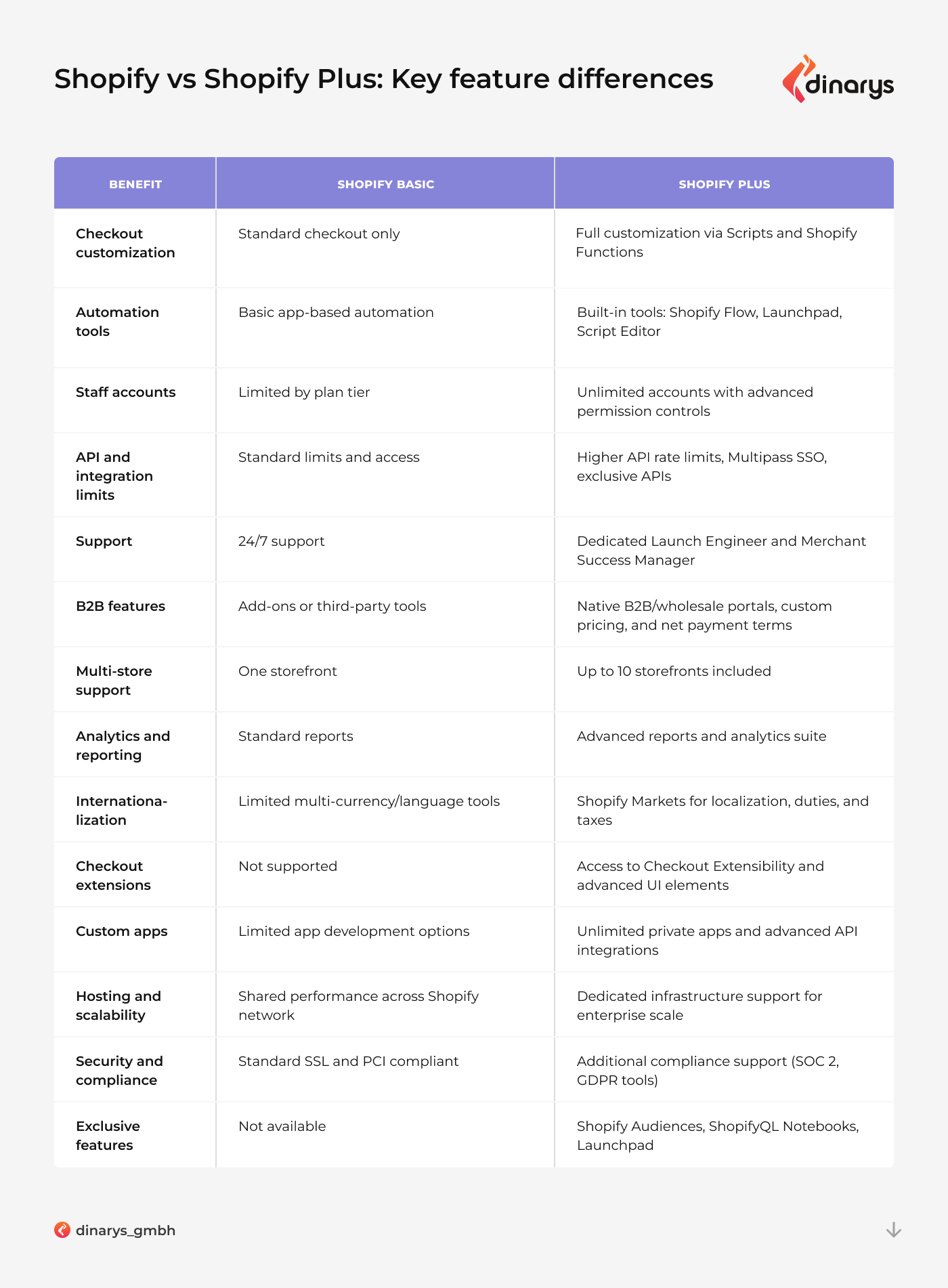
Shopify vs Shopify Plus: Key feature differences
Shopify Plus is more than just a higher tier; it’s a fundamental change in how much control you have over your online store. While standard plans are built to be user-friendly right out of the box, Plus is designed for businesses that need to bend the platform to fit their specific operational needs.
Here is a look at the features that define that shift:
These features make Shopify Plus ideal for businesses with complex workflows, large teams, multiple stores, need for unlimited bandwidth, and international operations.
However, while the platform itself is already powerful enough, getting the most out of these enterprise tools often requires a customized approach. If you're looking to build custom workflows or a unique storefront, you can explore our Shopify Plus development services to see how we help brands create the strong connection between standard features and custom business needs.
Shopify vs Shopify Plus: Pricing Comparison
One of the clearest distinctions between standard Shopify plans and Shopify Plus is the price tag. The standard tiers work well for small shops, but as a brand begins to scale, the limitations can get in the way. That’s where Plus steps in, as it's built for businesses that need more power, flexibility, and control.
Sure, the cost is higher, but it’s less about a monthly bill and more about investing in infrastructure that supports long-term growth. For brands with large volumes of sales, the real value lies in having a platform that stays out of the way, quietly handling the major tasks while you focus on bigger goals.
Plan
Monthly Cost
Transaction Fees (w/o Shopify Payments)
Staff Accounts
Support Level
Target Business Size
Basic Shopify
$39/month
2.9% + 30¢
Up to 2
24/7 email/chat support
Small startups or side hustles
Shopify
$105/month
2.6% + 30¢
Up to 5
24/7 email/chat/phone support
Growing small businesses
Advanced
$399/month
2.4% + 30¢
Up to 15
Priority support
High-growth SMBs with analytics or shipping needs
Shopify Plus
From $2,000/month (variable)
1.6% or lower (negotiable)
Unlimited
Dedicated account manager + priority access
Mid-market to enterprise businesses
For most businesses, the cost of Shopify Plus pays off through a mix of higher revenue and smoother operations. Over time, its built-in, advanced features also help cut down on the need for custom builds and reduce the maintenance load, saving both time and money in the long run.
GET THE MOST OUT OF YOUR MOVE TO SHOPIFY PLUS
Learn how our team helps you bridge the gap between standard features and the custom setup your business needs, as well as minimize maintenance and maximize ROI.
Shopify Plus: What Types of Businesses and Operations This Plan Is Best Suited For
Shopify Plus isn’t built for everyone, and that’s the point. It’s designed for businesses that are growing fast, moving a lot of volume, or dealing with operations that have simply outgrown a basic ecommerce setup. Whether you're managing complex logistics, scaling across markets, or just hitting friction with your current tools, Plus is built to handle it.
In this section, we’ll break down the key signs that your business might be ready for the upgrade, underlining the operational demands and growth stages where Shopify Plus starts to make real sense.
Type #1: Businesses with high transaction volumes
Shopify Plus is built for brands experiencing significant sales velocity: the kind of growth where you're regularly processing thousands of orders per day. At this scale, the priority shifts from simply making sales to maintaining an infrastructure that can handle them without friction.
Shopify Plus is designed to scale seamlessly during your highest-pressure moments, such as flash sales or the Black Friday Cyber Monday (BFCM) rush. With the capacity to support over 10,000 checkouts per minute, the platform provides the stability needed to ensure that major campaigns result in revenue rather than technical bottlenecks.
Type #2: International and multi-regional brands
If your business operates across multiple countries, Shopify Plus offers the infrastructure needed to handle that complexity without duplicating your workload. While standard plans offer basic cross-border tools, Shopify Plus provides a more robust multi-store architecture that allows you to manage up to 10 regional ecommerce stores under a single account.
This setup gives you the flexibility to localize every aspect of the shopping experience, from specific product availability and tax rules to local currencies and languages. By integrating these regional stores with tools like Shopify Markets, you can ensure that expansion feels like a natural part of your operations rather than a series of disconnected technical hurdles.
Type #3: Omnichannel retailers
If your business sells both online and in-store, Shopify Plus helps you bring everything together under one roof. Instead of juggling different systems for your website and physical locations, it works hand-in-hand with Shopify’s Point of Sale (POS) to keep inventory, orders, and customer details in sync automatically.
This kind of setup is especially helpful for brands that run a mix of retail shops, pop-ups, or sell through major marketplaces like Amazon and Walmart. With everything connected, your team avoids the usual headaches from scattered systems and your customers get a seamless experience wherever they shop.
Type #4: B2B and wholesale sellers
Shopify Plus gives businesses a major advantage when it comes to wholesale operations, thanks to its built-in B2B features, something you won’t find in the standard plans. For brands managing large catalogs, volume-based custom pricing, or bulk ordering, it simplifies what would otherwise require a tangle of separate tools. You can build custom wholesale portals directly within your existing store, tailored to your buyers' needs.
These features make it easy to offer flexible payment terms, customer-specific pricing, and other B2B perks, all without having to bolt on third-party apps. It means less maintenance, fewer extra costs, and one clean system to run both your retail and wholesale operations seamlessly.
Type #5: Companies migrating from legacy platforms
Shopify Plus is an ideal destination for brands migrating from ecommerce platforms like Magento, Salesforce Commerce Cloud, or WooCommerce. These businesses often face high development costs and rigid systems. Shopify Plus offers faster time-to-market, reduced technical debt, and greater flexibility through its extensive app ecosystem and customizable APIs.
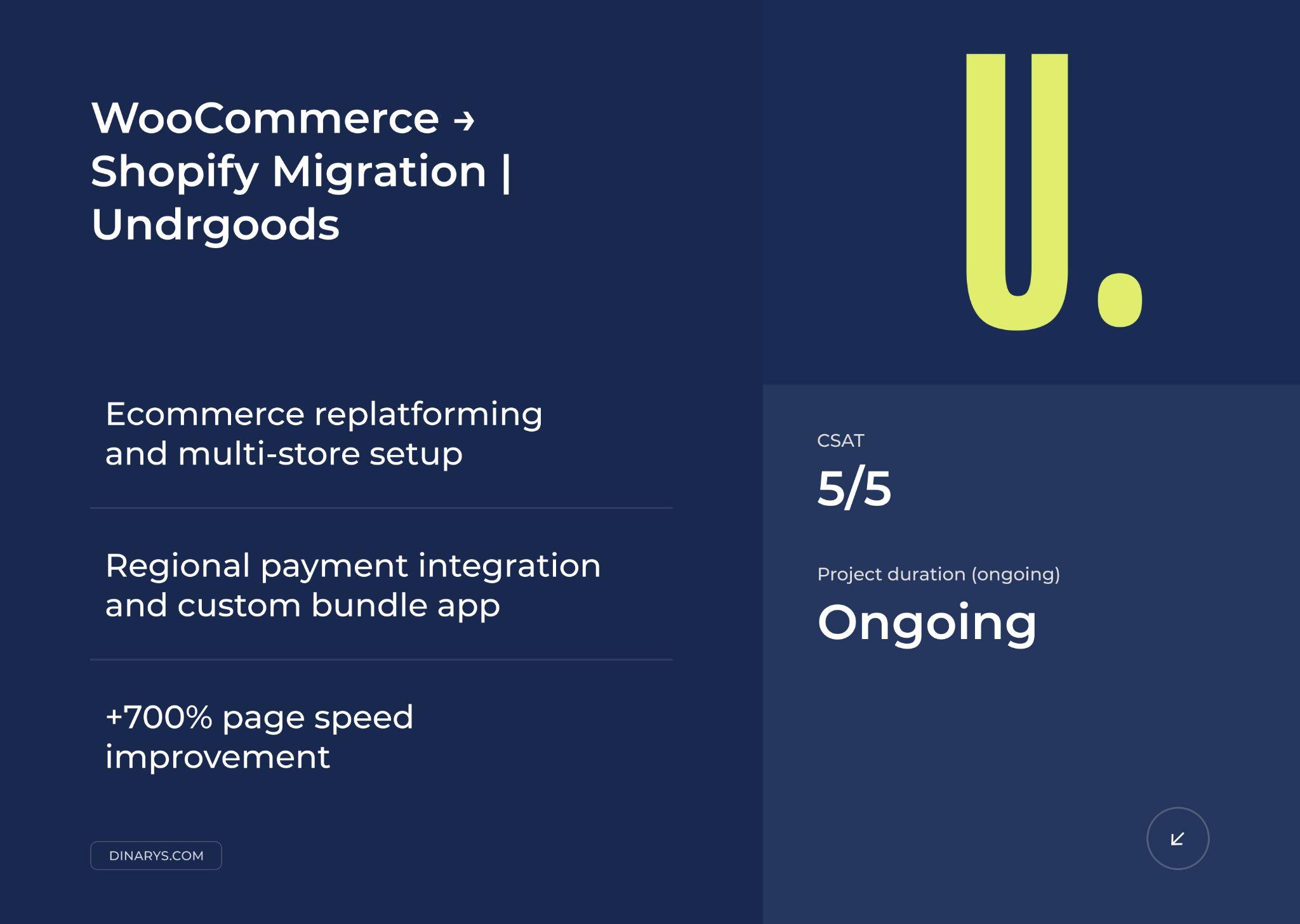
From our expertise, Dinarys helped Undrgoods transitioned from WooCommerce to Shopify Plus to address performance limitations, maintenance complexity, and scalability issues. The migration aimed to improve backend stability, checkout page experience, and support for a growing product catalog.
With Shopify Plus, they gained access to automation tools, faster load times, and a more streamlined user experience. As a result, the brand saw improved site reliability, easier content management, and a platform better suited for high-volume ecommerce growth.
Type #6: High-growth startups with complex needs
Even smaller teams often opt for Shopify Plus when they anticipate aggressive scaling or require enterprise-grade capabilities from the outset. This is common in high-margin verticals like luxury fashion or cosmetics, where the brand experience is just as critical as the transaction itself.
This need for deep customization often leads brands toward headless commerce. Shopify Plus provides the API depth and specialized frameworks, like Hydrogen, to make these custom setups manageable. If your business requires specialized logic or a bespoke headless setup, our team specializes in composable commerce solution development designed for high-velocity brands.
In essence, Shopify Plus is best for businesses that need to scale without friction, automate processes intelligently, and deliver a highly personalized and reliable shopping experience across channels and borders.
Most Common Benefits of Shopify Plus Outlined by the Industry
Shopify Plus is widely recognized across the industry as the benchmark for high-growth and enterprise-level brands. But beyond the headlines, the platform's reputation is built on how it solves very specific, high-stakes operational problems.
The following advantages of Shopify Plus are the ones most frequently highlighted by industry analysts and in merchant success stories:
1. Unlimited scalability and stability
Shopify Plus handles large volumes of traffic and orders with ease, supporting up to 10K checkouts per minute. This allows brands to run flash sales, product drops, and Black Friday/Cyber Monday events without fear of crashes or performance issues.
Why it matters: Brands can scale operations confidently and grow without switching platforms.
2. Advanced automation tools
With tools like Shopify Flow, Launchpad, and Script Editor, merchants can automate their important business processes, such as:
tagging VIP customers
managing inventory alerts
launching timed campaigns
applying dynamic discounts
Why it matters: Saves hundreds of manual hours, reduces errors, and ensures smooth execution of business workflows.
3. Checkout customization
Shopify Plus provides full control over the checkout experience using Shopify Functions and APIs. Brands can add custom upsells, conditional shipping rules, and discounts that enhance conversion.
Each Shopify Plus merchant is assigned a Launch Engineer and Merchant Success Manager to assist with onboarding, performance optimization, and platform growth.
Why it matters: Brands receive dedicated top-notch service and expert guidance, reducing the learning curve and helping solve complex ecommerce challenges.
5. Built-in B2B functionality
Shopify Plus includes native support for wholesale selling, allowing businesses to create separate B2B portals with tiered pricing, customer-specific catalogs, and net terms without third-party apps.
Why it matters: Such functionalityenables hybrid B2B/B2C operations on a single platform and simplifies wholesale operations.
6. Multi-store and global capabilities
Merchants can operate up to 10 storefronts under a single Shopify Plus account, tailoring each to a specific region or customer segment. Combined with Shopify Markets, businesses can localize language, currency, and tax settings for global expansion.
Why it matters: Such configurationsfacilitate seamless international growth while maintaining centralized control.
7. Advanced integration ecosystem
With higher API limits and exclusive endpoints, Shopify Plus allows for deeper integration with ERP, CRM, logistics, and analytics platforms. Merchants can also build unlimited custom and/or private apps.
Why it matters: Brands can create highly tailored technology stacks without platform limitations.
8. Conversion optimization tools
Tools like Shop Pay, custom checkout flows, and Shopify Audiences help increase conversion rates and reduce customer acquisition costs.
Why it matters: Shop Pay increases checkout speed by up to 4x, and Shopify Audiences helps brands reduce CAC by targeting high-intent shoppers across platforms.
9. Security, compliance, and reliability
Shopify Plus includes advanced security features, which are Level 1 PCI DSS compliant, and provides additional compliance tools for GDPR, SOC 2, and multi-factor authentication.
Why it matters: Enterprise brands with regulatory obligations or high-volume payment processing benefit from peace of mind.
10. Faster time to market
With robust theme flexibility, pre-vetted Shopify Plus Partners, and rapid deployment capabilities, businesses can go live faster than on traditional enterprise platforms.
Why it matters: Reduces custom development costs, accelerates ROI, and improves adaptability in competitive markets.
These benefits make Shopify Plus a compelling choice for businesses seeking a scalable, reliable, and flexible ecommerce foundation.
TURN THESE FEATURES INTO EFFECTIVE WORKFLOWS
Explore our expertise to see how we help brands automate their operations and get more out of every tool the platform offers.
Shopify Plus is more than just a list of extra features; it’s an investment that usually pays for itself as you grow. While standard plans are built to be affordable and easy to start with, Shopify Plus is designed for businesses that need to move faster and work more efficiently. How Shopify Plus impacts business growth in various aspects:
Aspect #1: Revenue growth
Revenue is the most direct indicator of business success, and Shopify Plus users consistently outperform industry benchmarks:
126% increase in online revenue within 3 monthsfor Monte Carlo after migration to Shopify Plus. In addition, they experienced 115% increase in transaction volume.
For example, Blakely, a fashion retailer, saw a 49% increase in global sales and an astonishing 130% year-over-year growth in the US after switching to Shopify Plus and implementing localized storefronts.
All4cycling, a sports equipment seller, attributed its 35% turnover growth directly to improvements in site functionality, speed, and checkout conversion post-migration to Plus.
How it's achieved: These growth outcomes are largely enabled by features like multi-store management for regional targeting, advanced analytics for performance tracking, faster loading times for customer retention, and seamless integrations that allow businesses to respond to demand without platform friction.
Aspect #2: Return on Investment (ROI)
When evaluating platforms, ROI goes beyond feature count, giving the way to cost-efficiency at scale:
Shopify Plus offers up to 36% lower total cost of ownership than platforms like Magento or Salesforce Commerce Cloud, which often incur additional licensing, infrastructure, and developer maintenance fees. To calculate your TCO with Shopify Plus, you can use the official TCO calculator from Shopify.
A strong example is Namuk, a children’s apparel brand, which reduced its reliance on third-party developers after migrating from Magento. The switch resulted in over 100 developer hours saved per month, dramatically lowering their operating budget.
Additional Plus benefits like unlimited staff accounts, free Shopify POS Pro access for 20 retail locations, and up to 10 included expansion stores eliminate recurring third-party software costs that often accumulate on other platforms.
How it's achieved: The platform's built-in flexibility, developer-friendly APIs, and bundled enterprise features reduce the need for external tools, ongoing developer contracts, and duplicated efforts across markets.
Aspect #3: Conversion rate improvements
Better performance directly impacts how many visitors convert into paying customers:
Shopify Plus merchants report conversion rate increases between 28% and 85%, depending on the degree of optimization applied, particularly through checkout customization, mobile speed, and targeted A/B testing (based on various business cases).
Advanced tools such as Shopify Functions allow businesses to create logic-based checkout experiences that adapt to customer segments, time of day, cart value, and more, resulting in up to 20% increase in average order value (AOV).
Using Shopify Audiences, Plus merchants can target high-intent shoppers more precisely, which has helped some reduce customer acquisition costs (CAC) by up to 50% in performance marketing campaigns.
How it's achieved: The ability to personalize and test the checkout process, leverage faster payment solutions like Shop Pay, and use powerful segmentation tools allows businesses to maximize conversions without sacrificing UX. Access to detailed insights and third-party integrations gives marketers the ability to fine-tune their funnels with precision.
Aspect #4: Operational efficiency
Streamlined operations not only save time but also prevent revenue leakage due to inefficiencies:
With Shopify Flow, merchants can automate repetitive tasks (like segmenting customers or triggering notifications), freeing up staff to focus on strategy rather than operations.
Launchpad allows brands to schedule product launches, discounts, and even theme changes, eliminating the need for manual intervention during big sales events.
For instance, All4cycling implemented automated invoicing, shipping prioritization, and tagging workflows, leading to faster order processing and fewer support inquiries.
Shopify’s hosted infrastructure provides 99.99% uptime and global CDN coverage, meaning businesses no longer pay for external hosting, cybersecurity tools, or server maintenance, often saving thousands in monthly IT overhead.
How it's achieved: Businesses leverage no-code automation to minimize human touchpoints, implement centralized admin tools for multi-store management, and use Shopify's reliable infrastructure to avoid investing in technical resources, allowing lean teams to operate at enterprise scale.
Shopify Plus Advantages in Comparison With Other Platforms
When evaluating Shopify Plus, it’s important to understand how it stacks up against other leading platforms, especially those used for marketing automation and operational streamlining. One of the major advantages of Shopify Plus is its ability to consolidate the technology stack that many businesses originally built using separate external tools.
Below is a breakdown of how the platform compares with popular automation and marketing systems:
Shopify Plus vs Automation Platforms (Zapier, Make, Automate.io)
Many businesses use third-party platforms like Zapier or Make (formerly Integromat) to automate workflows across ecommerce, marketing, CRM, and inventory systems. These tools are effective but often require ongoing configuration and carry limits based on usage tiers.
Where Shopify Plus wins:
Built-in automation: Tools like Shopify Flow, Launchpad, and Shopify Functions allow businesses to automate various processes such as tagging VIP customers, initiating fulfillment workflows, launching campaigns, and adjusting product visibility, all without external platforms.
Direct platform-level access: Unlike Zapier or Make, which operate through APIs and depend on third-party app connections, Shopify Plus’s automation tools function at the core of the store, allowing faster execution, deeper logic, and more secure triggers.
Cost-effective scaling: External tools often charge based on tasks, users, or app integrations, which can increase costs exponentially. Shopify Plus includes enterprise-grade automation without additional subscription layers.
When they work together: Shopify Flow also supports webhooks, meaning businesses can still integrate with tools like Trello, Google Sheets, or CRMs via platforms like Zapier when external logic is required.
Shopify Plus vs Marketing Automation Tools (Klaviyo, Mailchimp, HubSpot)
Marketing platforms play a crucial role in customer retention, email campaigns, and segmentation. However, many ecommerce brands stitch together a range of these tools to build complete funnels.
Where Shopify Plus streamlines:
Customer segmentation and personalization: Through Flow and ShopifyQL, Shopify Plus merchants can create behavior-based segments directly in Shopify and use them to trigger marketing automations.
Native integrations: Shopify Plus integrates tightly with email platforms like Klaviyo and Omnisend, giving Plus stores a more seamless data sync and eliminating sync lags or manual CSV imports.
Customizable checkout and audience tools: With Shopify Audiences, Shopify Plus merchants can use purchase behavior and Shopify store analytics to feed into ad platforms and reduce CAC. This feature is native to Shopify Plus and isn’t available to standard plan users.
Where dedicated tools still shine: For advanced omnichannel workflows, behavioral drip campaigns, or CRM enrichment, external marketing platforms still provide value, but Shopify Plus provides the ecosystem foundation where these tools perform better.
Money-saving advantages of the Shopify Plus ecosystem
A major reason businesses upgrade to Shopify Plus is not just for performance, but to consolidate redundant tools and reduce total software spend:
One subscription, many tools: Shopify Plus includes access to enterprise features like Flow, Launchpad, Shopify Scripts, and Shopify Audiences — tools that would otherwise require separate licenses through external vendors.
Reduced plugin reliance: By offering built-in automation and segmentation, businesses save money by canceling subscriptions to automation platforms like Zapier (which can exceed $600+/year at scale) and marketing CRMs with overlapping features.
Fewer technical dependencies: With Shopify Plus handling logic, scheduling, and campaign triggers natively, companies often eliminate the need for external development support to maintain or build automations, which can cost thousands annually.
Predictable pricing: Plus merchants benefit from predictable enterprise pricing instead of usage-based spikes from task-heavy platforms like Make or email send-based platforms like Mailchimp.
Businesses often find that the annual savings from reducing third-party automation and marketing tools can offset a significant portion of the Shopify Plus subscription cost.
Summary Table: Shopify Plus vs Automation and Marketing Tools
Feature/
Function
Zapier/
Make/
Automate.io
Klaviyo/
Mailchimp/
HubSpot
Shopify Plus
Internal workflow automation
Yes
(external; $20–$1000+/mo based on tasks)
No
Yes (Flow, Launchpad, Functions)
Event-based automation
Yes – multi-step workflows
($20–$100+/mo)
Limited
Yes
Checkout behavior triggers
No
No
Yes (included via Functions and Shopify Scripts)
Email campaign tools
No
Yes – $50–$2500+/mo based on contacts
Integrated via Klaviyo, Omnisend, others
Behavioral segmentation
Limited
Yes
Yes (with ShopifyQL and Audiences)
Ad retargeting support
No
Yes (indirectly)
Yes (Shopify Audiences)
Hosting and uptime
N/A
N/A
Fully hosted and monitored
Cost scaling
Scales with usage (can exceed $1,000+/mo)
Scales with list size (can exceed $3,000+/mo)
Flat rate ($2,000+/mo); includes advanced features
Total estimated monthly cost
$500–$2,500+ for advanced automation setups
$500–$3,500+ for high-volume campaigns
$2,000–$2,500 (flat, all-inclusive)
What makes Shopify Plus stand out is its ability to replace the typical patchwork of tools businesses often end up with as they grow. It’s easy to wind up using one app for email, another for wholesale, and a handful more just to get everything to work together. Shopify Plus is designed to simplify that, pulling all those pieces into a single, cohesive system.
That doesn’t mean tools like Zapier or Klaviyo aren’t useful. They still shine when you need to tackle really specific or advanced tasks. But for most of the heavy lifting, Shopify Plus handles things natively. You’re not bouncing between five different dashboards just to track one sale; your workflows, automation, and marketing logic are already built into your store.
Wrapping up
In the end, Shopify Plus isn’t just for massive, tech-heavy companies. It’s built for any brand that’s outgrown the basics and needs a platform that can keep up. Whether it’s faster checkouts, streamlined workflows, or smarter tools to market and manage your business, Plus is all about helping you grow without added friction.
It’s made for teams that want to move quickly, without dealing with patchy integrations or needing a full dev squad to make changes. From handling complex B2B setups to expanding into new markets, it gives you the structure and stability to scale confidently.
If your business is ready to simplify operations and take things to the next level, Shopify Plus could be exactly what you’ve been looking for.
IS YOUR CURRENT SETUP READY FOR YOUR NEXT BIG RUSH?
Our services focus on creating stable, high-performance environments that handle thousands of checkouts per minute. Let's ensure your platform is built to turn your biggest traffic spikes into revenue.