If you’ve been researching high-level ecommerce solutions lately, you’ve definitely run into Salesforce. But before you dive in, it’s important to understand what you’re actually buying. Many businesses group Salesforce with platforms like Shopify or Magento, but it doesn't actually work like one. It goes way beyond the "online store" model we’re used to.
The first thing to clarify is that Salesforce isn’t just a tool to run a website. Salesforce is a massive ecosystem where your sales, marketing, and customer service all live under one roof. While most platforms are like a "box" you buy and plug in, Salesforce is more like a foundation you build on. Instead of just adding a plugin every time you need a new feature, you have an opportunity to connect everything (from how you track leads to how you handle returns) into a single, shared system.
This “all-in-one” approach is a huge strength, but it’s also why things get complicated. Since the Salesforce platform is so open, you aren't stuck with a “one-size-fits-all” setup. You have the freedom to build exactly what your business needs, but that means every decision you make about your data or workflows becomes a permanent part of your foundation.
At the end of the day, a Salesforce project is rarely a "quick fix" or a simple weekend launch. Since the system is so interconnected, success depends less on the software’s features and more on how well it’s designed to fit the rest of your operations. This is why who builds your store matters just as much as what you’re building. You need a partner who understands the whole ecosystem and knows how to keep it stable as you scale.
What is Salesforce in 2026?
But if you only look at it that way, you’re missing the bigger picture. What makes Salesforce different is how it brings everything — your store, your customer data, your marketing, and your support — into one single place.
Instead of buying five different tools and trying to make them talk to each other, many businesses use Salesforce as their main system for everything. This is what defines the platform today: it isn’t just one product, it’s a group of services that are built to work together.
A platform built as an ecosystem
Salesforce is built around different "clouds," each handling a specific part of your company. The real value isn't in the individual tools, but more in the fact that they are designed to work together, sharing data and logic across your entire operation.
In the world of ecommerce, these are the main parts you will use:
Salesforce’ Clouds for ecommerce
What they do
Commerce Cloud
This is your digital storefront. It handles your product catalog, pricing, discounts, and the entire checkout process.
Sales Cloud Service and Service Cloud
These manage the "human" side of things. Sales Cloud tracks your leads and accounts, while Service Cloud handles customer support tickets.
Marketing, Experience, and Salesforce Sales Cloud
These focus on the customer journey. Marketing Cloud runs your email campaigns, while Experience Cloud builds custom portals for partners or B2B clients.
Data and Analytics
This is the "brain" of the system. Data Cloud pulls all your customer info into one place, and Tableau turns it into reports you can actually use.
When these pieces work together, you move past "isolated" systems. Instead of having your customer data in one place and your purchase history in another, everything is connected. Your marketing team knows exactly what a customer bought, and your support team knows exactly what that customer was promised, and all of these happens in real time.
How this changes your day-to-day operations
In a traditional setup, your online store, your marketing tools, and your customer support are usually separate. Data has to "travel" between them, and things only stay consistent if those connections don't break.
Salesforce does things differently. Instead of trying to link separate systems, it brings them all into one place. This has some very practical benefits for your business:
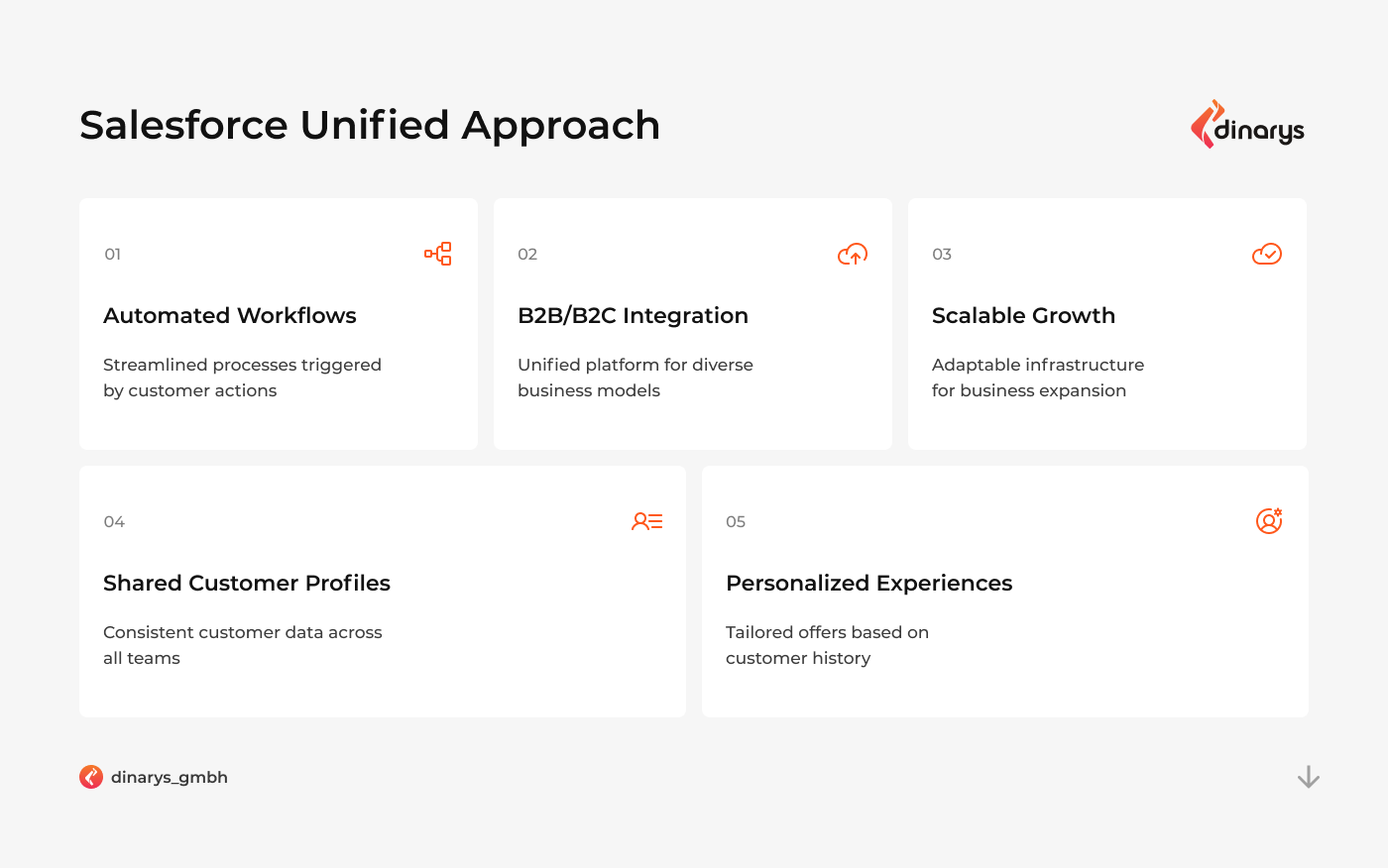
Everyone sees the same thing. Your marketing, sales, and support teams all look at the same customer profile. No more "guessing" which data is the most recent.
Personalization actually works. You can offer discounts or product suggestions based on a customer's real history. It moves from an idea to a real part of your store.
Easier to coordinate. When someone buys something or asks for help, it can automatically trigger the next step in another part of the system. Everything stays in sync.
B2B and B2C can live together. You can run a normal store and a complex wholesale business in the same environment. It handles custom pricing and big accounts without needing a second platform.
Growth doesn't mean more "clutter". As you scale, you don't always have to go out and buy new tools. Most of what you need is already there, waiting to be turned on.
Why Salesforce is not always the first choice
Salesforce’s level of integration is a big advantage, but it’s not for everyone.
Salesforce isn't meant to be a "lightweight" or "quick-launch" tool. It’s built for businesses that are ready to invest time in the setup and keep managing it as they grow. While other platforms might force you to do things a certain way, Salesforce gives you the "building blocks." You get to decide how to put them together, but that means you’re responsible for the final result.
Because of this, companies usually choose Salesforce in two specific situations:
SITUATION
WHY IT MAKES SENSE
You’re already in the ecosystem
If you already use Salesforce for sales or marketing, it’s much easier to bring your store "home" than to try and sync a completely different platform.
Your business is getting too complex
When managing five or six different tools becomes a nightmare, it’s often easier to manage one big system than to keep all those separate parts from breaking.
The role of development and implementation
Whether you’re building your storefront in Commerce Cloud, connecting to an ERP or PIM system, or setting up custom workflows, every decision matters. The choices you make during the initial setup will determine:
your site's speed
how easy it is to change things later
how much "technical debt" you’ll have to deal with down the road
That’s why a Salesforce project is rarely a simple "plug-and-play" build. It’s a process that requires a solid strategy for your data, a clear plan for your integrations, and a way to make sure all those different "clouds" are actually talking to each other.
Yes, the platform gives you the ecosystem, but turning that ecosystem into a working system for your business depends entirely on how it’s implemented.
BUILD A SALESFORCE ENGINE THAT LASTS
Don’t settle for a vendor that just checks boxes. Partner with a team that understands cross-cloud strategy, complex B2B logic, and long-term system stability.
Salesforce vs other platforms: Why development requires Salesforce Commerce Cloud implementation partners with real expertise
When people compare Salesforce to other ecommerce platforms, they usually just look at a list of features. But in the real world, the biggest difference is in how the system is actually built and maintained over time.
Most ecommerce platforms follow a "contained" model: they give you a set structure for your store, your products, and your checkout. You can customize things, but you’re always working within a fairly controlled environment. It’s like moving into a finished house where you can change the paint, but you can’t easily move the walls.
Salesforce works differently. It doesn't have those same clear boundaries. Instead of one single system, Salesforce provides a set of connected parts that you have to align with how your business actually runs. This completely changes the way development work happens:
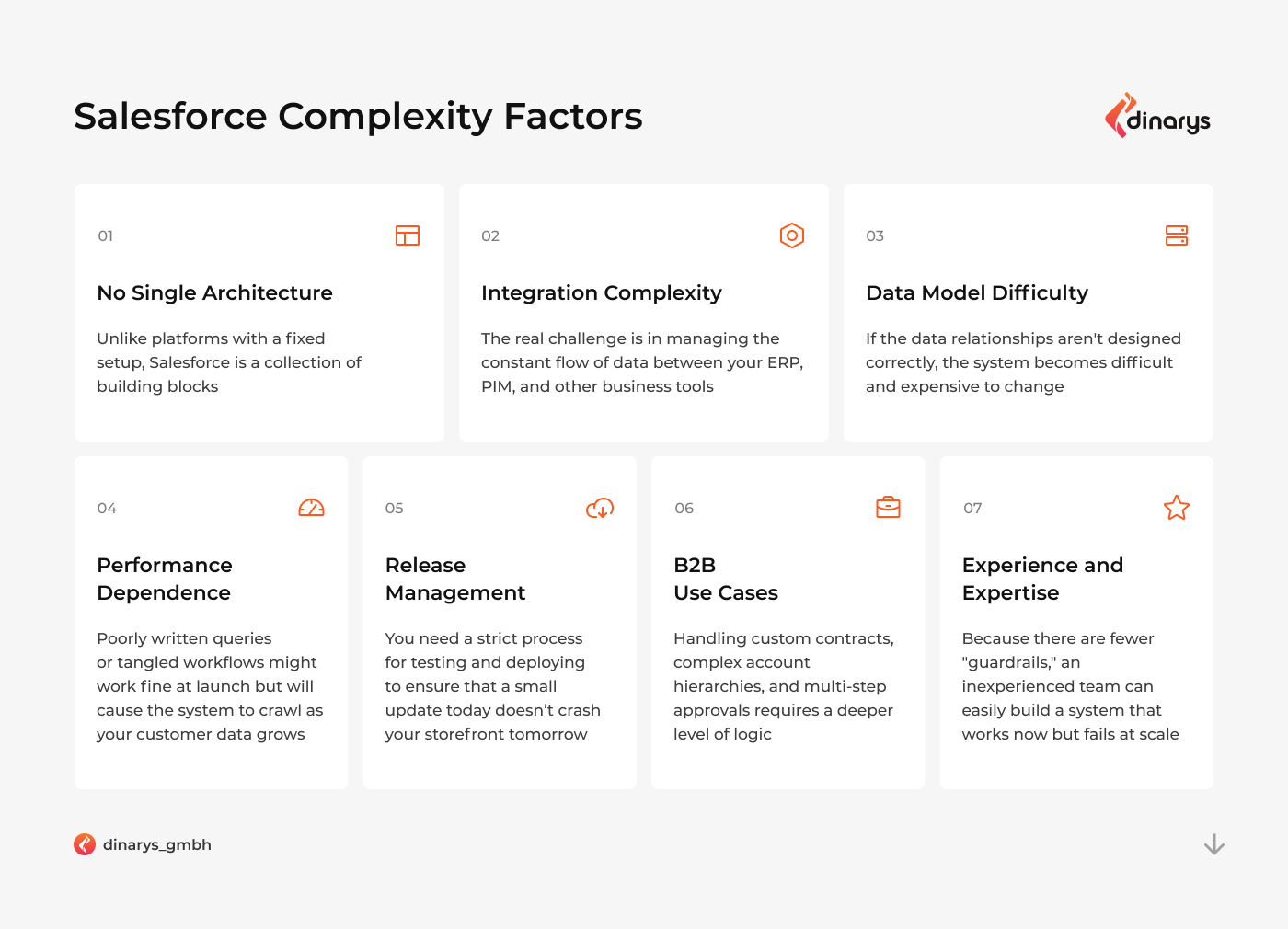
#1: There is no single “Salesforce architecture”
On platforms like Shopify or even Magento, you’re usually working within a known structure. Your choices are important, but the "walls" of the system are already there. With Salesforce, there is no single, "standard" way to build a solution.
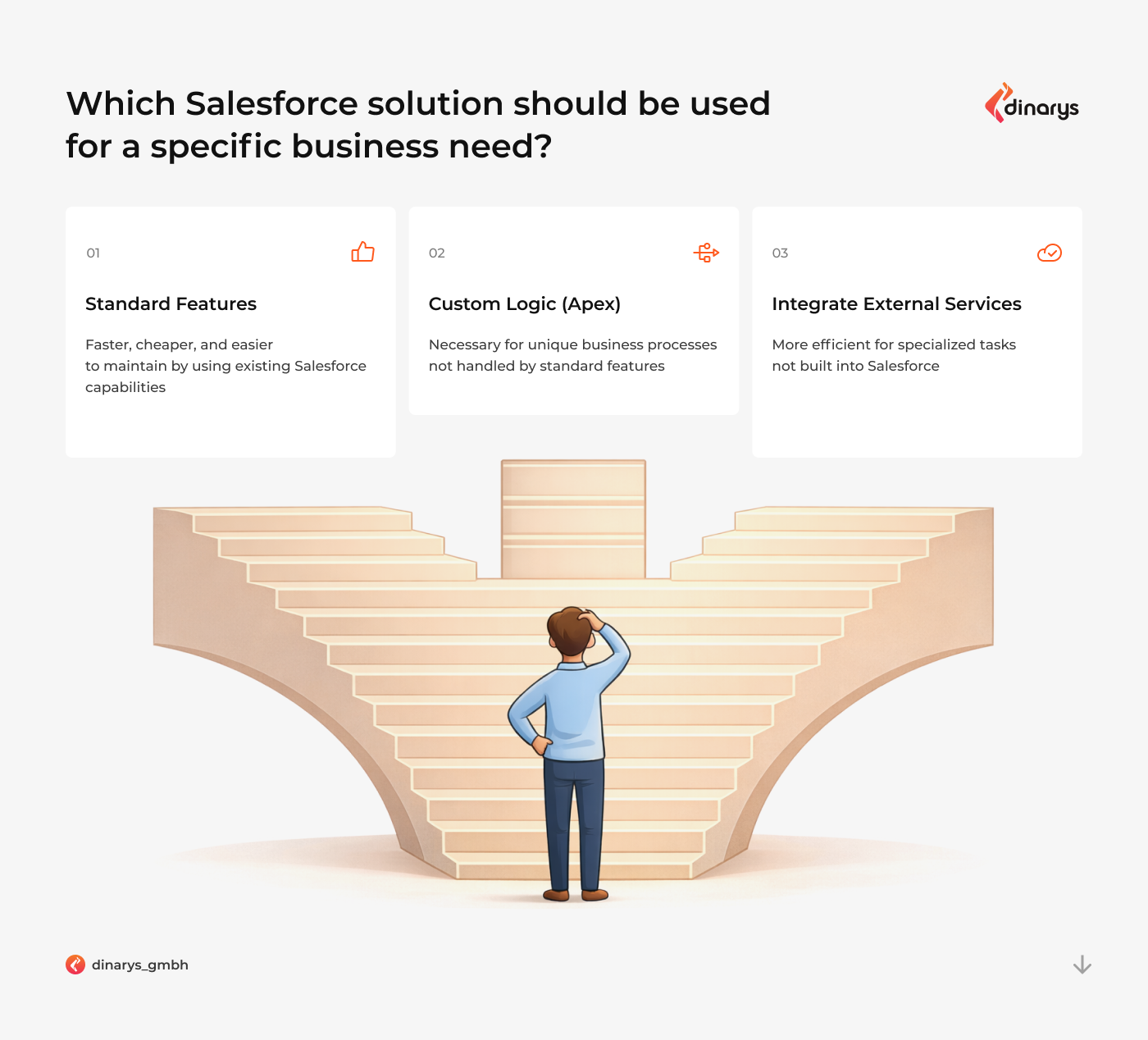
Think of it this way: the same business problem can be solved in four or five different ways. You could:
Usethe built-in features already in Commerce Cloud.
Write custom code (using Apex) to add new logic.
Connect to outside systems using APIs.
Link everything across your Sales, Service, and Marketing teams.
Every one of these choices has a consequence. Some might give you more freedom but will be harder to maintain later. Others might be easier to set up today but will limit what you can do next year.
This is why development on Salesforce is more about making decisions that will shape your business for years. Teams without enough experience often take the "easy" route for a quick launch only to find out later that they’ve built a system that’s too complex to change.
#2: Complexity lives in integrations, not just in the platform
Salesforce rarely works alone. Even though it’s a massive ecosystem, most businesses still need it to exchange data with their other essential tools, like:
ERP systems for financial services and inventory
PIM systems for product details
OMS for managing orders
Payment and shipping providers
The real challenge is in managing how the information flows between them. When these connections aren't handled by experts, a few common problems tend to pop up:
Information that doesn't match. You might see one inventory number in your warehouse and a completely different one on your storefront.
Sync delays. Orders might take minutes (or hours) to show up where they need to be, slowing down your whole operation.
"Who owns this?" confusion. It becomes unclear which system is supposed to be the "boss" of certain data, leading to errors.
Fragile error handling. The system works fine on a normal day but breaks the moment something unexpected happens.
Because Salesforce is usually the "heart" of your business, an integration problem is more than just a temporary error as it hits your marketing, sales, and support teams all at the same time. Fixing these issues requires more than just knowing how to write code. Eventually, you will need a partner who understands how the entire business structure fits together.
#3: Data model and customization add another layer of difficulty
One of Salesforce's biggest strengths is its flexible data model. You can customize the objects, relationships, and structures to fit exactly how your business works. But this flexibility is also a risk.
Think of your data model like the foundation of a building. Once the concrete is poured and the walls are up, it’s very hard (and expensive) to change the layout without affecting the rest of the house. When data modeling isn't handled carefully from the start, it usually leads to a few painful "side effects" as you grow:
Slow performance. The system feels heavy and sluggish because it’s trying to pull data from a messy structure.
Complicated workflows. Simple tasks become difficult because your team has to create "workarounds" to get the information they need.
Reporting dead-ends. You can't get the business insights you want because the data isn't organized in a way that your analytics tools can read.
Feature "tangles". One small change to a feature might accidentally break something completely unrelated because the dependencies are too messy.
Experienced teams don't treat data modeling as a "to-do" list item. They treat it as the core of your entire architecture. Without that strategic approach, the system gets harder to work with every single day.
#4: Performance depends on how everything is put together
On many platforms, site speed is mostly about having a powerful server (infrastructure). But with Salesforce, performance depends almost entirely on how the system is configured. Since Salesforce is a shared environment, your speed is determined by:
Data structure
Search queries format
Workflow automation
Integration execution
The tricky part is that a poorly built system might work perfectly on launch day when you only have a few customers. The real problems don't show up until your business starts to succeed. As your data grows and more people use the system, those early "quick fixes" start to slow everything down.
#5: Release management and environments require discipline
Salesforce has its own specific way of handling updates and new features. It uses "sandboxes" (safe testing areas), version control, and automated pipelines to move code from a developer’s computer to your live store.
When this process isn't set up correctly, it’s like trying to repair a car while it’s driving down the highway. Without a professional "engine room" setup, your business will face some very avoidable risks:
Team overlaps. Developers might accidentally "overwrite" each other’s work, causing features that worked yesterday to suddenly disappear.
Unstable launches. Instead of a smooth update, you get "broken" releases that force your team to spend the weekend fixing bugs.
The "Black Box" problem. It becomes almost impossible to track who changed what, making it a nightmare to undo a mistake.
Slow and risky deployments. Moving even a small change to the live site becomes a high-stress event that takes hours instead of minutes.
In larger teams, coordination is the only way to keep the platform stable. A professional partner doesn't just "write code" and hit upload — they build a safe, repeatable process that protects your business while you grow.
#6: B2B and enterprise use cases increase complexity further
Many companies choose Salesforce because they need to handle B2B or a mix of both B2B and B2C. In these cases, the "standard" online store model just isn't enough. In B2B, you’re dealing with:
Custom pricing. Different companies get different rates based on their contracts.
Complex accounts. You might have ten different buyers all working for the same organization.
Approval steps. A manager might need to "sign off" on an order before it’s officially placed.
Private catalogs. Showing specific products only to specific partners.
They change the entire way your system is designed: from how your data is organized to how your checkout process feels.
Compared to a simpler platform, a B2B setup requires a much deeper level of planning and making sure your technical team actually understands how your business deals are made. If they don't, you'll end up with a "fancy" store that your actual B2B customers find impossible to use.
#7: Why experience matters more here than on most platforms
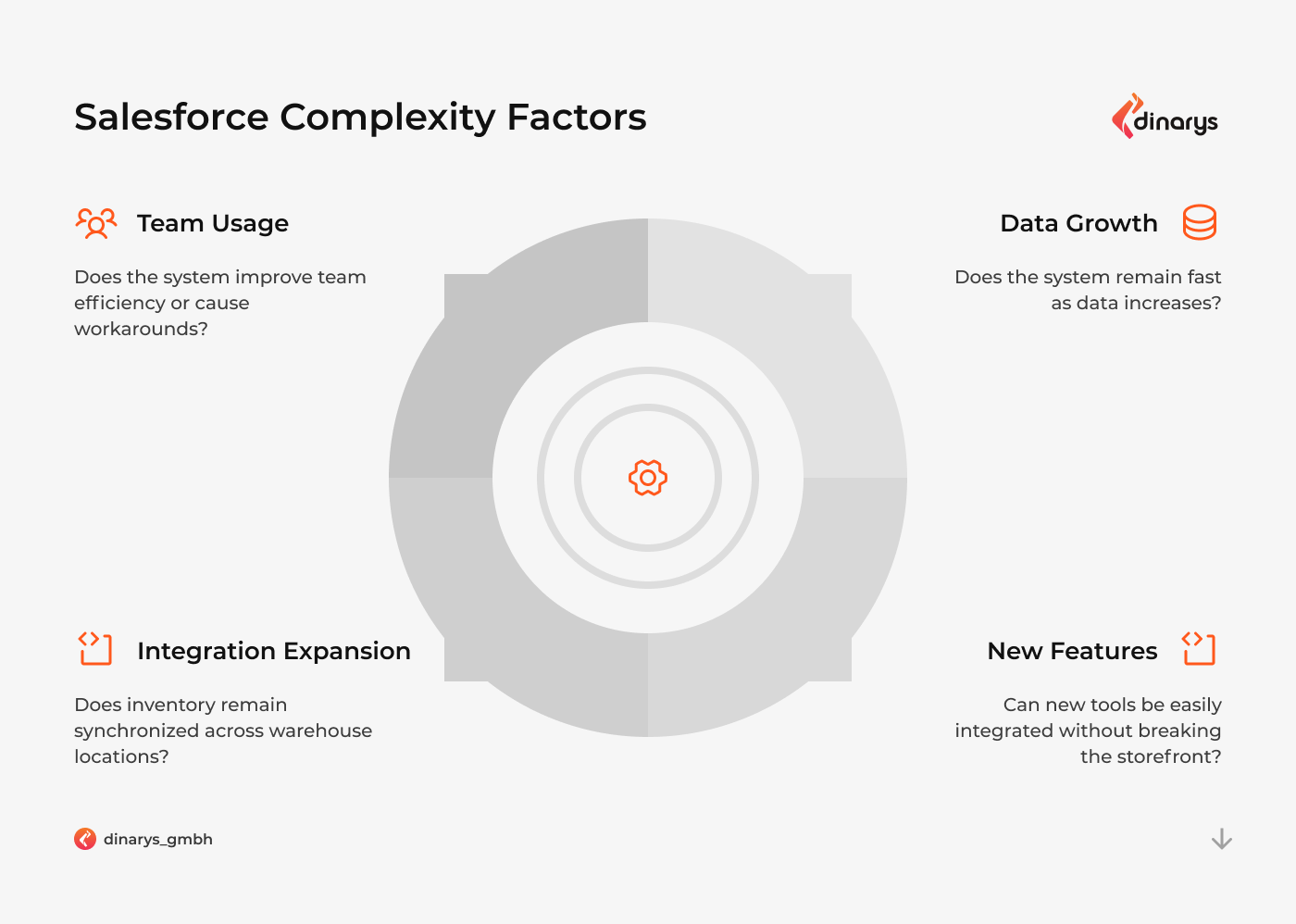
All these factors lead to a simple reality: a Salesforce project is a long-term investment. The biggest challenge is that technical shortcuts aren't always obvious at the start. You might launch a store that looks great and processes orders perfectly on day one. But the real test happens as your business actually starts to succeed:
This is the real difference between a team that just "knows the software" and a partner that understands how to build a lasting system. An experienced developer is looking at the next three years of your business. They know which patterns lead to dead ends and how to build a foundation that stays stable, adaptable, and easy to use as you scale.
How to evaluate Salesforce service cloud implementation partners
Because Salesforce is an ecosystem rather than a standalone platform, the risks are unique. A single decision made during setup can impact multiple parts of your business: from commerce and marketing to customer service and data operations. For this reason, your evaluation should look past what a vendor can build and focus on how they approach the system as a complete environment.
1. Clarity of Salesforce focus and ecosystem understanding
Best Salesforce consulting companies are transparent about their depth within the Salesforce ecosystem. They should be able to clearly explain which "clouds" they work with, whether it’s Commerce, Sales, Service, or Marketing, and, more importantly, how those pieces interact in a real-world project.
Salesforce isn’t just a tool for building storefronts, and vendors who treat it that way often overlook how data and workflows must connect across your entire business. A strong partner speaks about cross-cloud architecture. They understand that a change in your store affects your sales team, your marketing automation, and your customer service desk simultaneously.
2. Experience with complex, multi-system environments
Salesforce projects almost never exist in a vacuum. A capable vendor must have proven experience connecting external systems (like ERP, PIM, OMS, and payment gateways) into a single, reliable flow. More importantly, they need to understand how these connections behave under real-world pressure. During your evaluation, look for a partner who can explain:
Data synchronization: How they ensure information stays consistent across every system in real time.
Error handling: What happens when a connection fails, and how the system recovers without losing data.
Dependency management: How a change in one tool (like an ERP update) affects the rest of the Salesforce ecosystem.
At the research stage, pay close attention to how a vendor describes integration challenges. A partner who only talks about "successful outcomes" may lack the experience to handle the inevitable complexities that arise when multiple systems must work as one.
3. Approach to data modeling and system structure
Salesforce’s flexibility is rooted in its data model. While this is a major strength, it’s also where most long-term technical debt originates. Top Salesforce consulting company doesn’t treat data modeling as a background task — more like a core architectural decision. During your evaluation, a strong partner should be able to clearly explain:
Object relationships: How they design the connections between customers, orders, and products to ensure the system remains logical.
Scalability: How the data structure is built to handle a growing volume of transactions without slowing down.
Reporting and analytics: How the data is organized so that your leadership team can actually pull meaningful insights from the system.
If a vendor treats these topics as "technical details" rather than strategic decisions, it’s usually a sign of limited experience. A partner who understands the platform knows that a messy data model is the most expensive mistake a business can make.
4. Ability to balance native functionality and custom development
Salesforce offers a massive amount of out-of-the-box functionality. However, knowing when to use those standard features and when to move away from them is a critical skill for any development partner.
A strategic partner should be able to clearly explain their decision-making process:
5. Understanding of performance and scalability constraints
In the Salesforce ecosystem, performance is almost entirely about implementation quality. A system that works for 100 users can easily fail when you scale to 10,000 if the foundation is weak.
A reliable vendor treats performance as a core requirement from the very first day, not as a "fix" to be handled after launch. During your evaluation, a strong partner should be able to explain their approach to the four main drivers of speed:
Data structure. How they organize your records to ensure the system doesn't get "heavy" as your database grows.
Query design. How they write the code that retrieves information so it remains lightning-fast even during peak traffic.
Workflows and automation. How they design background processes so they don't "clog" the system and delay customer actions.
Integration patterns. How they move data between systems without creating bottlenecks at the checkout or in the admin panel.
6. Transparency of delivery process and risk management
Salesforce projects involve multiple dependencies and moving parts. Vendors should be able to explain how they plan, coordinate, and manage this complexity. This includes:
how they structure project phases
how they handle changes and evolving requirements
how they mitigate risks during integration and deployment
Avoid vendors who present Salesforce implementations as straightforward or linear. Experienced teams acknowledge uncertainty and plan for it.
7. Clarity about timelines, costs, and scope
Salesforce implementations are rarely quick. Vendors who provide overly optimistic timelines or simplified estimates often underestimate complexity. A suitable partner explains:
what affects cost and duration
where uncertainty exists
how scope may evolve during the project
Realistic expectations at the beginning reduce friction later.
8. Visibility into the team and ownership model
Salesforce projects require coordination between developers, architects, and sometimes multiple specialized roles across different clouds. You should understand:
who will be involved in the project
how responsibilities are distributed
who makes key architectural decisions
Strong Salesforce consultants and developers are transparent about team structure and ownership. Vague answers often indicate resourcing risks.
9. Evidence of long-term involvement and support
Salesforce systems evolve continuously. New features, integrations, and business requirements require ongoing changes. The right Salesforce consulting partner with real experience emphasize:
post-launch support
system monitoring
continuous optimization
long-term collaboration
If the focus is only on initial delivery, it may indicate a limited understanding of Salesforce as a long-term system.
10. Ability to challenge assumptions
One of the strongest indicators of a high-quality partner is their willingness to challenge your requirements. In a complex environment like Salesforce, a Salesforce consulting firm who simply follows instructions without questioning the impact is often a liability.
A strategic partner adds value by acting as a consultant. During your initial conversations, look for a team that is comfortable:
Suggesting alternative approaches: Finding a simpler, more efficient way to achieve the same business goal using standard features.
Identifying hidden risks: Pointing out where a specific request might create performance bottlenecks or integration conflicts down the line.
Advising against complexity: Helping you distinguish between "must-have" functionality and "nice-to-have" features that will only drive up maintenance costs.
11. Relevance of services offered
The Salesforce professional services a vendor prioritizes should directly reflect the technical and operational realities of the Salesforce ecosystem. In a professional partnership, you are looking for specific capabilities that protect your investment.
A mature Salesforce partner will typically offer services that address the system's lifecycle, such as:
Platform migration: Safely moving data and logic from legacy systems or other ecommerce platforms without losing business continuity.
System modernization: Updating older Salesforce setups to use the latest features and more efficient code standards.
Integration development: Building the connection between Salesforce and your ERP, PIM, or OMS.
Performance optimization: Auditing and fixing bottlenecks in data structures or queries to ensure the site stays fast.
System audits: Regularly reviewing the health of the platform to identify risks before they become outages.
Clear and specific service descriptions are usually a sign of practical experience. On the other hand, generic service lists often suggest a broader but less focused offering that may lack the depth needed for a complex ecosystem.
PUT THESE CRITERIA TO THE TEST
Selecting a partner is the most critical decision in your Salesforce journey. Let’s discuss your specific business goals and how our approach to data modeling, cross-cloud architecture, and long-term stability aligns with your vision.
Salesforce projects tend to vary widely depending on how the platform is used. For some businesses, it’s a commerce solution. For others, it’s the core system that connects sales, marketing, service, and operations.
The Salesforce implementation companies listed below have experience working in these environments. Their work typically goes beyond standard implementations and includes system design, integrations, and ongoing platform support.
This list is not meant to highlight “the best” Salesforce implementation partners in USA. Instead, it reflects a range of companies that have worked with Salesforce in complex setups. Each should be evaluated in the context of your business model, internal processes, and the role Salesforce is expected to play.
Dinarys
Dinarys is an ecommerce development company that supports businesses with Salesforce-related integrations and commerce solutions as part of broader digital commerce systems.
Company overview
Headquarters: Berlin, Germany
Operation period: Since 2014
Top clients: Toyota, Accenture, BORN, Panodyssey, Vaimo, Prostor, SanMar Canada
EXPERIENCE THE DIFFERENCE OF A STRATEGY-FIRST PARTNER
If you are looking for more than a technical vendor, let’s start a conversation. We specialize in solving the complex integration and data challenges that hold most Salesforce implementations back.
OSF Digital is a global digital transformation company focused on Salesforce multi-cloud implementations, helping enterprises build connected commerce and customer experience systems.
CloudMatic’s specialists are Salesforce CRM implementation partners, focusing on CRM customization and business process automation across different Salesforce clouds.
Company overview
Headquarters: USA
Operation period: Since 2021
Top clients: Not publicly disclosed
Salesforce services provided: Salesforce Implementation, Ecommerce & Accounting, CTI Integration, Marketing Cloud Integration, Automation Integration, SAP Integration, Product Development Outsourcers
Cloud Odyssey is a Salesforce-focused consulting company specializing in multi-cloud implementations and complex integrations using Salesforce and MuleSoft.
Company overview
Headquarters: UK
Operation period: Since 2020
Top clients: Titan, Public Storage, Willscot, Oli, Diageo, Zoya, Helios
Hyperlink InfoSystem is a global IT services company that provides Salesforce development alongside broader software development and digital transformation services.
Company overview
Headquarters: Ahmedabad, India
Operation period: Since 2011
Top clients: Google, Tata, NPCI, Disney, Zydus, SBS Discovery, Viacom, BBC
360 Degree Cloud is a Salesforce consulting company delivering CRM solutions and multi-cloud implementations for businesses undergoing digital transformation.
Company overview
Headquarters: USA
Operation period: Since 2012
Top clients: Deloitte, Audi, Olx, Nasdaq, KPMG, Accenture, Chanel, Volkswagen
When you evaluate a vendor, you aren't just hiring a team to write code. You are choosing the architects of your company’s digital foundation. The most successful businesses look for the partner who treats the data model, the integration logic, and the long-term stability with the same level of strategic importance as the immediate sales goals.
In the Salesforce ecosystem, the most expensive mistake isn't the high cost of an expert but a long-term cost of an amateur.
FAQ
Choosing the right Salesforce consulting partner is crucial to get the most value out of your investment. Engaging a consultant before project launch is a strategic step that prevents costly rework and ensures the platform architecture aligns with your specific business goals.
Key factors to consider when evaluating Salesforce consulting firms include industry expertise, track record, and support services. Salesforce consulting partners should have certified Salesforce experts who have experience working with different industries. This level of proficiency identifies potential integration hurdles early and defines a clear, efficient roadmap.
Furthermore, Salesforce consulting partners should provide smooth, uninterrupted services and stay with clients even after implementation for continuous support. This ensures your team maximizes the platform's potential long-term. To ensure you are hiring a qualified team, validation of a partner’s credentials can be done on the Salesforce AppExchange.
Salesforce implementation costs can be structured as fixed fees or time and materials, depending on the partner's pricing model. According to SingleStone, typical projects for Salesforce consulting firms range from $25,000 to $500,000+ depending on scope and complexity. Because most projects require a team with a mix of skill sets and experience levels, with full implementations easily reaching $100,000+, it is vital to understand how partner tiers affect your budget. For instance, Summit partners typically command higher rates ($200-300/hour) compared to Ridge partners ($100-175/hour).
The total investment is largely dictated by the size of your organization and the technical depth required. According to BrainSpate and Kloud Fusion, Small to mid-market implementations typically range from $50,000 to $250,000, while enterprise-scale projects can exceed $500,000 to several million dollars.
A comprehensive Salesforce implementation typically includes requirements gathering, system architecture, data migration, integration setup, user training, and go-live support. Beyond the initial launch, Salesforce implementation partners provide ongoing support, optimization, and evolution of your Salesforce environment after implementation to ensure long-term ROI.
Selecting the wrong partner can have significant consequences, as approximately 70% of CRM implementations fail due to weak adoption or technical missteps without expert guidance. One of the most frequent errors is financial; choosing a Salesforce partner based solely on price can result in higher long-term costs and project failures.
Strategic alignment is equally critical. Many organizations fail to clearly define their business objectives before selecting a Salesforce partner, leading to misaligned solutions. Furthermore, hiring a consultant who simply agrees with every suggestion can lead to ineffective solutions; a true partner should offer professional pushback to ensure best practices are followed.
Finally, internal preparation is often overlooked. A lack of basic Salesforce knowledge can hinder effective communication with potential consulting partners, making it difficult to vet their technical approach. Avoiding these common pitfalls ensures that your collaboration results in a scalable, high-performing platform.
You may share this article
Let professionals meet your challenge
Our certified specialists will find the most optimal solution for your business.