For a while, your online store is running just fine on your original technology stack. One platform takes care of the storefront. A third-party gateway handles payment processing. Fulfillment is managed through your current warehouse setup and shipping tools, and inventory updates flow from the back office — maybe not perfectly, but close enough that the team can patch issues as they appear.
But as your business grows, operations get more complex:
You add SKUs and promotions
Returns become routine
Support needs a complete order view
Finance needs faster closes
New channels enter the mix (marketplaces, wholesale/B2B, new regions, additional fulfillment locations)
Suddenly, selling is only part of the job. The harder part is keeping orders, inventory, and finances consistent across different software systems and multiple platforms while the team is already stretched thin.
As sales volumes rise and things like partial shipments, refunds, stockouts, and multi-warehouse fulfillment stop being edge cases, data mismatches between different systems become real problems that necessitate daily manual checks, manual data entry, status fixes, and finance cleanups. As a result, the team spends more time fixing things (copying data across all systems, apologizing to customers, dealing with returns, etc.) than improving the customer experience. Launches take longer, and business growth becomes increasingly costly.
This is usually when tech leadership pushes for more reliable integrations. You start looking at internal systems, payment systems (plus tax calculation / fraud prevention services), and third-party integration platforms to take pressure off the team.
But you can’t just stitch full operational platforms into a running ecommerce stack. You’ll need to map workflows and make decisions about data ownership, and you’ll need specialists who can build integrations that remain stable as your technology stack continues to grow.
In this article, we consider:
The main types of ecommerce integrations that online businesses can benefit from
What good integrations look like from the technical perspective, and where they typically fail as complexity grows
How to vet integration partners with a practical pre-call and on-call checklist
A shortlist of vendors equipped to integrate ecommerce platforms with core operational systems, from ERP and OMS to payments, tax, and fulfillment
Core Ecommerce Integrations (And What They Control)
Most ecommerce stacks contain the same types of integrations. Vendors vary, but the use cases they cover are more or less the same.
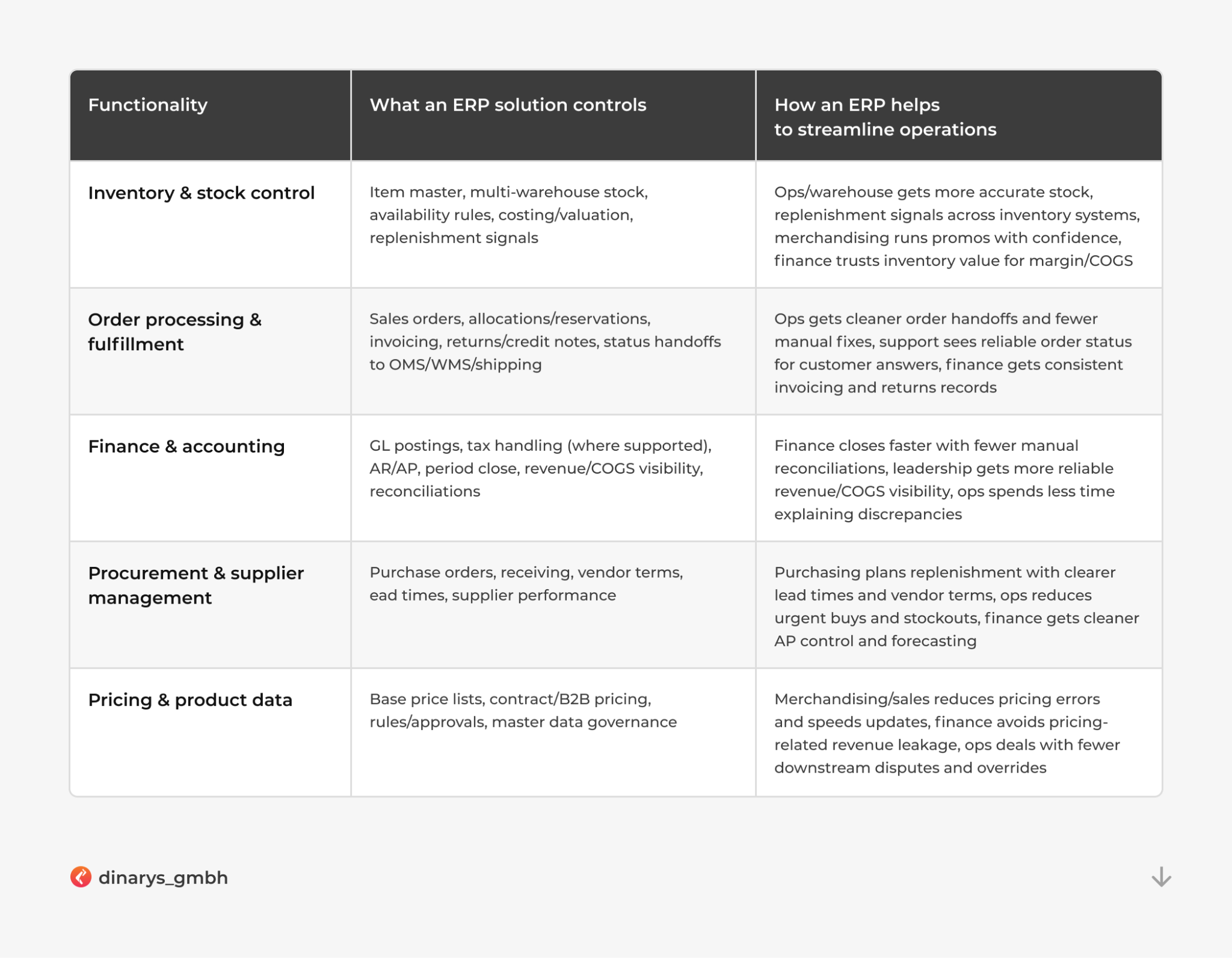
#1: Enterprise Resource Planning (ERP)
An ERP solution is a back-office system that centralizes core operations and finance. It is often the system of record for inventory and accounting, and it improves stock accuracy, speeds up month-end close, and reduces manual fixes caused by mismatched data across systems.
Popular ERP solutions include:
Enterprise: SAP S/4HANA, Oracle Fusion Cloud ERP
Mid-market: Oracle NetSuite, Microsoft Dynamics 365, Sage 100
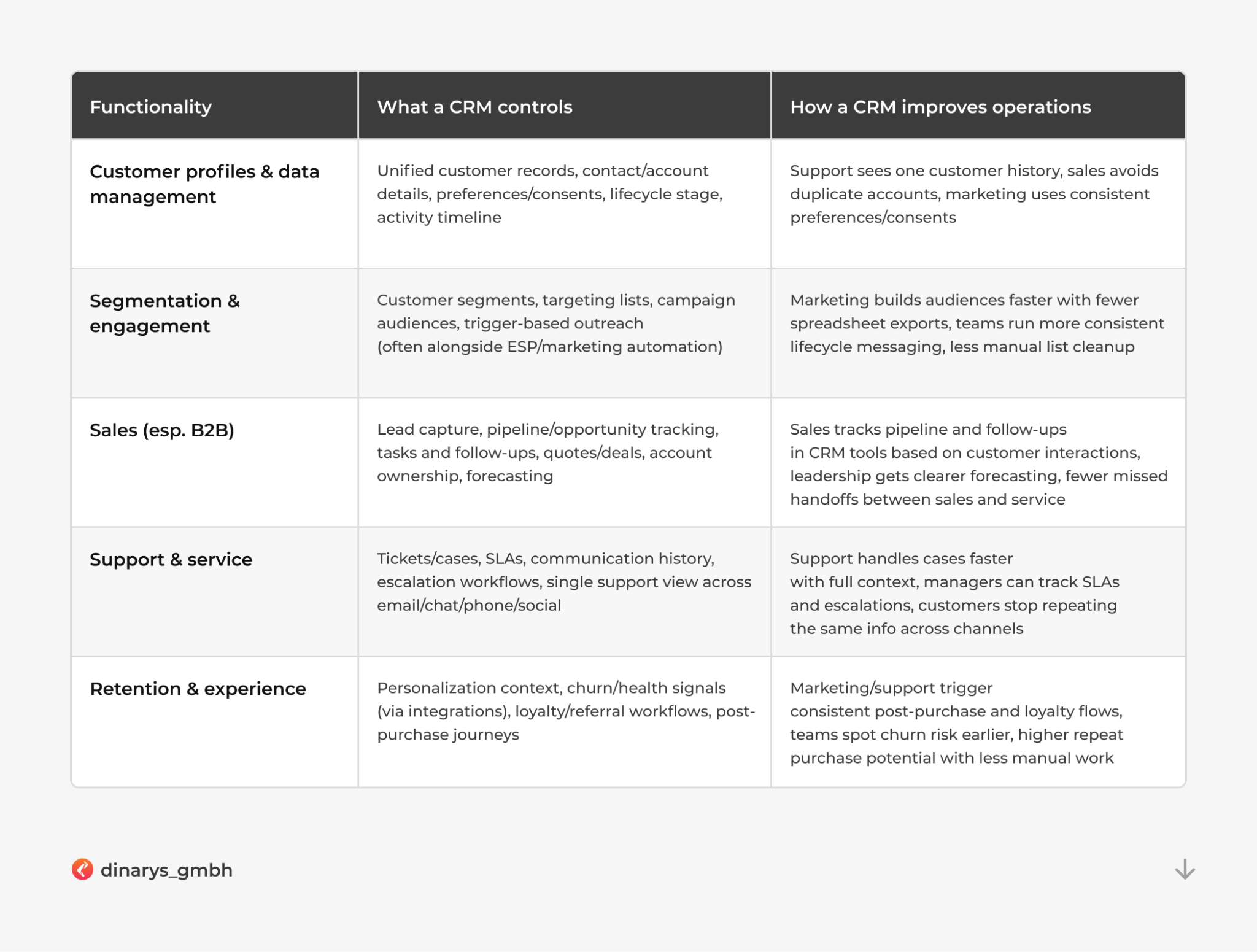
A CRM system centralizes customer profiles and interaction history across sales, support, and marketing. It keeps customer context consistent across channels, enabling faster support, better personalization, smoother workflows, and improved retention and customer loyalty.
Popular CRM solutions:
Enterprise: Salesforce, Microsoft Dynamics 365, SAP
Mid-market: HubSpot, Zoho CRM
SMB / flexible: Pipedrive, Zendesk, Freshdesk
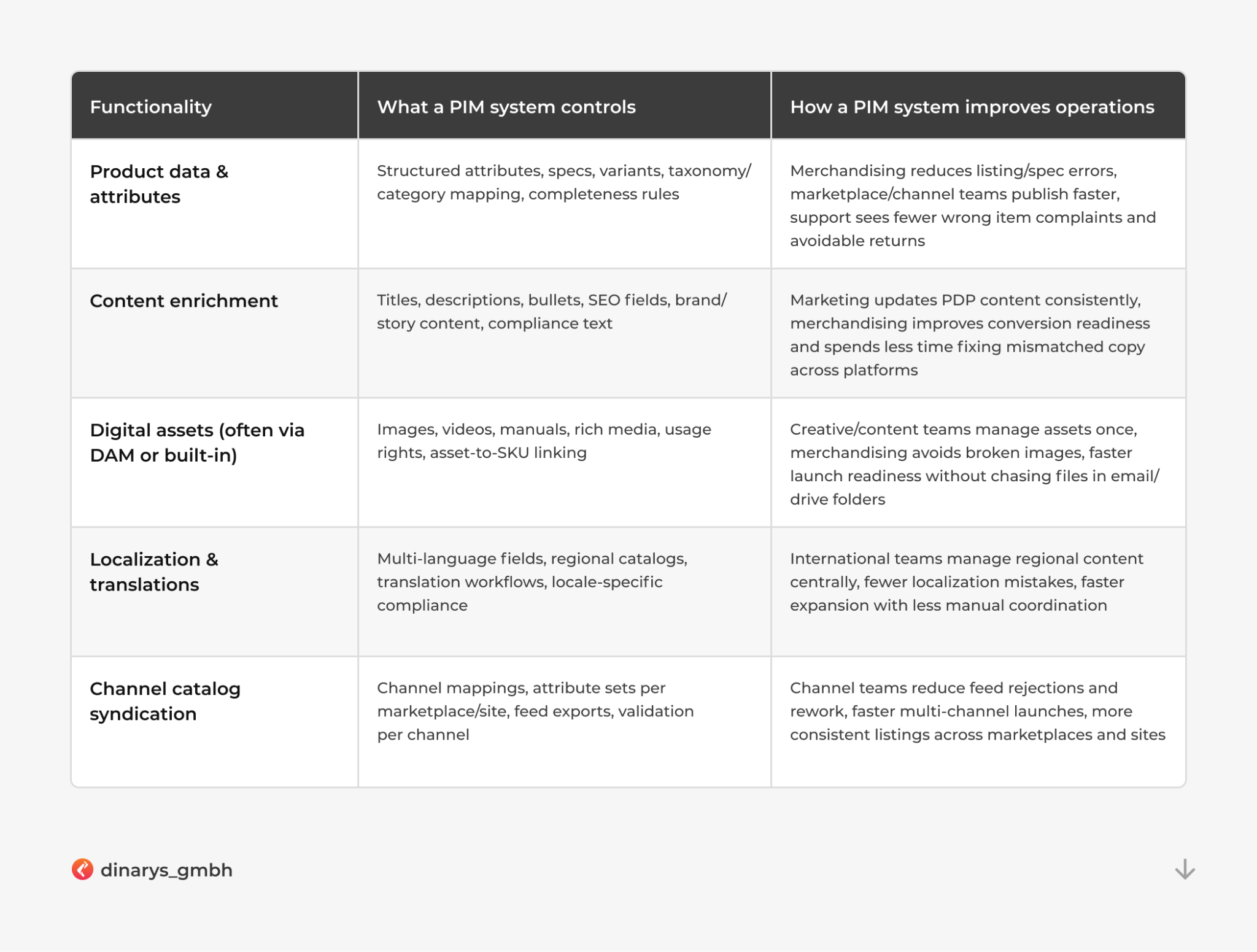
#3: Product Information Management (PIM)
A PIM system centralizes and governs product data (attributes, content, and enrichment) so listings stay consistent across your website, marketplaces, and other marketing tools. It replaces spreadsheets, speeds up launches, and reduces listing errors.
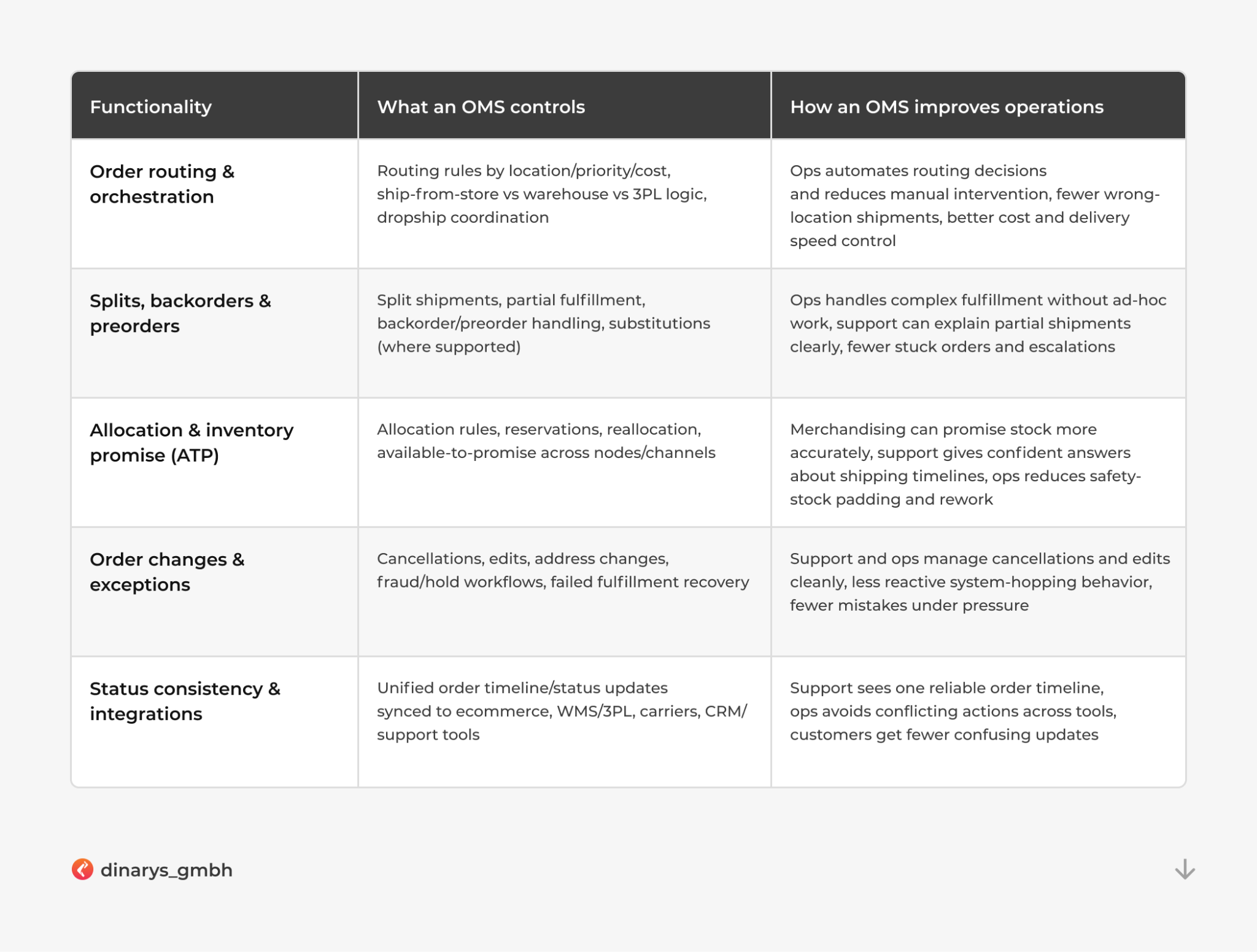
An OMS takes the order after checkout, reserves inventory, decides where it should ship from (warehouse/store/3PL), and splits the order into more than one shipment if needed. When an order moves through real operational states, such as stockouts, backorders, cancellations, partial shipments, returns, or refunds, the system applies the right rules and keeps statuses consistent across the ecommerce platform, fulfillment, and support. That reduces shipping mistakes and improves visibility.
Popular OMS solutions:
Enterprise: Manhattan Associates, Blue Yonder, IBM Sterling OMS
Mid-market: Fluent Commerce, Salesforce Order Management, NewStore
SMB / flexible: Brightpearl, Order Desk, ShipStation
#5: Payment Service Provider, Tax Engine, and Fraud Prevention
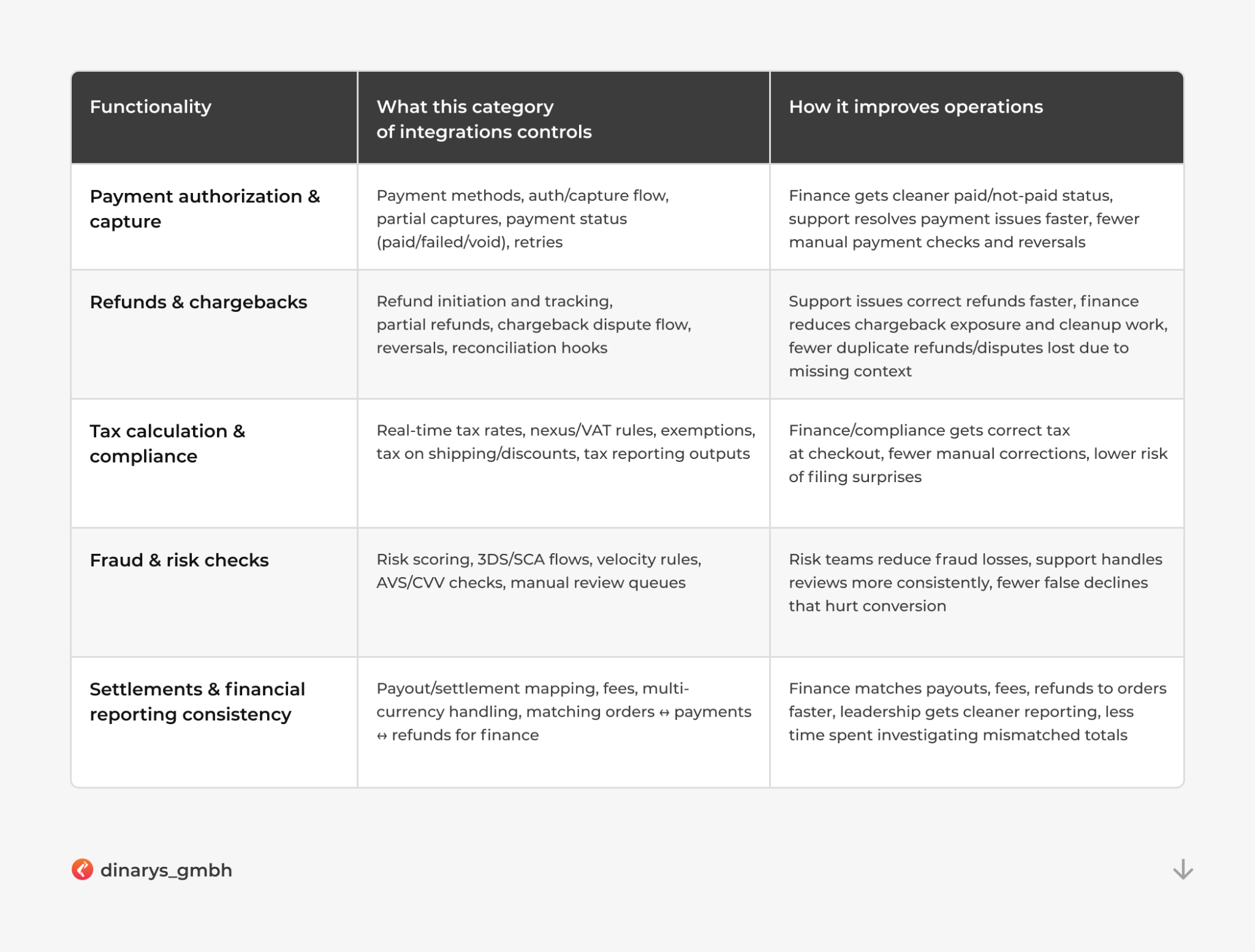
Payment service provider, tax engine, and fraud prevention systems manage the money and risk layer: payment authorization/capture, refunds/chargebacks, tax calculation, and fraud checks. They keep payment and tax states consistent and make reconciliation easier by tying together captures, refunds, fees, and settlements.
#6: Third-Party Logistics and Warehouse Management Systems (3PL/WMS)
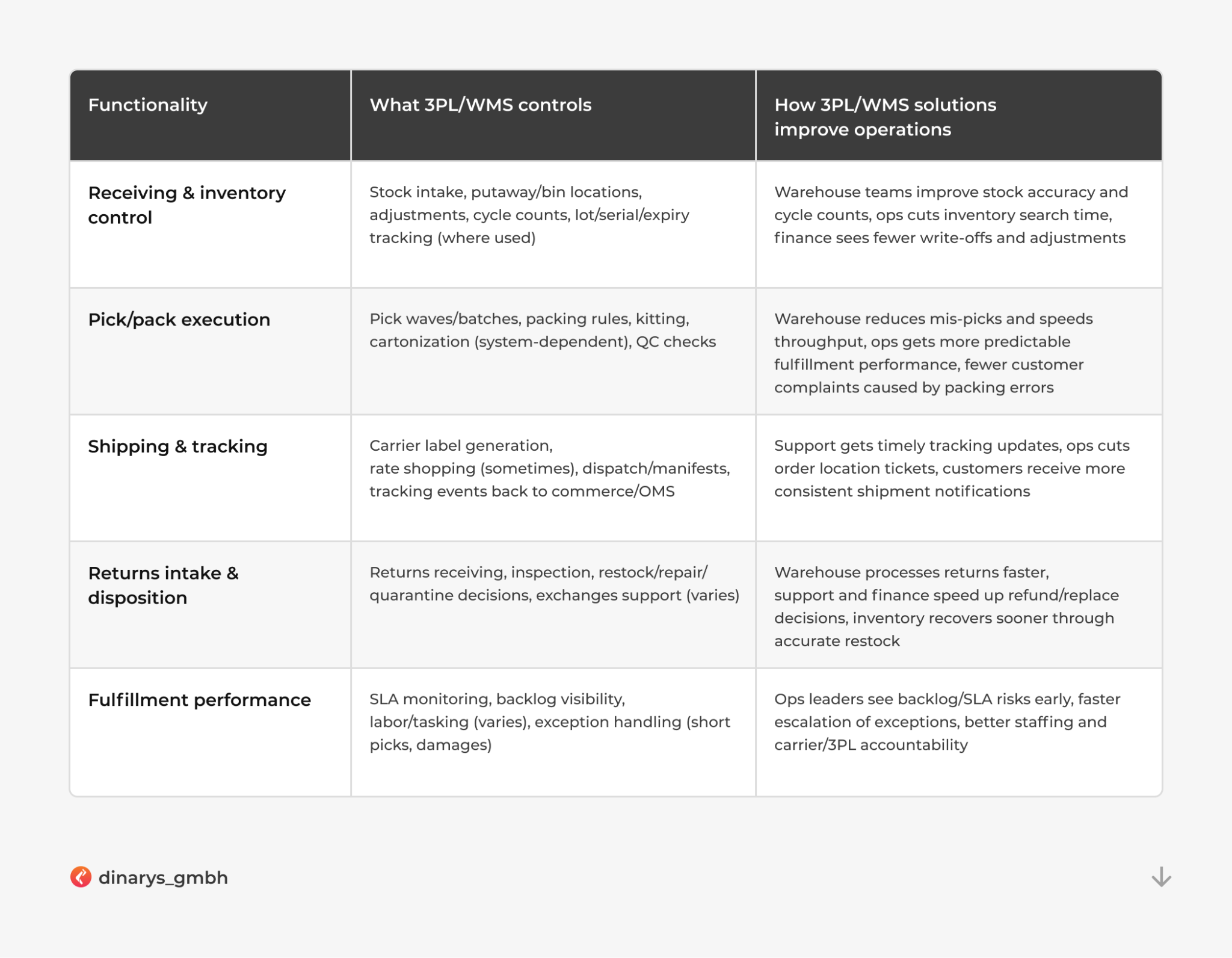
3PL and WMS systems are the fulfillment execution layer for receiving, picking, packing, shipping, tracking, and (often) returns intake. They keep inventory in electronic systems aligned with physical inventory, reduce mispicks, speed up shipping, and keep stock and order status consistent across ecommerce and operations.
3PL providers: DHL Supply Chain, GXO, DB Schenker, ShipBob
Now that you know what each system controls, the next challenge is keeping them aligned so that order, inventory, and payment state stay consistent across tools, even when updates arrive late, are out of order, or fail. That requires a clear operating model and the technical guardrails to enforce it.
NEED A CLEAR INTEGRATION PLAN BEFORE YOU TOUCH THE STACK?
Dinarys can audit your current workflows, define what each system should own, and outline how data should move so orders, inventory, and refunds don’t drift after launch.
How Ecommerce Integrations Should Work and Where They Fail
To understand why integrations fail, it helps to first define what a correct, stable integration program looks like.
How Ecommerce Integrations Should Be Built
Reliable integrations keep orders, inventory, and payments in sync across systems and continue to function even when components fail or change. Before implementing integrations, you should decide which systems make which decisions, whether each workflow is event-based or batch-based, and how failures will be handled without creating duplicates or causing data drift between systems. Because integrations run over APIs and webhooks, they must handle real-world constraints such as rate limits, timeouts, delayed or duplicated updates, retries, and changing payloads.
A mature integration setup starts with workflow design: Map the end-to-end flows that run the business and make explicit decisions about ownership and handoffs between systems. A clean “ideal path” typically includes:
Steps
What gets defined and delivered (across the ecommerce platform and the integrated system)
1) Discovery, audit, and process mapping
Audit the current stack and data quality, map real workflows (order → fulfillment → returns/refunds → finance), capture exceptions, and identify what must change vs stay.
2) Target operating model (process design)
Redesign workflows with BA/ops: define handoffs, exception handling, ownership by team/system, and what “correct” means operationally.
3) Architecture + ownership model
Decide where business logic lives (platform vs middleware vs ERP/OMS); define sources of truth and write paths (who can change which state), plus security boundaries.
4) Data model + migration plan
Define IDs and data contracts, mapping and cleanup rules, migration/backfill approach, and how you’ll reconcile outcomes after go-live.
5) Integration flow design + reliability
Choose events vs batches per workflow, design safe retries/replay and compensating actions, and build monitoring/alerts + runbooks for recovery.
6) Cutover + change discipline
Plan cutover windows and rollback, set go/no-go gates, and define versioning/regression checks + release discipline so updates don’t silently break sync.
These steps define the delivery program that makes the ecommerce platform and the connected system operate as one. If any part is skipped, systems won’t stay correct and recoverable once data volumes grow and the number of edge cases rises.
Why Ecommerce Integrations Break
Below are the most common reasons integrations drift out of sync in real ecommerce conditions, especially when volume, channels, and edge cases increase.
#1: Overlapping ownership of inventory and orders leads to conflicting data
In a growing technology stack, the storefront, ERP, OMS, PIM, CRM, payments, and 3PL can all hold overlapping versions of the same entities (product, customer, inventory, order, payment, shipment). If a single source of truth isn’t enforced, systems drift into competing realities. Here’s how that failure shows up in day-to-day operations:
Inventory drift when two systems update stock
What happens step by step:
Warehouse stock changes (receiving, transfers, adjustments) are recorded in the WMS or ERP, often with a delay or in batches.
Storefront availability is updated to keep products sellable (manual overrides, safety stock, promo pushes).
The storefront and ERP/WMS now show different inventory levels for the same item.
Customers purchase based on the storefront number.
Warehouses can’t pick and ship because physical stock does not match what the storefront promised.
Ops and support resolve this manually through reroutes, substitutions, splits, cancellations, and refunds.
What you see inside the business: Inventory looks right in one tool and wrong in another, orders that should ship get stuck, campaigns are paused because no one trusts stock
What it causes: Oversells, cancellations, missed SLAs, higher support load, extra shipping costs, margin erosion
Order status splits when teams fix orders in different systems
What happens in order:
Customer requests a change after checkout (cancellation, address change, item removal, swap).
Support makes the change in the most convenient system (often the storefront admin).
Warehouse or 3PL is still working from an older version of the order because updates arrive late, out of sequence, or not at all.
Fulfillment proceeds using outdated data and ships anyway (wrong address, shipped after cancellation, wrong items).
Systems now disagree on status (storefront says canceled or refunded, 3PL says shipped, ERP says invoiced).
Teams clean up manually through reships, returns, escalations, and additional refunds.
What you see inside the business: Support can’t confidently answer what’s happening because each system shows a different truth. Ops spends time coordinating after the fact.
What it causes: Misshipments, repeat handling, higher logistics costs, customer frustration, recurring escalations
Duplicates and broken reconciliation when IDs aren’t stable
What happens in order:
Products, customers, or orders exist in multiple systems without one shared primary identifier.
Integrations match records using weak keys (email, name, SKU text) rather than stable IDs.
Normal changes happen (renames, variant edits, merges, channel-specific SKU rules).
Matching breaks and duplicates appear across customers, products, or orders.
Refunds, fees, and settlements don’t attach cleanly to the right order lines across PSP and ERP systems.
Finance closes the month manually by matching records in spreadsheets and investigating mismatches.
What you see inside the business Duplicate customer profiles, missing history, inconsistent reporting, and constant questions about which number is correct
What it causes Manual reconciliation, unreliable analytics, slower closes, ongoing IT firefighting
#2: Events arrive late or out of order, so states drift
Sync problems usually show up as delays, partial updates, or duplicates. Ecommerce flows move fast: orders are created and paid, fulfillment progresses (sometimes in parts), and updates continue through cancellations, returns, and refunds. Connected systems, on the other hand, update at different speeds.
Common mistake
What it leads to in operations
Treating sync as “send record A to system B” instead of a stateful workflow
Reality lags behind systems. Statuses don’t reflect the true state of the order/inventory, so dashboards lie and decisions are made based on stale data. You see mistimed promos, wrong replenishment signals, and teams chasing exceptions because reporting is behind actual operations.
Using one-way sync where bi-directional state is required (or vice versa)
Orders get stuck in limbo or bounce between systems. Payment can succeed but fulfillment never starts (or starts twice), cancellations/holds don’t propagate, and support can’t explain what’s happening because each tool shows a different status. This usually results in manual unlocking and reprocessing.
No idempotency (the same event can be applied twice)
Duplicates that cost money. The same order/refund/capture is processed twice during retries or webhook redelivery, leading to double charges, duplicate refunds, duplicate shipments, and higher chargeback risk. Teams spend time reversing transactions and cleaning up customer-facing mistakes.
No replay strategy (failed events can’t be safely retried)
Permanent data gaps and manual recovery. When an event fails, it’s lost or requires unsafe resending, so downstream systems miss updates (shipment confirmations, refunds, inventory adjustments). The result is stuck orders, missing status transitions, and holes that finance has to reconcile by hand.
Weak cancellation/exception propagation timing
Ship-after-cancel and warehouse rework. Cancellations arrive after the pick/pack wave, so the 3PL ships anyway. You pay for returns/reships, inventory stays inaccurate longer, and support deals with angry customers.
#3: Real orders don’t follow one-to-one flows, so sync breaks
Once you add real-world rules (split shipments, substitutions, partial fulfillment, backorders, returns/exchanges, multi-tender refunds, B2B approvals, channel constraints), a single order no longer maps neatly to one shipment, one invoice, or one refund across systems.
Where one-to-one assumptions fail
Business impact when integrations don’t account for real-world rules
One order becomes multiple shipments and invoices, but connected systems still expects one shipment per invoice
Status and document mismatch across systems. Support sees one order, operations sees multiple shipments, finance sees multiple invoices. Customers get confusing updates, and teams spend time stitching orders back together manually.
Inventory and fulfillment states diverge across systems
Availability becomes untrustworthy. The storefront sells what can’t ship, or blocks what is actually available. Restocks and returns don’t update fast enough, so teams add safety stock and still get stockouts and cancellations.
Returns flow spans tools (RMA, receive, restock, refund, accounting), and data is often not in sync
Refund timing and accounting drift. Customers wait longer for refunds, restock doesn’t happen when it should, and finance can’t match returns to refunds and postings cleanly without manual checks.
Exceptions pile up across tools as edge cases grow
Manual work becomes the process. Teams handle splits, substitutions, partials, and backorders in spreadsheets or Slack. Over time, this creates more inconsistency, slower fulfillment cycles, and higher operating cost per order.
#4: Without monitoring and ownership, small platform changes cause silent failures
Even stable integrations degrade if change isn’t managed. New channels introduce new event shapes, market expansion adds currency/tax/shipping rules, and platform/app updates can change payloads, payment authorization amounts, rate limits, or the behavior of the API/integration (how requests/responses work, how statuses are returned, what triggers events). Without API management and monitoring, failure often happens silently.
What goes wrong without change discipline
What it leads to in operations
Silent failures after updates (sync stops that are unnoticed until ops breaks)
Breaks are discovered by ops, not monitoring. Orders stop updating, inventory drifts, and refunds/fees don’t flow. The first signal is usually support tickets, warehouse errors, or a financial discrepancy — after damage has already been done.
The release process relies on emergency patches
Permanent firefighting mode. Teams ship hotfixes without full testing, creating regressions and more incidents. Delivery slows because every change feels risky and requires manual verification afterward.
New channels added via point-to-point connections
Fragile web of integrations. Every new marketplace/region/warehouse adds another brittle connection, multiplying failure points and making it hard to change anything without breaking something else.
Teams fear deployments because they don’t know what will break
Change freezes and delayed releases. Updates get postponed, improvements take longer than necessary, and the stack falls behind business needs because no one can predict what a release will break.
No monitoring/runbooks/clear ownership (applies to everything above)
Recurring incidents + slow recovery. When something fails, nobody knows who owns the fix, how to resend missed updates without causing duplicate orders, or what “back to normal” looks like — so recovery is manual and slow.
These failure patterns are predictable, and they’re exactly what a strong integration partner should design against. The evaluation steps below will help you separate vendors who can deliver that discipline from vendors who can’t.
ALREADY LIVE AND DEALING WITH INTEGRATION ISSUES?
Dinarys can diagnose root causes, stabilize critical flows, and set up safe recovery and change discipline so problems don’t recur.
A strong integration partner understands how your business actually runs and can prove they’ll protect those workflows during growth and replatforming. The goal is simple: integrations that stay correct, observable, and recoverable as volume and complexity increase. To evaluate potential ecommerce service providers in a practical way, use the 12-step sequence below:
Step 1: Validate the credibility of API integration firms for ecommerce websites with independent proof (pre-call assessment)
Before you book a call, confirm a vendor’s credibility by reading independent reviews and real case studies.
Then scan the vendor’s case studies and service pages for specifics: what business systems were connected and what real problems they handled (order issues, stock mismatches, refunds/fees, handoffs between teams). For predictable delivery, choose a vendor that can outline a clear step-by-step delivery plan (review, plan, build).
Step 2: Assess operational fit (pre‑call assessment)
Check whether the vendor runs an operational fit audit instead of integrating as-is. Strong partners document which system owns each key state, where exceptions occur, and how handoffs happen between teams and tools. They should also be able to say what to keep, what to rebuild, and what to add so the setup scales.
A useful proof point is whether a vendor can show real multi-channel workflows, not just single-system connections. Dinarys’ overview of affiliate integrations with D2C marketplaces describes the kind of channel-to-core orchestration a growing ecommerce store needs:
Step 3: Validate the architectural approach (pre‑call assessment)
See whether a vendor can explain how the integration is set up and what will keep it stable as complexity grows. They should be able to state:
Which systems make key decisions (inventory, order status, refunds)
How updates move between systems (immediate vs scheduled, one-way vs two-way)
How they avoid mismatches when updates are late, out of order, fail, or repeat
How the setup scales to new channels, markets, warehouses, or B2B rules
A useful proof point is whether they also describe controls to keep the integration reliable: monitoring, safe retry rules, protections against duplicates, secure access handling, and a plan for implementing API/platform changes without breaking workflows.
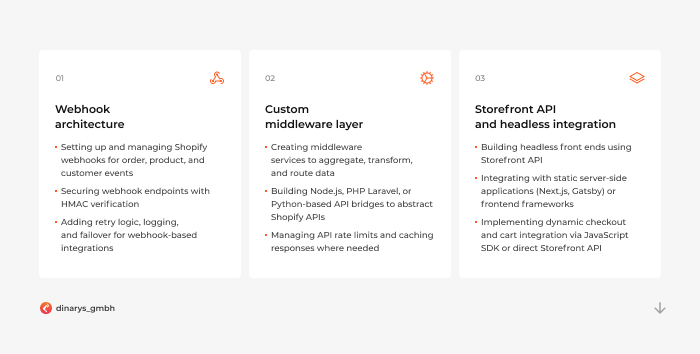
For example, Dinarys’ Shopify integration services page shows this level of clarity, including webhook flows, middleware, and an API/security layer:
Step 4: Confirm data integrity discipline (pre‑call assessment)
Look for whether the vendor treats accuracy as part of ecommerce data integration delivery. Strong teams explain how they keep product, customer, order, refund, and fee data consistent, and how they prevent duplicates and mismatches.
A strong proof point is whether they describe how they check results before and after launch, including structured testing during onboarding or a pilot run. If this isn’t mentioned, you’ll usually run into data integrity problems later that lead to manual cleanups, support confusion, and slow finance closes.
For example, Dinarys’ Magento to Shopify migration roadmap includes mapping, reformatting, cleaning, and validating data. It also calls for manual QA to avoid broken links between records.
Step 5: Check security and compliance readiness (pre‑call assessment)
Integrations move sensitive data by default (customer info, addresses, order history, refunds, and credentials). Before a call, look for any sign that the vendor treats security as part of delivery.
A useful proof point is whether they explain how they handle:
Who can access what and how access is controlled
How customer data is protected when it moves between systems
Where compliance boundaries are (privacy rules, and keeping payment data in the payment provider)
If a vendor’s publically available materials never mention security or compliance, it’s usually handled reactively after something breaks or an audit forces it.
Step 6: Confirm support models and change discipline when vetting API integration companies for ecommerce websites (pre‑call assessment)
Even solid integrations break as the stack changes (updates, new channels, new tax rules, new 3PL flows). Before a call, check whether the vendor clearly includes post-launch support as part of delivery.
A useful proof point is whether they describe ongoing support (stabilization after launch, monitoring, maintenance, response times) and how they release changes without breaking existing workflows (clear process, clear ownership when something fails). If this information isn’t publicly available, assume your team will own incidents after go-live.
Step 7: Stress-test order and payment safety (live validation)
In your evaluation call, start by discussing failures that get expensive fast: duplicate orders, double charges, missing refunds, and orders that were paid but never shipped. A strong partner should explain how they prevent these and keep payment status consistent across your store, payment provider, fulfillment, and finance.
Ask the vendor to walk through the following scenarios:
Payment succeeds, but the order fails to reach the ERP/OMS (or 3PL/WMS) system
Same update arrives twice, or a cancellation arrives late
Partial shipment with a partial charge or refund
Refunds and fees don’t match the final payout/settlement
What you want to hear is that a vendor prevents double processing, retries safely, and can reverse mistakes so the same order can’t be charged, shipped, or refunded twice.
Step 8: Check monitoring and incident readiness (live validation)
Next, validate whether a vendor treats observability as part of delivery. Ask what the vendor monitors, what triggers alerts, who is responsible for responding to those alerts, and how they confirm whether delayed updates still arrive correctly or whether systems end up showing different order, inventory, or refund states.
Then ask about their recovery process. A mature partner should have a clear incident playbook that covers:
How they safely pause processing
How they replay missed updates without creating duplicates
How they reconcile systems
How they communicate statuses while they’re being fixed
If they can’t describe a runbook-style recovery path and ownership model, you’re likely to discover failures via ops and finance after damage is already done.
Step 9: Verify QA, cutover, and rollback (live validation)
Now confirm that the vendor can handle the launch in a controlled way. Ask how they test real scenarios (splits, backorders, cancellations, returns/exchanges, partial refunds, multi-warehouse allocation) and what clear go/no-go checks they use.
Then ask for the cutover plan: timing, sequence, data migration, and rollback. They should explain how they keep data consistent during the switch and how they confirm orders, inventory, and payments still match right after launch. If they can’t explain rollback, your ops and finance teams carry the risk.
Step 10: Scalability and performance testing (live validation)
Ask how the vendor proves integrations can handle real pressure: promo spikes, marketplace surges, update backlogs, lots of orders at once. A strong partner should explain:
How they test high-volume conditions and what “passing” means
How they keep systems in sync when one system is slow
How they prevent slow systems (ERP, warehouse/3PL, payment provider) from causing timeouts, duplicate actions, or stuck orders
Make sure they mention safeguards such as queueing work, limits on how much runs at once, capacity targets, monitoring for delays/errors, and a plan for growth as volume increases.
Step 11: Post-launch operating model (live validation)
Finally, make ownership explicit. Ask who is responsible after launch:
Who triages
Who fixes
Who communicates
SLA response time
Ask what the vendor will cover after launch, what will cost extra, and how long they’ll help stabilize the integration. Also, ask how the vendor handles ongoing changes (updates, new channels, new tax rules, new warehouses) without breaking what already works, and ask how they roll out changes safely. If an update breaks order sync or inventory, what’s the quickest way to revert to the last working version while the issue is fixed?
These steps expose gaps that turn “working” integrations into operational risk. If a vendor can’t explain them, you’ll pay after the integration is live through manual fixes, unreliable data, slow closes, and risky releases.
Top Ecommerce API Integration Companies 2026: Shortlist of Partners
After applying your evaluation criteria and narrowing the field, the next step is to review vendors that consistently deliver functional and maintainable integrations. The companies below stand out for handling multi-system complexity with the process discipline required for stable outcomes as the ecommerce stack evolves in 2026.
Edvantis
Founded in 2005, Edvantis operates from Berlin and New York and delivers system integration programs focused on API/microservices and enterprise application integration, supported by expertise in data engineering , hybrid cloud/on-premises connectivity, and legacy modernization.
Company overview:
Integration-relevant services: Integration strategy, API & microservices integration, EAI, data engineering/pipelines, cloud & on-premises connectivity, legacy reengineering
Selected clients: Modulsystem Sweden AB, Doc Cirrus, SEMDATEX, Indeed, KPC Labs, ATRON Systems
Ecommerce platforms: BigCommerce, Adobe Commerce, Magento Open Source
Simform
Founded in 2010 and headquartered in Ahmedabad, India, Simform supports retail and ecommerce teams with cloud/MACH engineering, data engineering, and custom system integration.
Company overview:
Integration-relevant services: Data integration and custom integrations; cloud & DevOps engineering; MACH/cloud architecture; ETL/ELT pipelines, ingestion, and analytics enablement
Selected clients: Sony Music, Swift Shopper, FreeWire Technologies, Fujifilm, Red Bull
Ecommerce platforms: Shopify, Shopify Plus, Magento Open Source
Dinarys
Dinarys was founded in 2014 and now has operations in both Berlin, Germany, and Dnipro, Ukraine. The company delivers ERP-/CRM-led ecommerce integrations to retail and direct-to-consumer teams that need reliable order, inventory, and finance workflows. They also develop commerce platforms, carry out replatforming projects for growing brands with complex operations, and support ecommerce organizations in implementing operational systems and integrations across major commerce ecosystems.
Company overview:
Integration-relevant services: ERP integrations, business system integrations, ecommerce integration consulting and implementation
Ecommerce platforms: Shopify, Shopify Plus, BigCommerce, WooCommerce, Shopware, Adobe Commerce, Magento Open Source, Emporix, commercetools, SAP Commerce Cloud, Salesforce
WANT A CLEAR INTEGRATION ROADMAP WITH REAL SCOPE AND OWNERSHIP?
Dinarys can map your workflows across ERP, fulfillment, and payments, define what should be rebuilt vs kept, and outline a phased plan for implementing and stabilizing integrations, with validation gates and post-launch responsibility.
Founded in 2007 and headquartered in Warsaw, Innowise delivers ecommerce integration and migration services alongside broader ecommerce development and works with ERP, CRM, PIM, and other types of common operational systems.
Company overview:
Integration-relevant services: Ecommerce integration and migration, ERP services and third-party integrations, PIM implementation/PIM-to-ERP/CRM/eCommerce integration, CRM integration services
Selected clients: NTT DATA, Commercial Bank of Qatar, SPAR, Familux Resorts
Atwix was founded in 2006 and operates across the US and Europe, with teams in Chicago and Bratislava. The company focuses on ERP to ecommerce integration, building custom and API-based connections between major ERP systems and commerce platforms to reduce manual work in order and inventory workflows.
Company overview:
Integration-relevant services: ERP integrations for ecommerce, custom ERP integration solutions, API integration for ERP and third-party systems
Selected clients: Sony Biotechnology, Graphic Solutions Group, Wyze, Reinders, Wilson Sporting Goods
Ecommerce platforms: Magento Open Source, Adobe Commerce, Shopware, BigCommerce
MOBIKASA
MOBIKASA is a New York–based ecommerce agency founded in 2011. They build ecommerce stores and support them after launch, and they offer product catalog support through data management services such as data cleanup, enrichment, and ongoing product data work tied to PIM/ERP and storefront workflows.
Company overview:
Integration-relevant services: Ecommerce development across platforms, data management/data entry to support catalog readiness across systems
Selected clients: Perfumania, Fast Growing Trees, Nokia, Danetti, 1-800-Flowers, Versace, United by Blue
ELEKS was founded in 1991 and has a central office in Tallinn, Estonia. They deliver enterprise-grade retail software consulting and custom development services and offer system integration across the retail stack as a core part of broader delivery (including data/AI work that supports cross-system consistency and decision-making).
Company overview:
Integration-relevant services: Retail software consulting and development, enterprise applications and integrations, data and AI services supporting cross-system consistency
Ecommerce platforms: Salesforce Commerce Cloud, SAP Commerce, Adobe Commerce
Picking Among the Top Ecommerce Integration Companies
Integration work is easy to underestimate because many failures don’t show up on day one. Instead, they surface later as mismatched system states, operational friction, and manual cleanup.
There’s no single best integration company. The right partner depends on your technology stack, growth plans, and highest-risk workflows.
FAQ
Most vendors connect your ecommerce platform to the business tools that run operations — ERP/OMS/PIM/3PL systems, secure payment gateways (plus tax calculation tools), CRM systems, and analytics tools. They also handle integration architecture, testing, and post-launch support to minimize manual work and keep business processes stable as complexity grows.
Ask how a vendor keeps data correct over time. Strong vendors will explain their API capabilities; how events move through the system; how they detect drift across orders, refunds, and inventory; and how they validate results and recover from failures as systems change. Also, clarify what your platform supports natively versus what requires middleware or pre-built connectors to keep updates manageable.
The timeline varies by scope and complexity. In general, simple connector work often takes 2–6 weeks, while multi-system integrations (ERP/OMS/3PL, catalog, payments) typically take 8–16 weeks because they require mapping, testing, and operational readiness. More complex programs (multi-warehouse, multi-channel, B2B rules, finance-grade reconciliation) can run 4–6+ months. The best partners phase delivery so you can validate early, automate workflows safely, and avoid rushing changes that break payment or fulfillment flows.
Expect integrations that give support teams a unified view of customers and orders so they can resolve exceptions without chasing data across systems. Typical setups sync order status, shipment tracking, refunds, and customer profiles into your helpdesk/CRM. If you rely on social messaging or community channels, social integrations may also be included for a consistent interaction history.
Strong teams start by defining which system owns product data and which owns availability. They then sync catalog updates with validation controls to make sure the storefront has accurate data and maintain accurate stock across channels to prevent oversells and cancellations. The goal is less manual cleanup and more reliable automation for catalog publishing, stock updates, and channel rules.
At minimum, they should secure credentials, enforce least-privilege access, and keep audit-ready logs for incident response. This is especially important for payment and customer flows (gateways, refunds, identity). A vendor should also have practices that stay reliable as apps, vendors, and authentication methods change.
CRM integration and customer data management become critical when retention and service depend on a single, accurate customer view. Companies like Dinarys that deliver ERP-/CRM-led ecommerce integrations focus on keeping CRM software aligned with order history and key lifecycle events. This allows teams to personalize messaging based on customer behavior and pricing structure preferences, resolve customer issues with fewer back-and-forth messages, and deliver consistent experiences that drive repeat purchases and loyalty.
You may share this article
Let professionals meet your challenge
Our certified specialists will find the most optimal solution for your business.