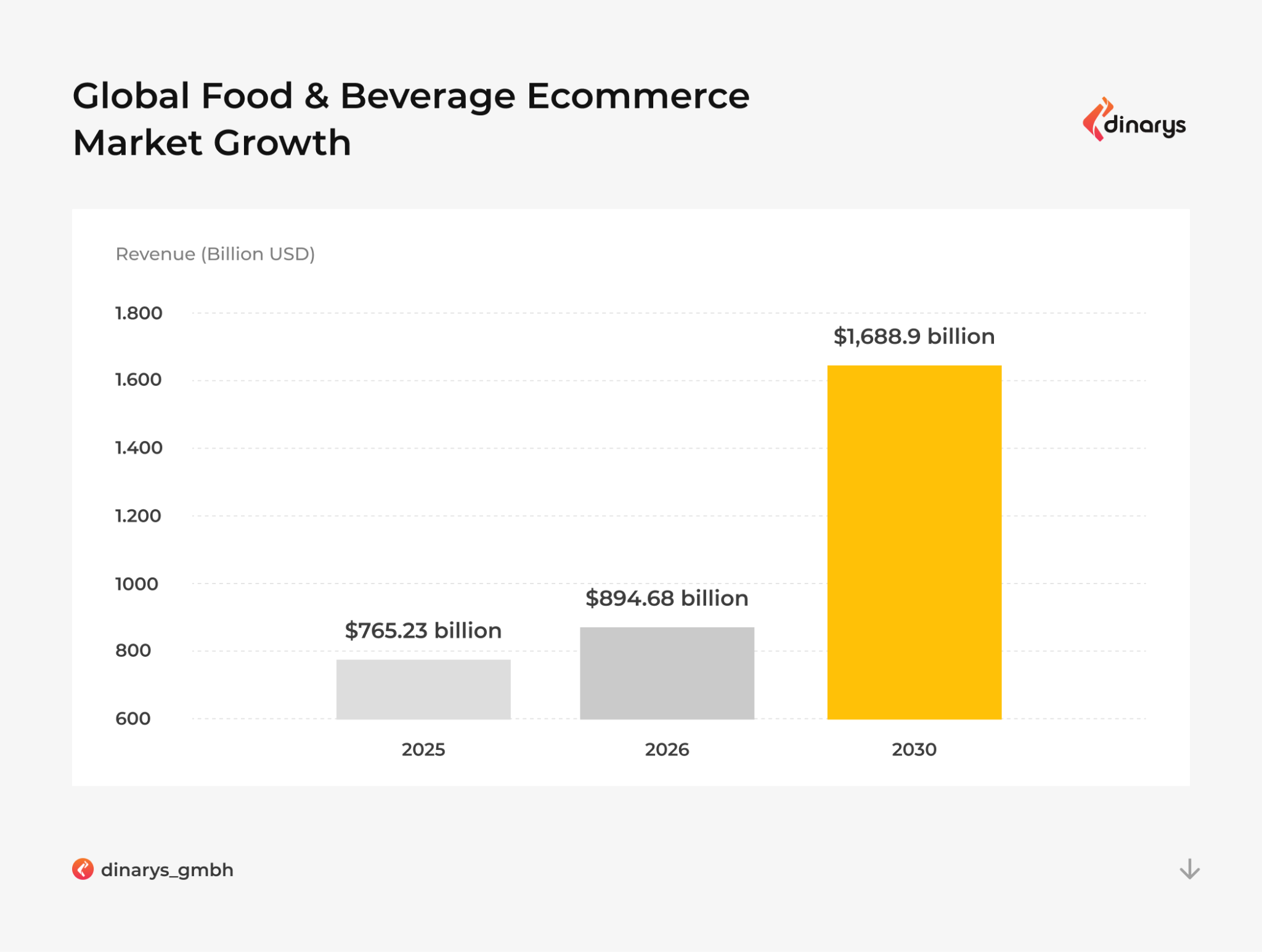
Food and beverage is one of the most operationally demanding categories in ecommerce and also a fast-growing one. According to The Business Research Company report, global food and beverage ecommerce reached $765.23 billion in 2025, is expected to grow to $894.68 billion in 2026, and is projected to reach $1,688.9 billion by 2030.
Part of that growth was accelerated by the COVID-19 pandemic, with around a 50% increase in online grocery and delivery orders at the time. While it began as a forced shift in consumer behavior, buying food and groceries online has become a lasting habit for many households in the United States, Europe, and Asia.
Growing demand for food and beverage ecommerce has subsequently led to it becoming more complex from both an operational and technical perspective. Today, it covers several distinct business models, including but not limited to those with their own fulfillment logic, customer expectations, and technical requirements:
Business model
Customer expectations
Key technical needs
Grocery delivery & pickup
Fast ordering, stock accuracy, flexible slots, clear updates
Real-time updates for stock, store availability, and delivery or pickup options
DTC food & beverage brands
Easy reorders, strong brand experience, clear product info
Simple support for reordering and a clear buying process from product page to checkout
Subscription-first businesses
Flexible plans, skip and pause options, predictable deliveries
Reliable subscription management for skips, pauses, plan changes, and delivery schedules
Meal kits & ready-to-eat
Freshness, clear delivery dates, easy plan changes
Accurate coordination between ordering, delivery timing, and internal planning
Restaurant meal delivery
Fast checkout, live updates, reliable ETAs
Order processing that stays in sync with kitchen and delivery operations
Support for account-based pricing, access rules, approval steps, and repeat ordering
For many brands and operators, that level of technical and integration complexity can be difficult to manage in-house. It takes specialized knowledge and continuous effort that internal teams are better off devoting to core business priorities instead.
This is where a development partner with experience in ecommerce architecture, backend integrations, and fulfillment logic becomes especially valuable. While you and your team are focused on working directly with the customer, the ecommerce development company will make sure your setup supports a smooth and reliable buying experience that gives customers the convenience, flexibility, and clarity they expect.
This article uses those considerations as a checklist for evaluating vendors. To help you choose more confidently, we will break down:
What makes this category hard to build for
What businesses need from their ecommerce setup
How to evaluate development partners
Which development companies stand out
What Makes Ecommerce Platform Development for Food and Beverage Complex
Food and beverage ecommerce is complex because businesses in this category follow very different operating models, and each of them needs a setup built around the right ecommerce logic. Even a small mismatch between the ecommerce logic and the operating model can create problems that compound over time.
The table below shows some of the setup mistakes an inexperienced developer can make along with the type of logic that needs to be built in for each model to work properly:
Business type
What needs to be implemented in the setup
What can be built wrong
Subscription businesses
Flexible recurring-order controls.Blue Apron’s Autoship flow shows that customers need to be able to skip deliveries, reschedule orders, and change delivery frequency from their account.
A one-time checkout flow created with rigid data modeling and hard-coded order states, so the setup cannot support skips, rescheduling, or delivery-frequency changes.
Grocery delivery businesses
Live inventory and local availability logic.Instacart treats the same product in different stores as different items because availability changes by location.
The setup relied on a product catalog with static stock visibility, so customers see products or delivery options the business cannot support.
The delivery flow structured like a standard shipped-order setup, so the storefront offers delivery options that do not match how the perishable goods need to be handled.
B2B suppliers
Volume discounts, enterprise level pricing, approval rules, invoicing logic, and user permissions. Walmart Business (a popular dedicated B2B platform) supports multi-user accounts, approvers, spend limits, and pay-by-invoice, all of which require manual or API-driven intervention.
The store built like a consumer-facing ecommerce site, pushing the wholesale buyers into the wrong ordering flow.
Restaurant meal delivery
Scheduled-order, pickup, and store-side timing logic.Grab’s merchant documentation shows scheduled orders and self pickup as distinct operational flows.
The ordering flow built like a standard ecommerce purchase path, so the storefront doesn't match how restaurant orders are actually processed.
Marketplace-led sellers / multichannel operators
Shared product availability, pickup and delivery logic, and order handling across channels. Whole Foods lets customers place grocery orders through regional platforms like Deliveroo in the UK, its own grocery page, through Amazon, and through the Amazon app for store-based pickup and delivery.
The store constructed like a separate sales channel, so product, stock, and order data become inconsistent across all business selling points.
These mismatches do not stay technical for long, affecting core business metrics, from conversion and order quality to repeat purchasing:
Baymard found that 18% of shoppers abandon checkout because the process is too long or complicated.
Which? found that 29% of online grocery shoppers received a substitution in their most recent order.
NETCONOMY reports that 35% of B2B buyers are frustrated by time-consuming reordering while 34% are frustrated by complicated approval processes.
The key task for a development partner is to understand the operating model and its specific demands before deciding how the ecommerce setup should work. Without that alignment, even a technically sound build can support the wrong workflows, create extra costs for the business, and weaken customer trust in the brand.
NEED A DEVELOPMENT PARTNER WHO UNDERSTANDS COMPLEX FOOD AND BEVERAGE ECOMMERCE?
Dinarys works with food and beverage businesses at different stages of growth and brings relevant experience in building, improving, and supporting setups with complex integrations, workflows, and fulfillment logic.
What Systems Should Ecommerce Development Companies for Food and Beverage Excel In
Food and beverage ecommerce businesses rely on a wide set of systems, tools, and subscription platforms.
In practice, that means the vendor needs to understand not only how to build the store itself, but also how to connect it to the systems the business already uses or plans to introduce.
What matters is whether a developer partner understands which system controls which part of the business and how to keep the website properly aligned with it as the business grows.
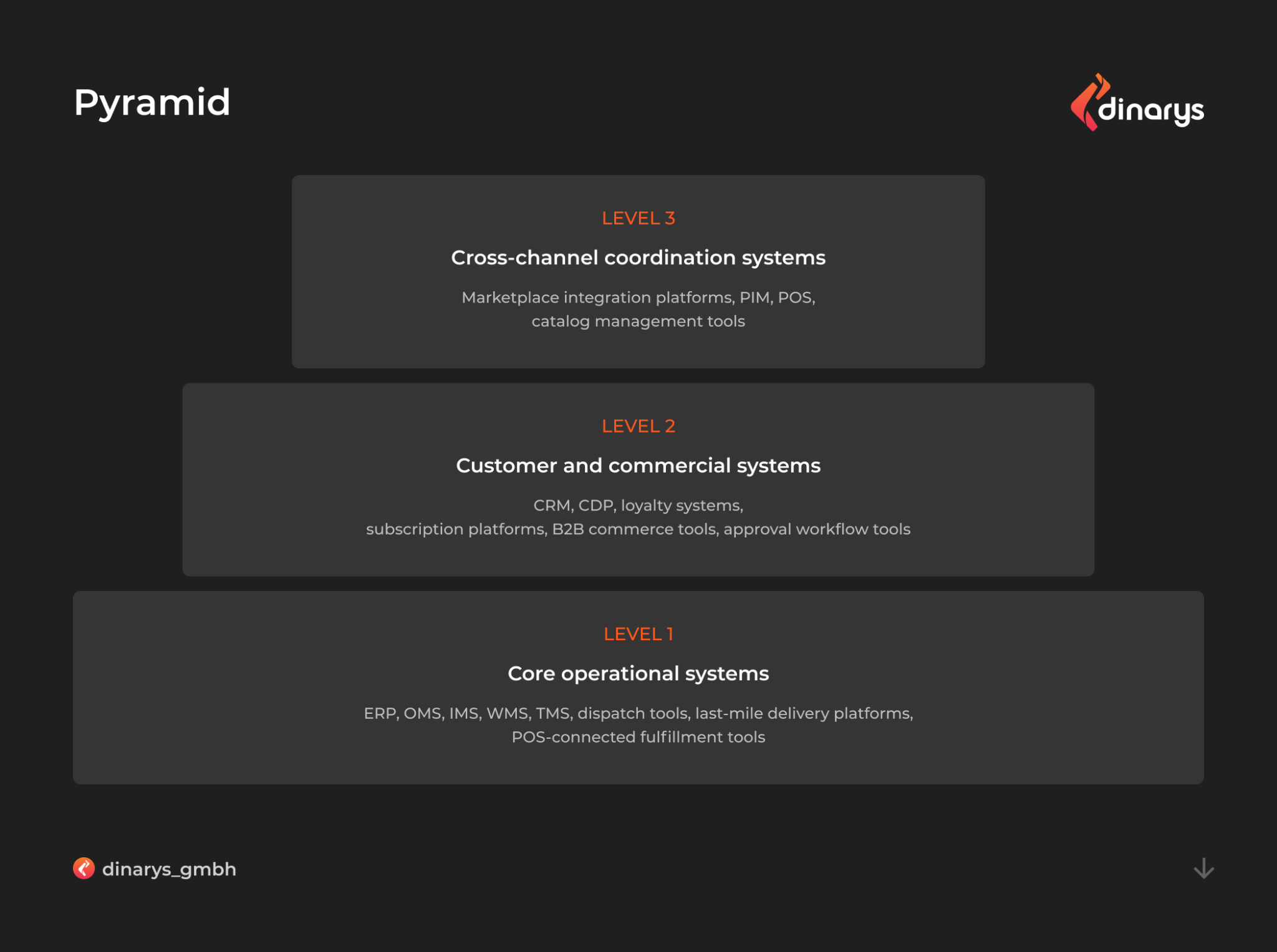
Systems for Inventory and Order Management
Inventory and order management systems allow to control what products the business can sell and what happens after an order is placed.
Common system types: ERP, OMS, IMS, WMS
Examples: NetSuite, SAP Business One, Dynamics 365, Cin7
The product availability in food and beverage ecommerce can change quickly:
Products may be in stock in one location but not another.
A short delivery window may depend on whether stock is available close enough to the customer.
The order may need to move through several steps after checkout before it is actually fulfilled.
Potential challenge: Failing to align the setup with the systems controlling this information would result in customers seeing products that are no longer available or order details that do not reflect what the business can process.
Systems for Delivery and Fulfillment
Delivery and fulfillment systems help the business route orders after checkout, deciding which location should handle them, when they can be prepared, and whether they should be delivered or made ready for pickup, while keeping routes efficient in terms of time, cost, operational disruption, and fuel use.
Common system types: TMS, dispatch tools, last-mile delivery platforms, POS-connected fulfillment tools
Examples: Onfleet, Bringg, Shipday, Toast
When buying food or groceries online, a lot is often shaped by timing of the order:
Delivery slot
Pickup option
Dispatch window
Cutoff time
These all reflect whether the business can actually prepare and hand over the order in time (especially important in businesses with local delivery, pickup, or short preparation windows).
Potential challenge: If these systems are not working properly, customers may be shown delivery or pickup options the business cannot actually handle. That can lead to delays and failed deliveries.
Systems for Customer Account, Subscription, and Repeat-Purchase
Customer account, subscription, and repeat-purchase systems store and organize customer data in a structured way, including account details, order history, subscription status, delivery preferences, and loyalty information.
Common system types: CRM, CDP, loyalty systems, subscription platforms
Many food and beverage businesses depend on repeat purchasing. A customer may need to:
Reorder the same products regularly
Update a subscription
Pause deliveries
Apply loyalty rewards
Manage account details without contacting support
These systems help the business manage repeat purchases more reliably, reduce manual work, and make actions like reordering, subscription updates, or loyalty rewards easier to support than they would be through separate spreadsheets or manual processes.
Potential challenge: If these systems are missing or implemented poorly, repeat purchases become harder to manage for both the customer and the business. Customers may struggle to update subscriptions, lose access to loyalty benefits, or have to contact support for simple account changes, while internal teams may end up handling these requests manually or working with incomplete customer data.
Systems for Pricing and Account-Based Logic
Pricing and account-based logic allow to control who can buy specific products and which terms apply to them.
Common system types: ERP, CRM, B2B commerce tools, approval workflow tools
Food and beverage businesses don't always sell to every customer in the same way. Wholesale buyers, multi-location customers, and account-based customers may all need different prices, payment terms, approval steps, product access, or ordering rules which need to be reflected in the setup.
By integrating these systems, the development partner would make sure that both current and potential customers see the right products, the right prices, and the right ordering conditions based on what the business already uses in its offline or B2B workflows.
Potential challenge: If these systems are missing or implemented poorly, customers may see pricing or product access that doesn’t apply to them, be unable to place orders under the right terms, or run into approval and payment issues that create extra friction for both the buyer and the internal team
Systems for Channel and Storefront Coordination
Channel and storefront coordination includes the systems keeping the website’s product data, prices, stock levels, and order information in sync with the other sales channels, such as marketplaces, physical stores, or POS-connected ordering.
Common system types: marketplace integration platforms, PIM, POS, catalog management tools
Examples: ChannelEngine, Akeneo, Shopify POS
Potential challenge: If these systems are missing or implemented poorly, customers may see different information in different places, and internal teams may have to correct those mismatches manually.
Operational reliability keeps customers from leaving. But the businesses gaining ground in the food and beverage category are also using emerging technology to make the customer experience faster, more personal, and easier to manage at scale.
What Technology Trends Are Shaping Food and Beverage Ecommerce and Why They Matter When Evaluating a Vendor
Vendors don’t need to push all of the existing food and beverage trends into every project, but they should understand which ones are already influencing the category and which may become relevant for your business next. Some of the most important trends in food and beverage ecommerce include:
Packaged platforms remain common for simpler setups. Platforms like Shopify and BigCommerce are still widely used because they offer out-of-the-box solutions that work well for many businesses at the early stage, allowing for a faster launch.
Headless and composable architectures usually become more relevant once a simpler platform setup gets too constricting, and the business needs more control, more flexible integrations, and more room to evolve.
AI-driven personalization is becoming more visible. Tools like Instacart’s Smart Shop show how AI can support product discovery, recommendations, and repeat purchases based on customer behavior.
D2C and subscription models continue to grow. For many food and beverage businesses, direct customer relationships and recurring purchases are becoming a bigger part of the business, which affects both the setup itself and the systems behind it.
Social commerce is becoming a stronger sales channel. Platforms like TikTok and Instagram increasingly influence how customers discover products and buy them, especially on mobile.
Knowing these technology trends helps when evaluating a vendor, because you need to see whether they understand not only the systems the business needs today, but also the trends that may start shaping platform, architecture, and integration decisions as the business grows.
Now that you know what matters when building and developing a food and beverage ecommerce business, the next step is to use that understanding when evaluating potential development partners.
How to Evaluate Ecommerce Web Development Companies for Food and Beverage
The framework below is designed to help you assess vendors from the right angle, review their work in this or related categories, and decide which one is the best fit at the current stage of your business growth.
#1: Check whether the vendor understands your business model [research and evaluation stage]
Make sure the vendor has built for your business model before, or at least understands what building for a specific type of food and beverage business implies from an architectural and operational perspective.
Check whether the case studies the vendor shows on their website present work for companies with similar buying patterns, fulfillment conditions, and operational rules. Those case studies should explain what was done, why it was done, and how it supported the client’s business model. That should be your first clue that the vendor is dependable.
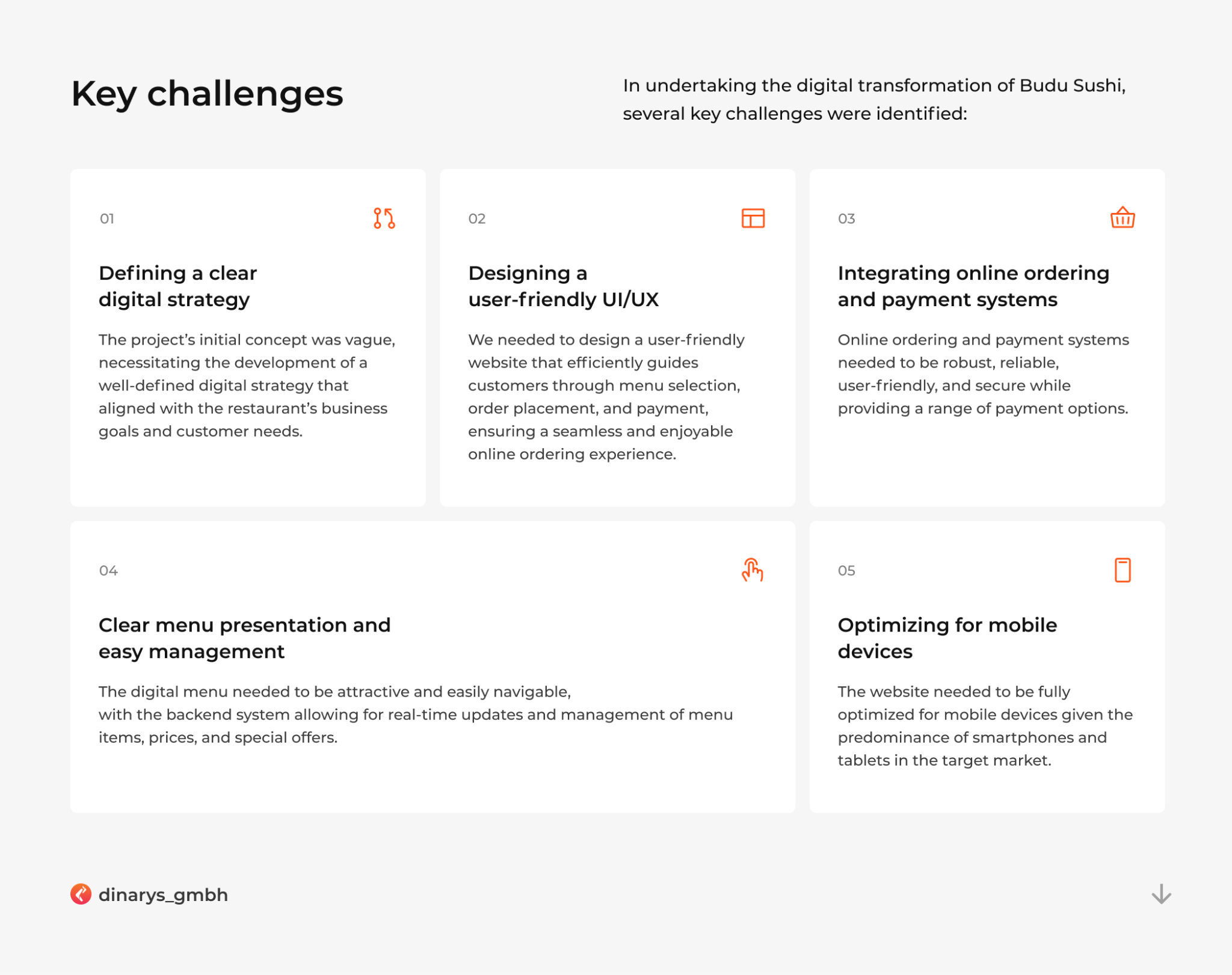
One example is our Dinarys Budu Sushi project, where the Dinarys team created a setup supporting online ordering, payments, menu presentation, and a mobile-friendly food ordering flow, allowing the business to substantially increase their online presence and boost online order volumes.
When finding a vendor you think could be a great match for your business, make sure that during the call they can clearly explain the specifics of building for your business model. Some of these may include:
Business type
What the vendor should be able to explain
DTC food & beverage brands
How repeat-purchase models support reordering, loyalty, account management, and mobile buying, and how the setup can grow into new channels without a major rebuild.
Subscription businesses
How subscription models handle recurring orders, skips, pauses, and customer controls between deliveries.
Grocery delivery businesses
How last-mile delivery or store pickup affects delivery windows, local inventory, routing, and fulfillment timing.
Meal kits & ready-to-eat businesses
How fresh, time-sensitive, perishable goods affect delivery timing, cutoffs, handling rules, and scheduled deliveries.
B2B suppliers
How wholesale or account-based selling changes pricing, payment terms, approvals, and account permissions.
Restaurant meal delivery
How delivery, pickup, kitchen timing, and dispatch affect the ordering flow.
Marketplace-led sellers & multichannel operators
How multi-channel selling keeps inventory, pricing, product data, and orders aligned across channels, and how the setup can grow into new channels or geographies.
#2: Make sure the development partner can handle integrations and operational complexity [evaluation stage]
A food and beverage site depends heavily on data coming from other systems, and those systems directly affect the accuracy of the website's available inventory and how orders are fulfilled.
Make sure the vendor can work with the operational complexity necessary for food and beverage industry and can explain:
What systems you need
What currently may be working inadequately
What can be done differently in your setup and why
This becomes even more important in businesses with delivery-based models, store pickup options, or multi-channel selling as these are very attached to the website staying aligned with operational reality in near real time.
#3: Check whether the vendor can make sound platform and architecture decisions [evaluation stage]
Food and beverage businesses face unique ecommerce challenges that general-purpose platforms often struggle to address. Deciding what kind of setup makes sense for your food and beverage brand should be based on your business model, operational needs, and the growth plan.
Some businesses may work well with mostly an out-of-the-box ecommerce setup (for example, on platforms like Shopify, BigCommerce, or WooCommerce) and a minimal set of connected systems. Others may need a more sophisticated build with custom storefronts, headless architecture, an API first architecture, a mobile app, or a combination of tools that can support subscriptions, local delivery, multi-channel selling, or account-based ordering.
Future capabilities also play a major role here. If you see it as a growing trend across the industry to introduce AI-driven recommendations, predictive replenishment, or voice-based ordering, you’d want to implement the same for your business to stay relevant. That means the setup architecture needs to be able to support those additions without forcing a major rebuild later.
A strong vendor should be able to explain why a certain platform or architecture fits the current stage of the business, how it can evolve as the model becomes more complex, and where hidden costs may appear if the setup is overbuilt or chosen without the right business logic in mind.
WANT TO REPLATFORM OR NEED HELP WITH ECOMMERCE ARCHITECTURE PLANNING?
Dinarys supports food and beverage businesses with platform selection, replatforming, and architecture planning for setups that need to stay flexible as the business evolves.
#4: Determine whether the vendor can design the buying experience your business needs [evaluation stage]
Food and beverage ecommerce solutions should streamline inventory management and create compelling product presentations. Moreover, a high-quality customer experience design should make the buying process clear and easy:
Making delivery and pickup options easy to understand
Helping customers manage subscriptions
Simplifying repeat purchases
Supporting a mobile-first experience for people who order on the go
Sometimes, making this all work may even require more advanced customer-facing features: personalized recommendations, AI-assisted product discovery, voice-activated ordering, or replenishment prompts based on previous behavior.
Your development partner should treat UX as an important part of how the business works and how it makes money. They should be able to explain how the website or app supports the buying experience your customers need and why that approach fits your business model.
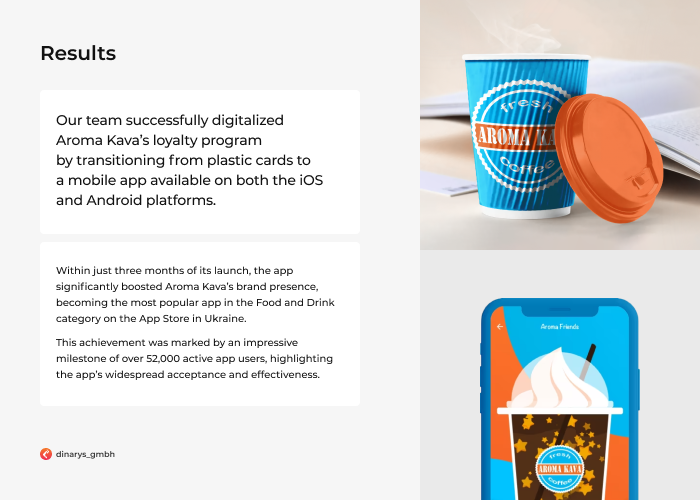
A good example of why UX planning matters is our work with Aroma Kava. The Dinarys team built a custom mobile loyalty app for iOS and Android that digitized the brand’s loyalty program and, according to the client, increased the average check by 20% after launch.
#5: Assess how the vendor works and supports the setup after launch [evaluation stage]
Food and beverage ecommerce projects usually involve several teams across the business. Operations, fulfillment, marketing, merchandisers, and customer support may all be involved. Because of that, the vendor needs to communicate clearly and effectively. They should explain who is responsible for what and break the work into stages the business can realistically manage.
The more complex the project is, the more important this becomes. Tasks like migration work, new systems, mobile apps, store pickup, last-mile delivery logic, or subscription-related changes usually affect more than one part of the business at the same time. It also matters whether the vendor can bring in the right specialists when the scope changes, instead of trying to solve everything with one fixed team. A suitable partner should be able to expand the team with the technical expertise the project actually needs.
So when you speak with the vendor, it’s worth asking:
Who will actually work on the project day to day, and how senior is that team?
How do they handle scope changes, delays, and disagreements?
What does the handoff process look like, and what does the brand own after launch?
Long-term support matters for the same reason. Ongoing maintenance, including regular security updates and performance monitoring, is important for ecommerce sites. Moreover, food and beverage ecommerce setups usually keep changing after launch. New functionality gets added, systems change, and the business grows. You need a partner who can support those changes while keeping the setup stable.
Our work with Untamed is a good example here. The collaboration was built around a fractional development approach, in which we expanded the team when needed, adding the right technical expertise quickly and supporting the product efficiently as the scope evolved.
To make that evaluation process easier, we have also put together a shortlist of companies you can use as a starting point in your search.
Top Ecommerce Development Companies for Food and Beverage in 2026: Analyzed and Profiled
The companies below stand out for different reasons, each bringing its own mix of ecommerce platform expertise, delivery depth, architectural strength, and operational fit. This section is designed to make those differences easier to see, so you can compare the options more clearly and narrow the list based on what your business needs to support next.
Dinarys
Dinarys is an ecommerce development and consulting company with proven technical expertise in the food and beverage sector. We can help your business choose an ecommerce platform, improve an existing store, and add custom functionality, supporting the setup over time as it grows more complex.
Company profile:
Location: Berlin, Germany
Operating since: 2014
Ecommerce Platforms: Shopify / Shopify Plus, BigCommerce, WooCommerce, Shopware, Adobe Commerce, Magento Open Source, Emporix, commercetools, SAP Commerce Cloud, Salesforce
Relevant services: Ecommerce development, consulting, migrations and replatforming, mobile app development, DevOps, QA/UAT support, ecommerce design, ongoing post-launch technical support
Selected clients: Aroma Kava, Budu Sushi, Antik Wein, Untamed
NEED HELP WITH INTEGRATIONS, REPLATFORMING, OR ARCHITECTURAL WORK FOR YOUR FOOD AND BEVERAGE WEBSITE?
Dinarys helps food and beverage businesses improve and rebuild ecommerce setups with stronger platform decisions, cleaner integrations, and a more reliable technical foundation for growth.
WeSoftYou is a software development company with substantial experience in retail-related projects. This company is a good choice for food and beverage businesses that need their website or app to work well when products are sold across several locations with different availability and frequent stock changes.
Relevant services: Retail software development, POS solutions, inventory management systems, web and mobile applications, integrations, AI integration solutions
Selected clients: Hypermarket, Baker Stuart Limited, AUDI, Living Security, LUCA.ai
Web Solutions NYC
Web Solutions NYC is an ecommerce agency experienced in supporting food and beverage businesses whose setup depends heavily on ERP-connected data, inventory accuracy, and more complex ordering and fulfillment conditions.
Location: New York, USA
Operating since: 2007
Ecommerce Platforms: Adobe Commerce/Magento Open Source, Shopware
Relevant services: Strategy and roadmap work, migrations, UX and build, integrations and, optimization and support
Selected clients: Graeter’s, Restaurant Depot, Pleasant Hill Grain
Scalo
Scalo is a custom software development company with expertise in custom engineering work, especially where the setup requires stronger integrations, modernization of an older system, or a more scalable architecture to allow for growing complexity in the future.
Location: Wrocław, Poland
Operating since: 2007
Ecommerce Platforms: Not publicly listed
Relevant services: Custom ecommerce development, API and integrations, web development, cloud and DevOps, UX and product design, legacy modernization, scalable architecture work
Selected clients: Company names hidden under NDA
Propeller Plan
Propeller Plan is an authorized Salesforce partner helping businesses optimize their Salesforce setup with expert implementation, customization, and support.
Location: Troy, USA
Operating since: 2016
Ecommerce Platforms: Salesforce
Relevant services: Salesforce implementation from scratch, third-party integrations, data migration, AI-related Salesforce services, portal and community development, custom app development, support
Innowise is an international software development and IT consulting company with substantial experience in supporting businesses that sell across multiple channels or need additional scalable solutions such as mobile apps.
Relevant services: Web and mobile app development, custom software development, cloud development, integrations, UI/UX design, QA, DevOps, development of marketplace-style commerce platforms
Selected clients: Vendi+, SPAR, Familux Resorts
Apptunix
Apptunix is a product engineering and software development company with proven expertise in building digital products for ordering, pickup, and delivery workflows. Their focus on AI-driven solutions may also be useful for businesses exploring smarter automation or recommendation features.
Location: Dubai, United Arab Emirates
Operating since: 2013
Ecommerce Platforms: Not publicly listed
Relevant services: Food delivery app development, grocery delivery app development, pickup and delivery solutions, restaurant management solutions, order management, delivery management, AI-powered recommendation and tracking features, dedicated support post-launch
Selected clients: McDonald’s, Dinein, Expo City Eats, Groofy, Jeeb
Wrapping up on the Best Ecommerce Development Companies for Food and Beverage
The best ecommerce development companies for food and beverage businesses are those that understand that a strong setup has to be built around the operating model of the business and support the right workflows. The vendor should be able to make grounded architectural decisions that allow your brand to realize its potential now while also staying ready for the technologies, systems, and capabilities that may become essential as the business grows.
LOOKING FOR A PARTNER WHO CAN HELP YOUR BRAND GROW ON THE RIGHT TECHNICAL FOUNDATION?
Dinarys helps brands develop ecommerce setups that support the business today and stay flexible enough for what comes next.
A mobile-first design is essential as over 50% of food shopping is done using mobile devices. Poor design can waste website traffic, weaken lead generation, and make repeat purchases harder than they need to be. A mobile-first setup usually works best when search, navigation, account actions, and checkout are designed to be simple and efficient on smaller screens, with more innovative approach tools like AI used only where it makes those interactions more useful.
Food and beverage businesses face unique challenges when it comes to product quality, food safety and regulatory compliance. The right development partner can ensure your platform can help manage this in a more structured way through the right platform design and, where needed, custom development. That usually means keeping ingredient, allergen, labeling, traceability, shelf-life, and documentation data consistent across the catalog and connected to inventory, order flows, and shipping rules. This reduces compliance risk, makes updates and recalls easier to manage, helps protect client satisfaction when the business sells to retail, wholesale, or regulated buyers.
AI-driven personalization improves customer satisfaction when it uses real behavior to make the store more relevant. Connected to customer relationship management data, past orders, client feedback, and broader sales trends, it can support better product discovery, stronger customer loyalty, and more targeted digital marketing.
Ecommerce development agencies should treat subscription and repeat-purchase models as core business logic, not as an add-on. For food brands, that means building recurring orders around delivery timing, stock, and account data through seamless integration.
A suitable partner should also have the development capabilities to support skips, pauses, reordering, and future changes without forcing a rebuild.
A common mistake is treating time-sensitive products like a standard catalog instead of building around delivery timing, cutoff logic, and handling limits. Problems usually start when the storefront is not aligned with the supply chain, when food distributors and internal teams are working from different data, or when a business expands into a digital marketplace without a comprehensive analysis of fulfillment risk and operational costs. Avoiding those issues usually depends on solid technical expertise.
Food and beverage ecommerce businesses often need to manage complex product variations, such as flavors, sizes, and pack formats, and they do not always sell products as fixed single units. In many cases, customers may need to order by weight, volume, pack size, case quantity, or other variable units of measure. That is why the ecommerce setup should be able to support flexible ordering units both on the storefront and in the systems behind it. If it does not, customers may be pushed into the wrong purchase flow, while internal teams may have to correct quantities, pricing, or fulfillment details manually.
You may share this article
Let professionals meet your challenge
Our certified specialists will find the most optimal solution for your business.