Keep the subscription app if its supported workflow covers the required contract, recurring billing and shipment effects, with someone accountable for the result. Add an integration when the app handles the contract but an order, warehouse or ERP record keeps the old value. Consider a bounded custom portal or service when a required step cannot be exposed through the existing interface, retaining suitable managed billing underneath it.
Test that distinction on one address change: the next renewal, an order already paid and the pending shipment are separate checks. This comparison is for an operating physical-goods subscription business with a reproduced problem—not a store choosing its first app. An operations or ecommerce lead coordinates the decision; the technical owner accepts the implementation and finance or an authorized signer approves spending.
Compare scopes, not no-code versus code
A subscription-management app is not a mobile shopping app. An API is an interface, not a complete scheduling or customer-service workflow. Shopify's responsibility model separates platform payment processing from app scheduling, billing-failure handling and management interfaces.
Configuration/native refactoring wins when existing settings or supported behavior cover the required contract, order and fulfillment effects. It loses when only future renewals change while an existing paid order retains the old value. Request the exact setting or operation and evidence of its effects.
App plus integration wins when the contract changes but an order, fulfillment or external-system record does not. Trace a permitted order to the warehouse record and its effective time. It is the wrong answer when the only missing piece is a customer-facing screen and the underlying data flow already works.
Bounded custom wins when an authorized API can support a required interface or service step that the existing surface cannot expose. It loses when the proposal replaces suitable billing unnecessarily or depends on unavailable access. Require an operation list and evidence that the merchant can use it.
These scopes can overlap: configuration, refactoring and integration may all involve code. A custom portal can retain a subscription service. Recharge's custom-portal guide illustrates that pattern; its Storefront API/SDK guide describes a different access surface. Neither establishes your entitlement or architecture. Map what stays and changes across billing/scheduling, portal, integrations/data and fulfillment, with maintenance ownership for each.
Four records an address change can touch
The Shopify-specific example below uses documentation captured October 26, 2026, with the contract-calculation guide rechecked November 5. The comparison method travels to other platforms; those platform facts do not.
Selling plan: the purchase offer. Editing it does not modify existing Shopify subscription contracts.
Contract: the subscriber's agreement, including shipping details and future billing terms.
Order: an already-created purchase record, separate from the contract.
Fulfillment: delivery work associated with an order, not proof that goods reached the customer.
A customer-profile address is another record. Identify the address and delivery the action actually targets. A request, calculated result, warning or webhook is not by itself proof of commitment. In Shopify's calculation flow, a successful result is reviewed and separately committed; a webhook does not commit it automatically.
Trace the same request in two starting states
The following cases are fictional and untested on a merchant. A customer requests OLD→NEW for a target delivery and future renewals. Keep the initial state and required effects unchanged across candidate routes; actual app access, cutoff and record authority need verification.
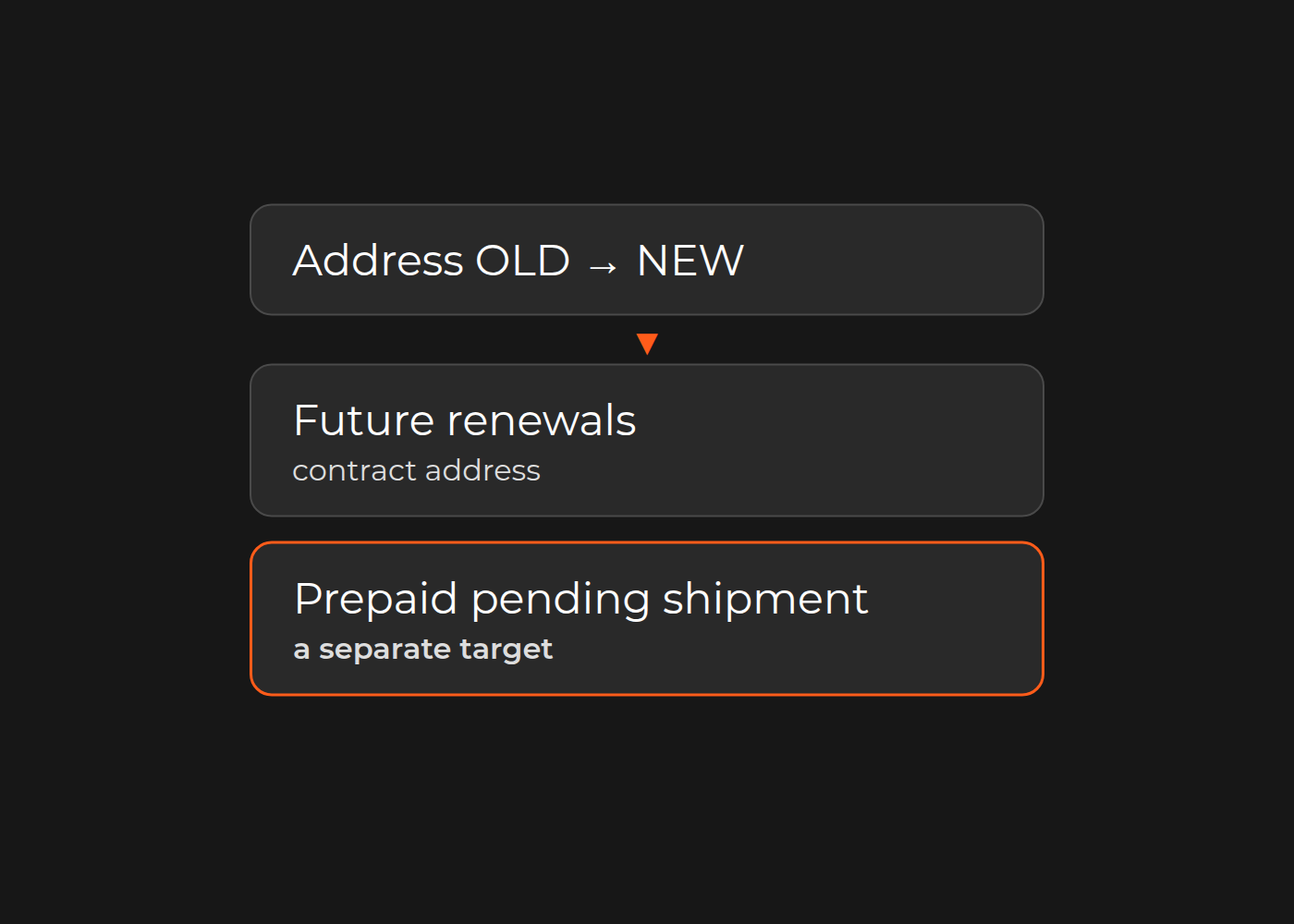
Case 1 — next charge not yet billed. Assume no target order exists. Investigate the contract address for the future delivery, then verify the expected next billing, order and shipment effects separately. An existing supported app action may cover the job, but the presence of an address-edit button is not that evidence. No observed charge or shipment is claimed here.
Case 2 — prepaid order already created. Assume an existing order with delayed fulfillment. There are two targets: NEW for the pending shipment and NEW for future renewals. Shopify's prepaid-order guidance states that contract changes, including address changes, are not automatically reflected on associated prepaid orders.
The documentary finding is therefore narrow: a contract-address edit alone does not establish the pending parcel's address. Check the app's order-sync behavior first. If the required effect remains uncovered, investigate a bounded integration or an authorized documented manual procedure. A new portal alone would not close that data gap.
Shopify-admin order editing is unsupported for prepaid subscription orders in that guidance. The contract-update guide's generic order-edit link does not override this limit. Committing a contract calculation does not modify existing orders or fulfillments. Do not infer a universal editing remedy, refund instruction or successful warehouse handoff.
Extend coverage to plan changes, charges and fulfillment
An address test does not establish the rest of the lifecycle. The matrix below is a set of hypothetical merchant policies to test, not documented capabilities of every app or reported Untamed workflows. All expected effects remain untested.
Action and assumed policy
Contract/portal target
Billing/order target
Fulfillment target
Change box from 2 to 4 before cutoff; next cycle only
Show 4 and effective cycle
No immediate charge; next order uses agreed 4-item price
Next instruction contains 4
Pause before cutoff
Show paused cycle
No charge/new order for suppressed cycle
No new work for that cycle
Resume explicitly for an agreed date
Show next active cycle
One intended renewal under agreed rules
One matching instruction
Approved refund after payment
Show actual refund status
Correct original payment and authorized amount
Separate decision for existing shipment
For each row, test a repeated request and compare the linked contract, payment, order and warehouse records. A portal showing four while the warehouse still sees two is an open mismatch. Add skip and cancel cases using your actual rules; do not derive their effects from this matrix.
Use the four-scenario matrix above with each candidate. It lists expected effects and an untested status—not test results.
Verify access, retries and recovery with the developer
Shopify's contract-update guide, checked November 5, says the calculation flow is available in GraphQL Admin API 2026-10 and later and directs legacy SubscriptionDraft users to a separate guide. Shopify-admin-created custom apps cannot request the protected scopes the flow needs. Verify the API version and app-creation route before implementation.
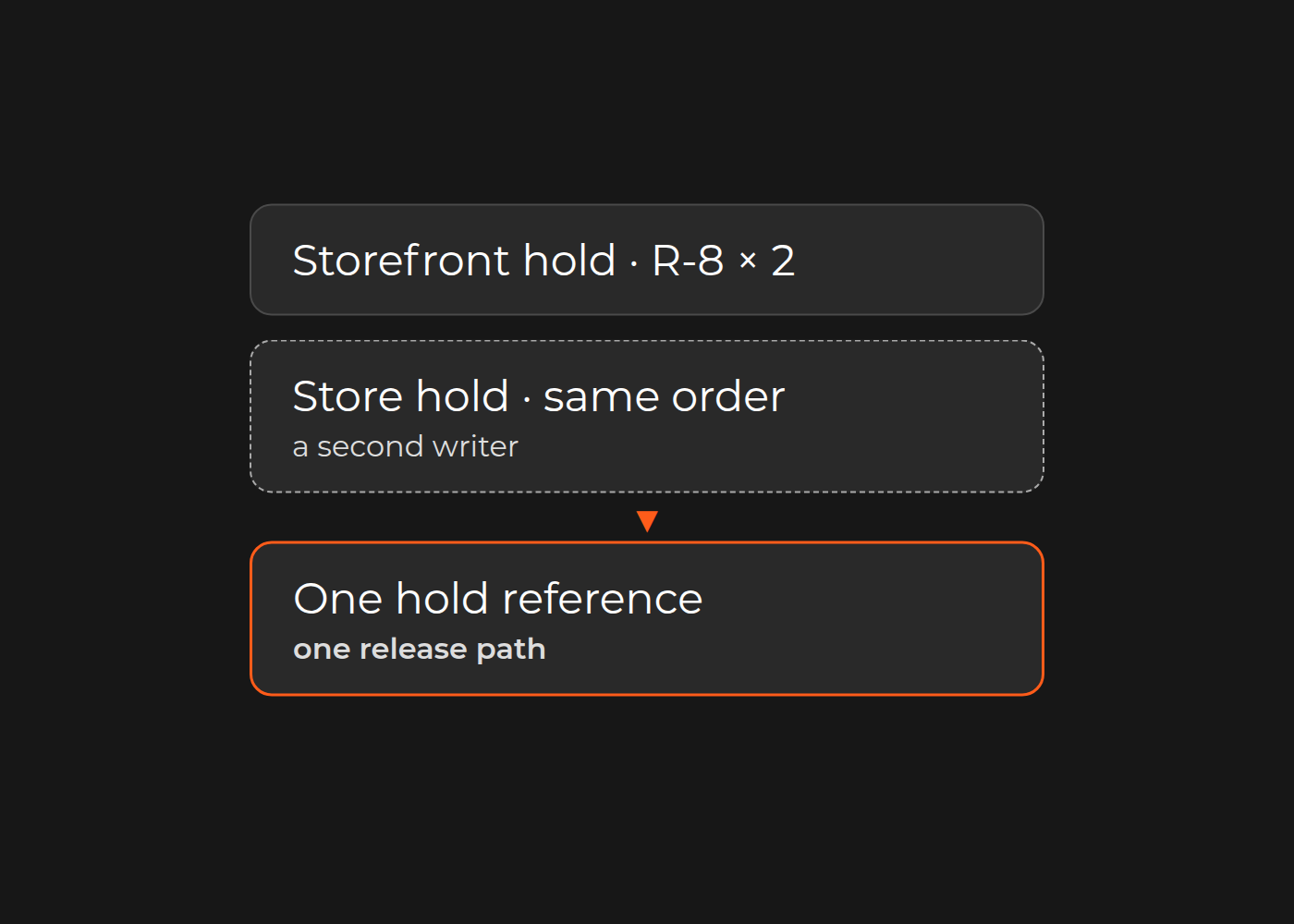
This part belongs with your developer or app vendor: repeating a change request must not produce an unintended second effect. In the documented flow, retrying calculate creates a new calculation; retrying commit for an already committed calculation returns the committed result. A stale contract requires the latest state and recalculation. These are operation-specific semantics, not an exactly-once guarantee across billing, orders and shipping.
Keep documentation, previews, sandbox observations and production observations distinct, with source/date and environment. An untested effect is not a failed test. If the contract changes but the warehouse retains OLD, name a recovery owner for the affected system and verify any correction. Software rollback does not reverse a charge or retrieve a shipment.
Compare full cost and ongoing ownership
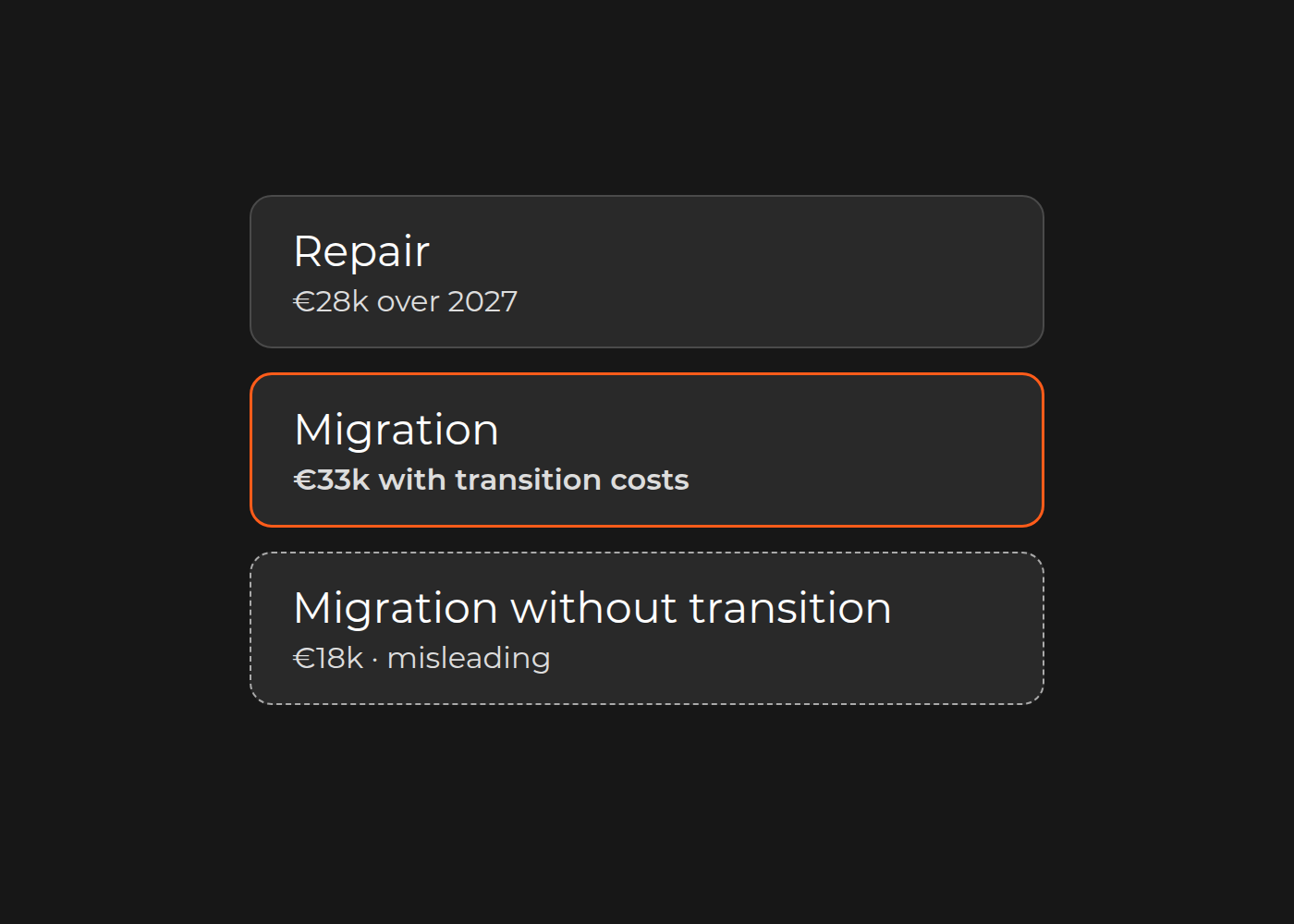
Give finance the same horizon and usage assumptions for every route. Include retained licenses/tiers and usage; scoped configuration, integration or build; any necessary migration; maintenance of retained and new components; exceptions/reconciliation; and release verification, documentation and handover. A retained app's fees do not disappear behind a custom portal.
Keep quotes, implementation estimates and unresolved costs distinct, with assumptions, owner and date. Missing information is not zero. If migration is unnecessary, say why rather than pricing replacement for one route and retention for another. Missing staff capacity is also separate from a missing app capability.
Use the remaining gap to scope the next step
There is relevant direct engineering evidence in Dinarys' Untamed case: the team enhanced and integrated a React subscription dashboard and built its supporting backend under the client's CTO. The account also describes storefront work, integration audit, CI/CD and documentation. It does not identify the subscription engine or prove the address, pause or refund scenarios above.
For a confirmed cross-system gap, Shopify integration services are a live service path. Compare a broader lifecycle implementation scope only after identifying the effects and ownership you need.
Prioritize the changes that repeatedly require manual handoffs rather than choosing architecture by subscriber count. If the app covers the effects with acceptable ownership, retaining it is a legitimate conclusion. If evidence is missing, the conclusion is unresolved—not “custom required.”
To discuss a bounded change, contact Dinarys with sanitized subscription rules, systems and retained components, one hard scenario, the acceptance owner and the precise unverified effect. An existing vendor or team may be able to close the gap; uncertainty does not automatically require another discovery project.
You may share this article
Let professionals meet your challenge
Our certified specialists will find the most optimal solution for your business.