A dealer asks for a part. The sales team finds a familiar description in a PDF, but the request still goes to the same experienced engineer. Someone needs to know which manual applies, whether the supplier uses another number, and what changed between equipment versions.
Can a buyer find a compatible, available part and get a correct quote without that engineer? Yes, for the cases where the route is built on authoritative compatibility evidence rather than a plausible search result. The route needs the equipment and its serial or version range (or an authoritative cross-reference), the current part number after any supersession, the source that states fitment, live stock, and a named specialist for every match the evidence does not support. Capture the information the expert uses to tell similar parts apart, and the expert is left with the genuinely unresolved cases.
If this sounds familiar, the immediate decision is not which AI assistant or electronic parts catalog to buy. It is which equipment family to examine first, and where its lookup process depends on knowledge that other staff cannot retrieve or verify.
For a service or commercial leader, the useful starting point is a recurring-question map: the question, the permitted source, the part-number relationship, the missing evidence, and the person responsible for the next decision. It separates avoidable searching from legitimate technical judgment.
What a lookup route without the expert has to record
Here is the decision record for one request, filled in with a fictional example: a Fable F100 labeler, whose full source map appears in the worked example further down. Every identifier, document and stock figure is invented for illustration.
Field
Filled value (fictional)
Who owns it
Equipment and model
Fable F100 labeler
Buyer supplies; intake checks it is present
Serial and version range
Serial FA1203, equipment revision B, US market
Buyer, from the rating plate
Part requested
“Label holder, item 7” on diagram D2
Buyer
Part ID from source
P-410 (parts list M-F100, rev. 3, p. 18, callout 7)
Document owner
Supersession
P-410 replaced by P-411 (bulletin B-12, rev. 1, §2), in that direction only
Product-data owner
Compatibility evidence
P-411 applies to F100 serials FA1000–FA1499, revision B, US market (applicability list A-F100, rev. 2, row 8)
Product-data owner
Inventory
P-411: 2 units available in the stock system
ERP or warehouse system
Quote
P-411, with the bulletin and applicability references attached
Sales
Unresolved match
None for serial FA1203; any serial outside FA1000–FA1499 stays unresolved
Service owner
Reviewer
Named service specialist, only for unresolved requests
Service owner
The fictional F100 request as a lookup route: the quote is issued only after the equipment is identified and fitment evidence covers that machine; anything else goes to a named specialist.
Accept the route only when it behaves correctly on cases like these, run in a test environment with the same fictional records:
Starting state
Action
Expected result
Adverse result to reject
Evidence
Pass/fail owner
F100, serial FA1203, revision B
Buyer asks for P-410
P-410 shown as superseded; P-411 offered with its fitment source and stock
P-410 offered as current, or P-411 offered without a source
Bulletin and applicability references on the result
Product-data owner
F100, serial FA1600
Buyer asks for item 7
No safe match; request routed to the specialist with what is missing
P-411 shown as compatible because the model name matches
Routing record
Service owner
“F100” only, no serial
Buyer asks for item 7
Serial or version requested; no quote yet
A quote issued on the model name
Intake record
Sales lead
Supplier number V-77
Buyer searches V-77
Resolved to P-410, then to P-411, with the same fitment check
V-77 treated as compatible on the alias alone
Supplier cross-reference row
Product-data owner
Cropped diagram, “label holder”
Buyer searches the description
Shown as an unresolved candidate
Presented as a match
Search log
Service owner
P-411 fits but stock is zero
Buyer requests a quote
Shown as unavailable; no silent substitution
A similar part substituted without evidence
Stock record
Sales lead
The test is simple to state: a superseded or incompatible part is never presented as a safe match, and an unsupported match goes to a specialist. A matching description is not proof of physical compatibility or of any safety certification.
Dinarys has built the identifier-first part of such a route for vehicle parts. Its automotive parts marketplace case, for a parts distributor under NDA, describes TecDoc parts-catalog integration on Shopify Plus, several lookup methods (VIN search, licence-plate lookup, make/model/year navigation and part-number search with cross-reference), cross-reference data for alternative parts, and data synchronization and validation systems set up during the TecDoc integration work. That is the identifier step this route relies on: the buyer reaches a part through an equipment identifier or an authoritative cross-reference, not through a description. TecDoc is an automotive catalog; for industrial equipment, the equivalent authority is usually the manufacturer's parts list and applicability data. The public case page does not describe AI, fitment validation, supersession handling, a specialist hold or manual-based fitment for industrial equipment, or a measured ordering-error result, and its “Expected results” section lists objectives rather than measured figures.
The rest of this page shows how to find where your own route breaks: which questions reach the expert, which sources are permitted, and which relationships are not yet recorded.
Why spare-parts questions keep reaching the same experts
Identifying the equipment: distinguishing a general model name from the specific product version and serial range.
Selecting the source: finding the applicable manual, parts list, or later bulletin rather than the first matching PDF.
Translating identifiers: recognizing a supplier alias or an old part number.
Checking applicability: establishing whether the candidate part is documented for the particular equipment configuration.
Resolving authority: knowing who can settle a conflict or authorize a technically supported quote.
Diagnostic distinctions, not tasks that search or AI can automatically replace; qualified technical judgment may remain necessary.
Those jobs should not all be classified as “search.” A technician who repeatedly locates an approved page is facing a different problem from one who must obtain missing compatibility evidence from the manufacturer.
This distinction has a concrete basis in manufacturers' documentation. Husqvarna's product-identification guide distinguishes the model name, product number, and serial number; it describes the product number as an input for parts, manuals, and compatibility. That is an example of why a familiar model name may not be enough—not a universal numbering rule for every manufacturer.
Look for repeated handoffs with the same explanation: “Ask the engineer; they know which version this is.” Then establish what the engineer actually supplies. The answer may be a document location, a missing equipment identifier, an undocumented decision, or a technical judgment that should remain with a qualified owner.
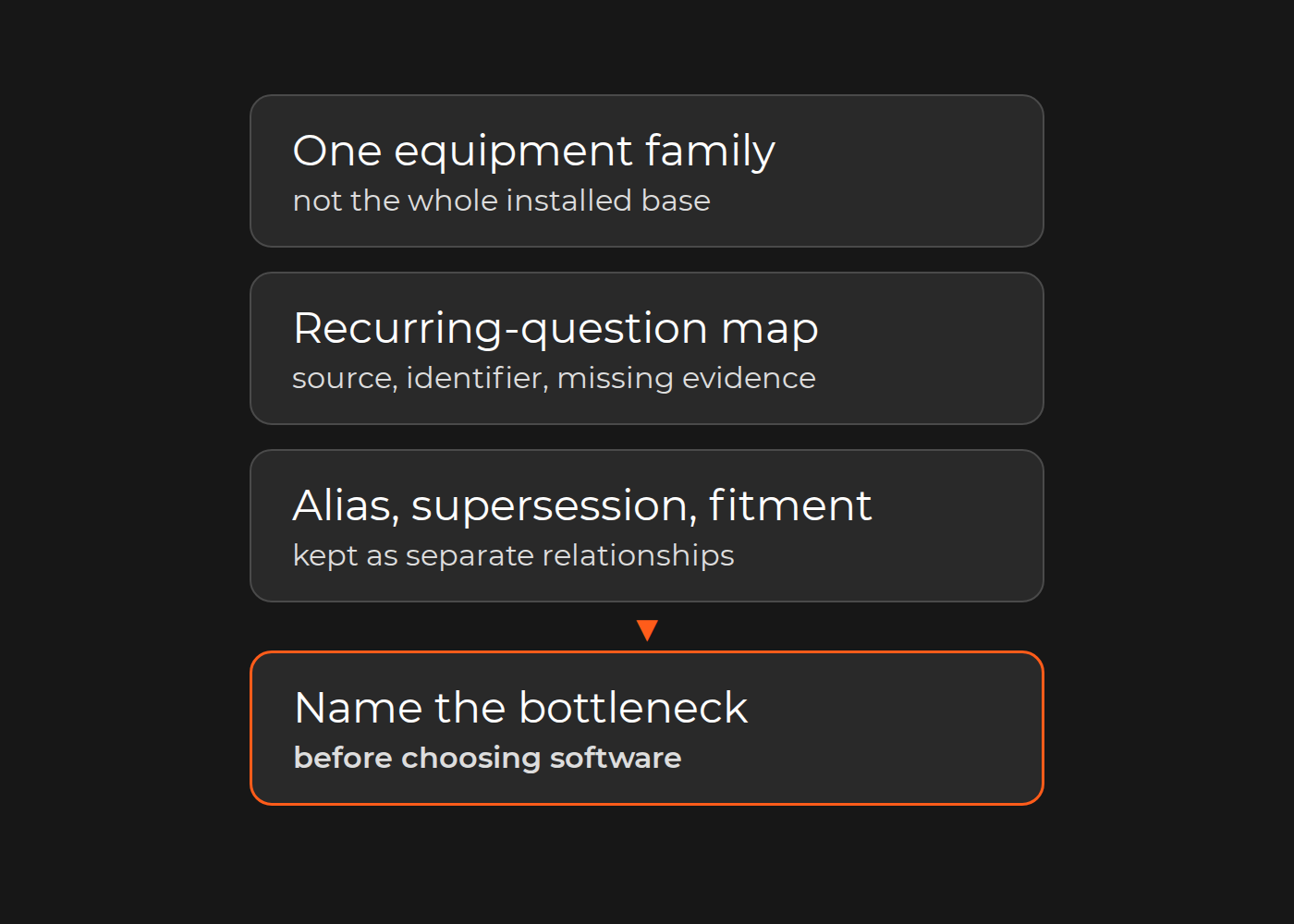
Choose one equipment family, not the whole installed base
Choose a family with recurring parts questions, sources you are permitted to examine, and a service owner who can explain unresolved cases. Keep the diagnostic scope explicit: included models, markets, known revisions, and request channels. If those boundaries are unknown, record that before comparing requests.
Do not choose only the cleanest recent product. Include ordinary lookups and troublesome requests within the selected family: an older identifier, a missing serial number, a conflicting document, and a question that remained unresolved. Keep unanswered requests visible rather than treating them as completed work.
The service leader should own the diagnosis. Commercial staff can identify where a quote waits; the document or product-data owner can establish source status; the equipment specialist can determine what evidence is missing. Confirm who has authority for each decision in your organization instead of assuming the most experienced employee owns everything.
The output is a narrow statement such as: “For this family, repeated questions stall because staff cannot identify the applicable parts-list revision.” It is not yet a requirement to replace the catalog or connect an AI system to ordering.
Build a recurring-question, manual, and part-lookup map
Use a worksheet alongside your existing service records. Give each request an ID and link it to source and mapping IDs; avoid copying restricted manuals into a broadly shared spreadsheet.
Record
What to capture
What it helps distinguish
Request and equipment
Original question, question category, family, model, serial number or range, equipment revision, market, and missing identifiers
A repeated question from a superficially similar but different configuration
Response path
Intake role, next role, clarification requests, escalation reason, and final disposition
A search delay from a necessary technical decision
Source
Publisher, document ID, revision, issue date, applicable equipment, exact page/diagram/note, controlled location, and date checked
A traceable answer from a remembered or unattributed statement
Access and use
Who may view it; permission to copy, share, index, or use it in an AI tool; rights owner and unresolved restrictions
An unavailable source from an inaccessible or impermissible one
Identifier relationship
Original number, candidate number, relationship type, direction, and supporting source
An alias from a supersession or an actual applicability statement
Evidence and ownership
Compatibility basis, exclusions, unresolved conflict, decision owner, and next action
A supported lookup from an assumption awaiting review
Effort
Observed active lookup time, expert time, rework, waiting, and measurement method
Staff effort from elapsed response time
Group requests by the underlying question, not just identical wording. “What is item 7?” and “Which number goes with this picture?” may be the same lookup task. Preserve the equipment and source differences so grouping does not imply that one answer fits every request.
Knowledge sources: record applicability as well as revision
A newer file is not automatically the right source for an older machine. Record both the document's revision and the equipment configurations it covers. Where a later bulletin changes a parts relationship, preserve the earlier reference and the later instruction with their respective scope; do not silently overwrite the history.
For every answer, another authorized employee should be able to retrace the document, revision, page, diagram callout, and associated notes. A copied screenshot without that context is a lead to investigate, not the final evidence.
Diagrams have limits. AMS's LTX manual introduction says its illustrations and parts list are for identification only, points readers to notes, and warns that identifying the required part may be difficult without model style and serial number. A diagram callout is therefore a locator in its source—not a certificate of interchangeability. Check whether the source's notes and applicability information resolve variant, revision, and market constraints.
Permissions: a visible file is not permission to reuse it everywhere
Record separate audiences for customer, dealer, and internal information. Also separate permission to read a document from permission to redistribute it or upload it into another system. An internal supplier catalog may support a staff lookup without being suitable for a dealer download or an AI index. Have the rights owner resolve uncertainty before transfer.
If search is involved, permission trimming means excluding material the requesting user is not entitled to retrieve. Do not assume this happens merely because the original folder was restricted. Microsoft's security-filter documentation describes an explicit filtering pattern and cautions that its identity strings do not themselves perform authentication or authorization. Record the access requirement now; implementation and testing come later.
Keep aliases, supersession, and verified fitment separate
Two different numbers do not necessarily mean two different physical items. Equally, a matching description does not establish that two items are interchangeable.
Keep four distinct labels in the map:
Supplier alias: a supplier's identifier refers to another documented identifier. Record who asserts that relationship and for which catalog revision. It does not establish equipment compatibility.
Supersession: a source records that one identifier has been replaced by another. Preserve the direction, effective scope, and any conditions. Do not assume the relationship works in reverse.
Verified constrained fitment: an authoritative applicability source supports the part for an explicitly stated model, serial range, equipment revision, and market. Any unknown or out-of-scope condition remains unresolved.
Ambiguous candidate: a label, diagram, partial number, or conflicting source suggests a possible match but does not resolve it.
The source reference is the starting record; the four relationship categories above follow from it. Illustrated with entirely fictional Fable equipment; no match or mapping independently authorizes a substitution, quote, or order.
These are different relationships, not confidence levels on a single “match.” Oracle's replenishment-planning documentation explicitly distinguishes substitution and supersession and allows unilateral or bilateral relationships. That supports recording relationship type and direction; a relationship configured in business software is not itself engineering proof that a part fits a machine.
The automotive case above shows the same separation: its page lists cross-reference lookup for alternative parts as a separate feature from vehicle lookup by VIN, plate or make/model/year. A cross-reference proposes a part; the evidence for the identified vehicle or equipment decides whether it applies.
Worked example: one family, separate evidence decisions
Everything in this example is fictional: the Fable F100 labeler family, identifiers, documents, dates, and evidence decisions. It is the source map behind the decision record at the top of this page and illustrates recordkeeping, not an actual part recommendation or a Dinarys customer result.
Suppose a request says, “We need the label holder shown as item 7.” The team finds the following records:
Mapping
Fictional source and locator
What the record supports
What it does not support
D2 / callout 7 → P-410
S1: parts list M-F100, rev. 3, February 10, 2026, p. 18
Source-confirmed diagram-to-number reference
Fitment for a machine whose configuration has not been established
V-77 → P-410
S2: supplier cross-reference X-6, rev. A, April 6, 2026, row 12
Supplier-declared alias in that source
Independent verification that V-77 fits the requested machine
P-410 → P-411
S3: bulletin B-12, rev. 1, June 15, 2026, §2
Recorded supersession in the stated direction
Reverse interchangeability or fitment across the whole F100 family
P-411 → specified F100 configuration
S4: applicability list A-F100, rev. 2, July 1, 2026, row 8
Verified within this fictional example only for model F100, serials FA1000–FA1499 inclusive, equipment rev. B, US market
Other serials, revisions, models, markets, or unrecorded modifications
“Label holder,” item 7 → P-510?
S5: cropped diagram with no document ID or revision
An ambiguous candidate requiring a traceable source
An alias, supersession, or verified fitment relationship
An employee can now answer the alias question without pretending to have answered the fitment question. The supersession record can explain why a newer number appears, but it cannot fill in a missing serial number. The cropped diagram remains unresolved even if its label looks right.
If the request supplies only “F100,” the next action is to obtain the missing equipment information and compare it with the documented applicability—not to use that unverified mapping to authorize a quote or order for P-411. Even the constrained fitment row is not a release authorization: normal technical and commercial controls still apply.
No label match, diagram callout, replacement number, or AI answer authorizes a substitution, quote, or order. An unverified mapping must remain on hold for the responsible owner. Safety-critical substitution and installation or repair instructions are outside this diagnostic exercise; route those requests through the appropriate qualified service process.
Reuse the worked map's structure
Set up the worksheet as three linked tabs. The Fable records above are a fictional illustration, not live product data, so keep them out of your working copy:
Source register: one row per source revision: publisher, document ID, revision, issue date, exact locator, applicability scope, controlled location, date checked, source status, permitted viewers, copy and sharing rights, indexing and AI rights, rights owner, and document owner.
Recurring-question map: one row per request: question category, original question, equipment family, model, serial number, equipment revision, market, missing inputs, source and mapping IDs, response path, repeat group, escalation reason, decision owner, next action, disposition, and the effort fields described below.
Part-number map: one row per identifier relationship, not one match score: source IDs, original and candidate identifiers, relationship type, direction, locator, evidence status, model, serial range, equipment revision, market, unresolved evidence, decision owner, and next action.
Join the tabs by ID: each request lists its source and mapping IDs, and each relationship row names the source revision that supports it. Separate multiple IDs with a semicolon, and do not infer a link from a chain of different relationship types.
Format identifier and serial columns as text so they keep their leading zeros and punctuation. Populate the fields with permitted records from your selected family. Missing evidence should remain “unknown,” not become “no restriction” or zero. The worksheet contains no order-release logic.
Measure the work before estimating the benefit
Choose and record an observation period and include unresolved requests at its end. For each request, distinguish:
Active searching by the first-line employee.
Additional expert lookup or judgment time.
Repeated clarification and rework.
Waiting for the customer, a document owner, or a technical decision.
Outcome: supported response, further information needed, conflict escalated, or unresolved.
Elapsed time between intake and response is not labor time. A ticket history may show when a request waited, but it usually needs additional observation to establish active effort. Mark estimates as estimates and unmeasured time as unknown. Do not enter zero simply because no timer was running.
Then summarize the actual sample: requests by question type, repeated missing fields, handoffs by reason, unresolved cases, and measured effort where available. If you calculate a share, state the denominator and sample period. If you combine staff time, keep categories non-overlapping so the same expert work is not counted twice.
This baseline can reveal what deserves attention without inventing an ROI forecast. It also feeds any later estimate, which depends mainly on manual quality, how many products and versions must be covered, who owns fitment data, the ERP integration for stock and quotes, and the specialist time needed to review unresolved queries. Mark each one you cannot yet describe as unavailable, not zero. A queue concentrated around missing serial numbers suggests an intake problem. Repeated page-finding suggests a retrieval or document-control problem. Cases with complete identifiers but conflicting applicability sources need product-data ownership and technical resolution, not faster guesses.
Check existing controls and search before adding AI
Revisit a comparable set of questions using the tools already available: the controlled document repository, approved manufacturer lookup, existing search, and documented identifier relationships. Check exact numbers as well as the language employees use. Keep the conditions comparable and note source changes.
Use the results to choose the smallest justified next step:
What the map shows
First action to investigate
Staff repeatedly request the same equipment details
Improve intake fields and explain why those details are required
The correct page exists but is hard to locate
Improve document naming, metadata, indexing, or existing search
Staff find multiple revisions without clear applicability
Assign document-control ownership and clarify source status
Alias or supersession relationships are remembered but not recorded
Have the responsible data owner document and maintain them
Compatibility evidence is absent or contradictory
Escalate to the authorized technical/product owner; keep the mapping unresolved
A source cannot be shared with the intended audience
Resolve rights and access, or use another permitted source
Structured fitment rules, manual-assisted search and AI-assisted retrieval solve different parts of this table; the comparison of those options belongs in a separate guide to electronic parts catalogs. AI-assisted retrieval may be worth evaluating later if a real retrieval problem remains. It cannot supply missing manufacturer evidence, grant source rights, or turn an ambiguous candidate into an authorized replacement. An electronic catalog may make information easier to find; that alone does not establish fitment or demonstrate fewer ordering errors.
Your next step: select the family and a permitted source sample
Choose one equipment family and name the service owner for its question map. Assemble a permitted sample of questions, applicable manuals and revisions, parts references, and unresolved cases. Include the information staff actually receive—not only polished examples with complete answers.
Use the map to agree where the work stops and who owns the missing evidence. First practical check: run the equivalent of the second and third cases from the acceptance table on your own lookup today: a real model with a serial outside the documented range, and a model with no serial. If a superseded or incompatible part can be presented as a safe match, or an unsupported match does not reach a specialist, that is where to start. If you discuss the problem with Dinarys, start with that family, the recurring questions, and a description of the sources you are allowed to share. Confirm permissions before sending documents through the contact channel.
The first decision is whether the bottleneck is intake, source control, retrieval, identifier data, or technical authority. Choose that before choosing software.
You may share this article
Let professionals meet your challenge
Our certified specialists will find the most optimal solution for your business.