A buyer knows what they need to accomplish but not your SKU. Your catalog asks for a product name, technical attribute, or part number. The salesperson translates the task into a product choice the website could not explain.
That call is not automatically a failure. Negotiation, unusual applications, and uncertain compatibility can legitimately require an expert. The opportunity is to separate those conversations from repeatable selection work your catalog could support.
For the ecommerce or catalog owner, the first question is whether buyers are blocked by missing data, an unusable selection path, or search that misses the right records. A new search engine cannot repair all three. Diagnose one category before buying another tool.
Sort sales calls by the buyer’s task
Use permitted search logs and consultation records, removing unnecessary personal and account information. Match a buyer’s query to what the salesperson actually had to do:
Exact-item lookup: the buyer knows a SKU or part number. Check indexed identifiers, formatting variants, and discontinued-item handling.
Attribute selection: the buyer knows dimensions or material. Check normalized fields and units, comparable data, and understandable filters.
Compatibility: the buyer needs fit with a model or configuration. Check an approved compatibility source and its model/revision distinctions.
Task-based selection: the buyer describes an intended use. Identify the clarifying questions that translate it into required attributes.
Replacement: the buyer needs an alternative to an old item. Check an authorized substitution relationship.
A synonym can solve a language mismatch. It does not establish substitution or compatibility. Record whether the salesperson found missing information, interpreted a rule, negotiated terms, or merely located a record the website already held. These imply different fixes.
Missing evidence is a data problem, not a ranking problem
Look for the required attribute, unit, substitution, or compatibility relationship in an authoritative source. Then trace whether it reaches the storefront and search index. Ranking cannot repair an empty attribute; an AI explanation cannot supply missing product truth.
For “replace discontinued SH-OLD,” the absence of an approved replacement record is a product-data ownership issue, not a reason to expand synonyms. A product expert must resolve it. Keep three states distinct:
Compatible: an approved record supports fit for the identified model and revision.
Incompatible: a recorded exclusion supports “does not fit.”
Unknown: evidence is missing; ask for clarification or expert verification.
Do not turn unknown into either compatible or incompatible just to produce a decisive answer. If product information needs systematic ownership or distribution, Dinarys’ PIM services are a relevant route. For inconsistent listings, attributes, and categories, see catalog management services. Neither requires replacing your existing system before the gap is understood.
What relevant catalog engineering looks like
Dinarys’ BigCommerce case, for an unnamed office supplies product wholesaler, describes updating product names, SKUs, and images, AI-assisted categorization, inconsistent-field cleanup, menu customization, and custom request-to-quote functionality. The page reports reviewing, updating, or downloading data on more than 137,000 products in a three-month project.
That is useful evidence of catalog preparation and commerce-interface work at a substantial scope—not a throughput benchmark. It does not establish a compatibility engine, production AI guided selling, or semantic-search uplift. The relevant lesson is to examine the data and navigation components before attributing a selection problem to the search engine alone.
Correct records can still sit behind the wrong interaction
Observe a real task through to cart or quote. Can the buyer understand labels, see selected filters, compare meaningful differences, and supply the detail that determines selection? Correct information is not enough if the decisive revision question is buried in a PDF.
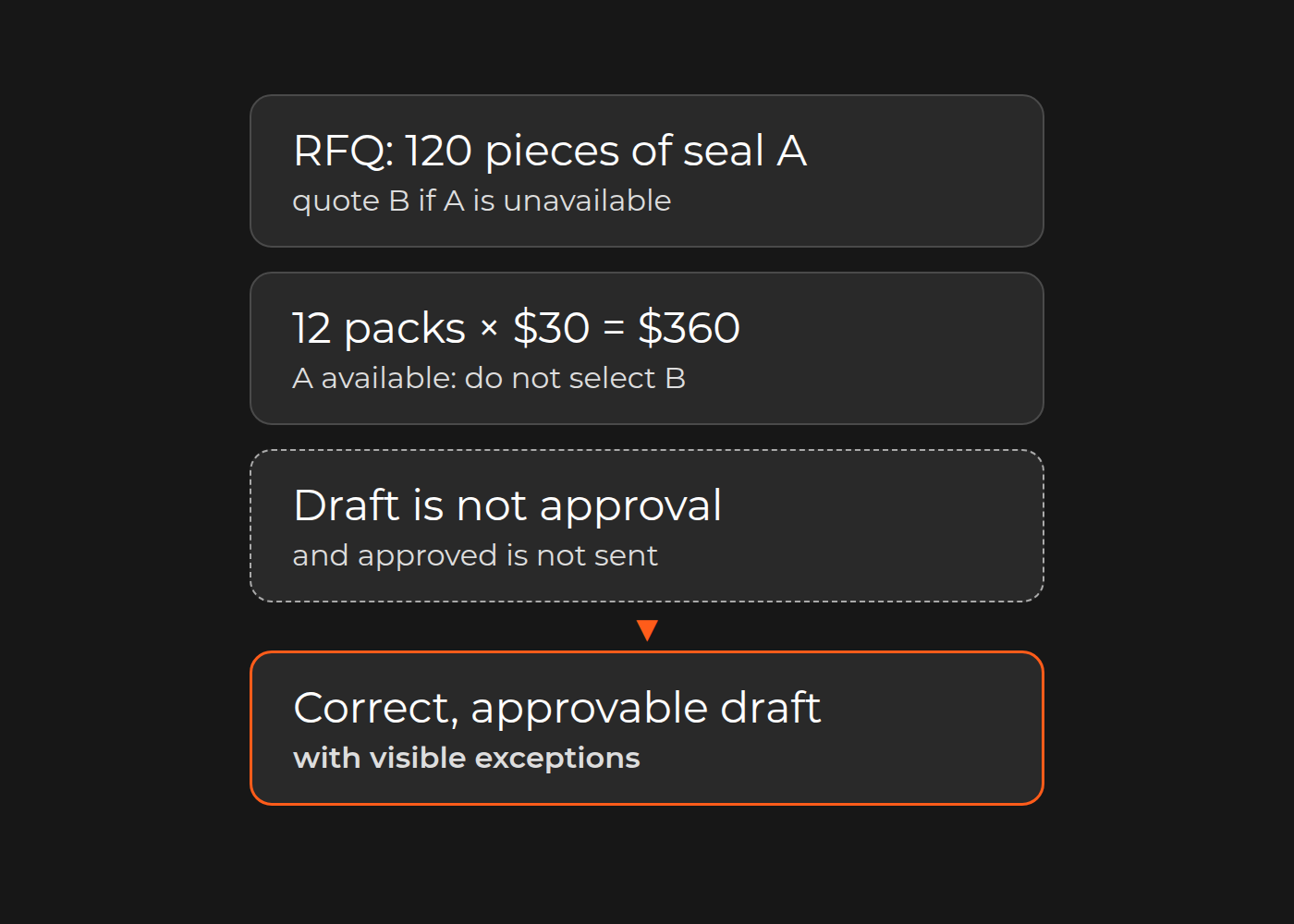
A legitimate quote can still require sales approval. Successful self-service may mean preparing a correct, reviewable request rather than eliminating people from checkout. Preserve the information already collected when handing that request to an expert.
Account-specific visibility also matters. A result can be technically suitable but unavailable to that buyer. Have IT trace assortment permissions and the authoritative price/availability sources; do not expose another account’s terms to make selection easier.
Search fails when an eligible record exists but cannot be found
Reproduce the query and compare it with an expert-approved expected result. Test exact identifiers, synonyms, and attribute queries separately. “SH40A” might need to find SH-40A under approved identifier normalization; a width query should find matching widths without asserting cabinet fit.
If the right eligible record exists but does not appear, ask IT to trace indexing, field mapping, and matching. Test a synonym or clearer filter before replacing the stack. Record outcomes by task class: many successful SKU lookups can conceal a serious compatibility failure in an overall success rate.
The shelf that “looks right” needs a revision question
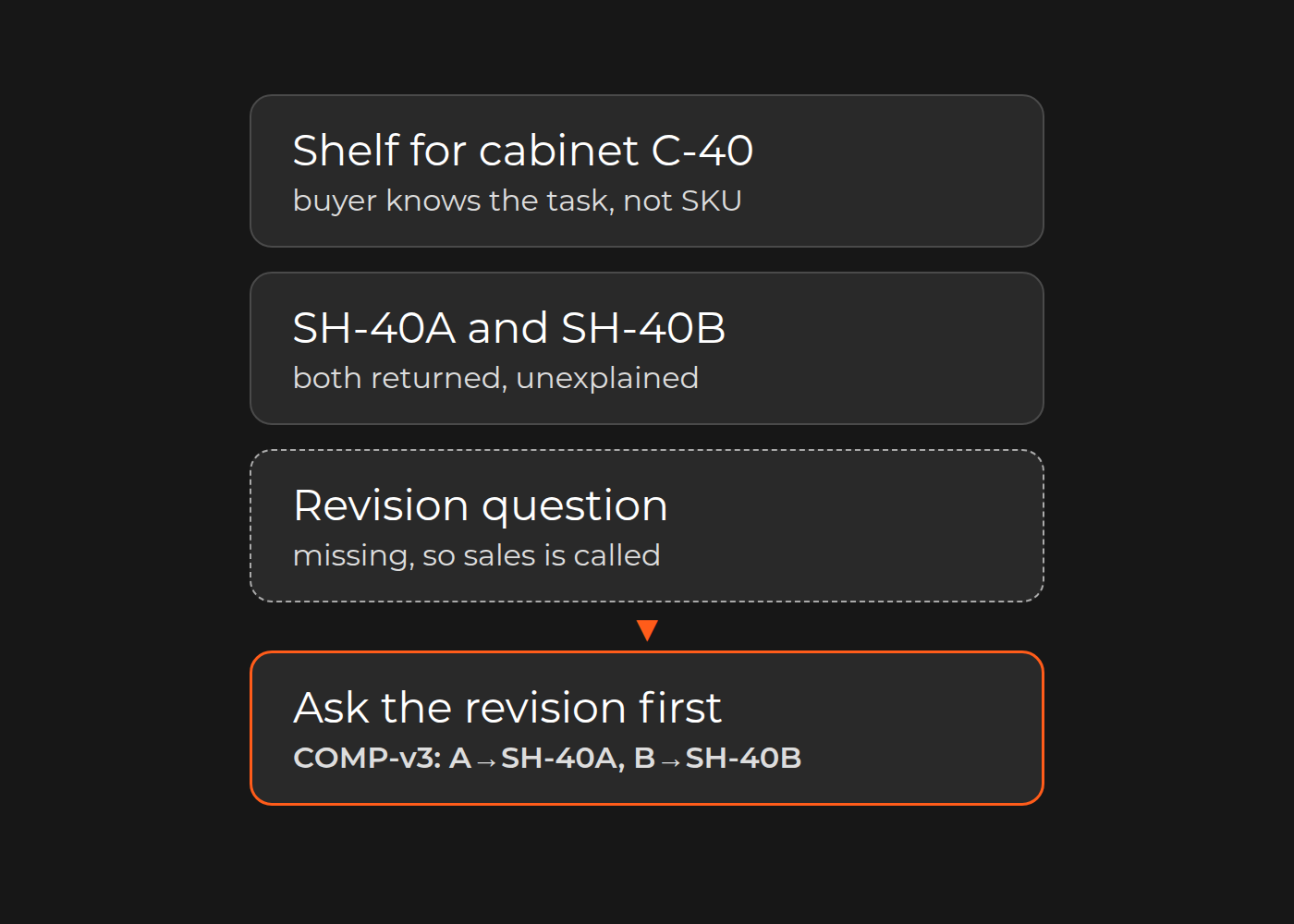
Fictional catalog example, not a product recommendation. A buyer asks for an extra shelf for cabinet C-40. The product expert’s approved matrix, COMP-v3, maps revision A to SH-40A and revision B to SH-40B. Width alone does not establish compatibility.
The salesperson asks which revision the buyer owns. The website returns both shelves without explaining the distinction. Here the evidence exists and retrieval finds candidates; the missing interaction is the revision question.
If the buyer cannot identify the revision, show approved identification help or hand off with the details already collected. If a shelf lacks an approved fit record, request verification even after the revision is known. A shared “40” in the names proves nothing about fit.
Build a small sample that reveals the next change
Choose a category with repeated questions and a product expert who can approve answers. The ecommerce lead owns the buyer task; the catalog owner approves product truth; IT checks retrieval, access, and integration. The budget owner needs the observed scale and consequence of the problem—not an assumed conversion uplift.
Use a record like this fictional starter sample:
Query/task
Expected response
Evidence or gap
“SH40A”
Find eligible SH-40A
Approved identifier variant
“Shelf for C-40”
Ask revision first
COMP-v3
“C-40, revision B”
Offer SH-40B if eligible
Approved fit + current offer
“Replace SH-OLD”
Request verification
No approved replacement
For every real row, also retain the current response, catalog version, failure point, responsible owner, and whether sales intervention was necessary. Tag data, interface, search, and genuinely expert-only work; more than one layer can fail.
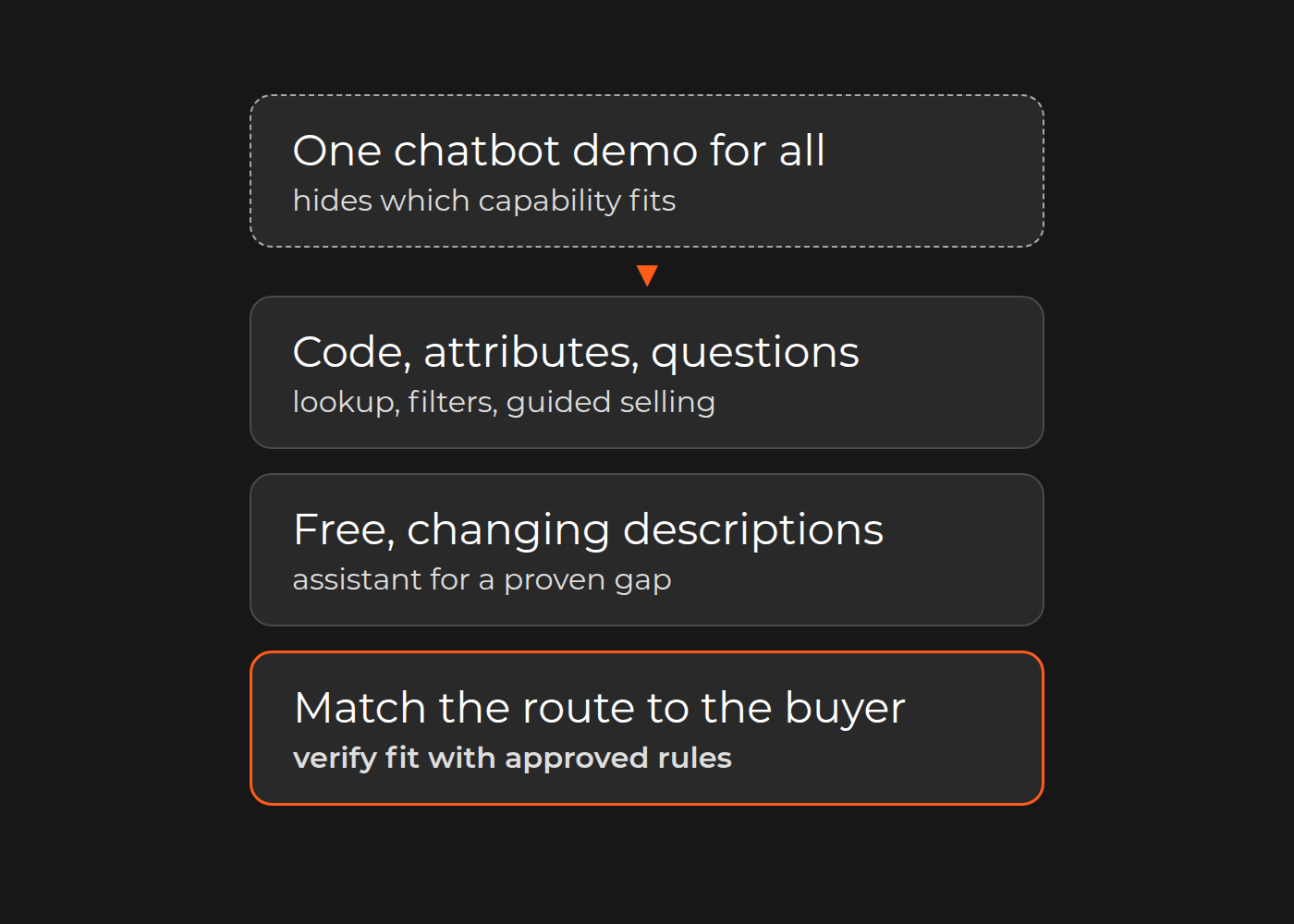
If a synonym or clearer filter resolves the task, stop there. Otherwise, compare guided selection or a shopping assistant against the specific unresolved buyer need—not against an attractive demo. Use a buyer-owned acceptance set before approving a broader discovery solution.
To discuss that gap, contact Dinarys with a sanitized category sample: failed queries and current responses, expert-approved answers or questions, the source rules, platform/version, and access or account constraints. This supports a decision about data, interface, or retrieval work while reserving human judgment for cases that need it.
You may share this article
Let professionals meet your challenge
Our certified specialists will find the most optimal solution for your business.