Content
E-Commerce
Nov 18, 2026
How to Commission a Retention Workflow Without Inflated Revenue Claims
Time to read: 5 minutes

A retention proposal can commit to a working journey, reliable customer events, and a defensible experiment. It cannot honestly promise that every attributed sale is additional revenue—or that AI will outperform a simpler rule.
For a CMO or head of ecommerce commissioning a repeat-purchase workflow, ask who owns the marketing logic and who verifies additional value. Start with a named lifecycle owner, a finance-approved measurement method, and a bounded pilot rather than a platform-wide rollout.
Dinarys publishes this guide and is a potential engineering supplier. Its ERP integration services address cross-system work; that does not replace lifecycle or measurement expertise. Evaluate us against the same requirements as any other candidate.
Buy one lifecycle decision, not an unspecified transformation
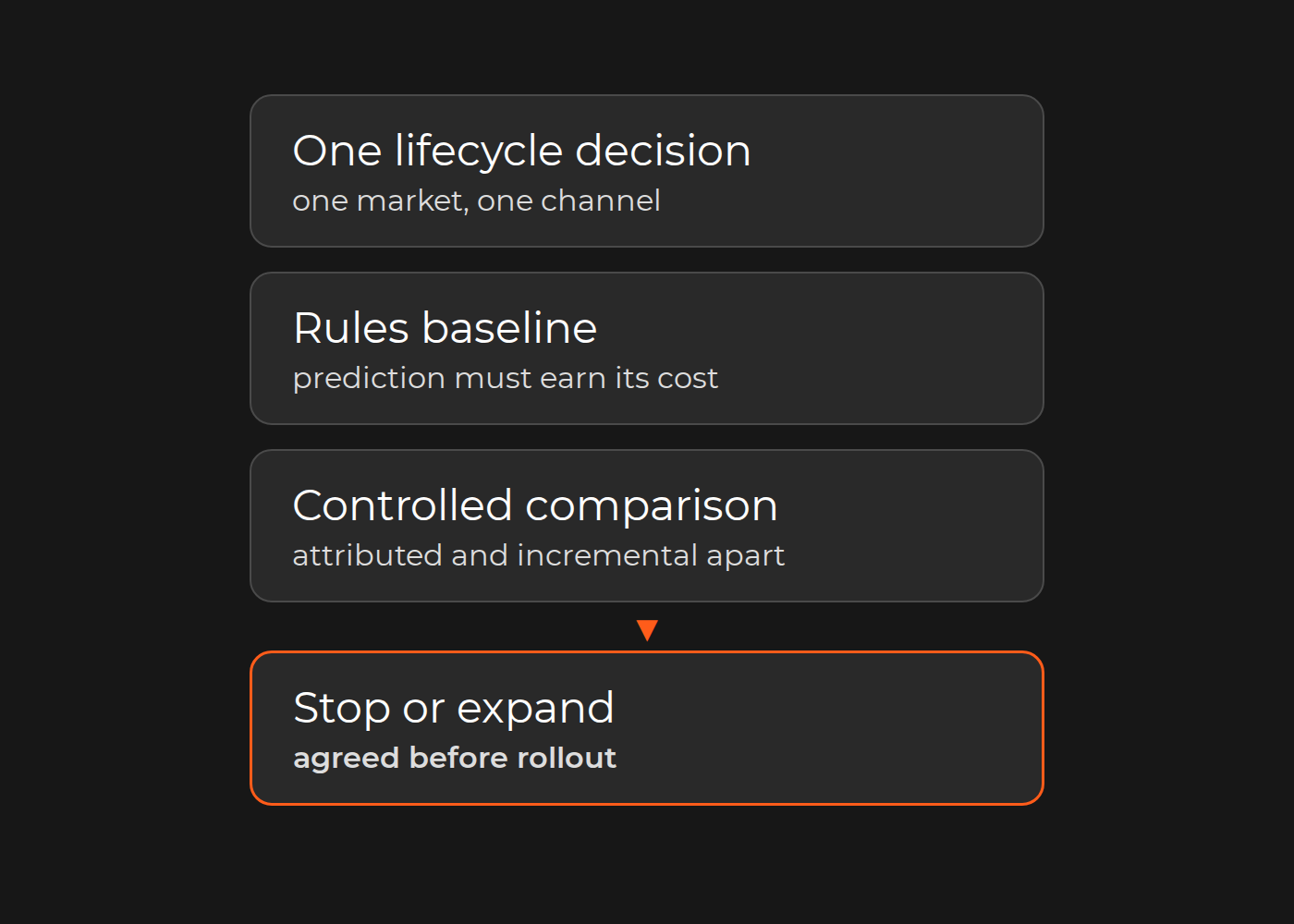
Write the scope around a decision: for example, whether to send a replenishment reminder to eligible buyers in one market. Identify its event, audience, exclusions, channel, and buying interval. A renewal reminder is not interchangeable with a win-back discount; baseline behavior and costs differ.
Check existing CRM journeys and predictive features first. A missing segment or standard connector may only need a CRM specialist or current provider. Engineering becomes relevant when purchases, refunds, subscription changes, or permission cannot be reconciled across commerce, ERP, and CRM. More data movement is not itself a retention strategy.
Include a non-AI hypothesis: “A rules-based reminder after an agreed replenishment interval may improve repeat contribution.” Prediction then earns its complexity against that rule, not merely against doing nothing.
Replace five proposal claims with inspectable commitments
Use the following language to negotiate scope and evidence. These are proposed requirements, not promises that a provider has already met them.
“The journey generated all this revenue”
Attribution shows sales assigned under platform rules, not sales caused by the intervention. Require a credible treatment-versus-control comparison adapted to the lifecycle decision. Do not add attributed revenue to estimated incremental revenue: they overlap.
Ask for: “Attributed sales and estimated additional contribution will be reported separately, with the comparison method, uncertainty, and limits.”
“AI will deliver uplift”
Without a rules baseline, the proposal cannot distinguish better prediction from the benefit of introducing any reminder. Ask what decision prediction changes and what criterion chooses between routes.
Ask for: “Prediction must justify its additional cost against the agreed rule. A negative or inconclusive result may leave the rule in place.”
“The ROI is already clear”
A return claim is premature before defining observation windows, returns lag, included costs, and implementation-cost treatment. Finance approves contribution after discounts, refunds, product costs, and relevant variable/channel costs without double counting.
Ask for: “Finance approves the cost definition before interpretation; implementation cost is included or explicitly reported separately.”
“One favorable number proves the pilot worked”
Correct events, predictive quality, and profitable customer response are different questions. A working workflow can coexist with a weak economic result.
Ask for: “Operational acceptance and the economic decision to expand will have separate evidence records and acceptors.”
“Our integration case proves full lifecycle expertise”
A catalog or ERP case demonstrates engineering without necessarily demonstrating CRM strategy or experiment design. Request a journey walkthrough, an identity exception, a measurement report, and operator-led handover evidence. Verify the named specialists and who supplies any missing discipline.
Ask for: “The scope names lifecycle, CRM, engineering, and measurement owners, with relevant evidence for each role.”
Separate three acceptance questions
Agree these records before signing the implementation scope. Passing one does not establish the other two.
Does the workflow operate correctly? Test purchases/refunds, retries, duplicates, delayed updates, consent checks, unsubscribe propagation, suppression, and pause behavior. Include a customer purchasing before a queued reminder is sent. Record whether the operator can detect and stop a bad segment.
Is the prediction better than the rule? Compare offline using only information available at the decision time. Reject a weak candidate before exposing customers; an offline score does not establish causal message value.
Does the intervention add value? Require a specialist-approved controlled comparison against a holdout (control) group, with outcome windows, returns lag, assignment unit, sample-size rationale, costs, and stopping rules agreed in advance. Whatever design the specialist chooses, the procurement requirement is a reproducible method and an accountable reviewer.
Finance and the CMO accept the method and honest conclusion, including “inconclusive” or “do not expand.” Do not condition acceptance of a valid measurement report on a positive commercial result.
Name who accepts each part and what remains after handover
The CMO/lifecycle lead approves segment logic, timing, exclusions, message rationale, and the rules journey. The CRM owner accepts suppression/frequency controls through test profiles and an operator-led pause rehearsal. The IT/data or ERP owner accepts source IDs, versions, refund handling, collisions, late events, and deduplication through reconciled examples.
Finance with the CMO, supported by an analyst, accepts comparable groups, cost definitions, uncertainty, and reproducible calculations. The authorized sponsor accepts scope/dependencies, change control, access handover, runbook, and ongoing ownership. Confirm budget authority and technical/privacy vetoes; the marketing champion does not automatically authorize identity merges or a new processor.
Retain ambiguous identities in an exception queue. An integration must not turn an unsubscribe into a new subscription. Handover includes event contracts, field mappings, rule/model versions, monitoring, suppression logic, experiment assignment/exposure history, pause/recovery instructions, and funded maintenance responsibilities.
A usable minimum scope can read: “One approved replenishment journey in one market/channel; verified purchase/refund inputs; current suppression; rules baseline; one controlled comparison; operator pause/recovery rehearsal; separate operational and economic acceptance. Other markets, channels, and models require a new scope decision.” Fill the business rules from your approved policy, not from the vendor’s generic template.
Check what the published engineering work actually covers
The Untamed case is the closest published example of the handover requirements above: alongside the subscription work, the public page lists a stable, uninterrupted deployment, back-end support after deployment, a technical audit of third-party integrations, and documentation. The SanMar ERP case shows the cross-system side: its stated goal was to integrate the client’s B2B and B2C websites with its existing ERP system. They support adjacent subscription and integration components, not a full CRM/CDP strategy engagement or measured AI-retention uplift.
Ask who supplies the lifecycle and measurement expertise for your proposal, and what evidence supports it. Public case descriptions do not confer private reference access or client endorsement of a new service.
To discuss a bounded pilot with Dinarys and your lifecycle specialist, bring one journey, a sanitized purchase–return–contact map, current contact restrictions, a rules baseline, and finance’s measurement definition. Agree the paid deliverables, dependencies, operating costs, and stop/expand decision before rollout—not after an attribution dashboard looks impressive.


Let professionals meet your challenge
Our certified specialists will find the most optimal solution for your business.