Should you buy predictive CRM, or first fix the data about orders, returns, and contact permission? AI customer retention is useful when a prediction improves an authorized lifecycle decision enough to justify its cost. Predicting who will buy is not the same as identifying who will buy because of a message.
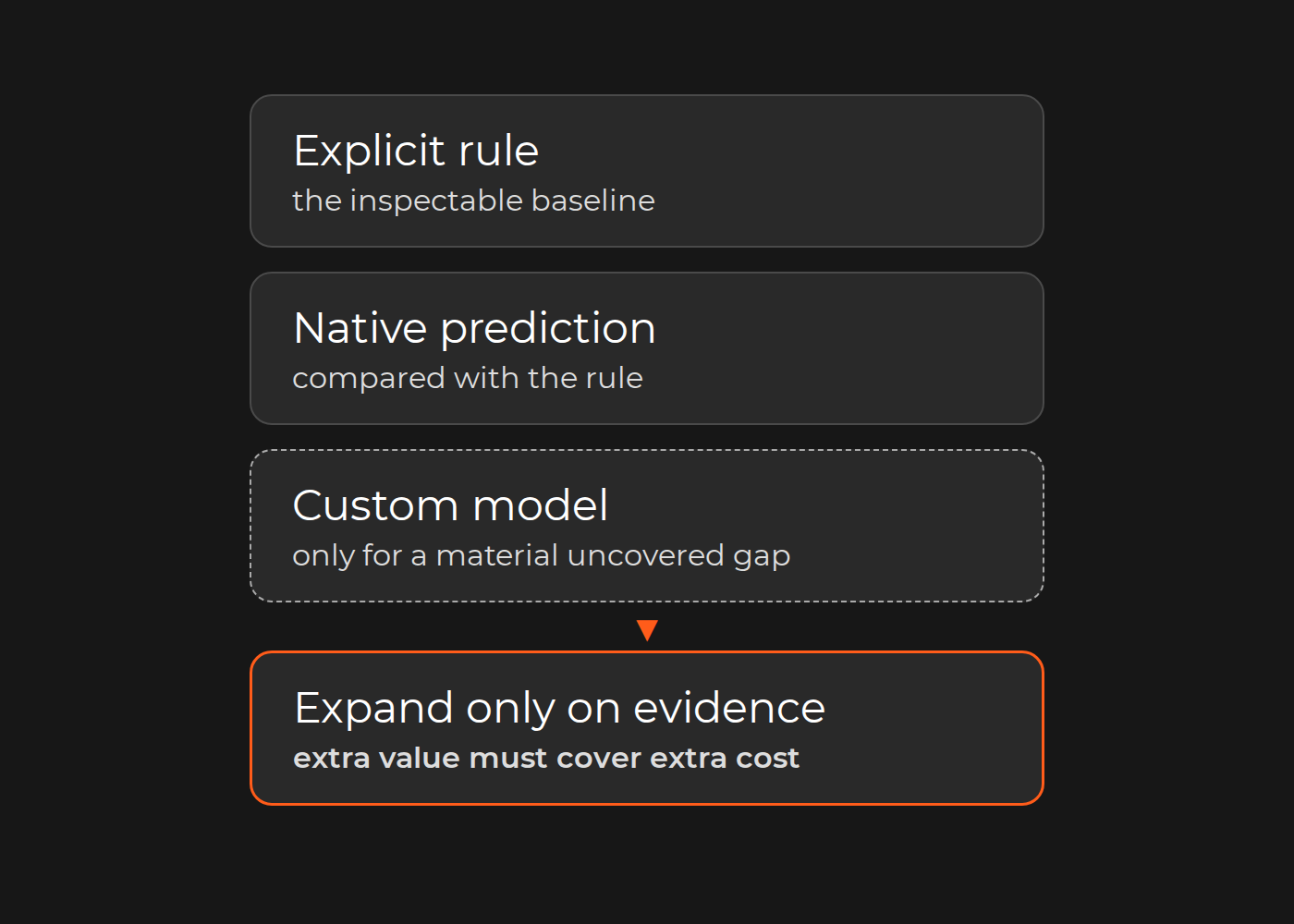
Start with an explicit rule. Adopt native prediction when a credible controlled comparison shows extra value over that rule; consider a custom model only for a material gap neither route covers. If the data cannot support the comparison, fix the evidence path first.
For ecommerce CMOs and lifecycle leads with established repeat demand, the useful comparison is rules versus native prediction versus custom modeling on the same scenario. If the actual problem is product value, pricing, or lack of repeat demand, prediction is not the first remedy.
Rules, native prediction, custom model—or none?
Candidate uses include lapse/churn-risk scoring, next-order timing, win-back prioritization, and offer personalization. Each needs a specific decision: whether to contact, when, or which approved intervention to compare. A lapse score does not prove a discount changes behavior. This guide uses reminder timing to keep the comparison clear.
Rules fit a known buying cycle
An explicit interval or event condition is an inspectable baseline. Keep it if it meets the need. It may lose when meaningful customer variation makes fixed timing inadequate, but demonstrate that gap rather than assuming AI is better. Correct identity, purchase, and suppression data remain necessary.
Native prediction fits a supported decision with demonstrable extra value
A platform feature can inform timing without a model platform of your own. Check eligibility, mapped events, model scope, permitted use, and actual account availability, then compare it with the rule. Native prediction loses when those prerequisites fail or its extra contribution does not cover its cost.
As of November 2026, Klaviyo’s predictive-analytics documentation describes a concrete limitation: expected next-order date uses individual and population order behavior, but does not consider which products the customer ordered. The vendor recommends standard replenishment flows when product-category cycles are known. That can make a well-designed rule the better starting point; it is not a claim about your account’s accuracy or uplift.
Custom modeling needs a valuable uncovered gap
Consider custom work when a material decision cannot be supported by suitable native options. Greater control brings training, evaluation, deployment, monitoring, and maintenance responsibilities. It loses when a rule or supported feature covers the job with less complexity, or nobody can own ongoing operation.
No model is the right choice when prerequisites are absent
Missing permitted history, reliable identity, current suppression, or a measurable hypothesis means repair those prerequisites first. Generative AI for drafting copy is a separate option: plausible text does not establish valid targeting, permission, incremental value, or authority to change discounts, credit, refunds, or subscriptions.
Keep subscription administration separate too. Changing a subscription or processing a renewal is operational work, not proof that a retention intervention adds value.
Make the data and suppression map decision-ready
For one lifecycle decision in one market/channel, specify:
Identity/purchases: verified commerce, POS, ERP and CRM links; unresolved collisions; qualifying order statuses; line-level returns/refunds.
Point-in-time events: occurrence, arrival, and decision availability, with replay, duplicate, and late-event tests.
Permission/contact rules: current purpose/channel restrictions, withdrawals, frequency limits, recent purchases, service issues, and other journeys. Retries must not undo suppression.
For each field record its source, transformation, owner, freshness rule, and failure behavior. An unknown identity remains unresolved rather than being merged to increase audience size. Privacy owners approve permitted profiling/contact uses and retention; security approves access. The CMO owns the journey, IT/data owns the evidence path, and finance accepts the economic comparison.
Separate prediction quality from campaign value
Evaluate the candidate against a simple baseline on a later, untouched period, using only information available at the historical decision. A refund may have occurred before the decision but arrived afterward: it still was not an available input. Adding it to historical features leaks knowledge the live decision could not have had.
Check relevant cohorts, missing-history cases, and changing purchase patterns. Define the criterion before inspecting results. Prediction error, calibration, or ranking can assess the model; none establishes that messaging the predicted audience causes profitable repeat purchases. Offline success is a reason to consider a controlled test, not automatic production approval.
Design two comparisons, not one attractive revenue report
For reminder timing, an analyst might randomly assign comparable customers from the same eligible population to:
Control: no tested reminder; ordinary service communications continue.
Rule: the approved reminder follows baseline timing.
Prediction: the same reminder follows candidate timing.
Prediction versus rule tests the timing method. Either active arm versus control tests whether its reminder policy adds value. Keep copy, offer, channel, contact limits, and unrelated campaign exposure comparable. If several elements change, the test estimates the combined policy, not the model alone.
Choose customer/account assignment to limit contamination. Predefine allocation checks, duration, outcome windows, sample-size reasoning, and stopping rules. Current restrictions apply in every group. Record post-assignment suppression rather than selectively removing inconvenient customers from denominators; agree a lawful analysis plan with privacy and analytics owners. Let purchases and returns mature and report uncertainty, missing data, and contamination.
Worked illustration: a higher contribution can still lose after cost
These fictional numbers explain arithmetic only. They are not client results, a powered experiment, a recommended sample size, or an established causal effect.
Suppose 1,000 customers are assigned to each group. Contribution before the extra software operating cost is $2,900 for control ($2.90/customer), $3,000 for rules ($3.00), and $3,200 for prediction ($3.20). Assume finance consistently defines contribution after discounts, returns, and agreed variable/channel costs.
The rule-minus-control difference is $0.10/customer; prediction-minus-control is $0.30. Prediction-minus-rule is only $0.20, or $200 for the illustrative group. If prediction adds $250 of allocated operating cost beyond rules, its illustrated advantage becomes negative $50, before implementation cost and uncertainty.
Prediction clears this operating-cost hurdle only if its credible extra contribution exceeds extra operating cost per assigned customer: here $0.20 versus $0.25. A credible difference above $0.25 would reverse that operating comparison; implementation and uncertainty would still matter. Finance must approve allocation and avoid double counting. Attributed revenue supplies neither the no-intervention comparison nor this marginal-cost test.
Decide what earns a next phase
Keep rules when they meet the need. Use a supported feature when it passes the agreed comparison and operating requirements. Consider custom work for an uncovered material gap with monitoring, rollback, and accountable lifecycle/data owners. Negative or inconclusive results are legitimate reasons not to expand; the authorized budget owner needs that option as well as an expansion proposal.
Dinarys’ Untamed case describes engineers enhancing and integrating a React-based subscription dashboard and building a new back end under the client CTO’s direction. That is subscription operations engineering—the work this guide keeps separate from retention modeling—not proof of a complete CRM/CDP rollout, a retention model, or incremental marketing uplift. For data gaps between commerce, ERP, and CRM, the nearest engineering route is ERP integration services, alongside a qualified lifecycle specialist and analyst.
For a conversation with Dinarys, bring one lifecycle decision, its rules baseline, a sanitized data/suppression map, proposed control assignment, and finance’s cost definitions. Once the route is justified, require any commissioning proposal to specify its evidence, acceptance owners, and stop/expand decision—not an inflated revenue target.
You may share this article
Let professionals meet your challenge
Our certified specialists will find the most optimal solution for your business.