Online fashion stores are currently on the rise. Global market ecommerce sales in the category are expected to nearly double from $1.17 trillion in 2026 to $1.84 trillion by 2030, at a compound annual growth rate of 11.8%. At the same time, more people worldwide shop digitally: 78% of EU internet users shopped online in 2025, and 46% of EU internet users bought clothes, shoes, or accessories online in 2024. In the U.S., ecommerce retail sales have also grown — though at a much lower rate — up from 16.1% in 2024 to 16.4% in 2025.
As the category gets bigger, this raises the execution bar for everyone, from global luxury labels to niche Direct-to-Consumer (DTC) brands. Customers expect fast, mobile-friendly storefronts that capture some of what makes in-store shopping effective:
Intuitive browsing across large, variant-heavy catalogs
Engaging visual design that allows customers to explore by look, style, or occasion
More confidence in purchase decisions through clearer product presentation and styling guidance
Smooth fulfillment and returns
That last point matters especially in fashion and apparel, with NRF’s latest research suggesting that 19.3% of annual online sales will be returned, and 82% of consumers say free returns influence where they shop online.
There is a lot of technical work sitting underneath all of this. Your team would need to have experience with the right platforms, technologies, integrations, and implementation patterns. That is one reason brands often struggle to do all of this smoothly in-house. Internal teams often end up spending too much time trying to patch together design, merchandising, integrations, and post-purchase workflows while still keeping day-to-day operations moving. The result is often a store that sort of works, but not especially well. This only becomes more expensive to fix later once weak UX, technical gaps, and operational issues start getting in the way of growth while your competitors move forward, expanding their customer base.
This is why considering an ecommerce development company in the fashion and apparel space is an important decision. However, you should remember:
The right partner can help a business build a solid technical foundation and make sure the storefront reflects the brand clearly and consistently, freeing up internal teams to focus less on fixing the store and more on growing it.
The wrong partner, on the other hand, would only waste your time and resources delivering a store that looks visually appealing but falls short where customers feel it most, from browsing and product discovery to checkout, delivery, and returns.
Based on our experience with fashion and apparel ecommerce projects at Dinarys, along with broader shifts across the industry, we’ve outlined what tends to matter most if you expect to achieve success in this space. In this article, we draw on that perspective to break down:
What fashion and apparel ecommerce actually demands
What to evaluate when comparing potential development partners
Which companies stand out as strong options when it comes to development
What Fashion and Apparel Ecommerce Demands
Your customers want to discover, compare, evaluate, and return products with as little friction and uncertainty as possible. Brands are expected to help customers navigate the assortment, compare options, and feel confident in what they are buying.
For your business, that means choosing a development partner or hiring an internal development team who can support those needs through the right technical, architectural, and operational decisions. Here is a list of challenges they have to account for:
The storefront has to show the brand clearly and help customers evaluate products
Your customers cannot touch, try on, or feel the product, so the storefront has to compensate in ways that, say, an electronics store does not. That means the presentation does a lot of the selling. The storefront has to communicate what the brand stands for while making products easy to find and compare.
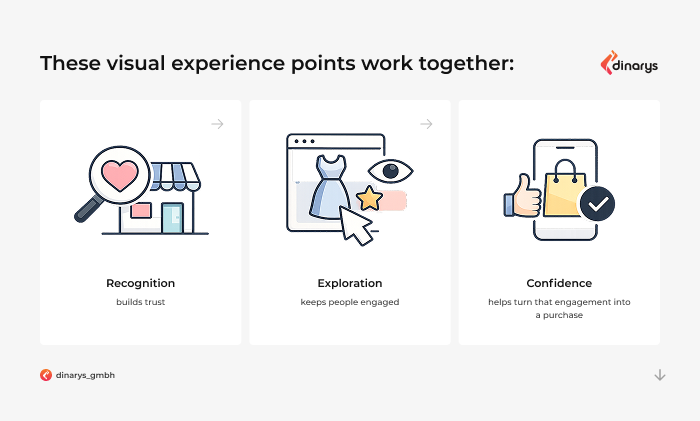
A strong visual experience should support:
Brand recognition, so the storefront feels consistent and customers can understand the brand's aesthetic, positioning, and intended audience
Style exploration, by helping customers see how products fit into a broader look, mood, occasion, or aesthetic.
Purchase confidence, by reducing hesitation that drives abandonment and returns through strong detailed imagery, clear variant presentation, and fit and sizing guidance
To support that in practice, the storefront’s technical setup should be built to keep brand presentation consistent across product pages, collections, campaigns, and other parts of the store as the catalog changes over time. That often means building reusable design patterns, keeping visual rules consistent across templates, and making it easier for teams to update content without breaking the overall brand experience.
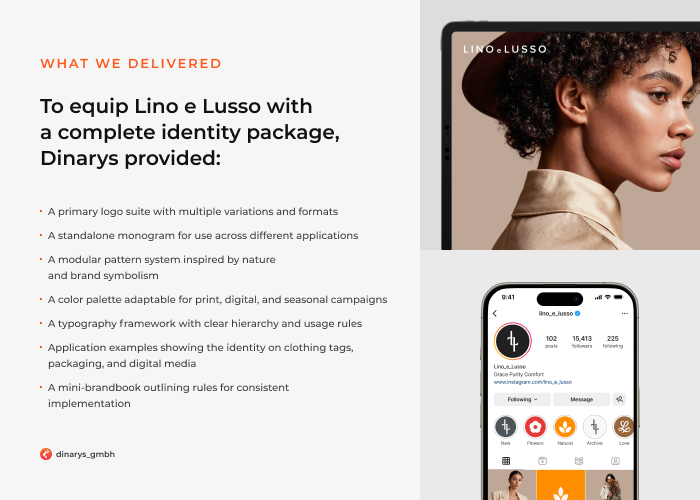
We have followed the same principle in our Lino e Lusso project, where the Dinarys team created a complete identity package designed to keep the brand consistent across digital and physical channels.
The catalog should be easy to browse and narrow down
In fashion and apparel, product discovery is harder to get right than in most other categories because of how customers shop. Shoppers may arrive with a mood, an occasion, or a vague aesthetic in mind rather than a specific product, and the storefront has to meet them there.
Good discovery starts with structure. That means:
Category and collection logic with products grouped in ways that make sense to shoppers, even if the internal inventory structure is different
Filters, attributes, and search that support both customers who arrive with a specific product in mind (such as “black linen blazer” or “men’s running shoes size 10”) and those who browse more loosely (such as “outfits for vacation” or “something to wear to a wedding”).
Merchandising control of campaigns, seasonal edits, and featured assortments that lets the brand shape product discovery without needing developer involvement every time something changes
What makes this hard is that none of these pieces work in isolation. Product grouping, filters, search, and merchandising controls all depend on how the catalog is structured underneath. If product data is inconsistent, attributes are incomplete, or variants are handled poorly, filters would become unreliable, search results would feel off, collections would become harder to manage, and the merchandising team would have less freedom to manage what shoppers see without running into technical limits.
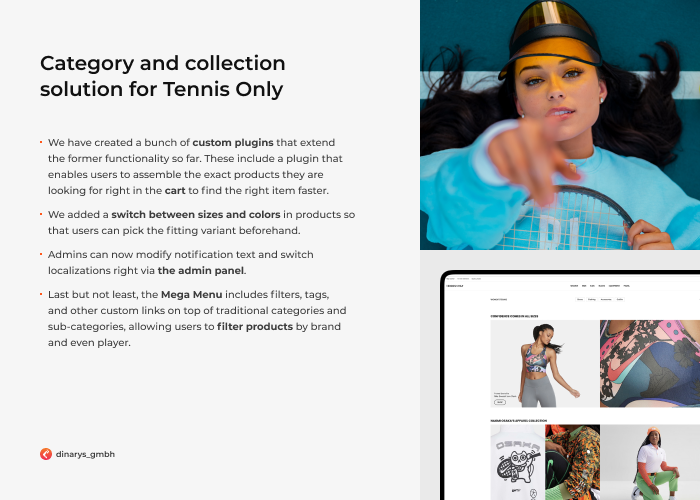
In practice, that can mean reworking product grouping, search behavior, and navigation structure together rather than treating them as separate UX fixes — as the Dinarys team did for Tennis Only.
For development partners, the early decisions around category structure, filter taxonomy, and variant grouping are expensive to undo later. Getting them right is a long-term operational concern.
Returns and delivery need to work as smoothly as browsing and checkout
Delivery, returns, exchanges, and post-purchase communication have a direct impact on customer loyalty.
When it comes to the post-purchase experience, customers expect:
Clear delivery updates, including accurate timing, shipping updates, and order visibility
Returns and exchanges without unnecessary friction or confusion
Communication consistent with the rest of the brand (not like a different company took over the moment the customer clicked Buy)
The technical challenge is keeping post-purchase data consistent across several systems. If the data isn’t consistent, customers would see it as wrong statuses, missing updates, and more difficult return or exchange processes. For development partners, this means building integrations where the storefront, order management system, returns platform, and post-purchase communication tools all share data in real time without breaking that sync when order volumes spike.
WANT TO UNDERSTAND WHERE YOUR STORE MAY BE HOLDING THE BUSINESS BACK?
Dinarys can evaluate your current setup and help identify the changes needed to better support day-to-day operations, improve customer shopping experiences, and ensure future growth.
Now that you know what fashion and apparel ecommerce demands in business and tech aspects, the next step is evaluating whether an agency can actually support it.
How to Evaluate Ecommerce Development Agencies for Fashion and Apparel
Depending on what stage of growth your business is at currently, your process of choosing a development company would look slightly different. Whether you’re launching fresh, outgrowing an earlier setup, expanding into new markets, or modernizing a legacy stack, the criteria below apply across all of those situations.
#1: Industry expertise in fashion and apparel [research and evaluation stage]
This is one of the first things worth checking, as general ecommerce experience doesn't always translate well into fashion and apparel.
At the research stage, look for case studies demonstrating a proven track record working for brands in fashion, apparel, footwear, accessories, or adjacent categories where customer behavior and merchandising demands are similar. Pay attention to whether the agency shows that it understands:
How customers browse in this category
How variant-heavy catalogs affect discovery and product presentation
How often collections and campaigns need to change
How sizing, fit, returns, and brand presentation influence the overall experience
These are the details that often make fashion and apparel projects harder to execute well than they first appear.
#2: Strategy and discovery that align the build with the business [research and evaluation stage]
Start by looking for case studies in which the vendor describes what shaped the scope of work and priorities in detail. This should go both ways. So, on a call, make sure they learn about your business before proposing anything. An experienced vendor would ask:
How the business sells and who owns day-to-day operations
What the team needs to manage independently after launch
What the next phase of growth is likely to demand
If an agency moves too quickly from brief to proposal, the final solution would likely have issues and constraints that should have been accounted for during planning. In practice, that often means a build that is hard to adapt, manage, and scale over time.
#3: Platform judgment and ecosystem fit [research and evaluation stage]
Look at the agency’s platform experience. A strong portfolio of live stores and expertise in the desired platform are crucial when hiring eCommerce developers. Working mainly with one platform is not a problem by itself. The real question is whether the development company can show, through relevant case studies, that it has used that platform well in situations similar to yours and explain why it made sense there.
That should also be clear in conversation. The vendor should be able to walk you through the trade-offs behind its recommendation, explaining:
Where the current platform creates constraints for your specific business model
What customization, content agility, or international expansion looks like on that stack
When replatforming is genuinely necessary versus when existing limitations can be resolved within the current setup
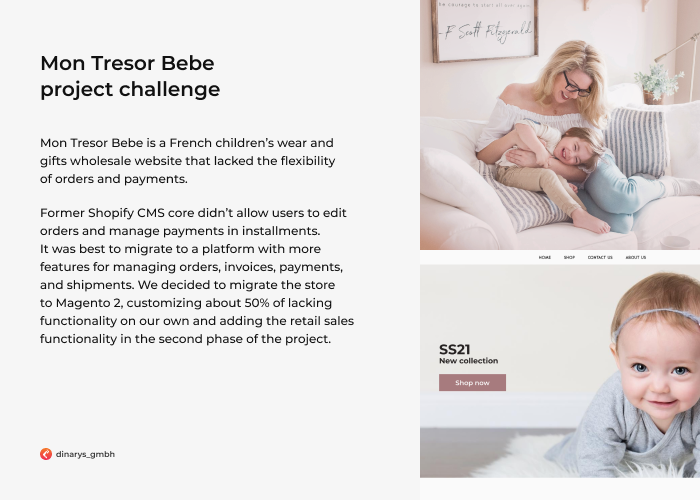
One good example of how this should work is our Mon Tresor Bebe project, where the Dinarys team recommended replatforming in response to specific limits in the existing setup around orders, payments, and installment functionality.
#4: Development capabilities that match the brand's growth stage [evaluation stage]
On a call, ask the vendor to describe the most complex technical challenge they have solved on a comparable project and how they approached it. Strong technical teams talk about trade-offs, constraints, and long-term maintainability. Look specifically for:
Whether they scope for stability first or default to building everything at once
How they approach performance at scale (catalog size, traffic spikes, variant depth)
How they handle technical debt
If a team agrees to your every requirement without flagging risk or suggesting phasing, that is usually a sign of limited architectural thinking.
#5: UX, storefront design, and customer experience support [research stage]
This is largely verifiable before a call. Look through the vendor's portfolio and assess whether specific work examples reflect the brand they were built for. Strong design work in fashion feels distinct from project to project. Weak work tends to look like variations of the same template.
Look for:
Mobile execution that doesn't feel like a scaled-down version of the desktop experience
Collection and category pages that reflect how different customers browse
Product pages that show effort put into variant presentation, making user confident in what they’re buying
On a call, ask how design decisions were made on a specific project. Agencies with strong UX capability should be able to explain the customer behavior, business constraints, and trade-offs they were working with.
#6: Integration and operational depth [evaluation stage]
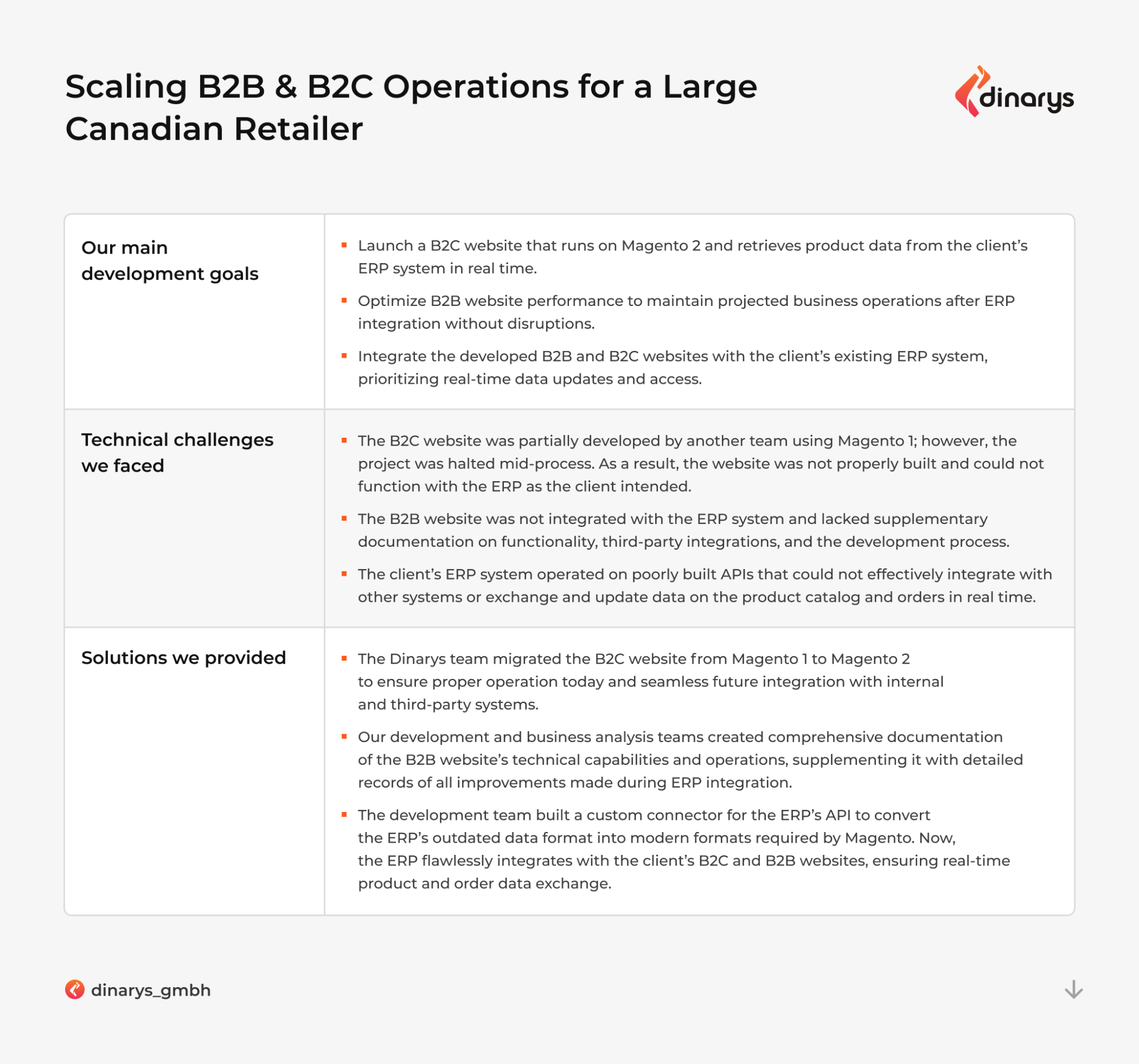
Ask for specific examples of integration work on comparable projects. The vendor should explain how they approached a complex integration, what broke, and how it was handled. For example, in our ERP integration work for SanMar, the challenge was not just connecting systems, but keeping catalog, pricing, stock, and order data in sync in real time.
An experienced and trusted partner that has worked with fashion stores before understands the quirks of system integrations. They anticipate the problems (orders stuck between the store and warehouse, returns that don’t process, inventory that doesn’t match) and plan for customized solutions from the start to keep everything running smoothly.
NOT SURE WHETHER YOUR STORE AND BACKEND SYSTEMS ARE WORKING TOGETHER RELIABLY?
Dinarys can review your ecommerce integrations and help you identify where data sync, fulfillment logic, or post-purchase workflows may already be creating risk.
#7: International and multi-market capability [evaluation stage]
If the company built for multi-market complexity before, they should be able to talk clearly about:
How they approach multi-currency and localization at a technical level
How they handle market-specific catalog rules, pricing, and tax logic
How they structure multi-storefront architecture so markets can be managed independently without duplicating the entire build
What matters here is how the setup is designed underneath. Different markets often need different pricing, tax logic, product ranges, shipping rules, content, and promotional calendars. The store has to support those differences without forcing the team to rebuild the same thing market by market. Weak structure in this area could lead to duplicated updates, more manual work for your team, and expansion becoming slower and more expensive.
#8: Merchandising flexibility and content agility [evaluation stage]
The question here is whether the agency builds storefronts that merchandising and marketing teams can actually operate without developer involvement on routine tasks. This is best tested by asking the company to walk you through how a merchant would handle a specific scenario after launch:
Updating a collection for a new seasonal drop
Changing homepage placements for a campaign
Moving products across categories
If those tasks require a developer, the setup is not ideal for fashion and apparel ecommerce.
#9: Engagement model and ways of working [evaluation stage]
This is often what determines whether a technically capable agency is actually good to work with. On a call, look out for the details:
Who will actually work on the project day to day, and how senior is that team
How they handle scope changes, delays, and disagreements
What the handoff process looks like and what the brand owns after launch
Ask for a reference from a client at a similar stage and size. Agencies confident in how they work will offer one without hesitation.
With those criteria in mind, the next step is to identify the agencies that actually show these signals in practice. Consider the shortlist below as a starting point for that comparison.
Best Ecommerce Development Companies for Fashion and Apparel in 2026: Analyzed and Profiled
The companies below stand out for different reasons, each bringing a different mix of platform expertise, delivery depth, and operational fit. Hence, the right choice would depend on what your business needs to support next.
Dinarys
Dinarys is an ecommerce development and consulting company with expertise spanning multiple industries.
Company profile:
Location: Berlin, Germany
Operating since: 2014
Ecommerce Platforms: Shopify / Shopify Plus, BigCommerce, WooCommerce, Shopware, Adobe Commerce, Magento Open Source, Emporix, commercetools, SAP Commerce Cloud, Salesforce
Relevant services: ecommerce audit, store builds and modernization, replatforming, data migration, integrations (OMS, POS, CRM), custom development, UX-focused storefront improvements, and ongoing post-launch technical support
WANT A TECHNICAL PARTNER WHO CAN BUILD A STORE READY FOR GROWTH?
Dinarys works with fashion and apparel businesses at different stages of growth and brings proven experience in building, improving, and supporting businesses in this category.
Infosys Equinox is an enterprise commerce platform and services provider.
Company profile:
Location: San Francisco, California, USA
Operating since: 2021 as Infosys Equinox, backed by Infosys, founded in 1981
Ecommerce Platforms: Infosys Equinox
Relevant services: composable commerce implementation, omnichannel commerce, enterprise modernization, digital design, commerce campaign execution and optimization, multi-market commerce support, and post-launch optimization
Selected clients: Nu Skin Enterprises, Young Living
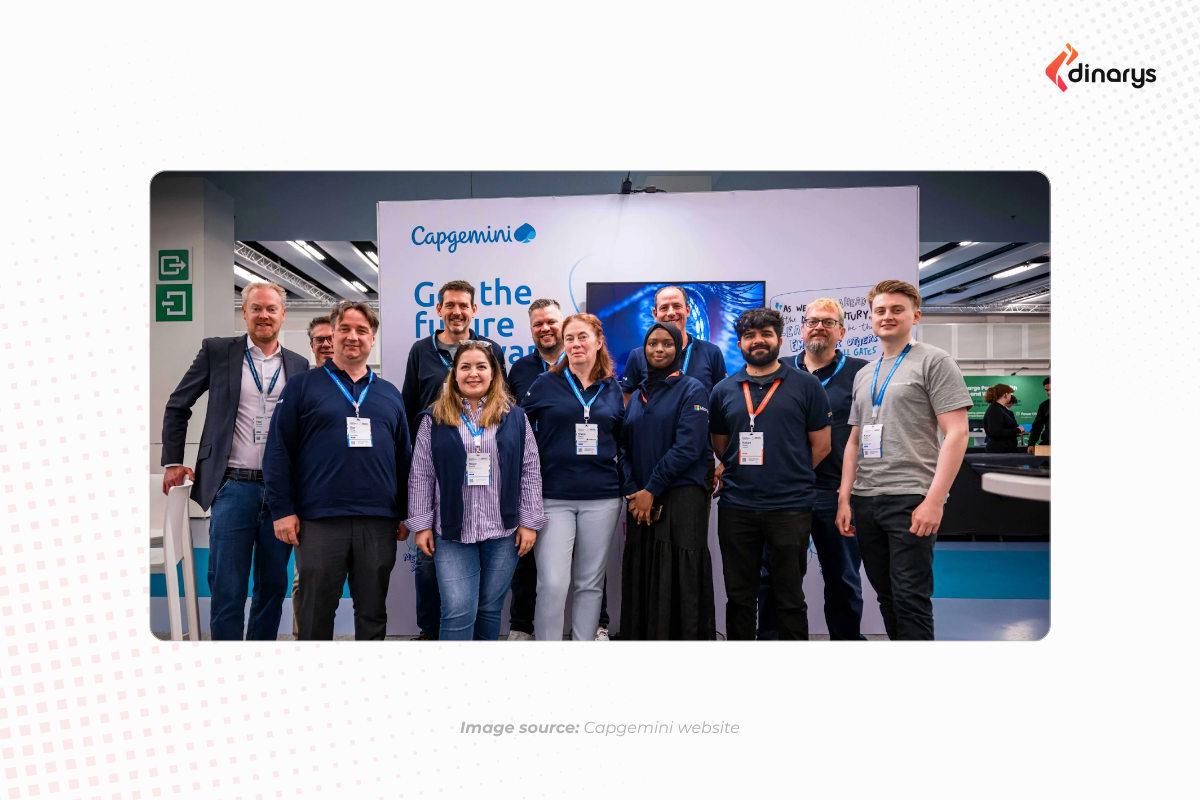
Capgemini
Capgemini is a multinational information technology services and consulting company.
Company profile:
Location: Paris, France
Operating since: 1967
Ecommerce Platforms: Salesforce Commerce Cloud, Adobe Commerce, SAP Commerce Cloud
Relevant services: commerce consulting, platform implementation, design, integrations (OMS, POS, CRM), custom application development, headless or microservices commerce, and managed support
Selected clients: NYDJ, ERES
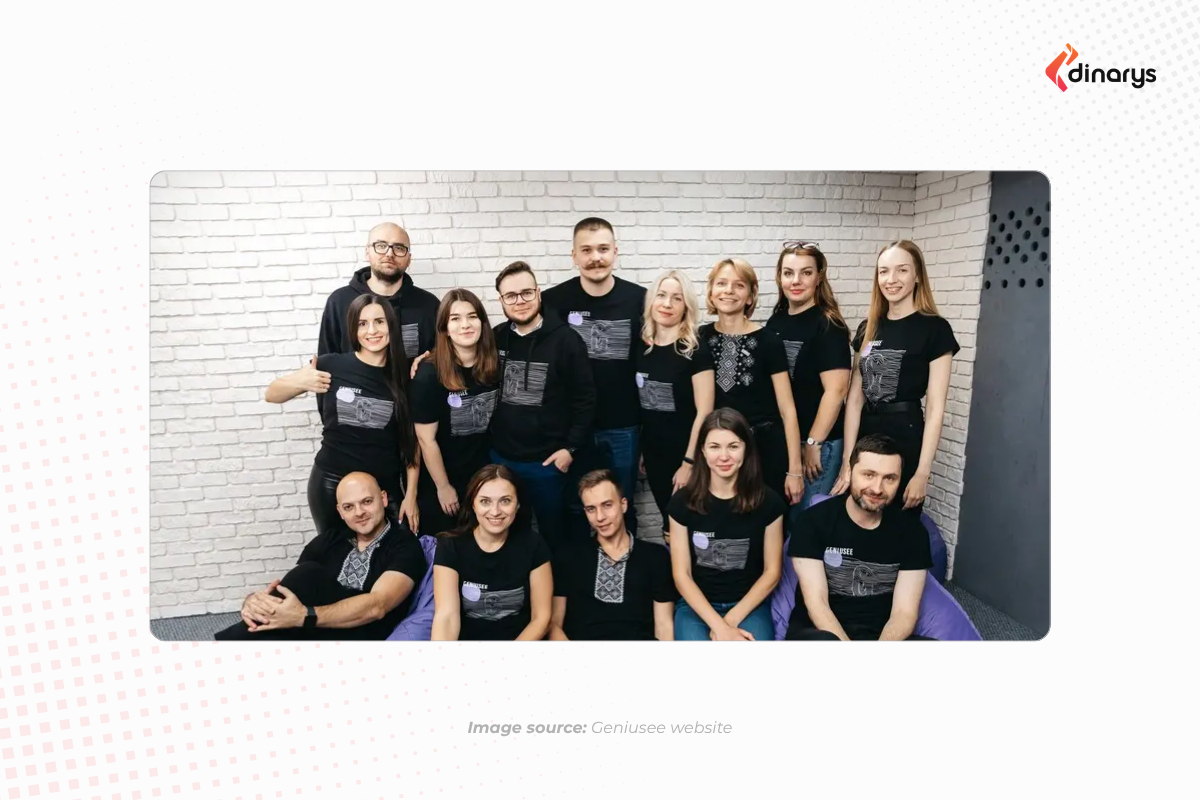
Geniusee
Geniusee is a software development company that does consulting and delivers custom web, mobile, and retail technology solutions.
Company profile:
Location: Kyiv, Ukraine
Operating since: 2017
Ecommerce Platforms: Shopify, SAP Commerce Cloud, Magento
Relevant services: retail software development, custom ecommerce development, mobile app development, payment and shipping integrations, UX/UI design, and support for scalable retail operations
Selected clients: Swoon, QuantumEye, Crave Retail
Airnauts
Airnauts is a digital product and commerce company focused on design, strategy, and website development services for beauty, lifestyle, and fashion brands.
Company profile:
Location: Warsaw, Poland; New York, USA; Paris, France
Operating since: 2012
Ecommerce Platforms: Shopify, Shopify Plus
Relevant services: ecommerce design, Shopify development, headless and custom storefront builds, UX/UI, digital transformation strategy, mobile commerce, Webflow builds, and digital product development
Selected clients: Michael Kors, Carolina Bucci, NOWNESS
CHI Software
CHI Software is a software development and consulting company delivering custom retail and ecommerce solutions, alongside broader engineering and AI services.
Company profile:
Location: Lviv, Ukraine
Operating since: 2006
Ecommerce Platforms: Shopify, SAP Commerce Cloud, Magento
Relevant services: retail software development, custom ecommerce web development, mobile app development, integrations, mobile commerce, UX/UI design, AI solutions for retail, and support for scalable commerce operations
Selected clients: MediaMarkt, VF Retail LLC
A Final Word on Ecommerce Platform Development for Fashion and Apparel
The best ecommerce development companies for apparel and fashion brands are usually the ones that understand that a strong online store is more than a polished frontend. It has to work from the customer side, has to be reliable and manageable for the team day to day, and has to have a strong operational system keeping it together.
Choosing a reliable partner is not just about who looks strongest on paper. Instead, look for a partner whose experience, technical expertise, and way of working can support your business moving forward.
FAQ
Omnichannel execution is a huge part of what good fashion ecommerce looks like, with mobile-first design being critical. Fashion shoppers primarily browse on phones, with more than 70% of US adults shopping online using mobile devices (according to the Shopify article citing Pew Research Center). If your site is not mobile-friendly, customers are more likely to leave before actually buying your product. Ensuring a seamless, secure, and user-friendly mobile experience on an ecommerce website is an important strategic approach that leads to higher customer satisfaction and better acquisition and retention.
commerce engine. It gives apparel and fashion brands more flexibility to design and manage the online store without being limited by the default frontend of a platform.
For fashion retailers, this can be useful when they need more control over design, faster experimentation, or custom features such as richer product discovery, editorial content, or advanced filtering. It can also help with performance optimization when the storefront experience becomes more demanding.
Many top online store development firms offer conversion rate optimization as a core service. CRO is the process of systematically testing and improving elements of your online store to increase the percentage of visitors who make a purchase.
The vendor can improve conversion rates by fixing the parts of the store that make buying harder than it should be (navigation, product pages, filtering, checkout, and mobile usability). They can also help streamline processes behind the storefront, making sure merchandising updates, content changes, and operational flows don’t disrupt the experience for customers.
It depends on scope. A simpler online store can take around 6–12 weeks, while a more complex build with custom design, integrations, and broader operational requirements often takes 3–6 months or more. For fashion brands, the timeline usually gets longer when the project includes variant-heavy catalogs, advanced filtering, localization, data migration, or more involved merchandising and approval cycles.
They differ mostly in flexibility, complexity, and how much technical control you need. Shopify is a user-friendly, all-in-one hosted solution ideal for startups and D2C brands. Magento (Adobe Commerce) is more customizable and better suited for established enterprises with more complex commerce operations. WooCommerce is open source and allows more control through WordPress, but it usually takes more work to maintain. The best ecommerce platform for your project success depends on catalog complexity, internal resources, growth plans, and how much flexibility you need over the storefront and backend.
You may share this article
Let professionals meet your challenge
Our certified specialists will find the most optimal solution for your business.