Content
E-Commerce
Nov 18, 2026
Accepting a Replenishment Pilot: What Planners Must Be Able to Override
Time to read: 5 minutes

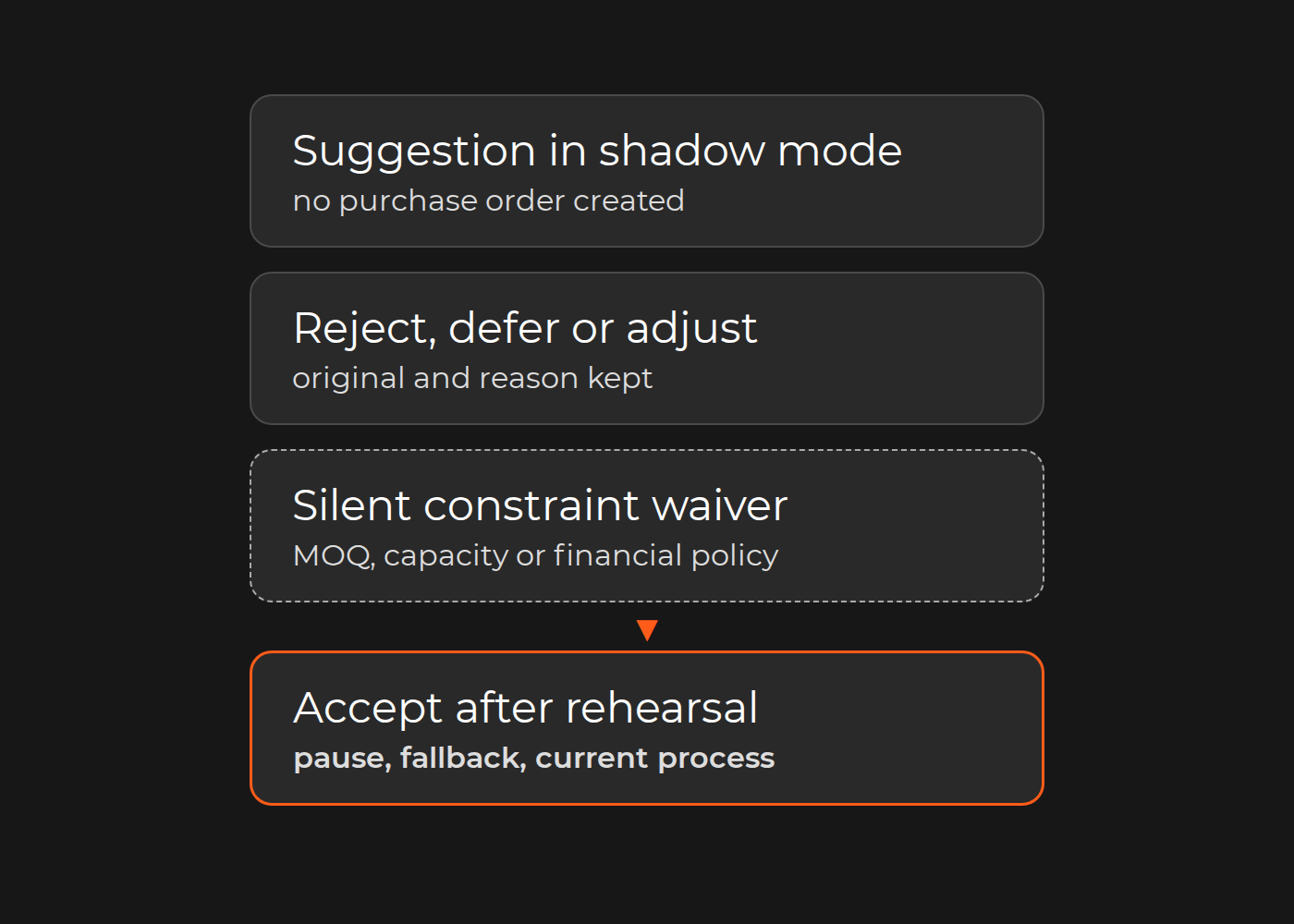
A replenishment pilot should leave planners with more control over a reviewable decision—not a recommendation queue they cannot challenge. Before accepting it, ask the provider to demonstrate rejection, a recorded correction, a category pause and a return to the current process.
Planners must be able to reject, defer and adjust within their authority. They must not silently waive a supplier minimum, capacity limit or financial policy. For a supply-chain leader choosing a delivery team, acceptance therefore covers both the tool's behavior and the people responsible for its decisions. Dinarys publishes this guide and is a potential supplier of the integration and exception-handling part of such a pilot, so apply the same acceptance tests to us.
Inspect one override record, not just an accuracy chart
Use a difficult example in the demonstration. The following record is fictional and has not been executed; it illustrates the evidence to request, not a successful pilot.
Original suggestion: 100 individual units for one item/location and receipt date.
Constraints: minimum order quantity (MOQ) 100; room for only 80 additional units at receipt, on the same unit and time basis.
Reviewer action: designated planning lead rejects the suggestion in shadow mode—advice is displayed but no purchase order is created.
Reason: no feasible positive order satisfies both constraints; 100 exceeds 80 by 20 units.
Forecast adjustment: none. Preserve the original forecast and suggestion; do not alter the input history to hide the conflict.
Exception owner: supplier/commercial policy owner must approve any MOQ exception; the capacity owner must approve a changed capacity assumption.
Status: unresolved, with the authorized current process used while the planner reviews alternatives.
Ask the provider to show where the actual reviewer, timestamp, affected items/locations, effective period and expiry are recorded. A screen that displays only the final quantity loses the original suggestion and its rationale. A demonstration that changes 100 to 80 without identifying the breached MOQ conceals the problem rather than solving it.
An infeasible suggestion is a valid finding
In the fictional record, ordering 80 breaks MOQ; keeping 100 breaks capacity. A forecast score cannot resolve that conflict. The tool should label the suggestion infeasible and name both constraints, not present it as an ordinary feasible recommendation.
A split receipt or a later date could make 100 feasible if supplier terms and capacity permit it. Ask which scenarios were evaluated and which assumptions changed. A different receipt date is a scenario for review, not a supplier commitment. Another location needs its own validated demand, stock and transfer constraints.
Deferral can also create a shortage. The planner must see that risk, retain the unresolved item and use the agreed fallback rather than receive a fictional “safe” outcome.
Separate an override from a blanket waiver
Planners should be able to challenge a forecast, alter an assumption within their authority, defer a recommendation or reject it. A change to a supplier minimum, capacity limit or financial policy needs its authorized owner and a versioned record.
Require these controls:
- Reject or defer without creating a purchase order.
- Adjust a forecast with a reason, affected scope, effective period and expiry, retaining the original for comparison.
- Correct a data problem through an owned process, rather than overwriting history until the result looks better.
- Route constraint changes to their authorized owners.
- Pause a category or location when data are stale or supply changes, with an agreed fallback.
An override record should preserve the original recommendation, reviewer, time, reason, approved change and subsequent decision. Do not automatically train the model to imitate every override: some reflect temporary disruptions, and some may prove unhelpful.
Name who supplies the expertise and who accepts it
For one category and defined locations, put these responsibility pairs in the proposal. Integration competence does not establish forecasting competence; confirm a qualified planning/forecasting specialist rather than an unspecified “AI team.”
- Forecast comparison: the forecasting specialist owns baselines, uncertainty and temporal evaluation. The planning lead accepts a reproducible backtest with bias and segment errors.
- Replenishment policy: the supply-chain specialist translates service objectives and constraints. Supply Chain/COO accepts the constraint worksheet and infeasibility examples.
- Economics: the specialist explains assumptions and calculations. Finance accepts the availability/inventory-value trade-off on agreed definitions.
- Integration and exceptions: engineering owns freshness, reconciliation and recoverability. IT/ERP accepts stale-data, duplicate and failed-handoff tests.
Confirm the budget signer and authority to change procurement processes for the actual engagement. A sponsor's enthusiasm is not purchasing authority.
There is a concrete adjacent engineering example in Dinarys' SanMar case: the team built a connector to convert legacy ERP data into Magento-compatible formats, connecting the client's ERP with its B2C and B2B websites for real-time product and order data exchange. That supports the integration role in this matrix, not forecast or inventory-policy validation.
The Prostor case shows what the integration-and-exceptions row looks like when a feed misbehaves: ERP data synchronization in the early sprints produced inventory-state inconsistencies that needed manual reconciliation, and they were identified and resolved during the first month of post-migration operations by adjusting sync frequency and adding a validation layer. Ask any provider for a comparable account of a stale or inconsistent feed it has had to correct. Discuss that bounded role through ERP integration services, with planning expertise separately confirmed.
Accept data truth before model output
The planner should accept the sales, returns and availability sample and its gaps before the model is judged. Engineers reconcile records; the planning specialist interprets them, keeping estimated demand separate from observations. Specify the backtest as a rolling-origin comparison against current rules and a seasonal baseline rather than accepting headline accuracy. If the category's actual gap is still unclear, start with a category-level stockout-and-overstock diagnosis. Shadow recommendations can expose decision differences but cannot prove realized inventory savings.
Rehearse handover before expanding
Have your planner handle a stale feed, supplier disruption, rejected suggestion and category pause. Verify that the last trusted snapshot is visible, the current process remains available and unresolved items have owners. Record who maintains constraints and monitors changes in demand or override patterns.
Keep shadow recommendations separate from purchasing. A later integration of approved orders needs explicit scope and authorization. Operational acceptance, economic evidence and a broader rollout are separate decisions. An inconclusive economic comparison can still produce a useful “do not expand yet” verdict.
Send a sanitized responsibility matrix, one infeasible-order example, your current planning/ERP systems and proposed fallback when you contact Dinarys. Ask for the data-connection and exception-handling scope alongside the separately confirmed planning specialist. If your existing platform and specialist already meet these criteria, use that route.


Let professionals meet your challenge
Our certified specialists will find the most optimal solution for your business.