Content
E-Commerce
Nov 17, 2026
Omnichannel Fulfillment Acceptance: Test the Exceptions Before Rollout
Time to read: 7 minutes

Who owns an exception between the POS, warehouse, and website—not just the API connecting them? Put that question into delivery-partner selection and launch acceptance, rather than the first incident call after rollout.
For retail COOs, ecommerce heads, and operations IT owners, acceptance should show that people and systems can complete one agreed fulfillment flow, explain uncertain states, and recover without losing control of stock or money. An API response proves a technical step, not fulfillment of the customer promise.
Dinarys publishes this guide and offers ERP integration services. Use the same evidence requirements when evaluating us. A bounded integration/operational change is a fit; a known text or status-setting defect may only need your existing support team.
Assign acceptance to the people who own the outcome
Name the person doing the work, the person accountable for accepting it, and those consulted or informed. This is the purpose of a RACI; a job title alone is not an authority grant. A partner’s cross-vendor lead coordinates evidence and technical repairs, while your authorized owners retain business decisions.
Inventory and order owners accept reservations and state mapping
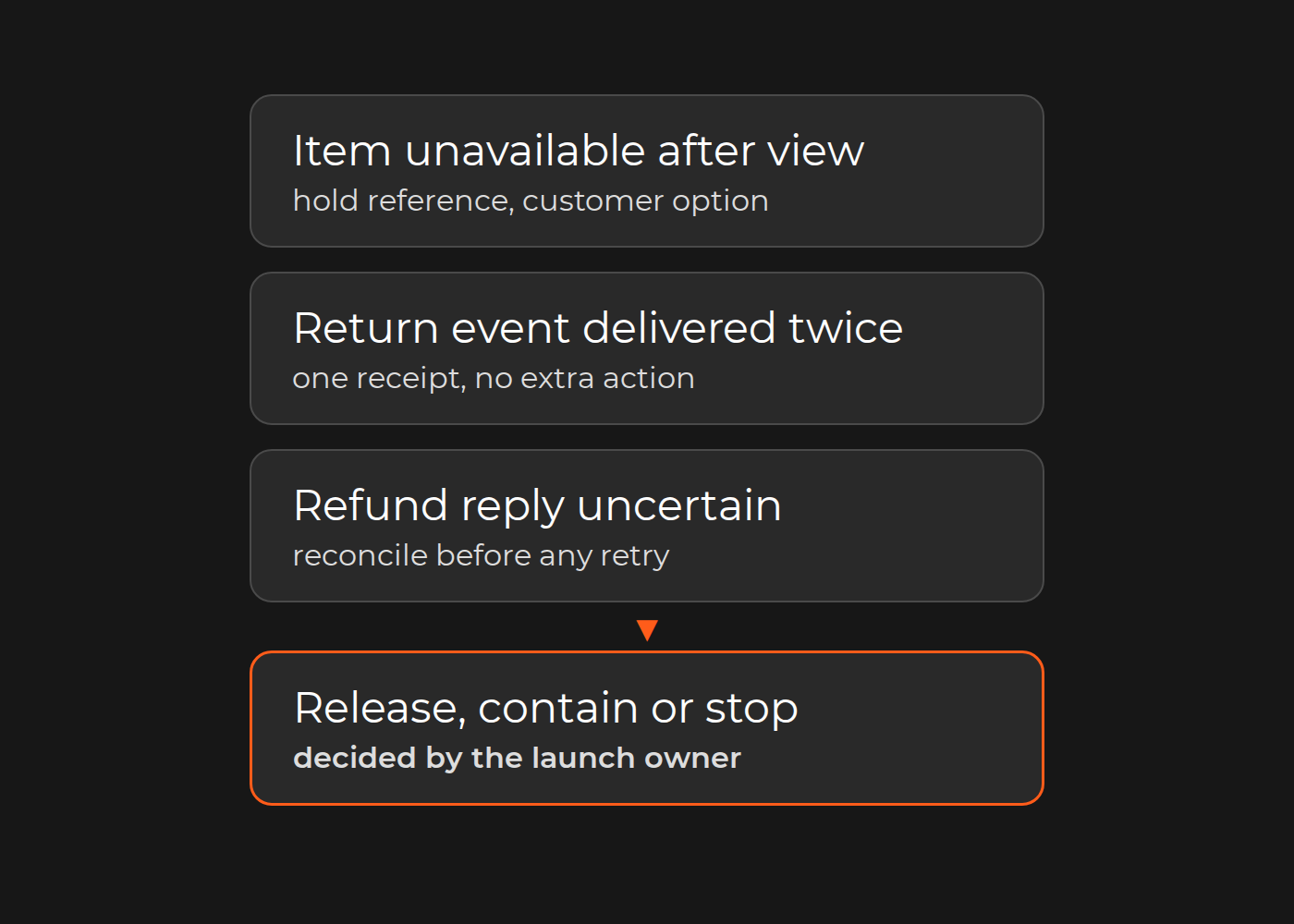
With engineers and the inventory analyst, test an item becoming unavailable after the availability view, a reservation-response timeout, and a basket that can only be partly prepared. Retain source time, request/hold references, line quantities, and customer options. Consult commerce and POS/warehouse owners; give support the resulting procedure. An order receipt is not evidence of a hold or readiness.
Store operations accepts physical recovery
Test cancellation arriving after picking and pickup expiring without collection. Retain pick/cancel ordering, stock disposition, hold/expiry/release references, and customer communication. Consult IT and service; inform ecommerce. Closing a store task must not imply that money was returned.
Returns operations accepts receipt and disposition
Replay a return-receipt event and check for a duplicate physical receipt or unintended financial action. Retain the return and event IDs, quantities, and state history. Returns works with service and finance; the policy/legal owner retains policy interpretation. Engineers implement the agreed rule rather than inventing return obligations.
Finance accepts refunds and reconciliation
In an authorized payment-service-provider (PSP) sandbox, test an uncertain refund response. Preserve the pending state, find the existing request, and reconcile payment and ERP/accounting records before retrying. Consult those system owners and inform service. Physical receipt does not authorize a money movement.
Delivery and launch owners accept different things
The cross-vendor lead maintains one defect/recovery record, including disputed boundary defects. Test restoration after an outage and delayed/reordered events; check that confirmed states do not regress. The customer program owner remains accountable for coordination.
The authorized launch owner uses those results and a rollback/containment rehearsal to release, contain, or stop. Name blocking defects and the authority accepting each residual risk. Finance, security, and technical owners are consulted; stores, service, and vendors receive the decision and runbook.
Define the environment before recording a result
Choose one model—such as buy online, pick up in store (BOPIS, or click and collect)—at defined locations. Identify commerce, the reservation authority, store/POS, warehouse where relevant, PSP, and ERP/accounting. If reservation ownership is undecided, first decide whether an OMS or bounded integration will own it; acceptance needs an agreed design.
For each connection record whether it is a real sandbox integration, simulated, or out of scope, together with the owner and evidence limit. For example, a PSP sandbox can demonstrate the tested integration behavior, not production settlement. Use authorized identities and fixtures, not real refunds, customer contacts, or production stock movements.
Agree status definitions, permitted transitions, freshness/timing rules, and customer wording. Keep “received,” “reserved,” “ready,” “collected,” “return received,” and “refund reconciled” distinct.
Each test record needs an initial state, trigger, expected system states, customer message, operator action, evidence references, actual result, acceptance owner, execution time, and build/configuration version. The checklist below sets out those fields and eight starter scenarios for you to fill in as you run each test.
Exception-pack checklist: fields and eight scenarios
Use this checklist with authorized sandbox data. It is a starting template, not a completed test pack or a legal or payment policy; do not issue real refunds or move production stock to complete it. Copy the record table once for each scenario you run.
Scope and authority
| Field | Your entry |
|---|---|
| Fulfillment model and test locations | |
| Build/configuration version | |
| Real sandbox connections, simulations, and exclusions | |
| System that owns reservations, and the systems that read them | |
| Status and freshness rules | |
| Customer-policy owner | |
| Cross-vendor coordination lead | |
| Authorized launch owner | |
| Blocking defects and who accepts each residual risk |
Record for every scenario
| Field | Your entry |
|---|---|
| Test ID and fixture, order, line, and location IDs | |
| Initial states and quantities | |
| Trigger, event identities, and event order | |
| Expected state in each system | |
| Expected customer wording | |
| Expected operator action and escalation | |
| Physical evidence references | |
| Financial evidence references, if applicable | |
| Actual result (record it when you run the test) | |
| Defect or remaining uncertainty | |
| Who runs the test / who accepts it | |
| Consulted / informed | |
| Execution date and time |
Eight starter scenarios
| # | Scenario | What to check | Your result and evidence |
|---|---|---|---|
| 1 | Item becomes unavailable after the availability view | Source time, hold reference, and the customer option offered | |
| 2 | Reservation reply times out | The existing request is investigated before any retry; no invented reserved or ready state | |
| 3 | Only part of a basket can be prepared | Line quantities are reconciled | |
| 4 | Cancellation arrives after picking | Stock disposition and hold release | |
| 5 | Pickup expires without collection | Remaining quantities and customer communication | |
| 6 | Return receipt event is delivered twice | One receipt; no unintended extra financial action | |
| 7 | Refund reply is uncertain | The existing request is reconciled before another action | |
| 8 | Integration recovers after an outage | Delayed or reordered events replay without regressing confirmed states |
Release decision
| Question | Your entry |
|---|---|
| Did an operator independently locate and resolve the controlled exception? | |
| Were in-flight physical and financial events preserved through rollback or containment? | |
| Passed / failed / not tested, with evidence | |
| Remaining issue, owner, containment, and decision authority | |
| Release, contain, or stop—and who authorized the decision |
Walk through a duplicate-return test
In a fictional controlled fixture, order T-31 has two collected units and one authorized return request. Event E-9 represents one physically returned unit. Redeliver the same event identity.
The expected outcome is one recorded receipt, not two. An authorized refund remains a separate financial process; replay must not cause an unintended extra action. Retain return ID, event ID, order line, quantity, state history, and applicable sandbox payment/accounting references. Finance approves the financial expectation.
For a reservation-timeout test, the initial state might be “item shown available” and the trigger a missing reservation reply within the agreed time. Expect investigation, not an invented reserved/ready state. Retain the existing request and reconciliation trace and check the approved customer wording. Record the actual result when you run the test, rather than copying the expectation.
Ask the partner to show relevant delivery and its limits
The Prostor public case shows why the pack includes post-launch reconciliation and outage-recovery scenarios. Dinarys’ scope for this omnichannel drugstore chain included real-time inventory sync across 427+ physical stores and the online storefront, with an offline pickup module. Inventory-state inconsistencies from ERP synchronization were identified and resolved during the first month of post-migration operations, by adjusting sync frequency and adding a validation layer. Ask a candidate how it will expose and resolve that class of disagreement in your pilot, and who owns the fix in the first weeks after launch.
This supports named retail integration and pickup components, not a complete OMS/returns rollout or proof that this test pack has run. Require comparable evidence for the proposed team and scope, and distinguish references available with permission from public case descriptions.
Ask each candidate: Which exceptions can you demonstrate with retained evidence? Who owns a defect disputed by another vendor? Can our store operator find an uncertain order using your handover materials without calling your developer?
Rehearse handover with in-flight orders
Have store and support operators use the runbook to locate an uncertain order, find alerts, reconcile the state, and reach the correct owner. Rehearse pausing unsupported promises and rollback or containment with in-flight orders. Reverting code does not undo an item already picked, a collection completed, or a payment captured.
The release record should identify affected orders, the remaining action, its authority, and evidence—not simply say “rollback successful.” A finite pack supports a scoped launch decision, not universal correctness or guaranteed delivery.
To review an acceptance boundary with Dinarys, bring a sanitized system/owner map, one fulfillment model, relevant policy rules, sample exception events, and the vendors who must participate. Agree what must pass, what may remain unresolved, and who can accept each risk before commissioning the rollout.


Let professionals meet your challenge
Our certified specialists will find the most optimal solution for your business.