Content
E-Commerce

Retail Software Development Companies: Top 10 Providers & How to Choose the Right One in 2026

The retail landscape in 2026 looks fundamentally different from just a few years ago. AI-driven personalization has moved from experimental pilots to core infrastructure, with 90% of retailers now deploying artificial intelligence in at least one operational area. Unified commerce architectures have replaced fragmented point solutions, and headless storefronts enable brands to deliver seamless experiences across web, mobile, in-store kiosks, and emerging social commerce channels.
Customer expectations have grown as well. Shoppers now demand sub-two-second page loads, real-time inventory visibility, and frictionless checkout across every touchpoint.
This transformation is possible thanks to custom retail software development agencies, ecommerce specialists, and platform-focused firms that build point-of-sale systems, ecommerce platforms, order management systems, warehouse management software, customer relationship management tools, and advanced analytics dashboards. From full replatforming to mobile commerce apps and complex ERP integrations, these providers deliver the software solutions that power modern retailers.
Organizations that successfully partnered with retail software development companies between 2023 and 2025 have reported conversion rate uplifts of 15–30%, page speed improvements cutting load times from 5–6 seconds to under 2 seconds, stockout reductions of 20% or more through better inventory management, and meaningful NPS gains tied to improved customer experience. On the flip side, 44% of retailers still report legacy system bottlenecks that slow innovation and limit their ability to respond to market changes. Having the right partner on your side is key to delivering comprehensive retail solutions, streamlining processes, and enhancing overall business performance.
Retailers can either build in-house engineering teams or partner with specialized providers like Dinarys – a certified and dedicated retail software development company. This article helps you navigate both paths by profiling the top 10 retail software companies and providing clear criteria for selecting the right partner.
What you’ll learn in this guide:
- The top 10 retail software companies serving midsize and large retailers in 2026
- Core service types offered by retail tech companies (ecommerce, POS, supply chain, analytics, and more)
- A practical framework for evaluating and choosing a retail software partner
Top 10 retail software companies in 2026
This section profiles 10 notable retail software development partners with a global or regional presence. Starting with Dinarys, these firms represent a cross-section of capabilities relevant to medium and large retailers undertaking replatforming, omnichannel integration, performance optimization, and custom development.
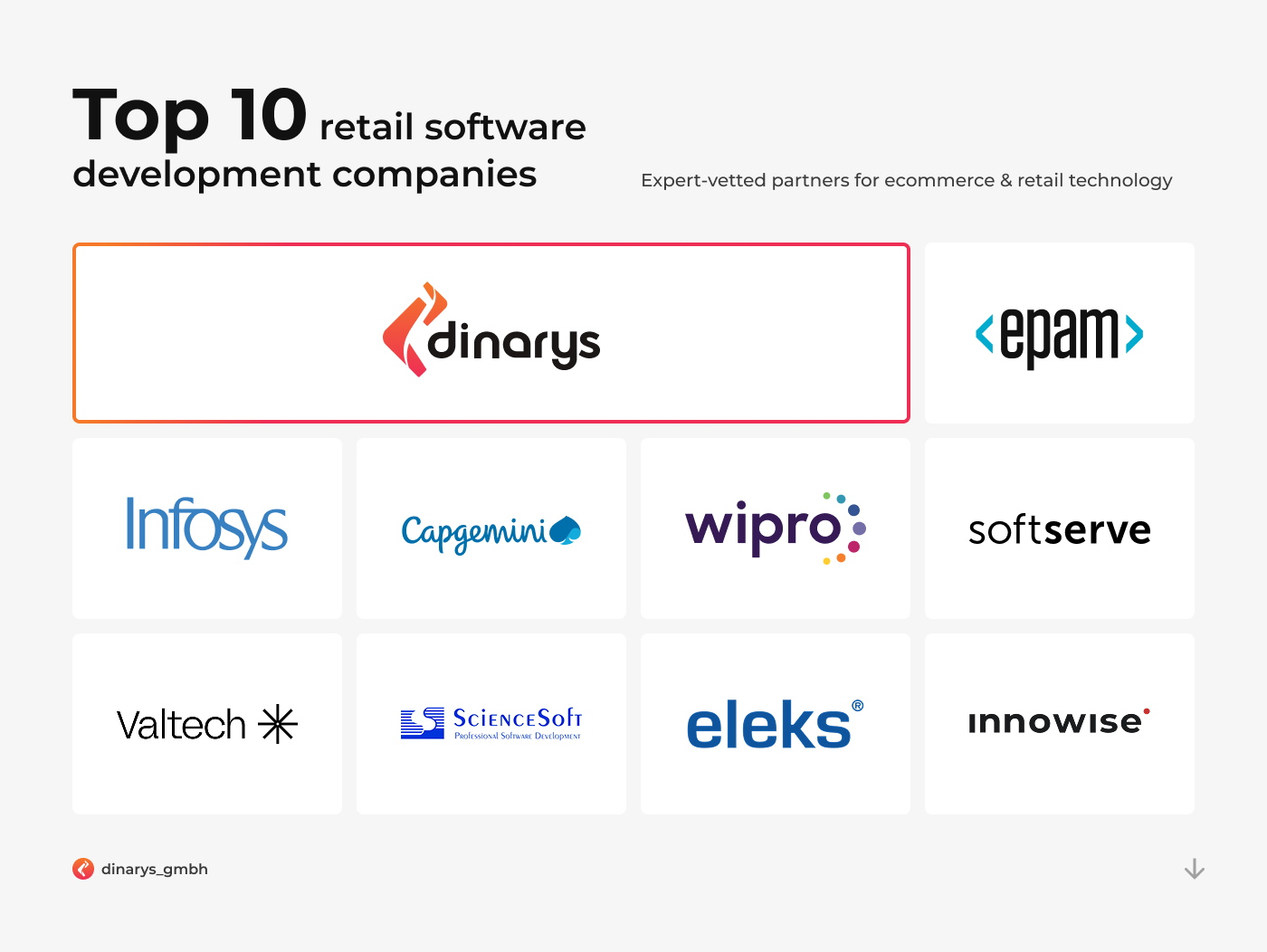
This list is not a ranking. Each company brings distinct strengths, and the best choice for you will depend on your specific business needs, technical requirements, and preferences. The profiles that follow cover core services, typical client profiles, technology focuses, and standout retail projects or strengths.
Dinarys (Europe & USA)
Dinarys is a certified ecommerce and retail software development company specializing in Magento/Open Source Adobe Commerce, Shopify, Shopware, BigCommerce, and custom headless builds. The company has offices serving Europe, the UK, and North America and is one of the top retail software development companies in the USA. The Dinarys team focuses exclusively on retail and ecommerce, delivering the technical expertise that complex digital commerce initiatives demand.
Within the retail and ecommerce segment, Dinarys focuses on enterprise ecommerce development, replatforming from legacy systems (such as custom PHP or Magento 1) to modern technology stacks, mobile commerce apps, UX/UI redesign for conversion optimization, and performance tuning for high-traffic retail stores. Dinarys also provides retail software development services spanning custom modules, advanced integrations, and ongoing platform support.
Typical clients are midsize and large retailers and manufacturers seeking to scale online revenue, expand internationally, or consolidate fragmented ERP, WMS, PIM, POS, and other systems into a unified commerce stack. Whether you’re a fashion brand with 50,000 SKUs or an electronics retailer managing multiple sales channels, Dinarys can build custom retail software tailored to your operations.
Key capabilities include:
- Complex integrations
- DevOps and cloud infrastructure
- 24/7 ongoing support and maintenance for mission-critical ecommerce sites
Completed projects demonstrate the range of work that Dinarys delivers. The company has undertaken full ecommerce replatforming, such as migrating a regional fashion retailer from Magento 1 to Adobe Commerce with multi-warehouse inventory, in 4–6 months. Site speed optimization projects have cut clients’ page load times from 5–6 seconds to under 2 seconds, directly improving conversion rates. And marketplace builds have enabled multi-vendor sales to launch in under 9 months, opening new revenue streams for enterprise clients.
Dinarys can act as your long-term retail tech partner, providing both dedicated project teams and ongoing engineering squads for continuous ecommerce growth. For retailers seeking a proven track record, deep platform expertise, and a partner who is invested in their success, Dinarys delivers.
EPAM Systems
EPAM Systems is a global engineering company with a robust retail and consumer goods practice. Known for delivering omnichannel platforms and large-scale digital transformations, EPAM serves Fortune 500 retailers, fashion chains, and grocery operators across North America and Europe. Their strengths lie in composable commerce architectures, microservices implementations, and complex integrations with SAP, Salesforce, and enterprise order management systems. EPAM has invested heavily in AI and data analytics since 2022, helping retailers optimize assortment planning, dynamic pricing, and recommendation engines. For organizations undertaking unified customer experience initiatives, loyalty platform builds, or in-store digitalization at scale, EPAM brings the enterprise-grade capabilities required.
Infosys
Infosys is a major IT services provider and among the best retail software development companies, with a dedicated retail and CPG portfolio. The agency is known for large ERP, POS, and supply chain modernization programs — work that spans end-to-end retail platforms combining ecommerce, store operations, merchandising, and analytics. Infosys frequently builds on SAP, Oracle, and Microsoft ecosystems, making them a natural fit for retailers with existing enterprise investments in those platforms.
For organizations undergoing multi-country rollouts or seeking standardization across hundreds of retail locations, Infosys offers the scale and methodology to execute. Their services tend toward larger transformation programs rather than nimble, specialized ecommerce builds.
Capgemini
Capgemini is a global consulting and engineering firm with extensive experience delivering unified commerce, click-and-collect, and store digitization for fashion, grocery, and electronics retailers. Since 2021, Capgemini has been building expertise in headless commerce, customer data platforms (CDPs), and AI-based personalization — capabilities that help retailers create seamless shopping experiences across physical and digital touchpoints. Their approach combines strategy, UX, and implementation, making them suitable for large transformation programs where business consulting and technology delivery must work hand in hand. Retailers seeking a partner for complex, multi-year initiatives often find Capgemini’s breadth of expertise valuable.
Wipro
Wipro is a global technology firm focusing on retail ERP, inventory management, and supply chain optimization alongside ecommerce and store management platforms. Their domain expertise spans demand forecasting, warehouse management, and automation of pricing and promotions using advanced analytics and AI. Retailers with complex logistics networks, multi-region operations, and significant supply chain management challenges often engage Wipro for long-term managed services and modernization programs. The company’s scale makes Wipro well-suited for enterprises seeking a single partner to handle both infrastructure and application development across their retail operations.
SoftServe
SoftServe is an engineering partner known for providing data, AI, and cloud-native development to retail and ecommerce brands. Their retail capabilities include recommendation systems, personalization engines, predictive inventory analytics, and modern storefronts on major ecommerce platforms. Typical engagements involve cloud migrations to AWS or GCP, re-architecting monolithic ecommerce systems into microservices, and building analytics dashboards for merchandising teams. Retailers seeking to leverage machine learning for customer behavior insights or operational efficiency often find SoftServe’s data-first approach compelling.
Valtech
Valtech is a global digital agency specializing in experience-led commerce, blending creative design, UX, and engineering for retail and D2C brands. They frequently implement solutions on platforms such as Adobe Commerce, Salesforce Commerce Cloud, and composable commerce stacks for fashion and lifestyle brands. Valtech is often selected for projects where brand experience and storytelling matter as much as transactional efficiency: think flagship ecommerce redesigns, immersive product experiences, and omnichannel customer journeys that enhance customer engagement at every stage. For retailers where customer experience is the primary competitive advantage, Valtech brings creative depth alongside technical execution.
Eleks
Eleks is a software engineering firm with a strong focus on custom retail tools: inventory systems, pricing engines, order management, and analytics for mid-market and enterprise retailers. Their services include legacy modernization, mobile app development for shoppers and store associates, and integrations with enterprise resource planning (ERP) systems and logistics providers. Eleks often works with European and North American retailers on midsized but complex projects where flexibility and custom software development are more valuable than rigid platform constraints.
ScienceSoft
ScienceSoft is a long-standing custom software company with dedicated retail and ecommerce offerings. Their portfolio includes POS systems, CRM implementations, WMS builds, and omnichannel storefronts. Notable work includes building unified customer databases, implementing loyalty programs, and optimizing order fulfillment pipelines for retailers operating both online and offline. ScienceSoft appeals to retailers looking for both consulting and hands-on development with clear, transparent processes and strong QA practices. Their methodical approach suits organizations that value predictability and documentation.
Innowise
Innowise is an engineering partner delivering ecommerce websites, marketplaces, inventory tools, and mobile apps for retailers and wholesalers. Their focus on modern tech stacks, cloud infrastructure, and integrations with payment gateways, shipping carriers, and third-party logistics providers makes them well-suited for mid-market retailers needing cost-effective nearshore or offshore development teams. For organizations seeking continuous feature delivery without building large in-house engineering departments, Innowise offers a practical path to ongoing ecommerce development.
Core services offered by retail software companies
Top retail software development companies including Dinarys typically cover the full lifecycle of retail technology: strategy, design, engineering, DevOps, and post-launch support. These companies deliver comprehensive retail solutions that streamline and optimize operations, often incorporating advanced tools to improve efficiency and support digital transformation. Understanding these service categories helps retailers evaluate vendors based on specific needs rather than generic capability claims and highlights the importance of processing sales data to generate actionable insights for data-driven decision-making.
This section breaks down the most common service categories you’ll encounter when evaluating retail development companies.
Custom ecommerce & omnichannel development
Custom ecommerce and omnichannel development covers building tailored ecommerce sites, marketplaces, and unified web/mobile shopping experiences for specific retail verticals: fashion, electronics, grocery, home improvement, and beyond. Unlike off-the-shelf templates, custom retail software adapts to your unique product catalog, customer journey, and operational requirements.
Typical features include:
- Product catalog management with complex attributes, variants, and bundles
- Advanced search and filtering with faceted navigation
- Promotion engines supporting flash sales, tiered discounts, and loyalty programs
- Customer account portals with order history, wishlists, and saved payment methods
- Real-time order tracking and delivery notifications
Omnichannel flows have become essential for modern retailers. Click-and-collect, buy online, pick up in store (BOPIS), ship-from-store, endless aisle, and curbside pickup options expanded dramatically between 2023 and 2025. Retail brands that unified these experiences saw measurable improvements in customer satisfaction and basket size.
Dinarys specializes in Magento/Open Source Adobe Commerce, Shopify, Shopware, BigCommerce, and custom headless builds using React, Vue, or Next.js storefronts. Performance optimization targets include Core Web Vitals compliance, sub-two-second page loads for mobile users, and SEO-friendly architecture that preserves organic traffic during migrations.
Store management & POS software
Retail store management and POS solutions encompass cash register systems, associate apps, in-store tablets, and back-office tools that keep retail stores running smoothly. Modern payment processing software has evolved far beyond simple transaction capture. Today’s systems integrate with ecommerce, inventory control, and customer management for a unified view of store operations. Secure payment processing is now a critical feature, ensuring fast, reliable, and secure transactions within physical retail environments.
Core modules include:
- Sales processing, returns, and exchanges
- Discount application and promotion handling
- Staff roles and permissions
- Cash management and end-of-day reconciliation
- Integration with central inventory and ecommerce orders
Mobile POS and self-checkout trends have accelerated since 2020. Tablet-based POS deployments and QR-based checkout reduce queue times and improve customer experience in retail locations, from boutiques to big-box stores.
Leading POS providers offer specialized strengths: Square is ideal for small to midsize businesses, providing user-friendly POS systems and mobile payment options. Toast is designed specifically for the food service industry, offering tableside ordering and kitchen management. KORONA POS is strong for specialized retailers that need high-precision inventory tracking and detailed reporting. Lightspeed Retail specializes in advanced inventory management for retailers with complex product lines, while Lightspeed POS is best for complex inventory, apparel, and multi-location retail.
Dinarys and similar firms integrate POS with ecommerce platforms and loyalty programs to ensure a single customer view. When a shopper buys online and returns in-store — or earns points at checkout and redeems them on mobile — retail systems must communicate seamlessly. Their ability to integrate directly impacts operational efficiency and customer loyalty.
Retail supply chain, inventory & order management
Supply chain resilience and precise inventory management became critical during the 2020–2022 Covid pandemic and remain top priorities for retailers in 2026. Stockouts, overstocking, and fulfillment delays directly impact revenue and customer satisfaction.
Order management systems (OMS) provide the logic layer for modern fulfillment. Key functionality includes:
- Routing rules that optimize which warehouse or store fulfills each order
- Split shipments when inventory is distributed across locations
- Backorder and pre-order handling
- Multi-warehouse logic for global retailers
Logistics software can help retailers optimize delivery routes to improve supply chain efficiency, streamline transportation planning, generate necessary documents, and monitor delivery conditions.
Inventory management systems deliver:
- Real-time stock visibility across stores, warehouses, and online channels
- Safety stock calculations and automatic replenishment triggers
- Demand forecasting using data analytics and sales trends
- Inventory tracking down to SKU and location level
Retail software companies integrate these systems with enterprise resource planning (ERP) solutions, warehouse management systems (WMSs), third-party logistics providers (3PLs), and marketplaces like Amazon, eBay, and Zalando via APIs. Supply chain transparency — knowing exactly where inventory sits and when it will arrive — enables retailers to make smarter decisions and reduce waste.
Dinarys often builds or integrates OMS/WMS capabilities as part of complex ecommerce implementations for midsize and large merchants. For retailers managing 100,000+ SKUs across multiple fulfillment nodes, this integration work is often the most technically challenging — and most valuable — component of a project.
Retail analytics, AI & personalization
Since 2023, AI adoption in retail has accelerated dramatically. Global AI spending is forecasted to exceed $2 trillion in 2026, up 36.8% from 2025, and 59% of retail executives anticipate positive returns from AI-driven initiatives within 12 months.
Concrete use cases in the retail industry include:
- Dynamic pricing that adjusts based on demand, competition, and inventory levels
- Recommendation engines driving cross-sell and upsell
- Personalized homepages, product listings, and email campaigns
- Churn prediction and customer lifetime value modeling
- AI-powered marketing automation tools for targeted campaigns
Data aggregation is foundational. Customer data from ecommerce, POS, marketing, and CRM systems flows into dashboards that help merchandisers and executives make decisions based on actionable insights rather than gut instinct. Retail analytics solutions process large volumes of customer and sales data to provide actionable insights on sales trends, customer behavior, and operational improvements. Retail-specific KPIs include average order value (AOV), revenue per visitor (RPV), repeat purchase rate, basket size, and return rates.
Dinarys implements analytics stacks — including GA4, custom dashboards, and BI tools — and integrates with customer data platforms (CDPs) or marketing automation tools to activate data across sales channels. For retailers seeking to enhance customer experiences through personalization, this analytics foundation is essential.
Replatforming, modernization & integration
Between 2022 and 2026, many retailers have moved away from legacy monoliths or home-grown systems to scalable ecommerce platforms. The drivers are clear: aging infrastructure limits agility, integration with modern tools becomes increasingly painful, and performance suffers as traffic grows.
The typical replatforming journey includes:
- Audit and discovery (4–8 weeks): Mapping existing systems, data flows, and pain points
- Platform selection: Evaluating Magento/Open Source Adobe Commerce, Shopify, Shopware, BigCommerce, or custom composable architectures
- Implementation and integrations (12–20 weeks): Building the new storefront and connecting ERP systems, PIM, CRM, WMS, payment gateways, shipping carriers, marketing tools, and POS
- Data migration and testing (4–6 weeks): Migrating products, customers, and orders while validating functionality
- Phased go-live: Soft launch followed by full cutover
Integration work – connecting existing systems into a cohesive architecture — often accounts for 40–50% of project effort. Retailers with decades of accumulated technical debt face the greatest challenges here.
Dinarys specializes in complex replatforming and integration projects where performance, SEO preservation, and minimal downtime are critical.
Example scenario: Migrating a regional fashion retailer from Magento 1 to Adobe Commerce or Shopify Plus in 5–7 months, preserving organic rankings, and improving site speed by 3x. Check what we’ve built and the business impact we’ve already delivered.
DevOps, cloud infrastructure & ongoing support
Infrastructure, automation, and support are central to modern retail software. Traffic spikes during Black Friday or Cyber Monday, holiday campaigns, and flash sales can overwhelm poorly architected systems. For enterprise clients, even minutes of downtime translate to significant revenue loss.
DevOps practices for retail include:
- Automated CI/CD pipelines for rapid, reliable deployments
- Blue-green deployments for zero-downtime releases
- Infrastructure-as-code for consistent environments
- Autoscaling setups on AWS, Azure, or GCP to handle traffic surges
Ongoing support services encompass:
- SLA-based bug fixing and incident response
- Security patching for ecommerce platforms and extensions
- Performance monitoring and proactive optimization
- Scheduled upgrades to keep platforms current
Dinarys offers 24/7 monitoring for mission-critical retail sites and can operate as an external ecommerce engineering department over multiple years. For retailers lacking internal DevOps expertise, this partnership model reduces risk and ensures systems remain stable as the retail business grows.
Page load times cut from 6s to under 2s. Conversions up 15–30%.
See what Dinarys can do for your retail business.
Schedule your first consultation
How to choose the most reliable retail software company
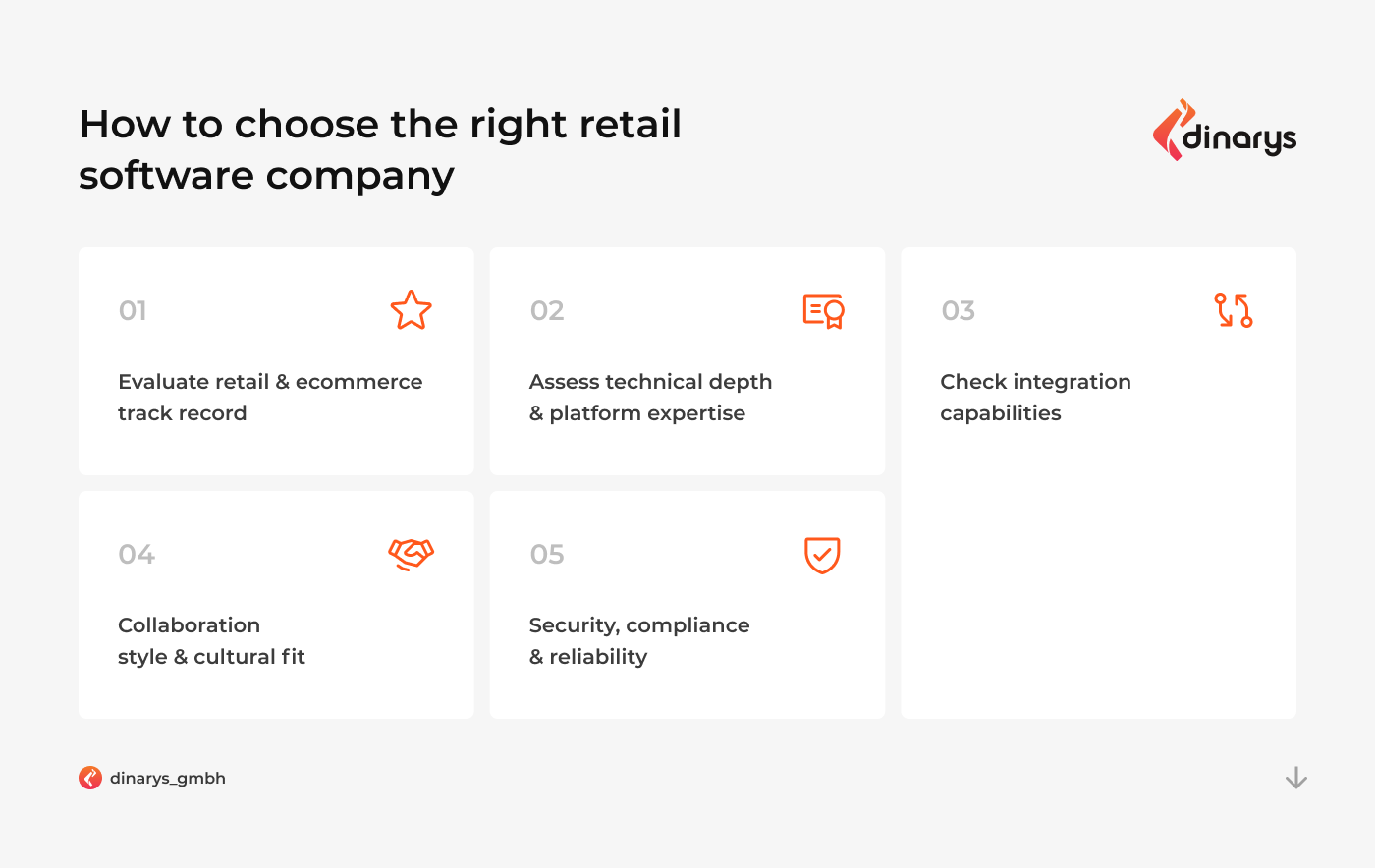
Selecting the right retail software partner affects long-term growth, risk management, and ability to innovate. A poor choice can result in delayed projects, budget overruns, and systems that don’t meet business needs. A strong partnership accelerates revenue growth and delivers a competitive advantage.
This section provides a practical checklist for evaluating retail development companies beyond marketing claims.
Evaluate retail & ecommerce track record
Look for proven experience with retailers of a similar size, vertical, and complexity. A vendor that has successfully delivered for multi-store fashion brands may not be the right fit for a D2C electronics startup — and vice versa.
Ask for case studies with concrete metrics:
- Revenue or conversion uplift percentages
- Reduction in cart abandonment
- Page speed improvements (before and after)
- Successful integrations with specific systems
Dinarys can share anonymized results and detailed before/after comparisons for past replatforming and optimization projects. Verify claims through independent reviews and presence in industry rankings or conferences.
Assess technical depth & platform expertise
Confirm that the vendor has certified experts or demonstrable competence in the platforms and technologies you plan to use. Whether you’re building on Magento/Open Source Adobe Commerce, Shopify, Shopware, BigCommerce, or modern JavaScript frameworks, your partner needs more than surface-level familiarity.
Architecture skills matter when planning for 3–5 years ahead. Consider:
- Monolith vs. microservices trade-offs
- Headless vs. traditional storefronts
- Composable commerce for maximum flexibility
Dinarys invests in platform certifications and architecture reviews to ensure performance and scalability for retailers expecting significant growth.
Check integration capabilities & data strategy
The real complexity in retail software usually lies in integrating multiple systems and maintaining clean, consistent data. Ask for examples of past integration work, including:
- ERP connections (SAP, Oracle, Microsoft Dynamics)
- WMS and 3PL integrations
- PIM systems for product data management
- POS integration for unified inventory and customer views
- Marketplace connections (Amazon, eBay, Zalando)
Dinarys often begins engagements with a systems and data audit, mapping current flows and identifying bottlenecks before proposing an architecture. Strong partners can also advise on data governance, analytics, and privacy (GDPR/CCPA) in addition to pure technical integration.
Collaboration style, transparency & cultural fit
Evaluate communication practices:
- Weekly demos and sprint reviews
- Regular progress reports
- Shared project management tools (Jira, Asana, etc.)
- Transparency around budget, scope, and risks
Ask how the company handles change requests, prioritization, and alignment with business stakeholders from merchandising, marketing, and operations.
Dinarys’s typical collaboration style includes agile sprints, product–owner alignment, clear documentation, and joint backlog management with clients. Cultural fit and a long-term partnership mindset often matter more than marginal rate differences.
Security, compliance & reliability
Retail software companies must understand PCI DSS, the GDPR, and other relevant standards, regulations, and laws surrounding the handling of customer and payment data. Ask vendors about:
- Secure coding practices
- Penetration testing frequency
- Vulnerability management processes
- Incident response procedures
Dinarys builds retail platforms that are secure by design. Among other things, this means that we regularly patch ecommerce cores and third-party extensions. Ensure your partner offers SLAs for uptime and clear RPO/RTO expectations for critical retail systems.
Key questions to ask prospective retail software partners
Structured questions will help you compare vendors objectively and uncover differences in approach and maturity. Use these questions during evaluation calls and RFP processes to get beyond marketing claims.
Essential questions for vendor selection in 2026
1. Can you walk us through 2–3 recent retail projects similar to ours and the KPIs you improved?
This reveals relevant experience and forces specificity. Look for concrete metrics rather than vague claims of success.
2. Which commerce and backend technologies would you recommend for our roadmap, and why?
This tests strategic thinking. Strong partners do more than implement what you ask. They also advise on platform choices based on your growth plans.
3. How will you integrate our ecommerce, ERP, WMS, and POS systems, and what risks do you anticipate?
Integration complexity is where projects often stumble. This question assesses technical depth and honest risk assessment.
4. How do you structure your teams and keep our stakeholders informed during the project?
This gauges collaboration style, communication cadence, and project management maturity.
5. What SLAs and performance benchmarks do you typically commit to for retail sites?
Clear expectations around uptime, response times, and page speed show operational seriousness.
6. How do you handle PCI, GDPR, and general data protection in your solutions?
Security and compliance cannot be afterthoughts. This ensures risk is addressed from the start.
7. How do you estimate costs, and how are scope changes handled during the project?
Financial transparency prevents budget surprises and builds trust throughout the engagement.
8. What does your support and maintenance offering look like once we’re live?
Post-launch commitment matters as much as initial delivery. Understand ongoing support tiers and SLAs.
9. How do you help clients stay ahead with new features such as AI personalization or new sales channels?
This checks strategic partnership potential — whether the vendor will help you innovate or just maintain the status quo.
Dinarys is prepared to answer each of these questions in detail and provide supporting documentation, case studies, and client references where needed.
Partner with Dinarys for future-ready retail software
The right retail software company can dramatically impact revenue, customer experience, and operational efficiency in 2026 and beyond. As AI reshapes personalization, omnichannel expectations continue rising, and supply chain complexity increases, retailers need partners with deep technical expertise and genuine retail industry understanding.
Dinarys combines profound ecommerce platform expertise — Magento/Open Source Adobe Commerce, Shopify, Shopware, BigCommerce — with strong integration capabilities and dedicated teams focused exclusively on retail and ecommerce. As a certified and specialized retail software development company, Dinarys handles everything from rapid audits and performance optimizations to multi-market replatforming and omnichannel rollouts.
Whether you’re streamlining operations, enhancing customer experiences, or building custom solutions that deliver a competitive advantage, Dinarys has the technical expertise and partnership mindset to make it happen. Contact us to discuss your current ecommerce stack, challenges, and roadmap — and schedule a discovery consultation with our retail technology experts.


Let professionals meet your challenge
Our certified specialists will find the most optimal solution for your business.