Content
E-Commerce

Top Ecommerce Performance Optimization Companies: Turning Page Speed into First-Rate Customer Page Experience


For online retailers, site speed has moved past being a technical detail, and reached a point where it’s a fundamental business constraint. As ecommerce platforms become more complex with third-party integrations and heavy media, the time a customer is willing to wait continues to decrease. Today, a slow site doesn't just annoy users but pushes them toward competitors and lowers your visibility in search results.
The current industry standard for measuring this experience is Core Web Vitals (CWV). These key metrics provide a standardized way to measure how quickly a page loads, how stable it remains as it renders, and how fast it responds to user input. For brands looking to scale, maintaining these scores is critical. It requires a move away from "quick fixes" toward a deep optimization of the site's architecture.
Finding the right partner for this work is difficult because many generalist agencies lack the specific engineering depth required to fix underlying performance issues without breaking site functionality.
In this article, we will examine the following:
- The technical reality of Core Web Vitals: A clear look at what LCP, INP, and CLS actually measure in an ecommerce context.
- The ecommerce business impact: How these metrics affect your Google rankings, Google Analytics results, and, more importantly, your conversion rates.
- Case studies: Real-world examples of the financial gains from optimization and the risks of ignoring performance.
- Vendor requirements: Why performance work requires specialized technical skills and a different approach than standard development.
- Evaluation criteria: How to vet a potential partner to ensure they can deliver measurable, long-term results.
- Top 7 performance partners: A list of reliable companies, including Dinarys, with proven expertise in ecommerce optimization.
Decoding Core Web Vitals for Ecommerce
To optimize an online store effectively, you must first understand the three specific metrics Google uses to judge "page experience." These are not just technical benchmarks; they are a quantified reflection of how a customer perceives your brand’s reliability and ease of use.
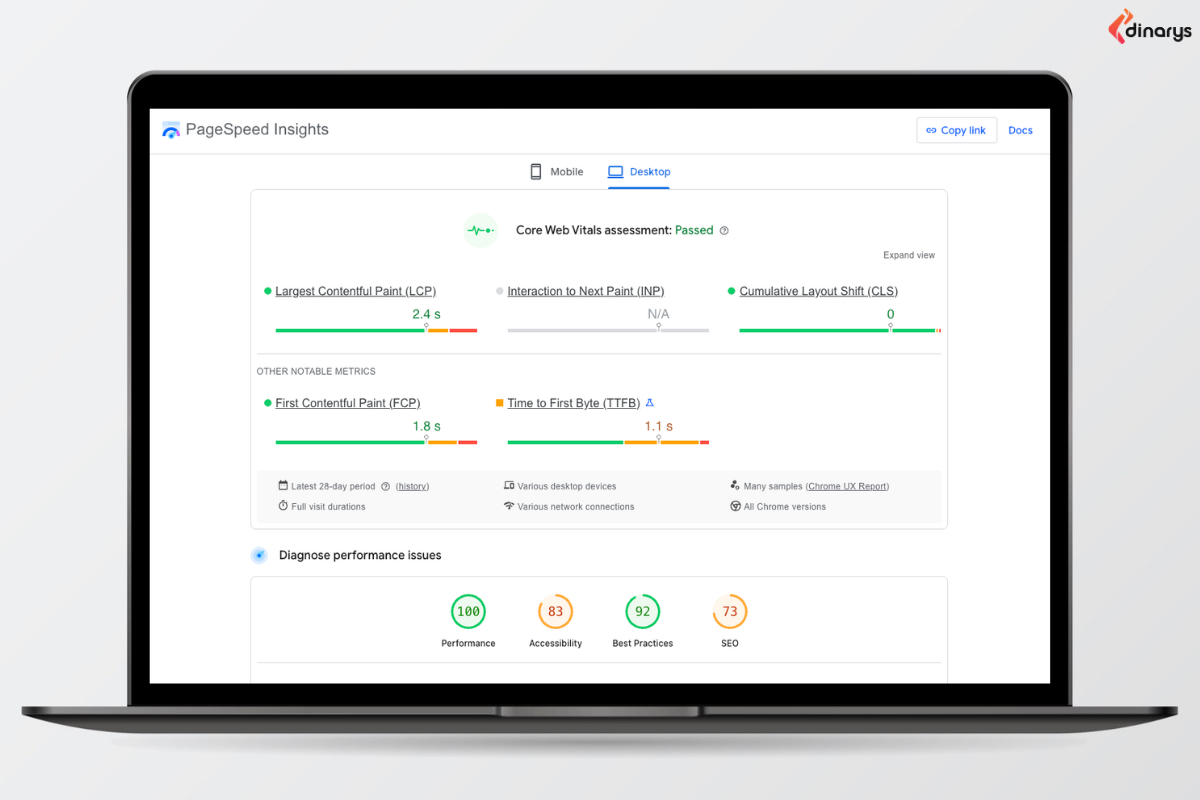
Largest Contentful Paint (LCP) — Loading Speed
LCP measures how long it takes for the largest piece of content on the screen to become visible to the user. In ecommerce, this is almost always the hero product image or a promotional banner.
- The Target: Under 2.5 seconds.
- The Impact: LCP is the "first impression" metric. If a customer arrives from a social media ad and is met with a blank white box where the product should be, they perceive the site as slow or untrustworthy. Studies show that even a one-second delay in LCP can lead to a significant drop in user retention.
Interaction to Next Paint (INP) — Responsiveness
INP is the newest Core Web Vital (having fully replaced First Input Delay (FID) in 2024). It measures the delay of every interaction a user has with your site from clicking "Add to Cart" to expanding a "Product Details" accordion. It tracks the time between the user's action and the moment the browser actually renders the next visual result.
- The Target: Under 200 milliseconds.
- The Impact: This metric defines how "snappy" your store feels. High-performance ecommerce requires near-instant feedback. If a user clicks a button and nothing happens for 400ms, they often click again, which can break checkout flows or lead to multiple items being added to the cart, creating frustration and friction at the most critical stage of the journey.
Cumulative Layout Shift (CLS) — Visual Stability
CLS measures how much the elements on your page move around while the site is still loading. This often happens when images, ads, or fonts load late and push existing content down.
- The Target: A score of less than 0.1.
- The Impact: CLS is a trust-killer. A common "negative case" in ecommerce is a customer going to click a "Search" icon, but a late-loading banner shifts the layout, causing them to click an ad or a different category instead. For a customer, this feels like losing control of the interface, which is a leading cause of mobile session abandonment.
| Metric | What it Measures | Ecommerce Target (Good) | Critical ecommerce Impact |
|---|---|---|---|
| LCP | Loading Speed — time to render the hero image/banner. | ≤ 2.5 seconds | Direct correlation to bounce rates on product pages. |
| INP | Responsiveness — delay for clicks, taps, and interactions. | ≤ 200 milliseconds | Affects the "snappiness" of Add-to-Cart and Menus. |
| CLS | Visual Stability — unexpected movement of page elements. | ≤ 0.1 score | Prevents accidental clicks and layout jumps during load. |
Why Performance is a Business Metric (CX and Google Ratings)
Optimizing for these vitals is a strategic investment in your bottom line.
- The SEO Ranking Filter: By 2026, Core Web Vitals have evolved from being a "tie-breaker" into a primary ranking filter. If two stores provide similar products and content, Google will consistently prioritize the one with superior performance. Poor scores can act as a ceiling, preventing even the best-designed stores from reaching the first page of search results.
- Customer Experience (CX) & Trust: Performance is the silent foundation of user experience. A fast site reduces "cognitive load," allowing the customer to focus on the product rather than the interface. When a site responds instantly, it signals professional credibility and operational excellence.
- Direct Conversion Correlation: Data from 2025-2026 benchmarks indicates that moving from "Needs Improvement" to "Good" across all three vitals can lead to a 15–25% increase in conversion rates. Conversely, sites with poor INP scores see a direct correlation with higher cart abandonment, as users lose patience with unresponsive checkout steps.
The ROI of Speed: Real-World Case Studies
Performance optimization is often viewed as a technical expense until the results are measured against the bottom line. Below are examples of how industry leaders have gained from their ecommerce website optimization and what happened when it was neglected.
The Winners: Positive Impact of Optimization
- Nykaa (Beauty & Fashion): By focusing on their Largest Contentful Paint (LCP), Nykaa achieved a 40% improvement in loading speed. This technical shift resulted in a 28% increase in organic traffic, proving that Google’s preference for fast-loading sites has a direct impact on market reach.
- Vodafone (Telecommunications): Vodafone targeted a 31% improvement in LCP across their digital storefront. This optimization led to an 8% increase in total sales and a 15% lift in their lead-to-visit rate. For a global enterprise, these percentage points represent millions in captured revenue.
- Renault (Automotive): Renault improved their LCP by just one second, which triggered a 14 ppt reduction in bounce rate and a 13% increase in overall conversions. This case highlights that you don't need "instant" speeds to see results: incremental improvements in stability and loading create measurable value.
The cautionary tales: Negative scenarios
- The "silent" revenue leak: A common issue for growing ecommerce brands is "script bloat" (the accumulation of excessive or inefficient JavaScript that overwhelms the user’s browser). As stores add tracking pixels, chatbots, and review widgets, Interaction to Next Paint (INP) scores often drop. Tencent Cloud presented data on how latency impacts business conversion rates, stating that each hundred milliseconds in latency increases the drop in conversion rates. Users interpreted this minor lag as a site error and abandoned their sessions. On the other hand, Deloitte identified that decreasing latency by just 0.1s (100ms) led to an 8.4% increase in conversions for retail sites.
- The SEO downgrade: In 2025-2026, many brands have seen their organic rankings slip after a site redesign that ignored Cumulative Layout Shift (CLS). When Google’s crawlers detect significant layout jumps —often caused by late-loading banners or shifting product grids — the site is flagged for "Poor Page Experience." Najumi reported a 30% loss in visibility after three months of migration due to poor performance optimization.
- Wasted ad spend: If your paid traffic lands on a page with an LCP higher than 4 seconds, your Customer Acquisition Cost (CAC) rises significantly. Recent benchmarks show that sites failing all three Core Web Vitals are 24% more likely to be abandoned by mobile users before the first meaningful interaction occurs.
IS YOUR STORE LOSING 15% OF ITS CONVERSIONS TO HIDDEN SCRIPT BLOAT?
Stop the revenue leak with a comprehensive Core Web Vitals audit and performance roadmap.
Why "Standard" Developers Aren't Enough
A common mistake in ecommerce management is assuming that a "good developer" is naturally a "performance expert." While most developers can build features, performance optimization is a separate discipline that requires a deep understanding of the browser's engine and the physics of data delivery.
Standard development focuses on functional requirements (does the "Add to Cart" button work?). Specialized performance engineering focuses on execution efficiency (how much does that button click tax the browser's main thread?).
Here are the main criteria which differentiate performance optimization specialists from ‘standard’, ‘ordinary’ developers.
1. The mastery of the "critical rendering path"
Generalist developers often rely on "plug-and-play" solutions or platform defaults, which results in "render-blocking" assets. A specialized vendor analyzes the Critical Rendering Path — the exact sequence of steps the browser takes to convert HTML, CSS, and JavaScript into pixels on the screen.
The specialist approach: They don't just compress images but identify the specific code that stops the browser from showing content. By using advanced techniques like Code Splitting and Tree Shaking, they ensure the browser only downloads the code needed for the initial view. This is the only way to consistently hit "Good" scores for LCP.
2. Managing the "Main Thread" for INP
With the shift to Interaction to Next Paint (INP) as a core metric in 2026, the battle for performance has moved to the browser's "Main Thread." Modern ecommerce sites are "heavy" with JavaScript, and standard coding often "locks" this thread, causing the site to ignore user inputs.
The specialist approach: Experts use Web Workers to move heavy background processing off the main thread. They implement Idle Tracking to execute non-essential scripts (like loyalty program pop-ups) only when the browser is "quiet." This ensures that when a user clicks "Checkout," the site responds instantly, rather than waiting for a background marketing script to finish.
3. Script Triage and Third-party governance
One of the hardest tasks in ecommerce is managing "Script Bloat" from marketing tools. A standard developer will usually just follow the installation instructions for a new pixel, leading to a "gradual accumulation" of code that slows the site over time.
The specialist approach: A performance partner acts as a "technical gatekeeper." They use Partytown or Server-Side Tag Management to offload tracking scripts to a background thread or a server. They perform "Script Triage" identifying which tools are actually providing value and which are destroying the site’s stability (CLS).
4. Integration with the 7-stage SDLC
For a generalist, performance is a "one-time fix" done at the end of a project. For a specialized partner, it’s an operational discipline.
- Governance over tactics: In our 7-stage SDLC at Dinarys, performance is integrated into the Planning & Analysis phase. We set "Performance Budgets" (e.g., "The homepage JavaScript cannot exceed 300kb").
- Automated regression: Specialists set up automated tests in the Testing phase. If a new feature causes a 10% drop in speed, the system automatically blocks the deployment, preventing "performance decay" before it reaches your website visitors.
5. Platform-specific deep refactoring
Every ecommerce platform has native bottlenecks that generalists often accept as "just the way it works." For example:
- Magento/Adobe Commerce: Specialists go beyond caching. They perform database query profiling to find slow SQL requests and implement Varnish/Redis configurations that generalists find too complex to manage.
- Shopify Plus: Since you cannot change Shopify’s core code, specialists focus on Liquid code optimization and app-script minification to bypass the platform's native limitations and improve TTFB (Time to First Byte).
How to Evaluate an Ecommerce Performance Optimization Partner
Choosing a vendor for performance optimization requires looking past impressive portfolios and high-level marketing claims. Because Core Web Vitals are rooted in deep technical execution, your evaluation should focus on the vendor’s tooling, their specialist roles, and their long-term governance model.
Use the following criteria to differentiate between a generalist agency and a true performance partner:
#1: Tooling and data methodology
A generalist developer will likely show you a Lighthouse score from a single test. A specialist knows that synthetic tests are only half the story.
The evaluation criteria: Ask if they use Real User Monitoring (RUM) and CrUX (Chrome User Experience Report) data. They should be able to explain how they analyze field data from real customers on actual mobile devices and varying network conditions (3G/4G).
The goal: You want a partner who optimizes for your actual customers, not just for a "perfect score" on a developer's high-speed laptop.
#2: Proficiency in "Interaction to Next Paint" (INP) strategies
Since INP became a Core Web Vital, it has become the most difficult metric to "fake." It requires a deep understanding of JavaScript execution.
The evaluation criteria: Ask the vendor: "How do you handle long-task management on the main thread?" A qualified partner should discuss techniques such as Yielding to the Main Thread, Code Splitting, or using Web Workers.
The red flag: If they only suggest "caching" or "image compression," they lack the JavaScript expertise required to solve modern responsiveness issues.
Use this table to distinguish between a generalist agency that offers "speed fixes" and a specialized performance partner:
| Criteria | Generalist Web Agency | Specialized Performance Partner |
|---|---|---|
| Primary Focus | Visual design and functional features. | Execution efficiency and rendering speed. |
| Testing Logic | Relies on one-time synthetic tests (Lighthouse). | Uses Real User Monitoring (RUM) and CrUX data. |
| Script Handling | Follows third-party installation guides. | Implements Script Triage and Server-Side Tagging. |
| INP Strategy | Usually ignores JavaScript execution delays. | Uses Web Workers and Main-Thread yielding. |
| Maintenance | Reactive (fixes speed only when asked). | Proactive (uses Performance Budgets in SDLC). |
#3: The specialist roster
A performance project isn’t a one-person task. In our day, it’s a cross-functional effort. Look for a vendor that provides a balanced team of specialists:
Performance engineers: Dedicated to the browser's critical rendering path and front-end architecture.
DevOps/SRE (Site Reliability Engineers): Focused on reducing TTFB (Time to First Byte) through server-side optimizations, Content Delivery Networks (CDN) configurations, and database query tuning.
Technical QA: Specialists who ensure that aggressive performance "hacks" (like lazy-loading or script deferral) don’t break essential site features like the checkout flow or search filters.
#4: Third-party governance framework
Most ecommerce stores are slowed down by third-party "script bloat" (marketing pixels, chatbots, heatmaps).
The evaluation criteria: How does the vendor manage these scripts? Do they have experience with Server-Side Tagging or tools like Partytown? A true partner helps you set a "Third-Party Budget," advising you on which scripts are essential and which should be removed to protect your site’s stability and CLS.
#5: Integration with the 7-Stage SDLC
Performance (as well as marketing performance) isn’t a one-time "sprint". Companies nowadays perceive it as a continuous quality metric. A reliable partner integrates speed into their Software Development Lifecycle (SDLC).
The evaluation criteria: Ask how they prevent "performance decay" after the initial optimization project. They should provide a plan for setting Performance Budgets during the Planning stage and automated Performance Regression Testing during the Testing stage.
The result: This ensures that a new marketing campaign or a new site feature doesn't accidentally tank your (search engine optimization) SEO rankings and conversion rates the moment it goes live.
Top 7 Ecommerce Performance Optimization Companies (2026)
Selecting a performance partner requires matching their specific expertise with your platform and business scale. Below are seven companies leading the industry in technical excellence and measurable ROI.
Dinarys
Dinarys specializes in turning technical debt into high-speed revenue engines. Our approach is unique because it integrates performance directly into a strict 7-stage Software Development Lifecycle (SDLC).
Specializing in Magento (Adobe Commerce) and Shopify Plus, we focus on the "Hard Vitals" — specifically INP and TBT (Total Blocking Time). We provide deep technical audits that identify exactly how third-party scripts and database queries are impacting your bottom line, followed by a governance framework to ensure those gains are permanent.
- Headquarters: Berlin, Germany
- Established: 2014
- Best for: SMB, high-growth brands that need an expert partner to handle complex technical refactoring and long-term performance governance.
TRANSFORM TECHNICAL DEBT INTO A HIGH-SPEED REVENUE ENGINE.
Our 7-stage SDLC ensures your Shopify or Magento store hits "Good" vitals and stays there.
Yottaa
Yottaa is a leader in ecommerce acceleration, particularly for enterprise retailers struggling with "third-party bloat." Their platform acts as a sophisticated traffic controller for your site’s JavaScript. By automatically sequencing and "sandboxing" marketing pixels and chatbots, Yottaa ensures that non-essential scripts never block the user’s ability to click or buy.
- Headquarters: Waltham, Massachusetts, USA
- Established: 2009
- Best for: Massive retailers with a heavy reliance on third-party marketing and analytics tools.
Naturaily
Naturaily is at the forefront of the headless commerce and composable movement. They specialize in building custom, high-performance frontends using modern frameworks like Next.js and Vue.js. By decoupling the presentation layer from the backend, they are able to achieve near-perfect scores in LCP and CLS, providing an "instant" feel that is difficult to achieve with traditional monolithic platforms.
- Headquarters: Wroclaw, Poland
- Established: 2011
- Best for: Merchants ready to move to a headless architecture for maximum architectural flexibility and speed.
Vaimo
As a premier global Adobe Solution Partner, Vaimo has deep roots in the Magento/Adobe Commerce ecosystem. They are known for their data-driven approach, utilizing their "Digital Maturity Assessment" to pinpoint where speed bottlenecks are causing the most significant revenue leakage. Their global reach makes them a top choice for international brands managing multiple localized stores.
- Headquarters: Stockholm, Sweden
- Established: 2008
- Best for: Large-scale international enterprises requiring complex global support and deep Magento expertise.
Inchoo
Inchoo has a long-standing reputation for being one of the most technical agencies in the ecommerce space. They specialize in the intersection of technical SEO and performance. Their specialized audits go deep into server-side performance, database optimization, and PHP execution, making them the "go-to" partner for merchants who depend heavily on organic search visibility.
- Headquarters: Osijek, Croatia
- Established: 2008
- Best for: Mid-to-large merchants whose primary growth strategy revolves around organic search and technical SEO.
Trellis
Trellis is a full-service ecommerce agency that prioritizes performance as a key KPI in every project. They are particularly skilled at replatforming and migrations. When moving a brand from a legacy system to a modern platform, Trellis ensures that the migration doesn't result in a "performance dip," protecting the client's existing SEO authority and conversion rates.
- Headquarters: Malden, Massachusetts, USA
- Established: 2012
- Best for: Brands undergoing a platform migration who need to protect their search rankings and site stability.
Section
Section differs from traditional agencies by providing an Edge Extensibility Platform. They allow developers to run performance-enhancing code at the network "edge," closer to the user. This significantly reduces TTFB (Time to First Byte) and improves LCP for brands with a global customer base. It allows for advanced image optimization and custom caching logic without straining the central server.
- Headquarters: Boulder, Colorado, USA
- Established: 2012
- Best for: Brands with a high volume of global traffic needing consistent, millisecond-level responsiveness across continents.
Final Thoughts: The Cost of Waiting
In 2026, the definition of a "successful" ecommerce store has changed. It’s no longer enough to have a beautiful design, you must provide a technical experience that feels invisible and instantaneous.
Core Web Vitals aren’t just a checklist for your developer. They are a direct indicator of your store’s ability to convert traffic into revenue. Whether you choose a global enterprise partner or a specialized boutique agency, the goal remains the same: move beyond the "quick fix" and build a high-performance foundation that can support your growth for years to come.
DON'T LET A SLOW CHECKOUT DEFINE YOUR BRAND'S GROWTH CEILING.
Partner with an expert team that ties technical performance directly to your bottom line.
Start your optimization journey
FAQ
SEO optimization involves using relevant keywords, optimizing meta tags, and creating high-quality content to improve search engine rankings and drive organic traffic to e-commerce sites. Beyond content, technical health is vital; implementing technical SEO best practices, such as ensuring a clean URL structure and mobile-friendliness, is crucial for improving a website's visibility in search engine results. Furthermore, businesses should implement deep schema markup (price, availability, ratings) to secure rich results in search engines. Conducting thorough keyword research is essential for SEO, as it helps identify relevant search terms that potential customers are likely to use when looking for products.
When implemented correctly by a specialized vendor, personalization strategies can significantly enhance user engagement by utilizing data-driven insights to tailor the shopping experience, such as recommending products based on browsing history or past purchases. Personalizing the shopping experience using data-driven insights, such as tailored product recommendations, can significantly improve user engagement and conversion rates. Additionally, dynamic content on e-commerce sites, such as personalized banners or pop-ups that reflect a visitor's location or shopping history, can increase engagement and conversion rates. However, these scripts must be optimized to ensure they don’t negatively impact Core Web Vitals.
A complicated checkout process is a major cause of cart abandonment, with research indicating that simplifying the checkout flow can significantly enhance user experience and reduce friction. Streamlining the checkout process by simplifying form fields and condensing steps can help reduce cart abandonment rates, as a complicated checkout is a major cause of cart abandonment. Implementing personalized product recommendations during this stage can also lead to increased conversion rates, as customers are more likely to purchase items that align with their interests and previous shopping behavior.
Trustworthy agencies use transparent, data-driven reporting that ties directly to business outcomes. A high-performing agency should offer a multidimensional strategy that covers both the backend and the customer journey. When vetting partners, look for results from brands with similar catalog sizes or industry constraints to verify agency effectiveness.
While Core Web Vitals are the technical baseline, Key Performance Indicators (KPIs) should include conversion rates, Return on Ad Spend (ROAS), Customer Acquisition Cost (CAC), and Customer Lifetime Value (LTV). Specifically, Customer Lifetime Value (CLV) estimates the total revenue a business can expect from a customer over the duration of their relationship, calculated by multiplying the average order value by the purchase frequency and the average customer lifespan. An optimized, fast-loading site directly supports these long-term financial goals.
To achieve sustainable growth, brands must move beyond surface-level fixes and focus on deep data analytics. By analyzing customer data and behavioral data, businesses can identify specific customer segments and tailor their marketing strategies to meet varying needs. Monitoring performance metrics and performance data allows agencies to refine optimization strategies that directly influence customer behavior. For instance, understanding how customers typically spend time on a page helps in placing high quality images and accelerated mobile pages (AMP) more effectively to maintain engagement. Furthermore, conversion rate optimization (CRO) is heavily reliant on understanding user behavior through customer feedback. This insight allows for the refinement of pricing strategies and the implementation of a guest checkout option to reduce friction. By continuing to conduct keyword research and leveraging data analytics, brands can see a measurable lift in their average order value (AOV), ensuring that every technical improvement serves a clear business objective.


Let professionals meet your challenge
Our certified specialists will find the most optimal solution for your business.
![Top Magento Website Optimization Tools & Techniques [2023]](https://dinarys.com/storage/images/blogs/pl4RciR4u4V9rqCkm6d1SXyLVW1iXdYQ1L6eLTyP.jpeg)