In 2026, digital commerce has moved beyond the limit of simple storefronts. With marketplaces now accounting for 67% of all online sales and growing at four times the rate of traditional ecommerce, the question for ecommerce businesses is no longer if they should adopt a marketplace model, but how they will architect it to survive.
However, the success of this model is entirely dependent on the vendor’s experience that would assist in building these marketplaces. While a standard ecommerce site focuses on the buyer and their technical foundation may be easier to build and manage, a marketplace is only as strong as the infrastructure it provides to its sellers. Moving to a multi-vendor ecosystem requires a total architectural change. The business stops being a retailer that sells products and becomes a platform that manages a network of independent contributors.
The main challenge for today’s decision-makers lies in finding a development partner capable of building this "invisible" infrastructure. A true marketplace development expert must go beyond the UI to engineer the self-service portals, automated payout systems, and data normalization pipelines that allow vendors to thrive.
This guide explores the structural mechanics of the modern marketplace and the criteria for evaluating online marketplace development companies that understands the technical weight of vendor orchestration.
Standard ecommerce vs. marketplaces: Technical and operational differences that define the nature of development complexity
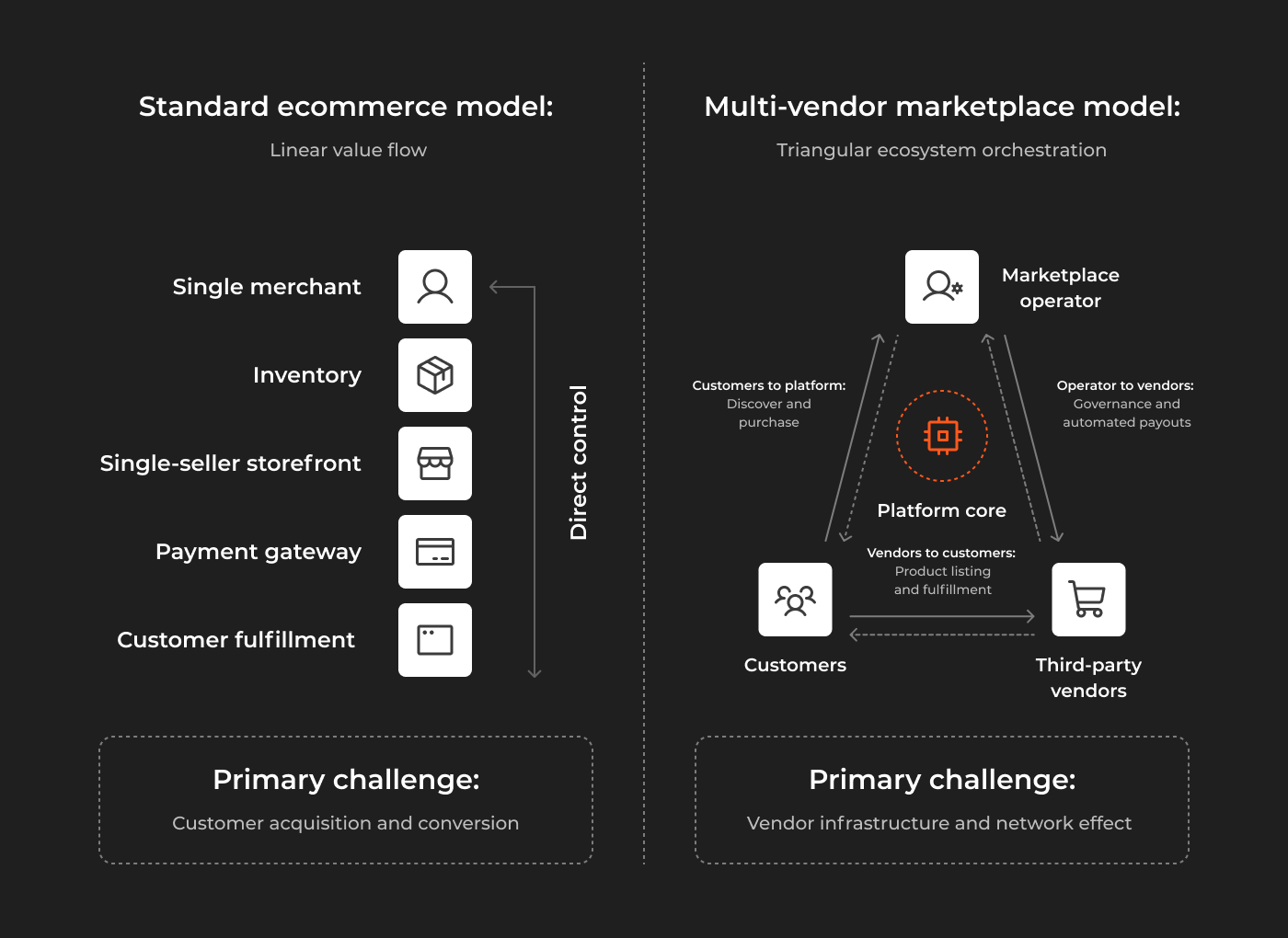
In a standard ecommerce model, the business logic is linear: a single merchant owns the inventory, manages the storefront, and fulfills orders directly to the customer. The primary challenge is customer acquisition and conversion. However, as organizations seek to scale without the overhead of inventory holding costs, the transition to an online marketplace model becomes a strategic necessity.
A marketplace introduces a fundamental change in architecture by moving from a two-party transaction to a triangular relationship. This shift requires a platform that can simultaneously manage three distinct operational layers:
Layers
Role & Primary Responsibility
Key Technical Requirement
The Operator (You, Your Business)
Orchestrator: Defines platform rules, manages global payment flows, and facilitates ecosystem trust.
Provider: Owns inventory and manages fulfillment; responsible for product data accuracy.
Dedicated Vendor Portal & Payout Management System
The Customer
End-User: Interacts with a unified storefront to discover and purchase products from multiple sources.
Seamless Multi-vendor Checkout & Federated Search
To understand how marketplaces differ from traditional online stores, we must look at where the complexity is managed. In a standard store, the complexity lies in logistics. In a marketplace, the complexity lies in orchestration:
Feature
Standard ecommerce
Marketplace
Inventory Ownership
Centralized (Merchant)
Decentralized (Multiple Vendors)
Fulfillment
Merchant-controlled
Vendor-dependent or Hybrid
Financial Flow
Simple (Customer to Merchant)
Complex (Split payments, Escrow, Commissions)
Data Source
Single source of truth
Federated data from multiple vendor feeds
We can also describe and picture the process of the standard ecommerce processes and marketplace in a schematic way:
Thus, the success of a marketplace has less to do with the size of its catalog and more to do with how well it supports the people selling on it. In a standard ecommerce build, the developer optimizes for a single user journey. In a marketplace, that focus has to expand: the engineering work becomes about giving third-party vendors a reliable, automated environment where they can actually operate without friction.
Because if a vendor runs into walls (unclear API documentation, inconsistent data handling, or payouts that require manual intervention), they'll simply move to a platform that doesn't make their life harder.
The shift from a traditional retail model to a marketplace is a fundamental change in a technical setup. This section outlines the transition from a merchant-owned inventory model to a platform-based orchestration engine, emphasizing the senior-level engineering required to manage this complexity.
Business logic of marketplaces and architectural requirements
The architecture of a marketplace must be specifically engineered to support the technical workflows of its sellers. A high-quality build is not measured by the storefront alone, but by the efficiency of the vendor’s operational environment, from API-driven B2B procurement and ERP integrations to the automated data normalization required for large-scale B2C retail.
To say precisely, the underlying architecture must be specifically engineered to support the transaction logic of the target audience. For example:
These marketplace platforms facilitate high-volume wholesale transactions between companies. The technical priority is supporting professional procurement behaviors. This includes building robust "Request for Quote" (RFQ) workflows, tiered bulk pricing, and integration with enterprise ERP or CRM systems to manage corporate credit limits and purchase orders.
Focused on connecting retail brands with a broad consumer audience, the primary challenge here is Data Normalization. The platform must be capable of aggregating thousands of diverse vendor feeds and ensuring that product attributes remain consistent, searchable, and optimized for high-conversion SEO.
Driven by peer-to-peer trade, these marketplaces rely heavily on Trust Engineering. The architecture must prioritize identity verification, user rating systems, and secure escrow services, holding payments until the buyer confirms the receipt and condition of the goods to prevent fraud.
Direct-to-Consumer (D2C)
Example of D2C marketplaces:Nike (member shop), Casper
This model allows brands to sell directly to their end customers while hosting complementary third-party vendors to round out the ecosystem. The technical priority is unified brand experience and data ownership.
Model
Technical focus
Engineering requirements
B2B
Complex procurement logic
Senior engineers must build deep ERP integrations and support tiered pricing or corporate credit workflows.
B2C
High-velocity data ingestion
Developers must create automated pipelines to normalize diverse vendor product feeds into a unified catalog.
C2C
Trust engineering
The architecture must prioritize automated identity verification and secure escrow payment logic for peer-to-peer safety.
D2C
Unified brand experience
ExperienceSenior engineers must build sophisticated middleware to sync external vendor inventory with the core storefront and automate split-payment logic for multi-vendor checkouts.
Dinarys recently executed a technical integration for a D2C brand looking to scale through affiliate networks and external marketplaces. The challenge was a fragmented system that relied on manual data handling, which is a common bottleneck for growing platforms.
Our engineers built a flexible integration layer that automated inventory and pricing synchronization across all sales channels. By shifting from manual processes to an automated "system of record," the client maintained data accuracy and stable order flows without increasing operational overhead.
Development strategy outline #1: Expansion to a marketplace for established retailers
For established brands, moving to a marketplace model is a natural evolution of what they've already built. Unlike a startup entering from scratch, an established retailer has to layer multi-vendor capabilities onto a live environment, without disrupting day-to-day operations or the brand trust they've spent years earning. Done right, this shift transforms the business from a seller into a platform host, and that opens up three meaningful advantages:
#1: Scaling without the risk
Established retailers can expand into new categories without the financial exposure of buying or storing new inventory. A multi-vendor architecture lets the business test real demand for new product lines before committing to them.
On the technical side, this requires building robust vendor onboarding pipelines, typically involving automated product feed ingestion (via REST or GraphQL APIs), real-time inventory sync, and flexible data normalization layers that can handle inconsistent third-party catalog structures. Engineers should have hands-on experience with ETL pipeline design, message queue systems like Kafka or RabbitMQ, and schema mapping strategies that keep owned and third-party stock cleanly separated at the data layer.
#2: A stronger brand presence
Curating a network of quality vendors turns a retailer into a go-to destination for their industry — not just a store. That reputation compounds: as more specialized vendors join the platform, the customer experience deepens, and the competitive gap widens against traditional single-inventory rivals who simply can't offer the same breadth.
Technically, maintaining brand consistency across a multi-vendor catalog demands rigorous content governance:
automated quality checks on product data
image standards enforcement
review workflows that prevent low-quality listings from surfacing
Vendors and the engineering teams supporting them should be comfortable working with PIM systems, content validation APIs, and configurable approval logic that scales without manual intervention.
#3: Insight from the inside
Running a marketplace puts the retailer at the center of a rich stream of market data. By observing how third-party vendors interact with their existing audience, the operator gains a clear view of pricing dynamics and unmet demand without the cost of formal R&D.
However, making this work requires more than standard analytics: the engineering team needs to build event-driven data architectures that capture granular interaction data: vendor-level conversion rates, cross-catalog search behavior, and margin performance by fulfillment type. Expertise in data warehousing solutions like BigQuery or Snowflake, stream processing tools like Apache Flink, and BI integration layers is essential for turning raw marketplace traffic into decisions.
Development strategy outline #2: Engineering a marketplace as the core business start
Launching a marketplace as your primary business requires a "platform-first" engineering mindset. Unlike an expansion, where you might "bolt on" a multi-vendor plugin to an existing store, a from-scratch build must be architected for federated management. Challenges of the "from-scratch" approach:
The "Cold Start" problem: You must simultaneously convince vendors to list products on an empty platform and convince customers to shop from unknown vendors.
Architectural flexibility: Because a startup marketplace often needs to pivot its business model (e.g., moving from a commission model to a subscription model), the code must be modular. A composable/headless architecture allows you to swap out payment or search engines as the business evolves.
Trust engineering: For a new business, the marketplace is the brand. Developing proprietary trust mechanisms, such as automated vendor vetting, AI-driven fraud detection, and robust dispute resolution workflows—is as critical as the checkout button itself.
Implementation strategy: The architect’s choice
Before selecting a stack, it’s critical to engage a team that understands the distinct technical requirements of each platform type. A high-quality marketplace developer doesn't just specialize in one tool. They possess the architectural expertise to work through different ecosystems, whether it’s a high-orchestration enterprise engine or a modular headless build.
Senior engineers must be able to evaluate the specific trade-offs of each approach, ensuring that the chosen technology aligns with the vendor's operational needs and the company's long-term scaling goals.
Platform-based (SaaS/PaaS)
Utilizing a specialized marketplace engine allows the business to outsource the "heavy lifting" of multi-vendor logic. These platforms come pre-configured with the complex database schemas required for vendor-product-customer relationships.
Strategic advantage: Significantly faster time-to-market and lower initial R&D costs. Security updates, PCI compliance for payment integration, and core functionality are managed by the provider.
The trade-off: Customization is often limited to the front-end or specific API hooks. If your business model requires a proprietary transaction logic that deviates from standard industry patterns, a pure SaaS platform can become a constraint.
Custom software development and composable architecture
For businesses where the marketplace is the core product, a headless or composable approach is often the strategic preference. This involves building a proprietary core or using specialized APIs to "compose" the platform.
Strategic advantage: Total ownership of the intellectual property and the user engagement and experience. This architecture allows you to swap out specific components, such as a search engine or a payment processor, without rebuilding the entire system. It’s designed for high-scale, unique business rules, and deep integration with proprietary internal systems.
The trade-off: Requires a high-caliber engineering team and a larger upfront investment. The burden of maintenance, security, and infrastructure scaling rests entirely on the operator.
The hybrid approach
Many enterprise-level marketplaces now opt for a hybrid model: using a robust marketplace engine (like Mirakl) to handle the back-end orchestration while building a completely custom, headless front-end to maintain a unique brand identity and superior performance. This provides the reliability of a proven platform with the flexibility of a custom build.
ALIGN YOUR TECHNOLOGY WITH YOUR BUSINESS MODEL
Every marketplace model has unique architectural hurdles. Whether you are building for B2B wholesale or a D2C ecosystem, our engineers can help you define the right technical requirements.
Why senior engineering from top marketplace development companies is non-negotiable
Custom marketplace platforms aren't merely a high-traffic website; it is a distributed system managing thousands of concurrent data streams. When the architecture fails, it doesn't just result in a broken page—it results in financial discrepancies, lost inventory data, and a collapse of trust between vendors and customers.
Hiring junior or generalist developers for a marketplace project often leads to technical debt overstretch, where the system's complexity eventually outpaces the team's ability to maintain it. Senior engineering is required to manage three critical technical domains:
1. High-concurrency database management
In a standard store, inventory is updated by one entity. In a marketplace, hundreds of vendors may be updating prices, stock levels, and product descriptions simultaneously via APIs or manual uploads. A senior architect must design the system to handle these write-heavy workloads without locking the database or creating race conditions where a product is sold twice.
2. Financial orchestration and clearing
The most sensitive part of marketplace engineering is the movement of money. A senior developer must build logic that can:
Calculate and withhold dynamic commissions.
Handle split payments, where a single customer transaction is instantly divided among multiple vendors.
Manage automated Know Your Business (KYB) and Know Your Customer (KYC) flows to comply with anti-money laundering regulations.
Implement robust logging for every cent to ensure the platform remains auditable.
3. API-first architecture and scalability
Marketplaces live and die by their ability to integrate. Senior engineers prioritize an API-first approach, ensuring the platform can act as a hub for external logistics providers, tax engines (like Avalara), and vendor ERPs. They build for horizontal scalability, ensuring that if your vendor count grows from 10 to 1,000, the infrastructure scales automatically rather than requiring a complete rewrite of the core codebase.
4. Data normalization and federated search
When vendors provide data in different formats (CSV, XML, JSON), a senior engineer must build an automated normalization pipeline. This ensures that despite the diversity of sources, the customer sees a unified, high-performance storefront with accurate filtering and search results. Junior teams often attempt to solve this with manual entry or rigid schemas that break as soon as a new vendor joins.
In short, senior engineers don’t just write code; they design the economic infrastructure of your business. Their involvement is the difference between a platform that scales and one that requires a total re-platforming within the first year of operation.
BUILD FOR SCALE, NOT JUST LAUNCH
Don’t let technical debt stall your growth. Partner with a senior engineering team that prioritizes the technical vendor experience and long-term system stability. Reach out to Dinarys today to ensure your marketplace is built on a modular, future-proof core.
The categorized marketplace tech stack you and your potential technical vendor must be familiar with
Selecting digital commerce platforms depends on the architectural weight required for your specific model and the level of technical ownership you wish to maintain. In 2026, the market is segmented into four primary tiers, each serving a distinct strategic purpose:
1. Enterprise ecosystem orchestrators (The "Gold Standard")
These platforms are designed for large-scale retailers and global conglomerates who need to transform existing ecommerce infrastructure into a multi-vendor engine.
Mirakl
Mirakl is the dominant force in enterprise marketplaces. It’s a SaaS-based engine that sits on top of your existing tech stack (SAP, Salesforce, Magento) to handle vendor onboarding, catalog management, and payout automation at a massive scale.
Examples of marketplaces built with Mirakl: Macy’s, Decathlon.
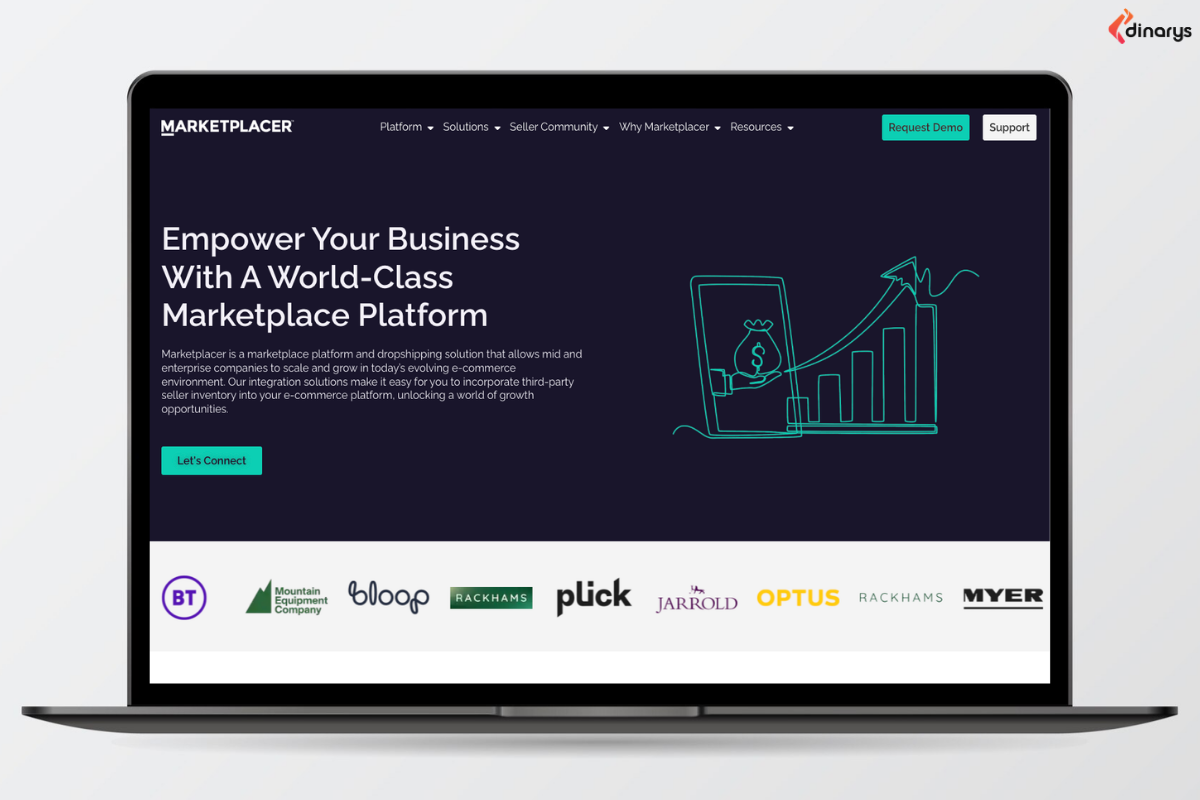
Marketplacer
Marketplacer is a global competitor focused on high-performance scalability. It’s particularly strong for businesses that need to integrate complex global supply chains and multi-currency payout systems with minimal friction.
Examples of marketplaces built with Marketplacer: Nikon, Nyer.
2. Ecosystem plugins (The "Fast-Track" Entry)
Ideal for businesses already established on a primary ecommerce platform that want to experiment with a marketplace model without a total replatforming.
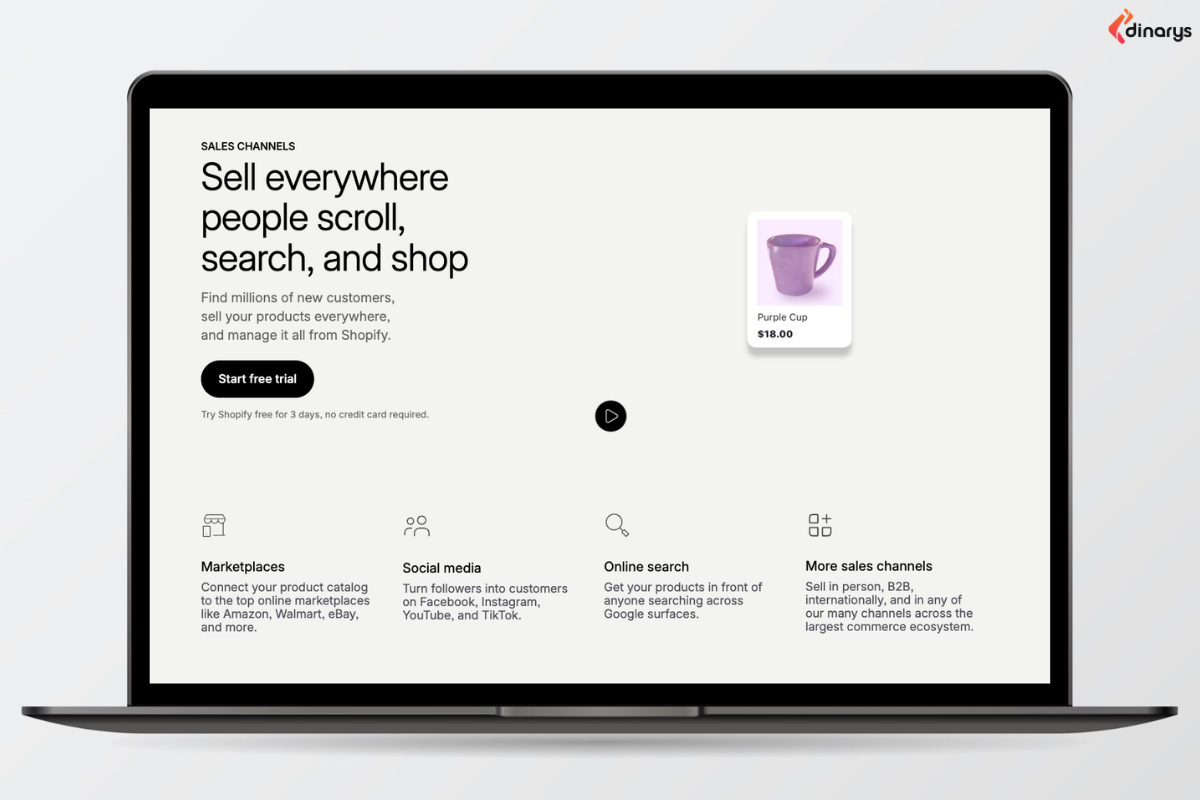
Shopify (Marketplace Kit)
For the Shopify ecosystem, Shopify Marketplace Kit provides a set of APIs and tools to turn a standard store into a multi-vendor platform. It’s best suited for "curated" marketplaces where the brand maintains tight control over the vendor list.
Examples of marketplaces built with Shopify: Ahalife, Verishop.
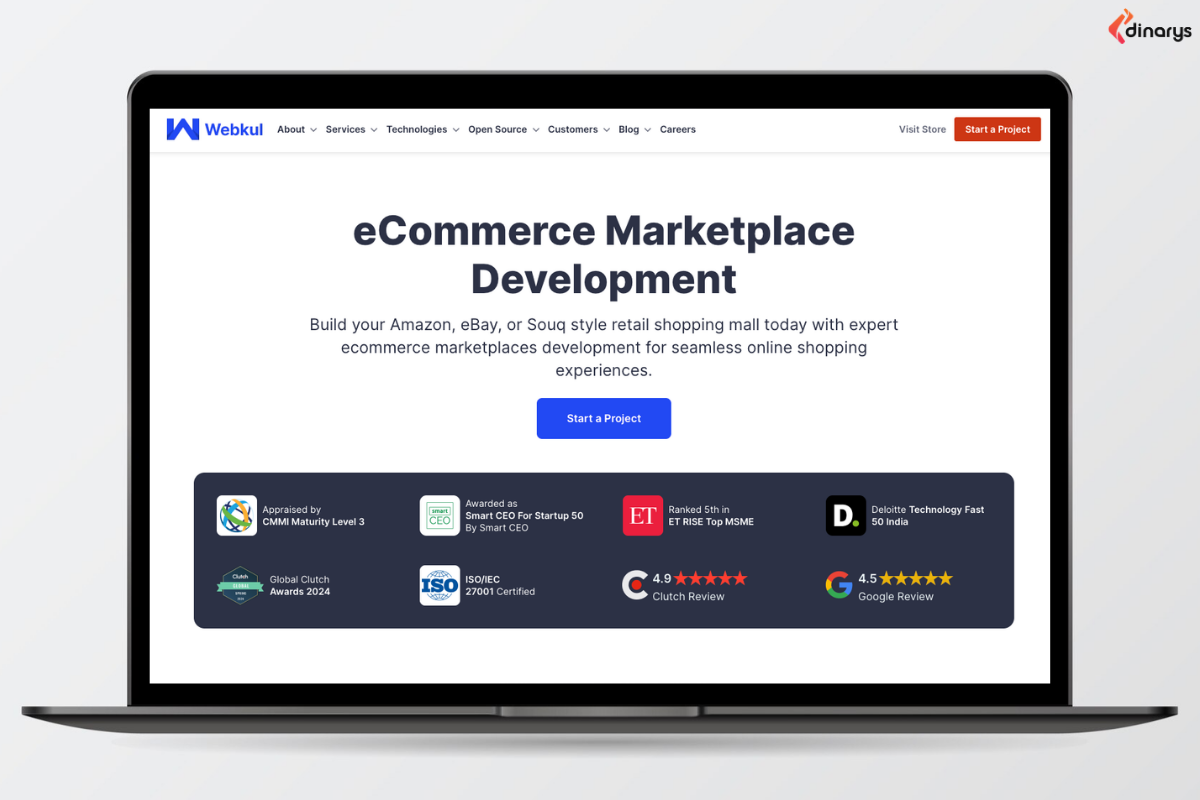
Webkul
Webkul is a modular extension provider that works across Magento, Shopware, and Shopify. Webkul is the go-to for small-to-mid-market businesses that need a comprehensive suite of marketplace features (like vendor dashboards and split payments) integrated directly into their existing admin panel.
Examples of marketplaces built with Webkul: UNICEF marketplace, The Food Market.
For companies that require total control over their source code, database architecture, and security protocols, self-hosted solutions offer the most flexibility.
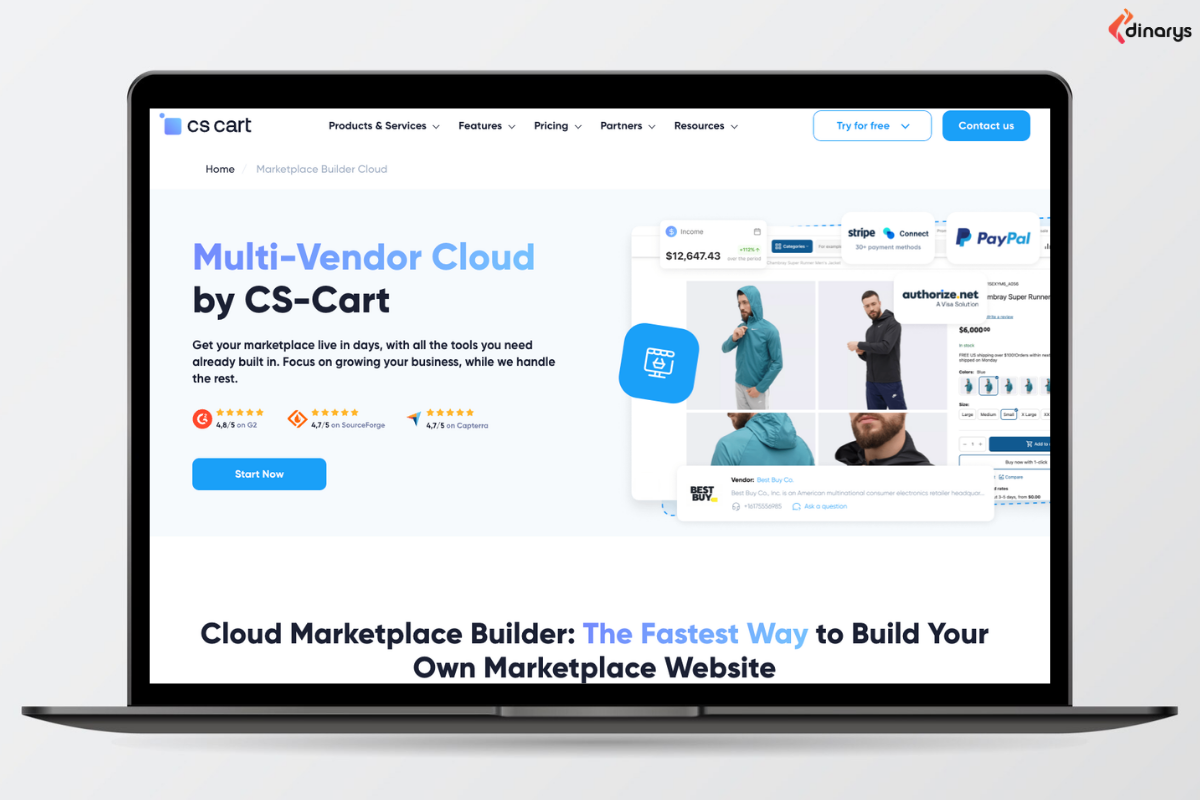
CS-Cart Multi-Vendor
CS-Cart is a PHP-based powerhouse specifically engineered for marketplaces. Unlike standard ecommerce software with a plugin, CS-Cart was built from the ground up for multi-vendor logic. It’s highly customizable and popular for niche C2C or B2B platforms where proprietary features are a competitive advantage.
Examples of marketplaces built with CS-Cart: ShopClues, Yumbles.
This is not a single platform but a "best-of-breed" approach. By using an API-first architecture, developers can pick individual services for custom marketplace development.
Frontend: Next.js for high-performance, SEO-optimized storefronts.
Payments: Stripe Connect or Adyen for automated split payments and vendor verification.
Search: Algolia or Elasticsearch for handling multi-vendor product filtering.
Backend: A custom-built core or a headless commerce engine (like Commerce Layer) to orchestrate the transaction logic.
Examples of custom marketplace solutions: StockX.
The following table categorizes the leading platforms by their "architectural weight" and strategic use case:
Category
Platform
Strategic Use Case
Best For
Enterprise Gold Standard
Mirakl / Marketplacer
Global retailers looking to scale without inventory risk.
Multi-region, high-volume ecosystems
The Ecosystem Play
Shopify (Marketplace Kit)
Brands already on Shopify looking to add 3rd party vendors.
Curated B2C marketplaces with a focus on UX and rapid setup
The Modular Entry
Webkul
Mid-market businesses on Magento/Shopware needing a rapid feature set.
Existing ecommerce stores expanding into multi-vendor logic
Self-Hosted Specialist
CS-Cart Multi-Vendor
Businesses requiring full code ownership and high customization.
Niche C2C/B2B platforms with proprietary transaction rules
Composable/ Headless
Custom + Best-of-breed APIs
Tech-first companies building a unique, proprietary transaction engine.
Startups or innovators where the tech is the competitive advantage
How to evaluate marketplace developers (the 8-point audit)
Selecting the right marketplace development company is a high-stakes decision. Unlike a standard ecommerce store, a marketplace is a living ecosystem that requires a deep understanding of multi-party transaction logic and financial compliance. To ensure your partner can build for long-term scale, use this 8-point technical and operational audit to analyze marketplace app development companies.
#1: Proven multi-vendor architecture experience
A development team may have built dozens of standard stores, but marketplaces require a different approach.
How to check:
Request case studies that specifically feature three-way ecosystems (Admin-Vendor-Customer).
Look for evidence of how they handled vendor onboarding workflows and complex multi-seller catalogs.
Best marketplace software development companies should be able to explain how they manage "federated data", where information comes from hundreds of external sources but appears unified to the buyer.
#2: Payment orchestration and split-payout expertise
The movement of money is the most complex part of a marketplace.
How to check:
Verify their experience with specialized gateways like Stripe Connect, Adyen, or Mangopay.
Ask how they handle "ledger-based" accounting to ensure the platform remains auditable.
They must demonstrate how they handle automated commission withholding, split payments at checkout (where one payment is divided among multiple sellers instantly), and secure vendor payouts.
#3: Mastery of data normalization and federated search
When hundreds of vendors upload product data in different formats (CSV, XML, JSON), the storefront can quickly become chaotic.
How to check: Ask how they automate data ingestion.
A senior partner should explain their process for normalizing diverse vendor feeds so that the customer experiences a unified, advanced search and filtering system. They should have a strategy for product matching, preventing the same item from appearing as five different listings because five vendors uploaded it differently.
#4: Headless and composable commerce capability
Using a rigid, all-in-one software system has become a major business risk. These monoliths are difficult to change and slow to scale, making it hard for companies to keep up with faster competitors.
How to check: Check for proficiency in MACH architecture (Microservices, API-first, Cloud-native, and Headless). Dedicated teams should be able to explain how they can swap out a search engine (like Algolia) or a shipping carrier without rebuilding the entire platform core.
This modular mindset is essential for pivoting your business model without starting from zero.
#5:. Security, compliance, and regulatory knowledge
Marketplaces are subject to intense scrutiny regarding data privacy and financial regulations.
How to check: Ensure they are fluent in PSD2 (Europe), GDPR, and regional tax nexus complexities. Ask about their protocols for data isolation, ensuring Vendor A cannot see the proprietary customer data or sales figures of Vendor B. They should also be able to explain how they handle KYC and KYB verification for sellers.
#6: Scalability and high-load benchmarking
Your platform must survive its own success.
How to check:
Review their strategy for horizontal scaling. Can they prove their architecture handles high-concurrency scenarios, such as 10,000+ vendors updating inventory simultaneously during a peak sale period?
Ask for load test results or a description of their caching strategy (e.g., using Redis or Varnish) to keep the storefront responsive under pressure.
#7: Discovery and business logic maturity
The best developers are technical consultants, not just "order takers."
How to check: Does the team spend significant time in a Discovery Phase?
A mature partner will challenge your business logic (questioning your dispute resolution flow or commission structure) to ensure the technical build aligns with your commercial goals. They should help you define the "minimum viable ecosystem" before writing the first line of code.
#8: Post-launch DevOps and SLA support
A marketplace launch is only the beginning of its evolution.
How to check: Evaluate their Service Level Agreements (SLAs). Do they offer dedicated DevOps support for incident response?
A marketplace requires constant performance tuning and security patches. Ensure they have a clear process for Continuous Integration/Continuous Deployment (CI/CD), allowing them to push updates without taking the marketplace offline.
Best marketplace development companies (2026)
This selection highlights high-authority global firms that prioritize architectural integrity, scalability, and technical transparency. They are reliable marketplace development companies in 2026 with extensive experience in web development, mobile app development, custom development, UX/UI design, MVP development, as well as post-launch support and ongoing support.
Dinarys
A specialist in high-performance migrations and technical orchestration, Dinarys excels in transforming complex legacy systems into scalable, multi-vendor ecosystems. Our expertise lies in the "heavy lifting" of platform engineering, specifically with Magento and Shopware. We are a reliable partner for businesses that require deeply customized backend logic, seamless ERP integrations, and high-concurrency database management for large-scale B2B and B2C marketplaces.
Headquarters: Berlin, Germany
Operating since: 2014
MODERNIZE YOUR COMMERCE ARCHITECTURE
Transitioning to a marketplace model requires a partner who understands the technical weight of multi-vendor orchestration. If you are ready to evaluate your current infrastructure for a platform pivot —
A powerhouse in Composable Commerce, Netguru is known for its "Product Design Process" and rapid MVP scaling. They specialize in online marketplace development from scratch using a modern, API-first stack (Ruby on Rails, Node.js, and React). With a high NPS of 73, they are a strategic choice for enterprises like OLX Group that need to modernize user journeys and implement complex payout workflows across global markets.
Headquarters: Poznan, Poland
Operating since: 2008
Vincit
Ideal for regulated industries and mission-critical systems, Vincit is recognized for its "Pixel-Perfect" technical execution and high-stability architectures. They focus on user experience and security, making them a top choice for marketplaces in the healthcare, finance, and PropTech sectors where data isolation and regulatory compliance (like PSD2) are non-negotiable.
Headquarters: Tampere, Finland
Operating since: 2007
FATbit Technologies
The creators of the Yo!Kart engine, FATbit offers a unique, balanced approach between ready-made speed and custom flexibility. Their solutions are particularly effective for startups and mid-market companies that need a cost-effective, feature-rich B2B or B2C foundation that can be heavily customized by a skilled internal or outsourced team.
Headquarters: Punjab, India
Operating since: 2004
Saritasa
Saritasa focuses on systemic problem-solving and complex business logic. They are experts in B2B industrial marketplaces, providing deep integration with IoT and custom operational software. Their approach is highly analytical, moving beyond simple retail storefronts to build intelligent platforms that automate reporting and supply chain transparency.
Headquarters: California, USA
Operating since: 2005
10Clouds
A leader in Agentic Commerce and AI-driven marketplaces, 10Clouds specializes in integrating Generative AI for dynamic pricing, fraud detection, and conversational discovery. They are the ideal partner for tech-first companies looking to leverage Large Language Models (LLMs) and automated agents to gain a competitive edge in 2026’s generative search environment.
Headquarters: Warsaw, Poland
Operating since: 2009
Imaginary Cloud
Consistently ranked as one of the fastest-growing tech firms in Europe, Imaginary Cloud is defined by its commitment to "Clean Code" and low defect density. Their developers focus on building technical debt-free solutions, making them a premium partner for businesses that prioritize long-term maintainability and a 30% faster time-to-market than industry averages.
Headquarters: Lisbon
Operating since: 2010
Wrapping up: Going beyond the storefront
In 2026, the success of a marketplace is defined by the integrity of its ecosystem. As commerce goes toward an "agentic" era, the quality of your underlying data and the reliability of your vendor network become your most valuable assets.
Building a marketplace is a fundamental commitment to becoming an infrastructure provider rather than a simple retailer. Whether you are expanding an established brand or launching a platform-first startup, the goal is to move past the initial "cold start" and create a self-sustaining network effect. With a modular, senior-engineered architecture and a transparent evaluation framework, you ensure that your platform is capable of adapting to future shifts in global logistics, decentralized finance, and automated discovery.
Ultimately, the marketplace model offers the most resilient path to scale in a volatile digital economy. It allows businesses to diversify risk, monetize data-driven insights, and capture market share without the traditional constraints of physical inventory. The companies that will lead the next decade are those that stop viewing the marketplace as a technical project and start treating it as a strategic engine for growth.
FAQ
Choosing a development partner involves not just coding capability but also understanding the marketplace dynamics, including managing multiple vendor types and complex payment systems. Prioritize development teams with proven experience in multi-vendor platforms and strong UX/UI design skills for complex user journeys when choosing a partner for a marketplace app.
A reliable marketplace development company should demonstrate a proven marketplace portfolio, clear understanding of your business model, strong backend and cloud architecture skills, mobile capability, AI familiarity, transparent pricing, mature QA and DevOps processes, and a post-launch support model.
When evaluating potential vendors, ask about their project management processes, technical and architectural fit, security and compliance measures, testing and QA processes, intellectual property ownership, and SLAs for post-launch support.
Red flags to watch out for when choosing a marketplace development company include a lack of marketplace case studies, unclear architecture, no QA or automated testing, no DevOps or cloud experience, and a focus on templates rather than understanding your specific model.
Companies developing marketplace apps should adopt Agile methodologies for regular updates and project alignment with stakeholders. Furthermore, successful marketplace development is associated with choosing agencies that have clear service level agreements for ongoing support and maintenance post-launch.
You may share this article
Let professionals meet your challenge
Our certified specialists will find the most optimal solution for your business.