The answer lies in complexity. Magento and Adobe Commerce are usually not the first ecommerce platforms a business considers, because they are built to handle a level of complexity that isn’t always needed from the start. They offer deep customization, flexible data models, and the ability to connect with multiple internal and external systems.
While simpler platforms that dominate the headlines — like Shopify or BigCommerce — are great for standard retail, they often ‘hit a ceiling’ when faced with sophisticated business logic. For example:
Managing unique contract pricing, tiered approval workflows, or custom "request a quote" systems that standard checkouts cannot support
Syncing real-time data with legacy ERPs (like SAP or Oracle) that requires custom business rules basic APIs cannot process
Handling millions of potential SKU combinations or product dependencies that break a standard grid
Maintaining total control over data storage and encryption protocols in highly regulated industries
At the same time, Magento remains the industry standard for enterprises that need to manage:
Massive, multi-store architectures
Handling dozens of localized storefronts from a single backend
Complex B2B workflows
Custom pricing
Tiered permissions
Intricate quote-to-cash cycles
Deep system integration
Seamlessly syncing with legacy ERPs, CRMs, and custom middleware that SaaS APIs can't always touch
That’s why the Magento platform and Adobe Commerce are often used when a business is building a more complex solution from the start, or when predefined systems stop fitting.
However, because these platforms are so flexible, they are equally sensitive. Ordinary Magento developers might get a site live, but an Adobe Commerce Specialist ensures the site is performant, secure, and scalable. Without that technical expertise, the very flexibility that makes Magento great can quickly turn your backlog into a never-ending cycle of fixes and the whole backend — into technical debt.
In this article, we’ll cover everything from what the platforms provide to their history, and to the list of the best Magento development companies.
Adobe Commerce and Magento relations in ecommerce
Magento has been around for a long time, and for good reason. It’s still the top choice for businesses that deal with massive catalogs, unique workflows, or complex systems, which "standard" platforms just can't handle. Also, because it started as an open-source tool, its real value is total control, as Magento gives you full ownership of your data, infrastructure, and how your Magento store actually functions.
In 2018, Magento was acquired by Adobe. This acquisition didn’t replace Magento overnight, but it changed the way the platform would develop over time. Magento became the foundation of what is now known as Adobe Commerce, a broader commerce solution positioned within Adobe’s ecosystem of digital experience tools.
Today, Magento and Adobe Commerce are closely related but not identical:
Feature
Magento Open Source
Adobe Commerce (Cloud)
Best for
Tech-heavy teams who want total control
Enterprises needing scale and native Adobe tools
Cost
Free software (license-wise)
Paid, tier-based licensing
Infrastructure
You manage your own hosting and security
Fully managed cloud environment included
Capabilities
Core commerce features + full code access
Adds B2B modules, visual Page Builder, and AI tools
Integrations
Manual setup for third-party tools
Native sync with Adobe Analytics, Target, and AEM
Maintenance
Your team handles all patches and scaling
Built-in deployment, security, and performance tools
The difference lies in scale, tooling, and ecosystem integration rather than in core commerce logic.
This shared foundation is why vendors often refer to “Magento/Adobe Commerce” together. They aren’t separate platforms in the traditional sense, but different editions built on the same technology stack. Choosing between them depends on business size, operational complexity, and how tightly commerce needs to be integrated into a broader digital experience strategy.
Understanding this relationship is important when evaluating development partners. Experience with Magento Open Source doesn’t automatically mean experience with Adobe Commerce Cloud, and vice versa. While the technologies are related, delivery complexity, infrastructure requirements, and long-term ownership responsibilities differ significantly between the two.
UNDERSTAND IF MAGENTO IS THE RIGHT FIT FOR YOUR BUSINESS
Dinarys can help assess your requirements, complexity, and long-term needs before committing to Magento or Adobe Commerce.
Why Magento and Adobe Commerce development requires experienced Magento development companies
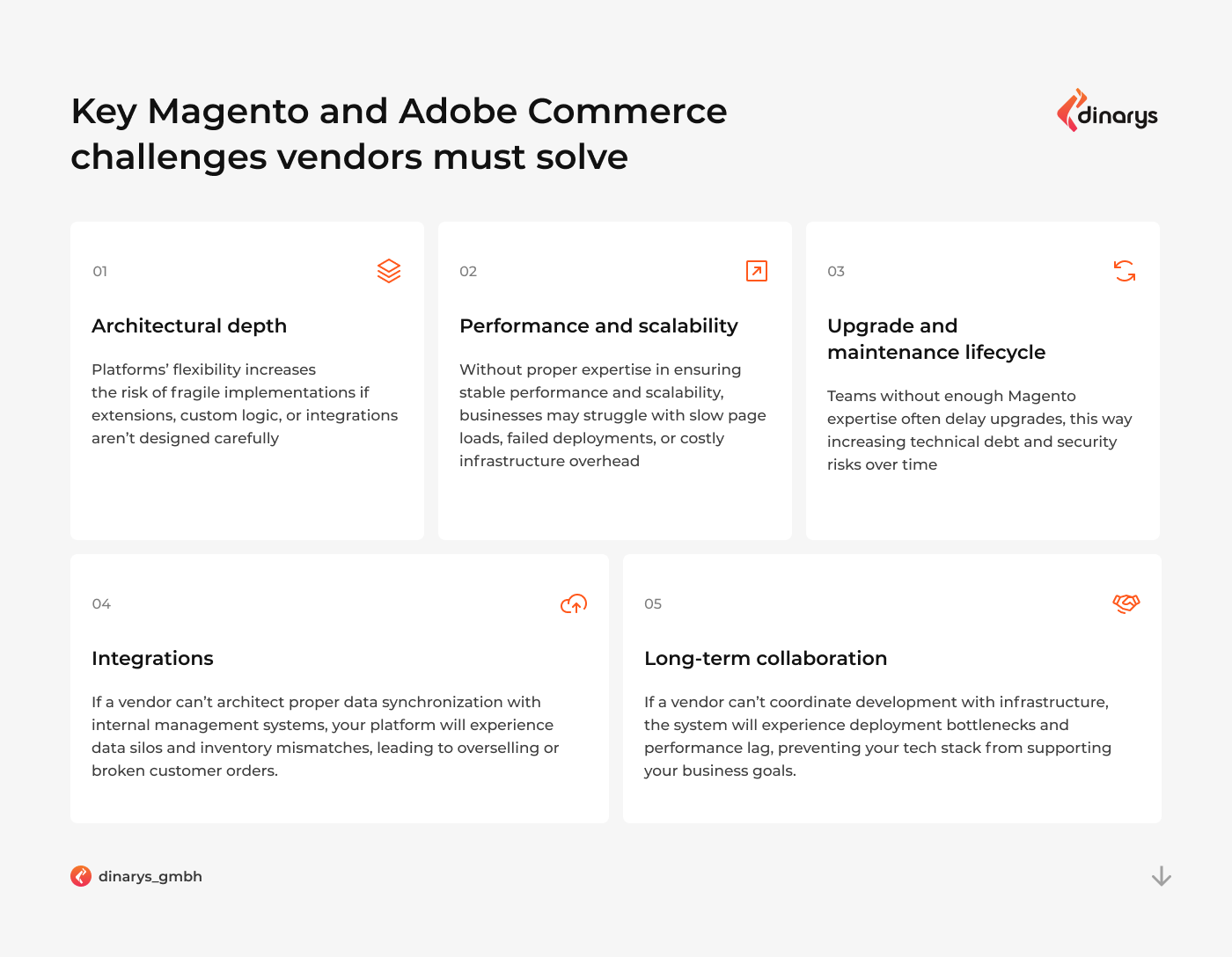
Magento and Adobe Commerce are rarely used as out-of-the-box solutions and almost always require deep customization, integration, and long-term technical ownership. That’s why your potential partner have to deal with the following challenges associated with these platforms:
Challenge #1: Architectural depth
Magento is highly modular and extensible, which allows businesses to configure the platform around their operations. At the same time, this flexibility increases the risk of fragile implementations if extensions, custom logic, or integrations aren’t designed carefully. Poor architectural decisions tend to surface later in the form of performance issues, upgrade problems, or unstable integrations.
Challenge #2: Performance and scalability
Adobe Commerce is often chosen for high-traffic stores, large catalogs, and complex pricing or promotional logic. Achieving stable performance in these scenarios requires an understanding of caching layers, indexing, database optimization, and infrastructure setup. Without this expertise, businesses may struggle with slow page loads, failed deployments, or costly infrastructure overhead.
Challenge #3: Upgrade and maintenance lifecycle
Magento releases frequent updates, security patches, and version changes that can affect custom code and third-party extensions. Teams without enough Magento expertise often delay upgrades. This, in turn, increases technical debt and security risks over time. In Adobe Commerce Cloud environments, this complexity extends to CI/CD pipelines, cloud tooling, and deployment workflows.
Challenge #4: Integrations
Magento and Adobe Commerce are commonly connected to enterprise resource planning (ERP), custom relationship management (CRM), product information management (PIM), payment, and fulfillment systems. These integrations are rarely simple plug-ins. They involve data modeling, synchronization logic, error handling, and monitoring. Inexperienced teams may implement quick fixes that work initially but fail under real operational load.
Challenge #5: Long-term collaboration
Development, infrastructure, marketing, and operations are all affected by platform decisions. Certified Magento developers understand how to coordinate these moving parts, manage risk during changes, and maintain stability while the business continues to operate.
Mistakes aren’t always visible at launch, but they become costly to fix later. This is why businesses using these platforms often prioritize vendors with proven, hands-on experience rather than teams that are learning the technology during delivery.
How to understand whether specific Magento web development companies are suitable for partnership
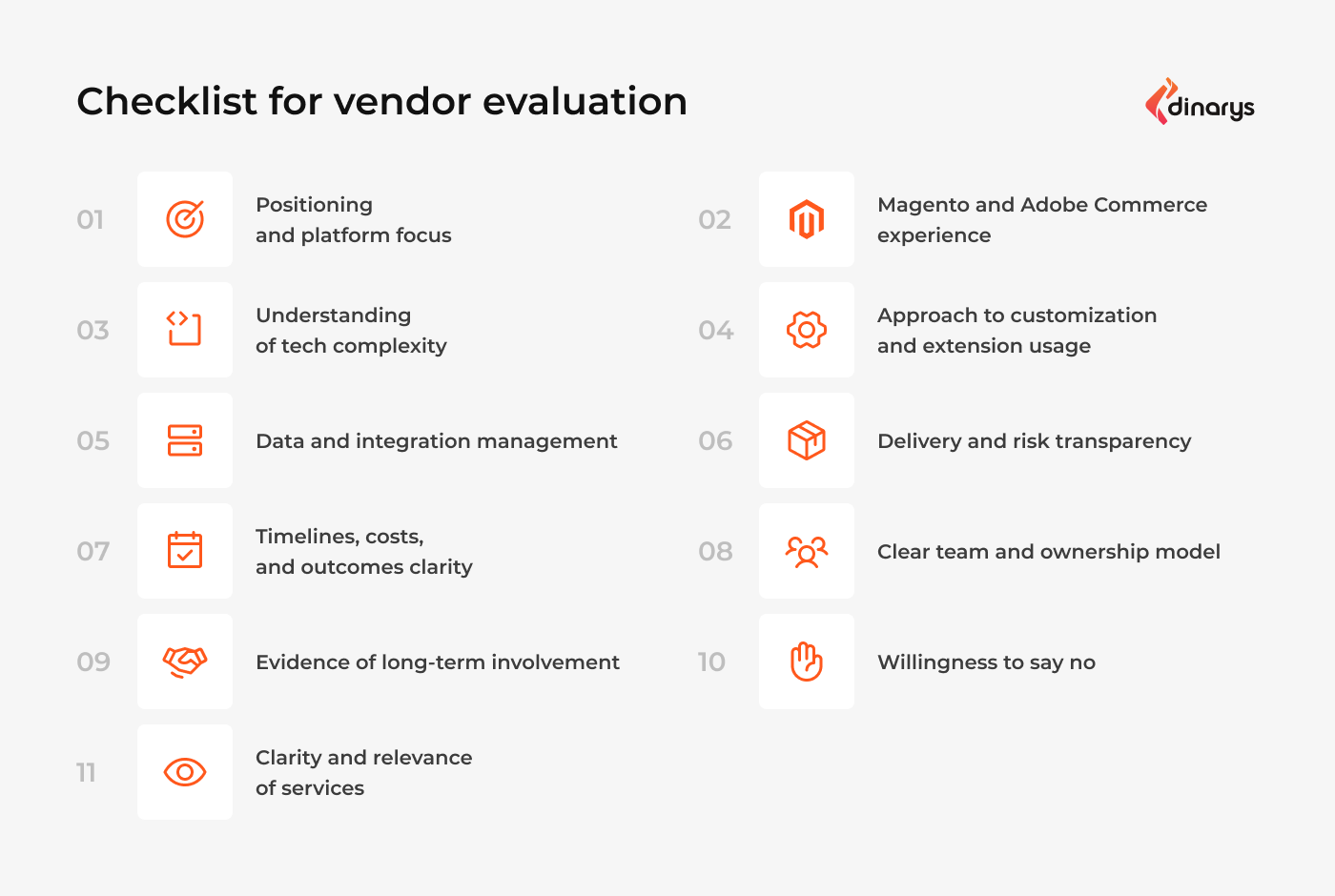
Magento and Adobe Commerce projects tend to expose vendor maturity very early. The platform’s flexibility, architectural depth, and operational impact make it difficult to “fake” experience once conversations move beyond surface-level capabilities. The criteria below are meant to help businesses evaluate vendors before committing time, budget, or internal resources:
#1: Clarity of positioning and platform focus
Leading Magento development companies are open about how Magento and Adobe Commerce fit into their overall service offering. They clearly articulate the types of businesses they usually work with, the industries they know best, and the operating models they support. This includes being transparent about scenarios where Magento or Adobe Commerce may not be the right choice.
Vendors with real experience tend to describe the platform in the context of business complexity (catalog size, integration needs, customization level, and organizational structure), not just as a universal solution. If Magento appears as just one item in a long list of platforms, it may indicate limited depth or opportunistic positioning.
#2: Depth of hands-on Magento and Adobe Commerce experience
Depth of experience shows up in how vendors talk about problems, not in how confidently they talk about Magento ecommerce solutions. Teams with real Magento experience can explain:
what tends to go wrong
where complexity hides
which decisions have long-term consequences
Vendors can discuss real project dimensions: large or highly structured catalogs, complex pricing logic, customer-specific rules, or multi-store setups. They also tend to reference past challenges they faced during projects and what they chose not to do and why.
Deep experience sounds measured, sometimes cautious, and grounded in specific examples of architectural or operational challenges.
#3: Understanding of architectural and infrastructure complexity
Magento and Adobe Commerce performance is tightly connected to architecture and infrastructure. A capable vendor understands that commerce logic, hosting, caching, indexing, and deployment pipelines aren’t separate concerns.
At the evaluation stage, a suitable partner should be able to explain:
how architecture decisions affect scalability and upgrade paths
how infrastructure choices influence performance and cost
how cloud environments differ from self-managed setups
Vendors who oversimplify these topics or ‘pass’ all responsibility to hosting providers often lack ownership of the full system. Experienced teams understand that long-term stability depends on making infrastructure decisions deliberately.
#4: Approach to customization and extension usage
Magento’s strength lies in its extensibility, but that same extensibility can easily become a liability. Mature vendors approach customization with restraint: they evaluate whether existing extensions genuinely fit the business case, whether custom development is justified, and how changes will behave during upgrades.
At the research stage, it’s important to assess whether a vendor understands:
how extensions interact with core Magento functionality
how custom logic affects maintainability and performance
how to keep implementations upgrade-safe
Vendors who often go for heavy customization without discussing long-term implications often transfer risk to the client.
#5: Ability to manage integrations and data flows
Most Magento and Adobe Commerce implementations sit at the center of a broader system landscape. ERP, CRM, PIM, payment, logistics, and analytics systems all exchange data with the commerce platform.
An experienced vendor can explain how they design and manage these integrations:
how data consistency is maintained
how failures are detected and handled
how performance is protected under load
They treat integrations as first-class components of the system. This perspective becomes especially important when replatforming or scaling operations.
#6: Transparency of delivery processes and risk management
At the pre-evaluation stage, you are not looking for a detailed project plan, but you should hear a coherent story about how the vendor delivers work. This includes how they plan phases, manage dependencies, and respond to change.
Mature vendors openly discuss where Magento projects typically carry risk: migrations, integrations, performance tuning, or upgrade paths. They explain how they mitigate those risks and what assumptions their approach depends on.
A lack of transparency here often indicates limited experience with complex delivery or a preference to defer difficult conversations until later.
#7: Clarity about timelines, costs, and outcomes
Magento and Adobe Commerce projects are long-term commitments. Vendors with experience tend to frame timelines and budgets as ranges rather than guarantees. They explain which factors influence cost and where you can face uncertainty.
Overly confident estimates at the research stage often indicate pressure to close the deal instead of an accurate understanding of scope. Realistic vendors help set expectations early, even if that makes the initial conversation harder.
#8: Visibility into the team and ownership model
Magento projects depend heavily on the people involved. A suitable vendor is transparent about team structure, roles, and decision-making authority. You should understand who leads architecture decisions, who handles integrations, and how escalation works.
Vague descriptions of “access to experts” or interchangeable teams often hide resourcing risks. Experienced partners explain how they maintain continuity and how teams exchange knowledge over time.
#9: Evidence of long-term involvement beyond launch
Adobe Commerce platforms require ongoing attention. Security patches, platform upgrades, performance tuning, and business-driven changes are strict and continuous; you can’t just stay on the same version of the platform all the time because it feels more comfortable for you.
Vendors with long-term experience emphasize post-launch responsibilities. They talk about upgrade strategies, monitoring, and optimization rather than treating launch as the end point.
#10: Willingness to say no and challenge assumptions
One of the strongest indicators of vendor maturity is their readiness to challenge assumptions. This may include questioning whether Magento is the right platform, pushing back on scope, or recommending alternative approaches.
Vendors who never say no often prioritize short-term agreement over long-term outcomes. Those who ask difficult questions early tend to protect both delivery quality and business stability.
Taken together, these criteria help distinguish vendors who understand Magento and Adobe Commerce as complex, evolving business systems from those who treat them as interchangeable development tools.
#11: Clarity and relevance of services offered
The list of services a vendor offers can tell a lot about how they approach Magento and Adobe Commerce projects. It’s not just about how many services are listed, it’s more about how well they reflect real platform needs.
A suitable vendor typically covers areas that are directly connected to long-term platform health. This includes:
migration from other platforms or Magento versions
platform modernization
performance optimization
technical audits
integration support
ongoing maintenance
These services indicate that the team is used to working with systems that evolve over time.
It’s also important to look at how these services are described. Clear, specific explanations usually reflect real delivery experience. Broad or generic descriptions may show that the services are offered in theory.
IDENTIFY RISKS IN YOUR CURRENT OR PLANNED MAGENTO SETUP
Dinarys helps uncover architectural issues, performance risks, and integration challenges before they impact your operations.
Top Adobe Commerce and Magento 2 development companies
The Magento development services companies listed below have experience working with Magento Open Source and Adobe Commerce across projects of varying scale and complexity. Their work typically involves more than storefront development and often includes platform customization, integrations, performance optimization, migrations, and long-term platform support.
This list is not a ranking and should not be treated as a universal recommendation. Each of these Magento website development companies operates with different delivery models, platform focus, and levels of specialization. Some are more experienced with enterprise Adobe Commerce Cloud environments, while others focus on Magento Open Source implementations with deep customization requirements.
The purpose of this section is to provide a structured starting point for evaluation. Each company should be assessed against your specific business context, technical complexity, and long-term ownership expectations, using the criteria outlined earlier in the article.
Rave Digital
Rave Digital is an ecommerce development company focused on Adobe Commerce and Magento-based, tailored solutions for businesses with complex operational and integration requirements.
Company overview
Headquarters: USA
Operation period: Since 2008
Top clients: Yamaha, Nestle, Dior, UFC, Paramount+, Library of America, FujiFilm, Ammunition Depot
Services provided: Adobe Commerce and Magento development, Magento B2B development, Magento enterprise development, platform replatforming and Magento migration, Magento extension development, system integrations, Magento maintenance
Dinarys is an ecommerce software development company that works with B2B and B2C businesses across different markets, helping them build, migrate, and scale Magento and Adobe Commerce platforms that support real operational needs.
Company overview
Headquarters: Tallinn, Estonia
Operation period: Since 2009
Top clients: Toyota, Accenture, BORN, Panodyssey, Vaimo, Prostor, SanMar Canada
IT Delight specializes in Magento and Adobe Commerce development, supporting businesses that require deep customization and long-term platform stability.
Company overview
Headquarters: Ukraine
Operation period: Since 2012
Top clients: Hypernode, Johannes King, Amasty, Gorilla, Walker Slater, Sportano
Polcode is a software development company with a dedicated Magento and Adobe Commerce practice, supporting businesses with custom ecommerce solutions and platform migrations.
Company overview
Headquarters: Poland
Operation period: Since 2006
Top clients: Puccini, Boom, Easton, Peter Christian, Benx, Bestshop24
Innowise supports mid-market and enterprise businesses with Magento and Adobe Commerce development, focusing on complex migrations, integrations, and scalable commerce architectures.
Company overview
Headquarters: Global
Operation period: 15+ years
Top clients: Hays, Spar, BS2, Digital Science, Commercial Bank, Topcon, NTT Data, Familux Resorts
Services provided: Custom software development and design, mobile app development, software integration and migration, mobile store audit and enhancement, AI implementation, software testing
Adobe / Magento partner? Not publicly disclosed
Scandiweb
Scandiweb is an Adobe Commerce–focused agency working with enterprise and fast-growing brands on complex Magento implementations and long-term platform optimization.
Company overview
Headquarters: Latvia
Operation period: Since 2003
Top clients: Puma, Michigan, The New York Times, Boy Scouts of America, Adobe, Samsung, Lafayette 148, Rockar
Services they provide: Adobe Commerce and Magento development, support and maintenance, design, migration, speed and performance optimization, integrations, SEO, Magento consulting, hosting
Wrapping up on top Magento web development companies
Magento and Adobe Commerce remain relevant not because they are simple, but because they can support businesses that have outgrown simpler platforms. Their flexibility, however, shifts responsibility onto the teams and partners who work with them. Decisions around architecture, customization, and integrations affect outcomes long after the initial build is complete.
Choosing a development partner in this context is more about judgment. The right partner understands where complexity adds value and where it creates unnecessary risk. They treat the platform as part of a broader operating system for the business, not as a standalone storefront.
For companies considering Magento or Adobe Commerce, the quality of collaboration often matters as much as the choice of platform itself. A partner that can challenge assumptions, explain trade-offs, and take ownership beyond launch helps turn platform flexibility into a long-term advantage rather than an ongoing burden.
APPROACH MAGENTO AS A LONG-TERM SYSTEM, NOT A ONE-TIME PROJECT
Dinarys helps teams implement Magento and Adobe Commerce with clear structure, realistic expectations, and ongoing support.
Magento development services include platform migration, custom development, and performance optimization. Magento development companies offer services such as custom module development and e-commerce platform integrations.
1. Performance optimization is a key service provided by Magento development agencies to enhance the functionality of e-commerce stores. Custom development is essential for creating tailored e-commerce solutions that meet specific business needs.
2. E-commerce platform integrations are a common service offered by Magento development companies to enhance functionality and user experience. Magento development services include UX/UI design to improve the overall user experience of e-commerce platforms.
3. Magento development companies excel in intuitive UX/UI design, business tool integration, platform migration, and customization.
Experience with Magento and Adobe Commerce is crucial when choosing a development company. Companies that can't show past successful Magento projects should be avoided during vendor selection.
A reputable Magento development company should feature detailed case studies that outline problem-solving methods and measurable results. These materials help assess how the vendor handles complexity, integrations, and long-term platform ownership.
Magento is one of the most powerful and widely used e-commerce platforms around the globe. Magento offers unmatched scalability and customization for e-commerce businesses.
Magento is built for B2B success with features like custom catalogs, company accounts, and seamless ERP integrations. B2B stores require functionalities like custom pricing tiers and bulk ordering, which Magento supports natively or through structured customization.
The total cost of ownership in Magento projects should not be based solely on lowest pricing but also on quality and hidden fees. Development approach, architecture decisions, long-term maintenance, and upgrade paths all influence the real cost over time.
Choosing experienced Magento development partners often reduces future expenses by avoiding fragile implementations and costly rework, especially for complex or high-traffic stores.
You may share this article
Let professionals meet your challenge
Our certified specialists will find the most optimal solution for your business.