An ecommerce platform is rarely questioned when it supports everyday work without friction. Orders flow, teams move at a reasonable pace, and changes feel manageable. But when the workflow breaks down, the platform becomes noticeable:
Routine updates take longer than expected
Performance issues keep returning
Integrations feel fragile or risky to change
You face constraints when planning custom features or entry into new markets
These issues don’t appear all at once. They build gradually and are often explained away as being temporary or being acceptable trade-offs. But over time, they begin to influence how teams work and how the business can move forward.
At some point, these issues begin directly affecting your business operations:
Marketing slows down
Operational effort increases
Customer experience becomes inconsistent
Browsing and checkout friction grows
As a result, conversion and retention decline; growth plans become more cautious. Not because demand is missing, but because the platform no longer supports change reliably.
This is usually where replatforming enters the conversation.
Replatforming can help remove long-standing constraints and restore flexibility, but it’s not a simple reset. When approached without enough technical expertise or preparation, replatforming can introduce new problems and make operations even harder to manage.
This article takes a practical look at ecommerce replatforming. We explain:
When replatforming makes sense
Why it requires experienced specialists
How to evaluate potential partners
Which replatforming agencies are worth considering
What is replatforming in ecommerce?
Replatforming in the ecommerce industry means replacing the core commerce platform that a business relies on to run its online operations. Replatforming is not a visual redesign or a feature upgrade. At its core, replatforming is changing the system that handles products, orders, pricing, integrations, and the flow of data across the business.
Most businesses don’t approach replatforming as a goal in itself. Companies undertake replatforming when their current ecommerce platform can no longer support their operational and growth plans.
What ecommerce replatforming services involve
A replatforming project affects much more than the storefront customers see. It typically includes changes to:
the ecommerce platform that powers the ecommerce website
how data is stored, migrated, and synchronized
integrations with ERP, CRM, and PIM systems, payment providers, and fulfillment tools
internal workflows used by marketing, operations, and support teams
technical processes around deployment, updates, and maintenance
Because of this scope, B2C, D2C, and B2B ecommerce replatforming touch both technology and operations. Decisions made during the replatforming process often define how flexible or constrained the business will be for years.
Replatforming vs. optimization and redesign
Replatforming is often confused with other types of ecommerce work. The difference matters because each option carries a different level of risk and impact:
Aspect
Optimization
Redesign
Replatforming
Primary goal
Improve and fine-tune the existing setup
Update the look, feel, and user experience
Replace the core ecommerce platform
Scope of change
Limited, incremental improvements
Visual and experience-focused changes
Structural and system-level changes
Typical activities
Performance tuning, UX improvements, small feature enhancements
New design, branding updates, layout changes
Platform migration, data transfer, integration rebuilds
Impact on core system
Core platform remains unchanged
Core platform remains unchanged
Core platform is replaced
Operational impact
Low
Low to moderate
High
Reversibility
Easy to adjust or roll back
Relatively easy to modify
Difficult to undo once completed
Why replatforming is considered a high-impact decision
Unlike many ecommerce initiatives, replatforming has long-term consequences that extend beyond launch. Choosing the right ecommerce platform (or the wrong platform) influences:
how easily new features can be introduced
how stable integrations remain over time
how much manual work internal teams need to do
how predictable development and maintenance costs are
Well-planned replatforming can remove long-standing friction and open room for business growth. Poorly planned replatforming may solve short-term problems while creating new constraints that are harder to notice early on.
Replatforming as a business decision
Although replatforming is often initiated because of technical issues, its success depends on business alignment. The decision should be driven by how the company sells, operates, and plans to grow, not only by platform capabilities or trends.
When approached thoughtfully, replatforming becomes a way to realign technology with business reality and achieve substantial technical and business results. For example:
Libasachieved strong direct-to-consumer growth, reaching significant revenue scale with over 80% year-over-year growth and a notable increase in average order value after replatforming from Adobe Commerce to Shopify Plus, which supported faster execution and scalable online operations.
Good Ranchers achieved year-over-year revenue growth of nearly 50%, improved checkout conversion, and raised subscription adoption after replatforming from BigCommerce to Shopify, helping to stabilize recurring purchases and improve the buying flow.
V’s Barbershopimproved site performance, engagement, and the online booking experience after replatforming to Shopify, enabling smoother customer interactions and more consistent digital touchpoints across locations.
Pullup & Dip achieved a more than threefold increase in their conversion rate, reduced their bounce rate by roughly half, and increased online sales by nearly 50% after replatforming from Shopware to Shopify Plus, driven by better usability and an improved checkout experience.
Ventum Racing increased session duration and sessions per user after replatforming to BigCommerce, using a more flexible ecommerce setup to better support product storytelling and customer engagement.
Theo Chocolate improved their ecommerce store performance and operational efficiency after replatforming to BigCommerce, enabling better scalability during peak demand and smoother content and catalog management.
Designerie achieved revenue growth of over 30% and a significant increase in B2B online orders after replatforming from Shopify to BigCommerce, allowing the business to better support wholesale and retail customers within one platform.
Bernstein Badshop improved site stability, usability, and the overall shopping experience after replatforming to Shopware, which supported a more reliable storefront for a complex product catalog.
M-Medientechnik achieved a fourfold increase in conversion rate, increased order volume by around 50%, and reduced the bounce rate after replatforming to Shopware 6, benefiting from improved performance and a modernized storefront.
Cargo Crew achieved over 30% growth in online revenue, improved their conversion rate, and increased items per order after replatforming from Adobe Commerce to commercetools, enabling more flexible multi-site and B2B/B2C support.
Eurail improved platform scalability and transaction reliability after replatforming from Drupal to commercetools, supporting high traffic volumes and a smoother booking experience for international customers.
CHRONEXTachieved significantly faster site performance, improved mobile commerce, and a measurable conversion rate increase after replatforming from Salesforce Commerce Cloud to commercetools, enabling faster localization and more efficient internal operations.
When ecommerce businesses need replatforming and ecommerce replatforming consultancy
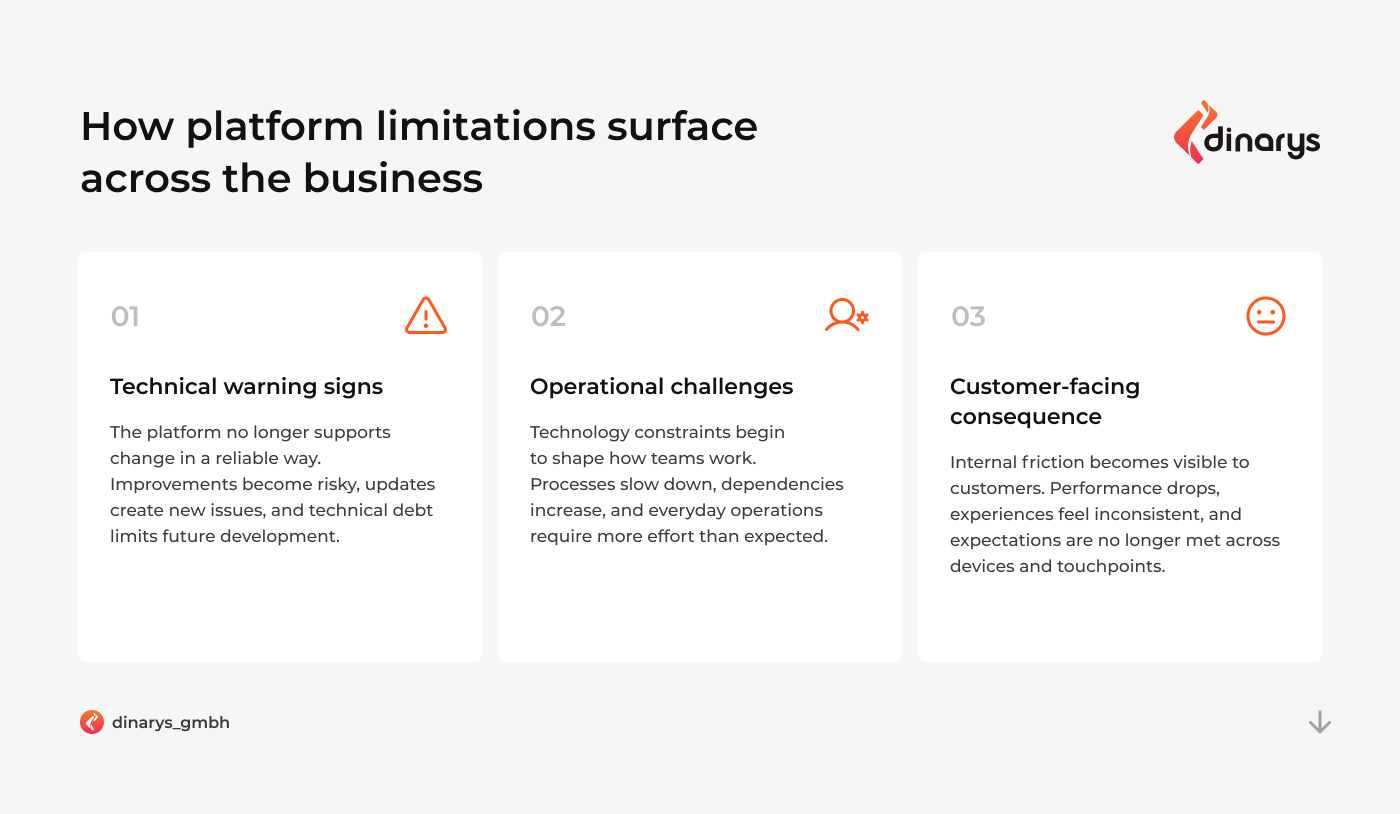
Most ecommerce businesses don’t decide to replatform or switch ecommerce platforms because their current system suddenly stops working. More often, the platform continues to function but with increasing effort, cost, and compromise. Over time, limitations accumulate and begin to affect how the business operates, how customers experience the store, and how confidently the company can plan ahead.
Replatforming usually becomes necessary when these issues stop being isolated inconveniences and start shaping daily decisions:
Technical warning signs that are hard to ignore
From a technical perspective, replatforming is often considered when the existing platform no longer supports change in a reliable way. Common warning signs include:
third-party integrations breaking or behaving unpredictably with every update
outdated architecture limiting modern development approaches
growing technical debt making even small changes risky
increasing reliance on workarounds instead of stable solutions
At this stage, teams spend more time maintaining the platform than improving it. Development slows down, releases are stressful, and long-term planning becomes difficult.
Operational challenges inside the business
Technical constraints rarely stay confined to the development team. Over time, they begin to affect how the entire organization works.
Typical operational challenges include:
marketing teams depending on developers for routine updates
delayed campaigns because changes take longer than expected
manual processes being introduced to compensate for system gaps
rising maintenance costs that are hard to justify
difficulty supporting new regions, currencies, or business models
Instead of technology supporting the business, the business adapts itself to technological limitations. This often leads to frustration across teams and slower decision-making.
Customer-facing consequences
Internal friction almost always surfaces on the customer side. This is evidenced by negative customer feedback and a lower customer satisfaction rate among consumers who want to enjoy a user-friendly interface and a seamless customer experience. When the platform struggles, customers notice, even if they don’t know the cause.
Common customer-facing issues include:
slow page loads and inconsistent performance
unreliable checkout or payment flows
limited functionality on certain devices or browsers
an outdated or inflexible user experience
lack of personalization or relevant recommendations
These issues increase friction throughout the buying journey and reduce trust, especially for returning customers who expect stability and improvement over time.
How customer issues affect business outcomes
Customer-facing problems don’t stay isolated at the experience level. They directly affect key areas of business performance:
Area of impact
What happens
How it affects the business
Financial impact
Lost conversions, lower average order value, fewer repeat purchases
Revenue declines over time, while acquisition costs increase to compensate for weaker conversion and retention
Trust erodes, negative reviews, and negative word-of-mouth affect brand perception and slow growth
Strategic impact
Platform limits experimentation and expansion
New initiatives are postponed, markets are avoided, and growth opportunities are missed due to platform constraints
When replatforming becomes the rational next step
Replatforming becomes a rational decision when the cost of staying on the current platform exceeds the cost and risk of change. This moment is rarely obvious at first, but it becomes clear when:
teams avoid making changes because they are too complex or threaten to break the platform
the customer experience stops improving despite the project team’s ongoing effort to technically support all essential ecommerce operations
growth plans depend on assumptions the platform cannot support
At this point, replatforming is no longer about technology preference. It’s about restoring flexibility, reducing friction, and creating a foundation that allows the online business to move forward with confidence.
Why ecommerce replatforming solutions and projects require experienced specialists
Replatforming is often underestimated because, on the surface, it looks like replacing one technology with another. Products are migrated, features are rebuilt, integrations are reconnected, and the store goes live again. In reality, the ecommerce replatforming process is closer to restructuring a business system than rebuilding a website, which is why it’s difficult for inexperienced vendors to ensure a smooth transition.
The biggest risk is that replatforming may appear successful at launch while creating new problems that surface months later.
Hidden issues that are easy to overlook
Many of the most damaging replatforming issues are not visible during development (or even at go-live). They emerge later, when the platform is handling live traffic, processing real orders, and supporting day-to-day business operations.
Common hidden issues include:
incomplete or inconsistent data migration
loss of historical SEO value due to poorly handled URLs, metadata, or redirects
broken or unreliable analytics that distort performance measurement
integrations that work in isolation but fail under load or edge cases
assumptions about business processes that no longer hold after migration
Inexperienced teams often focus on feature parity and visual completeness. Experienced teams pay closer attention to what must continue working without interruption, even when the platform underneath changes.
Platform-specific complexity is not interchangeable
Every ecommerce platform comes with its own logic, constraints, and long-term implications. Features that seem similar on the surface often behave very differently as part of a larger system.
some platforms prioritize speed of launch, others long-term flexibility
customization may be easy in one area and costly in another
extension and app ecosystems vary significantly in quality and stability
performance, scalability, and maintenance effort differ by architecture
Without this understanding, teams may recreate old problems on a new platform or introduce limitations that only become clear when the business grows.
Platform selection is a strategic decision, not a technical one
Choosing a new platform is often framed as a technical comparison. In practice, it is a business decision with long-term consequences.
An experienced specialist evaluates platform fit based on:
how the business sells today and plans to sell in the future
internal team capabilities and dependencies
integration needs across operations, finance, and logistics
tolerance for customization, maintenance, and ongoing development costs
Selecting a new ecommerce platform that solves current pains but limits future options is a common and costly mistake. Avoiding it requires experience with both successful and unsuccessful replatforming initiatives.
Why experience changes the outcome
Experienced replatforming partners approach ecommerce replatforming projects with the assumption that requirements, deadlines, tools, or implementation approaches will change mid-process, that legacy data will be messy, and that edge cases matter.
This does not eliminate risk, but it changes how risk is handled. Instead of reacting to problems after launch, experienced specialists anticipate them and reduce their impact early.
UNDERSTAND WHAT YOUR PLATFORM IS REALLY LIMITING
Dinarys can help assess your current ecommerce setup, identify hidden risks, and determine whether replatforming is the right step for your business.
Return on investment (ROI) expectations and long-term value of replatforming
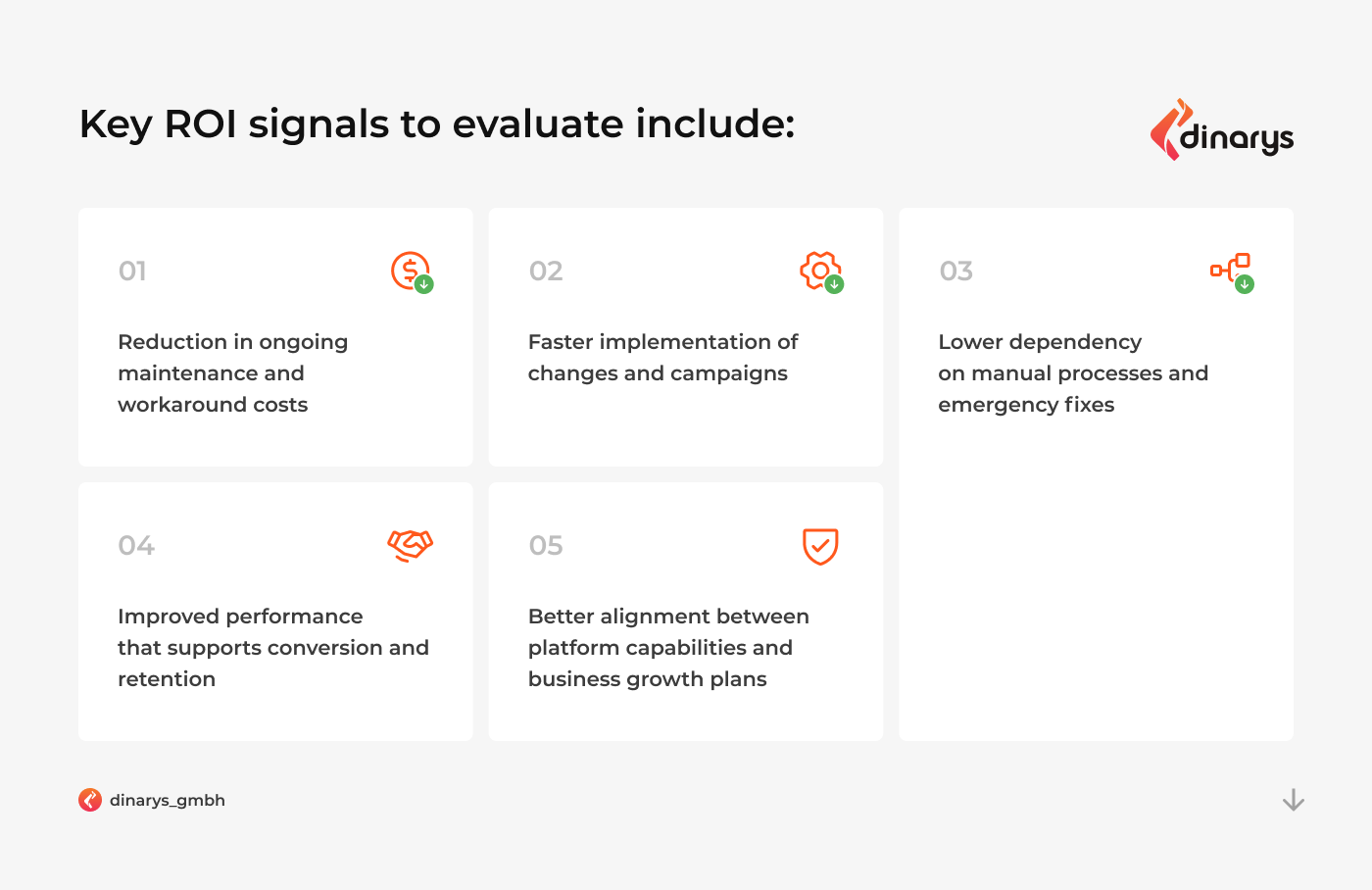
Replatforming is often justified as a technical necessity, but its real impact is measured through return on investment over time. A strong replatforming partner should be able to discuss ROI as a combination of cost control, operational efficiency, and revenue enablement.
In the short term, replatforming almost always increases costs. Migration effort, parallel system support, custom solutions development, and temporary inefficiencies are part of the ecommerce replatforming journey. Vendors who promise immediate financial returns often overlook these realities.
A more reliable indicator of value is how the new platform changes the economics of everyday work.
Over time, these factors influence marketing efficiency, operational scalability, and customer lifetime value.
When assessing replatforming vendors, it’s worth asking how they measure success beyond launch. Partners who can explain where long-term value is expected are more likely to treat replatforming as a business investment rather than a technical handoff.
How to evaluate the best ecommerce replatforming companies
Once you decide that replatforming is necessary, the focus shifts to whom you should trust to lead that change. At this stage, most vendors will present themselves as capable. The real challenge is distinguishing between teams that can deliver a successful launch and those that can support your business through the full transition and beyond.
Replatforming vendors should be evaluated differently from general ecommerce development partners. The scope, risk, and long-term impact of replatforming necessitate a deeper level of scrutiny.
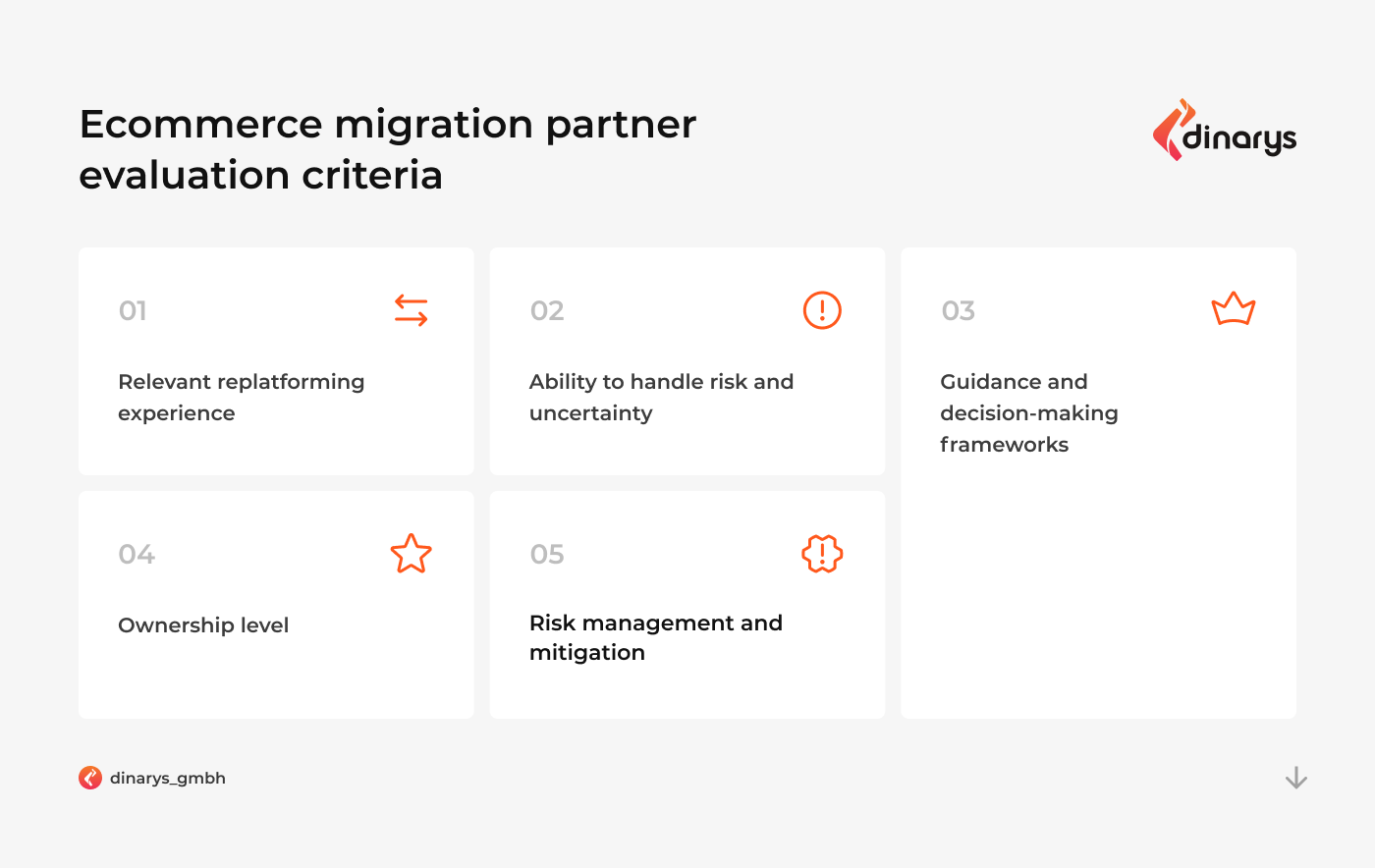
#1: Look for replatforming experience, not just platform expertise
Many development teams are proficient at building new online stores on modern platforms. Fewer have experience migrating live businesses with existing customers, data, and operational dependencies.
When evaluating vendors, pay close attention to:
proven experience with replatforming projects
ability to explain past migrations, including challenges and trade-offs
familiarity with data migration, SEO preservation, and phased rollouts
understanding of how to keep the business running during transition
A vendor that treats replatforming as a standard build project is likely to underestimate its complexity.
#2: Assess how vendors talk about risk and uncertainty
Replatforming always involves unknowns. Mature vendors acknowledge this early and explain how they manage the risk of facing hidden or unexpected issues.
Green flags include:
clear discussion of assumptions and dependencies
willingness to outline potential failure points
structured approaches to testing, rollback, and contingency planning
realistic timelines that account for validation and iteration
Be cautious of vendors who present replatforming as a predictable, linear process. Confidence without acknowledgment of risk often leads to issues later.
#3: Evaluate platform guidance and decision-making support
Before jumping into implementation, a reliable replatforming partner validates whether the chosen platform is the right fit in the first place.
Look for vendors who:
can compare platforms in the context of your business model
explain why certain platforms may not be suitable
discuss long-term implications of specific technical choices or decisions at the outset
challenge assumptions when necessary
Platform neutrality combined with clear reasoning is often a sign of experience.
#4: Consider ownership beyond launch
Many replatforming issues surface after the ecommerce site goes live, when real traffic, real orders, and real workflows come into play.
Evaluate whether the vendor:
defines responsibility for post-launch stabilization
supports knowledge transfer and documentation
remains involved during the early operational phase
takes accountability for issues that emerge after release
A vendor’s willingness to stay engaged after launch often reflects their confidence in the ecommerce solution they’ll deliver.
#5: Consider a vendor’s ability to identify, manage, and mitigate replatforming risks
Replatforming carries risks that are difficult to reverse once the project is underway. A reliable partner should be able to clearly explain where these risks exist and how they will be managed before any technical work begins.
When evaluating a vendor, pay attention to whether they can demonstrate:
a structured approach to migration planning and validation
clear processes for protecting SEO, data integrity, and traffic
experience managing transitions during live business operations
architectural decisions that avoid creating new long-term dependencies
Vendors who cannot articulate risks up front often expose ecommerce merchants to avoidable issues later in the project. Careful evaluation at this stage helps reduce the likelihood of costly rework, operational disruption, and long-term platform instability.
EVALUATE REPLATFORMING OPTIONS WITH CLARITY
Dinarys supports businesses in comparing platforms and vendors based on real operational impact.
By the time a business reaches the stage of shortlisting replatforming partners, the goal is no longer to find a vendor that can simply do the work. Most teams can migrate data or rebuild a storefront. The real task is finding a partner that understands how replatforming affects operations, customers, and long-term decision-making.
The companies listed below have experience working with live ecommerce businesses through platform transitions. Their work goes beyond technical migration and typically includes assisting with platform vendor selection, managing risk, ensuring data and SEO continuity, and providing post-launch stabilization. These partners operate across major platforms including Shopify Plus, Adobe Commerce, BigCommerce, Shopware, Salesforce Commerce Cloud, and commercetools.
This list is not a ranking, and each company has its own strengths, delivery models, and platform focus. The intention is to point you in the direction of replatforming partners that you can evaluate against your business context, complexity, and business goals as well as current market trends, market demands, and customer expectations.
Dinarys
Dinarys is an ecommerce software development company that works with B2B and B2C businesses across different markets. The team helps companies build, modernize, and scale ecommerce platforms that support real operational needs.
Company profile
Headquarters: Berlin, Germany
Operating since: 2014
Top clients: Toyota, Accenture, BORN, Panodyssey, Vaimo, Prostor, SanMar Canada
Services: Team augmentation, ecommerce platform migration, DevOps migration, data migration, architecture migration and modernization, integration migration, SEO, mobile optimization, frontend migration, migration consultancy, IT audit
Vaimo is a global digital commerce agency with extensive experience in large-scale replatforming projects, supporting brands through complex platform transitions and multi-market growth.
Company profile
Headquarters: Stockholm, Sweden
Operating since: 2008
Top clients: WEG, Diptyque, JDE Peet’s, BAUHAUS, Tarkett, Runnings
Services: Ecommerce replatforming, platform migration, commerce strategy, custom development, integration and data migration, composable architecture implementation
Innowise supports enterprise and mid-market businesses with complex ecommerce migrations and replatforming initiatives across multiple commerce platforms.
Company profile
Headquarters: Warsaw, Poland
Operating since: 2007
Top clients: LVMH, Nike, Siemens, The Walt Disney Company, Costco, Accenture, Nvidia, Mastercard, Nestlé
Services: Ecommerce replatforming and migration planning, custom development during platform transition, integration with existing systems, headless and API-driven commerce implementations
Superco is a Shopify Plus–focused commerce partner that supports high-growth brands with replatforming and platform transitions centered on performance and scalability.
Company profile
Headquarters: London, United Kingdom
Operating since: 2019
Top clients: Represent, Allbirds, Ursa Major, Puresport, Tileflair, Myomaster
Shopify services: Shopify Plus store design and development, migration services, customizing Shopify themes, UX and conversion optimization, subscription and retention strategy, growth and optimization support
Certifications: Shopify Platinum Partner
1Digital Agency
1Digital Agency supports ecommerce businesses through platform migrations and store replatforming projects, with a focus on data continuity and operational reliability.
Company profile
Headquarters: Philadelphia, Pennsylvania
Operating since: 2012
Top clients: Fast Specialties Group, Wireless Age, A&J Cycles, CLX Gaming, A Specialty Box, Ladivine
Services: Ecommerce platform migration, data transfer and validation, SEO migration, custom development during replatforming, post-migration optimization
DigitalSuits is an ecommerce agency focused on Shopify and Shopify Plus migrations, helping merchants move from legacy platforms while preserving data, SEO, and operational stability.
Company profile
Headquarters: Austin, Texas
Operating since: 2019
Top clients: Toyota, Accenture, BORN, Panodyssey, Vaimo, Prostor, SanMar Canada
Services: Shopify replatforming and migration, data and SEO migration, platform assessment, integration migration, custom development to support platform transition, post-launch stabilization
Netalico works with growing brands on Shopify Plus replatforming projects, helping businesses transition from complex or limiting platforms while maintaining performance and search visibility.
Company profile
Headquarters: Miami, Florida
Operating since: 2022
Top clients: Big Green Egg, Feetures, Audio Advice, Crossrope, Vybes, Brondell, The Original Oatly
Services: Ecommerce replatforming, Shopify Plus migration, UX and frontend rebuilds, integration migration, custom development, post-launch support
Wrapping up on ecommerce replatforming consultants and partners
The platforms, partners, and tips for successful migration discussed in this article illustrate a simple point: successful replatforming rarely comes from moving fast or choosing what looks familiar.It comes from understanding where the current platform creates friction, being honest about operational constraints, and working with trusted partners who can explain trade-offs as clearly as solutions.
There is no universally “right” platform or vendor. The best choice for you depends on your business model, future growth plans, internal capabilities, and risk tolerance. Taking the time to evaluate partners, ask uncomfortable questions, and assess real migration experience reduces the likelihood of repeating existing problems on a new platform.
When approached carefully, replatforming becomes a way to realign technology with how the business actually works. When rushed or treated as a replacement exercise, it often shifts complexity rather than removing it.
MAKE REPLATFORMING A BUSINESS DECISION, NOT A RISK
Dinarys helps ecommerce teams approach platform transitions as long-term investments, with clear trade-offs, realistic timelines, and measurable outcomes.
Choosing an ecommerce platform is a foundational decision that affects how a business operates, scales, and serves customers over time. Before comparing features or vendors, it’s important to understand which factors matter most for long-term stability and growth.
1) Scalability should be a top priority when choosing an ecommerce platform. As the business grows, the platform must support higher traffic, larger catalogs, and more complex operations without constant rework.
2) Choosing a platform with a proven track record of uptime is essential for maintaining customer trust and satisfaction. Downtime directly affects revenue and brand perception, especially during peak sales periods.
3) Understanding your customer base is key to selecting the right ecommerce platform. Different customer behaviors, buying patterns, and regions place different demands on performance, features, and integrations.
4) Total cost of ownership (TCO) should be considered when evaluating ecommerce platforms. Licensing, development, integrations, maintenance, and long-term scalability all influence whether a platform remains sustainable over time.
Modern ecommerce architectures, such as headless and composable commerce, enhance flexibility and scalability for businesses. These approaches allow teams to evolve individual parts of the system without rebuilding everything at once.
Modern ecommerce platforms are designed to support rapid innovation and integration with new technologies, which is essential for staying competitive. This makes it easier to adopt new tools, channels, and experiences as market conditions change.
Headless commerce decouples the front end and back end, allowing for greater customization and integration with third-party services. This approach gives businesses more control over user experience while keeping the core commerce logic stable.
Composable commerce allows brands to build their tech stack using best-of-breed solutions, enabling them to adapt quickly to changing market demands. Using a composable architecture can improve performance and scalability by allowing businesses to select the highest performance services for their applications.
In 2026, many top agencies specialize in AI-integrated migrations and headless commerce architectures. These capabilities help businesses modernize their platforms while preparing for automation, personalization, and data-driven decision-making.
Agencies should have certified developers for the target platform, such as Shopify Plus Experts or Adobe Commerce Certified specialists. Certification signals familiarity with platform standards, best practices, and common migration risks.
B2B projects require specialized knowledge of complex pricing rules and account-based permissions. Unlike B2C, B2B platforms often need to support negotiated pricing, multiple buyer roles, approval flows, and customer-specific catalogs.
These requirements affect platform selection, architecture, and migration strategy, making B2B replatforming projects more sensitive to planning and execution quality.
You may share this article
Let professionals meet your challenge
Our certified specialists will find the most optimal solution for your business.




![BigCommerce to Shopify Migration [Practical Tips Included]](https://dinarys.com/storage/images/blogs/W1sqeZZ7I5rSnlZuefjjTzf83raEM3wpFghY3cVU.png)