When your store is growing, you expect your ecommerce platform to keep up. But sooner or later, your goals and your platform’s capabilities diverge. What used to function well enough becomes the reason your store falls behind. Business growth, operational load, and technical demands expose that your current ecommerce platform can’t support:
Scaling (it becomes harder to scale both functionally and architecturally)
Stable releases (the release cycle slows down due to platform limitations)
Stable performance (fixes don’t stick and don’t solve critical issues)
New integrations (they become fragile due to platform limitations and unstable APIs)
Intermediate fixes (every “small” change results in development hours, workarounds, delayed campaigns, operational uncertainty, and budget bloat)
New technologies (adapting a more modern architecture becomes impossible without piling on complexity)
The platform still “works.” It delivers the functionality built two or three years ago and sustains the basic day-to-day flow. However, making it do anything more forces the team into constant compromises, manual fixes, and fragile add-ons. Customers soon feel the results through slower pages, inconsistent behavior at checkout, occasional errors, and a generally less reliable experience.
Business Impact of a Negative Customer Experience
Over time, a negative customer experience on your website causes customers to consider other shops. For you, this means lost conversions and revenue left on the table:
Time period
Consequences of a negative customer experience
Business outcomes
In 12 months
Delivery slows, maintenance grows, and small changes take longer than they should.
Teams spend more time keeping the store stable than improving it. Roadmap velocity drops.
In 2 years
Constraints stop being technical details and start dictating what’s possible. Strategy is shaped by what the platform can tolerate.
Planning equals trade-offs: you can ship initiative A or B, not both. The market moves faster than your release cycle.
In 5 years
The platform becomes a ceiling. Scaling gets disproportionately expensive, or certain capabilities simply can’t be implemented at all.
Your roadmap turns into workaround maintenance and debt management. Competitiveness erodes as competitors deliver faster and without issues.
At this point, you’re already looking at platform migration — and it’s no longer if, but how.
But the longer you wait, the more expensive this decision becomes because:
Competitors are already offering a better customer experience
Some repeat customers have quietly switched to competitors
Your team is spending more time keeping the platform afloat than building what users actually expect
By this point, migration stops being a strategic upgrade and turns into a forced correction, with higher risk, higher cost, and less room for proper planning.
Whichever new ecommerce platform you choose, the move can’t be treated as a simple data transfer. Whether you’re moving from Magento to Shopify or from WooCommerce to BigCommerce (or upgrading within Adobe Commerce), you need an experienced team of migration experts who understand your specific setup and can run the transition in a safe and controlled way.
How Migration Helps Solve These Problems
Successful migration removes the constraints that are slowing you down. Here is a detailed look at what ecommerce replatforming can do for your business:
Technical improvements
Business improvements
Impact on users
Better performance and scalability (fewer bottlenecks, faster storefront on the new platform)
More stability during peak traffic, fewer incidents, and more predictable planning for campaigns and growth
Pages load faster and fail less often → fewer abandoned sessions and more completed checkouts
Access to platform-native features (less customization, faster releases on the ecommerce platform)
Less time spent maintaining workarounds, more time shipping improvements, faster testing of initiatives
Shoppers see improvements fast (payment options, promotions, navigation) → the store feels modern and consistent
Operational efficiency (cleaner workflows for marketing, merchandising, and support teams)
Faster catalog/content changes, fewer manual tasks, fewer internal hand-offs to keep things running
Product pages, pricing, and availability info are more accurate → fewer frustrating surprises at checkout
Higher conversion rates, fewer support tickets, less revenue leakage from checkout issues
Checkout feels predictable, especially on mobile → fewer drop-offs at the most critical step
Stronger integration stability (less fragile sync across ERP/OMS/WMS/PIM, payments, shipping)
Fewer order/fulfillment issues, fewer silent integration failures, more reliable operations end to end
More accurate shipping rates, delivery statuses, stock levels, and order updates → higher trust after purchase
Cleaner data and governance (better catalog structure, fewer duplicates, easier ongoing management)
More reliable search and filtering, fewer catalog errors, easier to expand assortment
Shoppers can find what they need faster, filters behave correctly, fewer dead ends → less frustration and higher satisfaction
More flexibility for future architecture (room for headless/composable patterns without patchwork complexity)
Easier to add channels, front ends, or services without rebuilding core logic; faster adaptation to market needs
Better cross-channel experience over time (speed, personalization, consistency) → shoppers feel the brand keeps up
Why Should You Work with a Specialist for Your Ecommerce Platform Migration?
Experienced migration specialists can bring structure to the complex platform migration process. They know where platform migration projects usually fail and can build safeguards into the migration process from the start.
Just as importantly, specialists approach migration systematically. This means that they:
define ownership of responsibilities and deliverables
sett validation gates
align technical decisions with business operations
This is where internal teams often struggle, as migration requires dedicated attention and resources, repeatable playbooks, and familiarity with multiple ecommerce platform patterns and tooling.
An experienced partner can reliably minimize downtime with a disciplined migration process: new platform configuration (access, environments, core settings), rigorous data mapping and reconciliation, integration rebuilds with end-to-end testing, a controlled cutover plan, structured post-migration support. As a result, moving to a new platform results in stability and growth rather than a recovery cycle.
WANT TO MIGRATE WITHOUT SLIDING INTO A RECOVERY CYCLE?
Dinarys works with many ecommerce platforms and can help you plan and run a controlled migration. We’ll help you choose and configure your new platform, map and validate data, perform integration rebuilds, enforce cutover discipline, and handle post-migration stabilization.
Why Your Choice of Migration Partner Matters in 2026
Choosing a top migration company in 2026 genuinely matters, as the risk isn’t only in how you migrate — it’s also in what platform you migrate to. Going with a popular platform that doesn’t match your business model or integration needs will turn your project into ongoing rework and raise your total cost. This is exactly why an objective partner is valuable early.
And if the migration process itself is run poorly, the damage compounds fast:
At the technical level, this shows up as broken templates, inconsistent data, checkout edge cases, and unstable sync between systems.
Operationally, it creates manual workarounds: support tickets spike, fulfillment exceptions grow, and marketing loses reliable attribution.
Business-wise, performance drops and trust erodes — customers hit friction, conversion falls, repeat purchases slow down, and competitors capture demand you used to convert.
Financially, the impact follows quickly: lost sales during downtime, higher ad spend to compensate for declining rankings, and unplanned development time to stabilize what should have been stable from day one.
The result is often downtime, SEO losses, inventory inaccuracies, and data gaps.
When SEO rankings slip, the impact can be severe:
Spotibo notes that a botched site migration can cause a 20%+ loss in organic traffic.
Salience shows a real migration example where ~40% of organic traffic disappeared immediately after launch (and notes they’ve seen worse outcomes).
Search Engine Journal reports a 30% organic traffic drop after ecommerce store migration as a common, real-world outcome when SEO controls aren’t handled end to end.
When something goes wrong, the key question is simple: Who owns the recovery? If the vendor’s role was to move data and launch, your team becomes the incident response unit. A specialist partner is valuable because they plan for failure modes and contingencies up front with clear scope ownership, validation gates, rollback paths, and post-launch responsibility so accountability doesn’t disappear at go-live.
Hence, most of the time, working with proven experts pays for itself in avoided mistakes.
In this guide, you’ll discover:
How to evaluate migration vendors before you contact them
What risks show up when you choose an unreliable partner — and how to spot red flags early
Which company/vendor evaluation criteria actually predict a safe migration
A curated shortlist of top ecommerce migration companies and their specializations
Choosing an Ecommerce Replatforming Partner: Evaluating Vendors Before the Intro Call
Vendor selection usually starts before the first call. At this stage, you’re scanning websites, case studies, and other publicly available resources to figure out who can actually manage a high-risk ecommerce platform migration without disrupting revenue and day-to-day business operations.
The challenge is that most migration agencies look similar at first glance. Everyone promises “minimal disruption,” “full data migration,” and “a smooth go-live.” But those phrases don’t tell you how a team works under real constraints.
At the research stage, the goal is to reduce uncertainty, not to find the most impressive presentation. You want to spot vendors who treat migration like a controlled program rather than a fast rebuild with an import script.
A useful way to think about vendor evaluation is to separate claims from signals:
Claims. What a company says they can do:
We migrate everything.
We preserve SEO.
We’re experts in X ecommerce platform.
Signals. What you can verify before a call:
How clearly a company defines their scope of responsibility
How they talk about reconciliation and QA
Whether they explain their cutover strategy
Whether their content describes real-world platform migration experience
The rule is simple: prioritize signals and treat claims as marketing.
If a vendor can’t clearly explain scope ownership, reconciliation, QA, cutover planning, and SEO safeguards, or if their case studies skip those parts, expect operational breakdowns to surface during final testing or in the weeks after launch, when fixes are disruptive and expensive.
You also want to sanity-check fit early. A partner that’s perfect for a small catalog move may not be the right match for an ecommerce store with multiple storefronts, B2B pricing rules, subscriptions, or ERP/OMS/WMS dependencies. Migration success is heavily influenced by this alignment. The more complex the operations, the less forgiving the transition.
Key Criteria for Selecting Top Rated Ecommerce Migration Companies
The criteria below focus on what usually determines outcomes to help you evaluate vendors in a practical way before you invest time in discovery calls and proposals.
#1: Platform expertise
A migration partner’s platform expertise matters most when it’s specific to your situation. Many agencies list Shopify, Magento, WooCommerce, and BigCommerce on their website. Fewer can show recent, relevant work moving stores from your current platform to your target platform under real-world constraints.
At the research stage, look for evidence of repeatable experience, as the details of migrating from one specific platform to another are where cost and risk tend to hide. A vendor that has migrated from your current platform to your target platform will usually understand:
Whether the target platform actually fits your business goals and operating model
What “feature parity” really means on the particular platform
What platform limitations you’ll hit after launch — and how to design around them
Where data models don’t map cleanly (variants, attributes, bundles, custom fields)
What tends to break during cutover (checkout logic, customer accounts, tracking, fulfillment sync)
Which parts are easy to move vs what must be rebuilt or replaced
How technical decisions translate into business workflows
How to resolve operational bottlenecks that in-house teams often carry
What to plan for now so that technical, operational, and business processes can scale cleanly later
How to shape the architecture so there’s room to implement new technologies later without disruption
When a potential vendor answers these questions with generalities, it’s usually a sign they’ll be learning on your project.For migrations, that often means greater risk and higher costs later on.
#2: Migration scope coverage
Many vendors claim to offer migration services, but their scope isn’t always end to end:
Some teams focus mainly on data migration
Others rebuild the storefront but expect your internal IT to handle integrations
SEO support can end up meaning a basic redirect list — without a full URL inventory, content parity checks, or post-launch monitoring that protects search engine rankings
The issue is that these inconsistencies in migration scope often surface during testing or right after launch, when the platform migration process is already in motion and fixes become expensive.
At the research stage, you’re validating one thing: Does the vendor cover everything our ecommerce business depends on, and can they show how they do it?
What scope coverage should include (at minimum):
Type of workstream
What it includes
Storefront
Theme build, templates, navigation, search and filtering, core UX flows for the online store
Hypercare, monitoring, stabilization, performance tuning, and conversion rate optimization during the post-migration phase
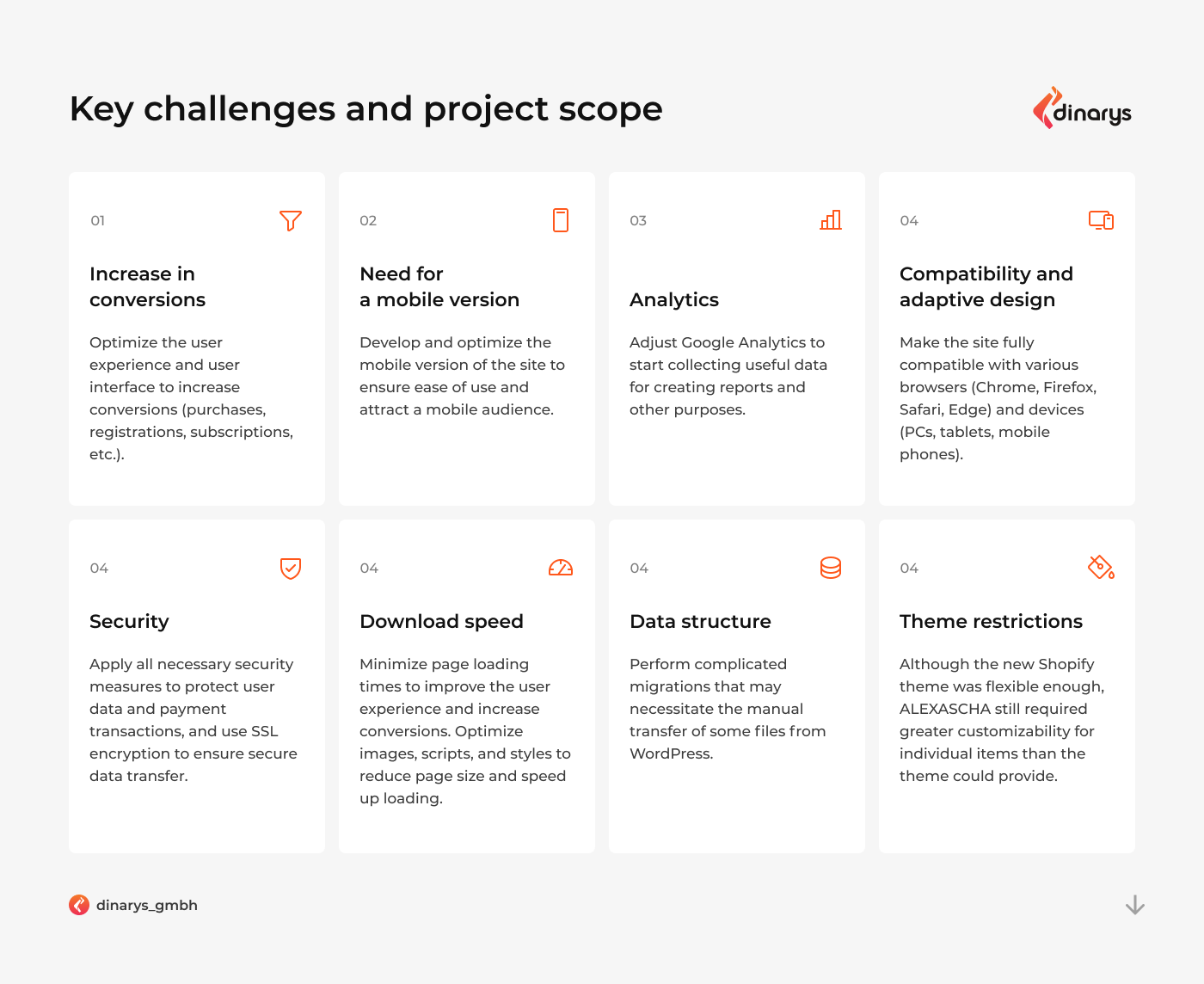
A useful proof point is whether the vendor documents the full move. Dinarys’ Shopify migration overview is a clear example of what this looks like:
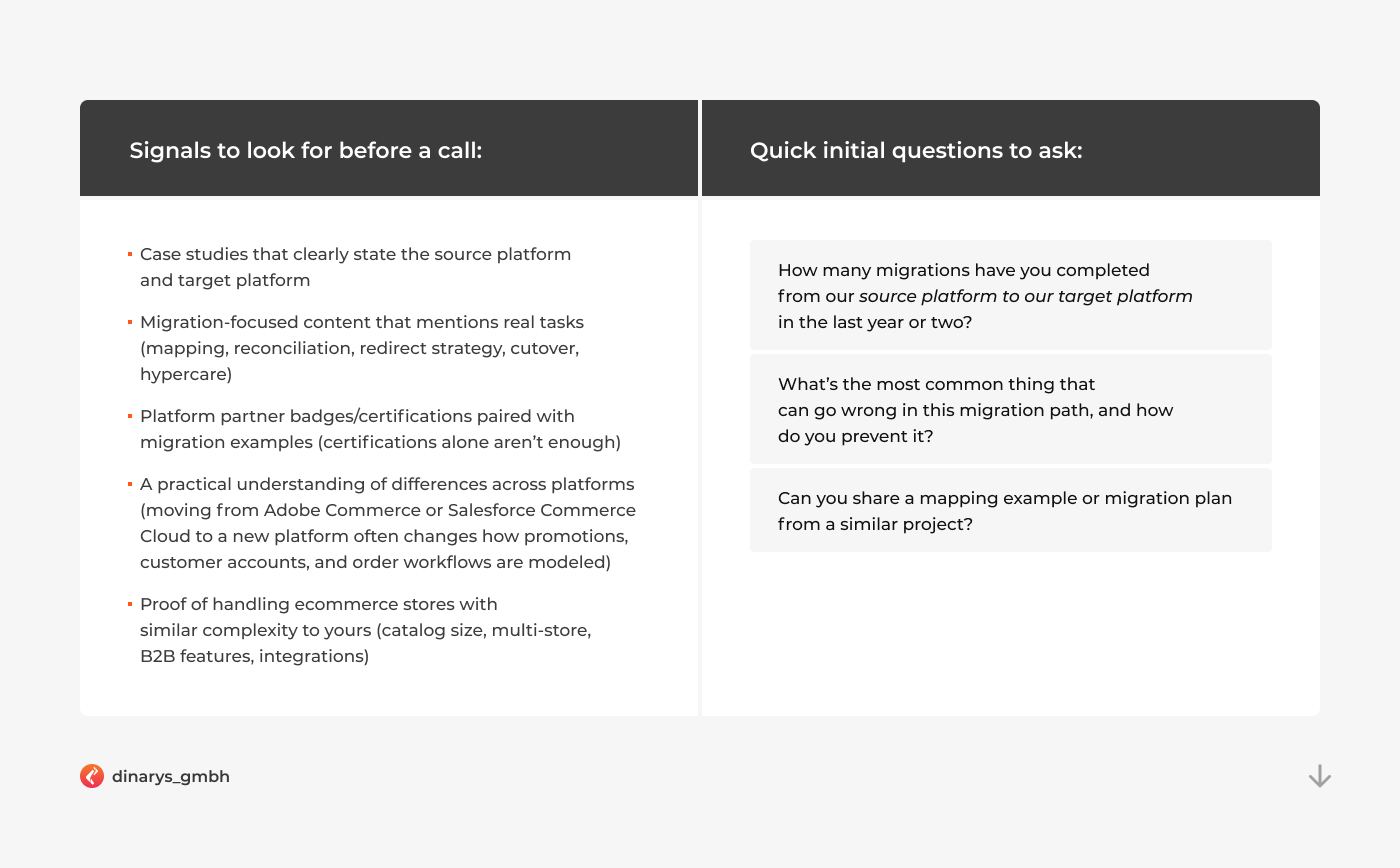
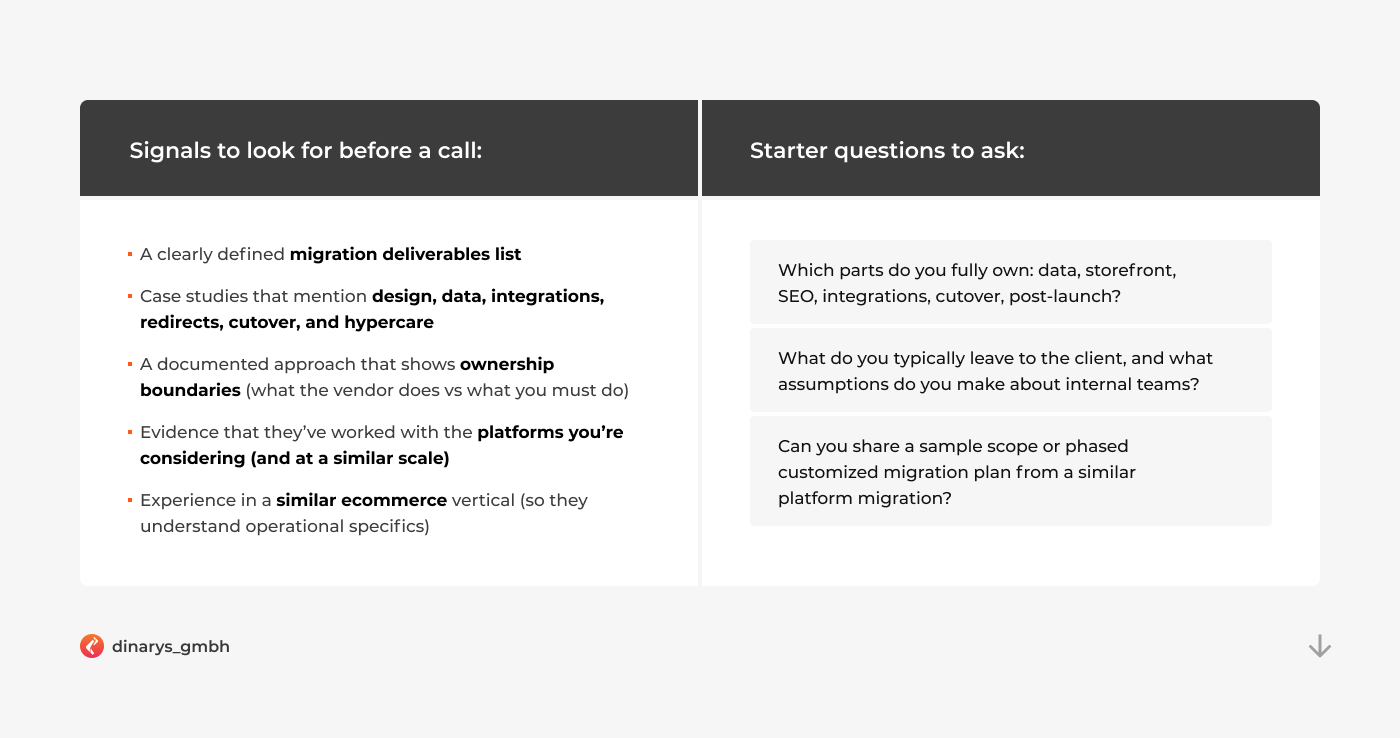
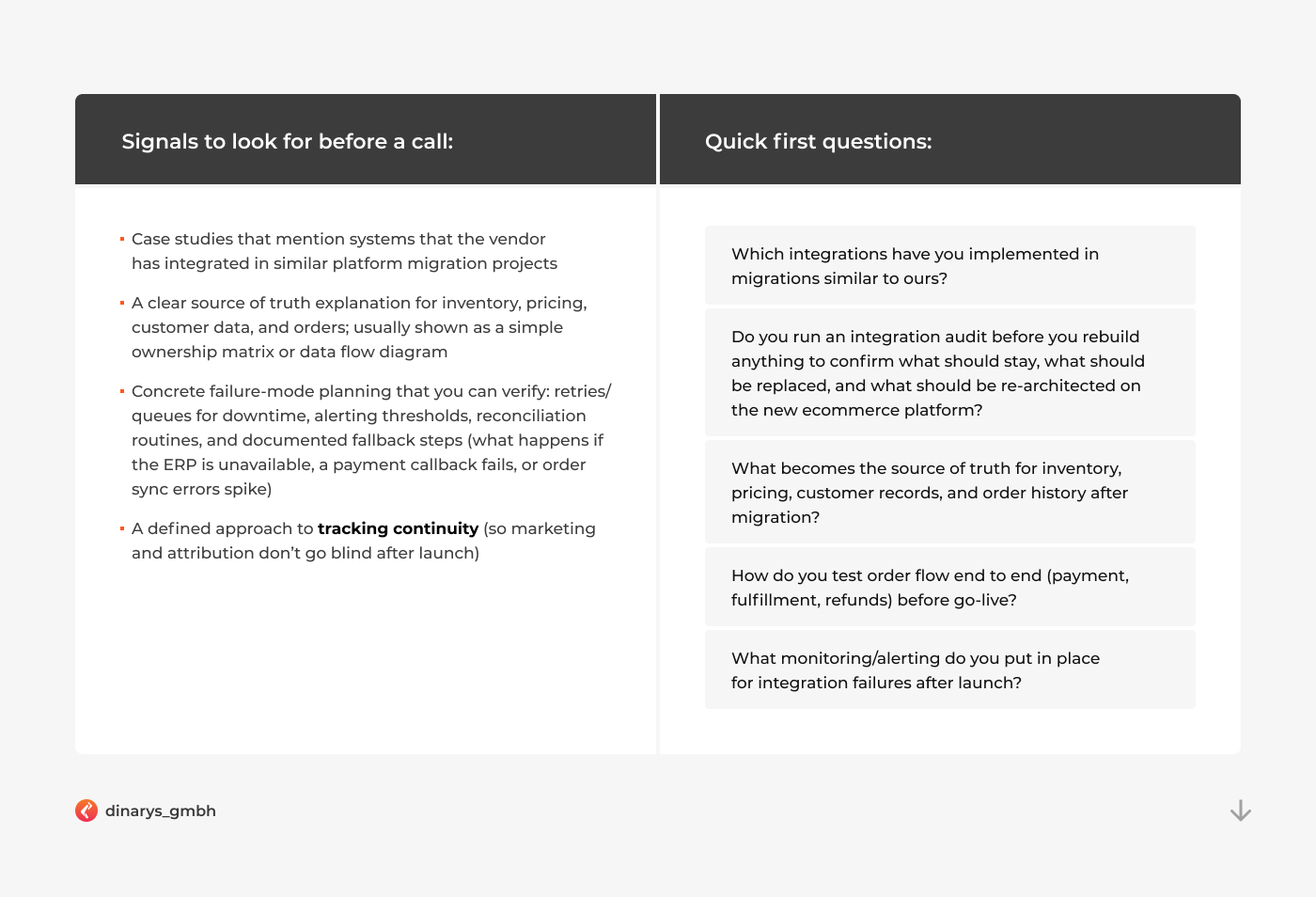
Here are practical signals and starter questions that will quickly reveal whether a vendor can actually run a controlled migration:
A good partner won’t pretend every project is identical. Instead, they will be explicit about the scope, as unclear ownership is one of the most common reasons for a smooth migration to turn into delays, rework, or a launch without full operational readiness.
#3: Data integrity discipline
Data migration can be surprisingly hard to get right.
Most ecommerce stores have years of accumulated complexity. If a partner doesn’t treat data integrity as its own workstream, the new ecommerce platform may launch with hidden problems that quickly turn into operational pain involving inventory inaccuracies, broken filters, pricing inconsistencies, and support tickets.
So the question isn’t “can you migrate our data?” It’s: How do you ensure our migrated ecommerce data is accurate, usable, and consistent with real business operations?
What strong data integrity work looks like:
Type of work
Scope
Data mapping
Clear field-to-field rules (including custom fields/metafields), transformations, and edge cases
Trial imports in staging to catch mapping issues early
Reconciliation checks
Comparing totals and key values before and after (counts, prices, inventory, customer records, order history)
Sampling validation
Manual checks of top-selling SKUs, complex products, high-value customers, key categories, and promo rules
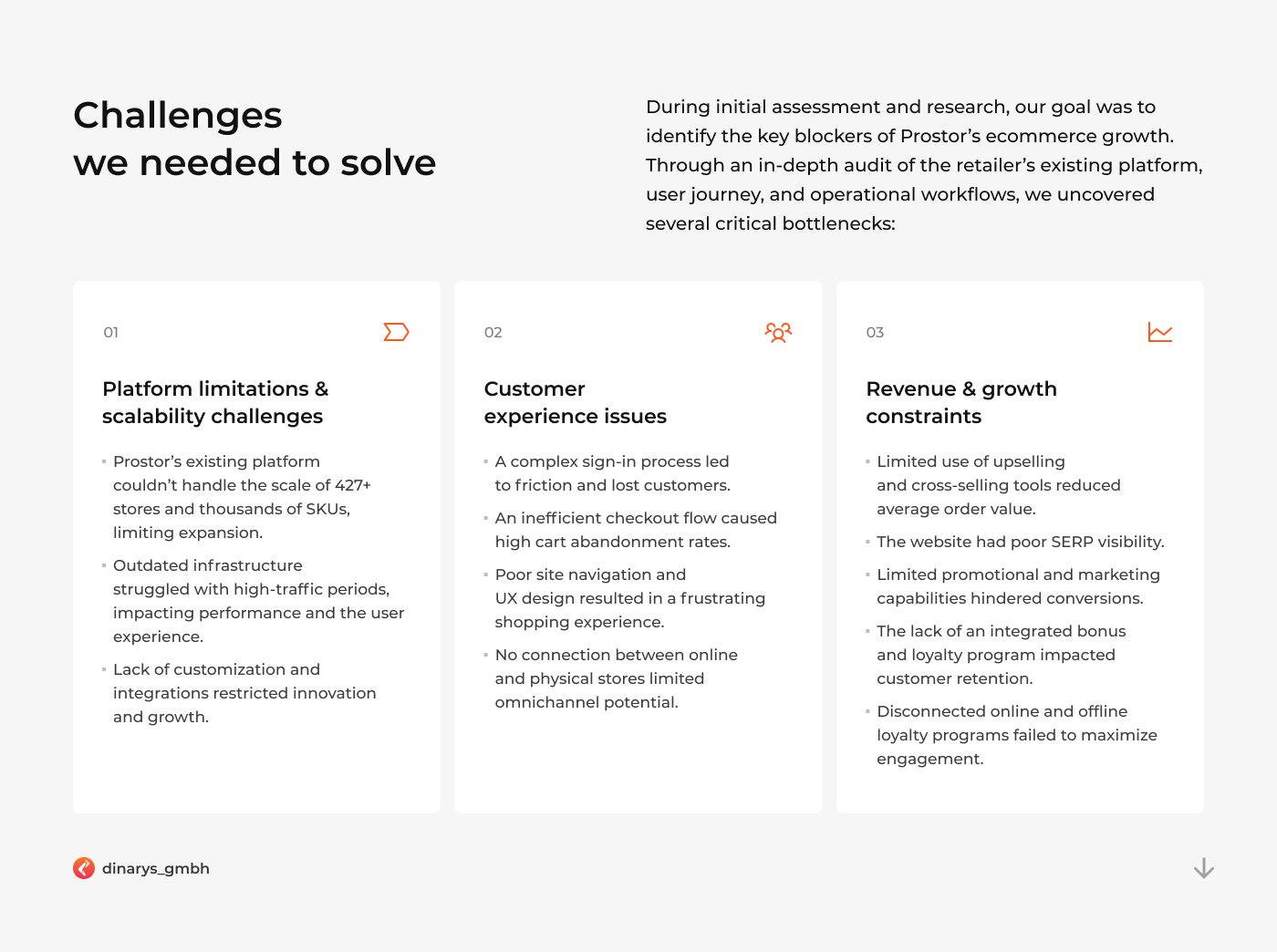
It’s a good sign when a vendor documents migration work beyond moving products, explaining the challenges faced, what was reworked, and what was improved. This Prostor case study by Dinarys perfectly illustrates an enterprise-grade Magento 2 transition:
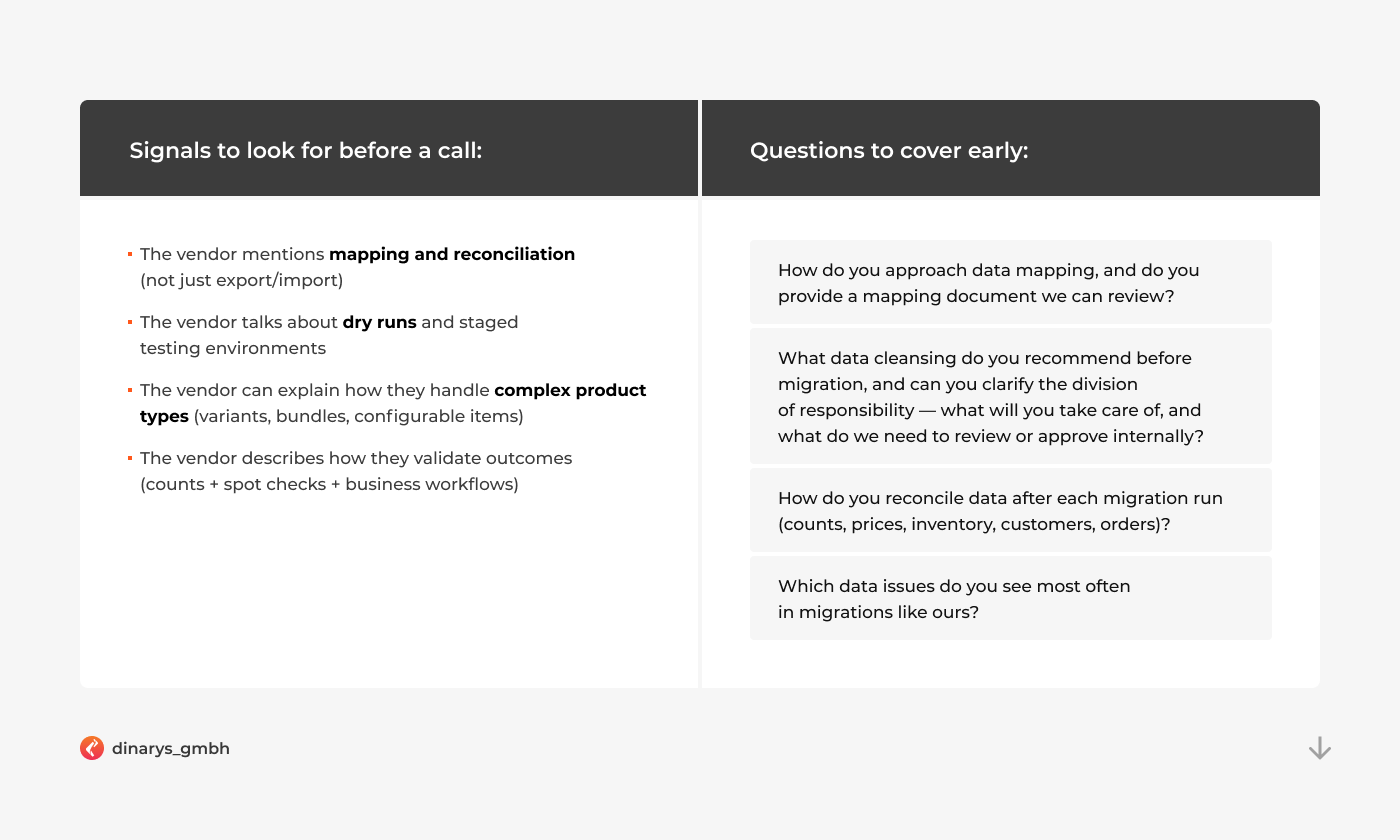
Use the signals and questions below to quickly verify whether a vendor has real data-integrity discipline:
A reliable migration partner should have case studies or other publicly available materials describing how they prevent data loss and what checks must pass before anything is allowed to go live.
#4: Modern technology readiness
Adopting a modern architecture is not automatically the right step in ecommerce platform migration. Many vendors mention headless and composable architectures, AI and automation, BI and data layers, ML-driven personalization, and complex integration patterns, but mentioning these things doesn’t tell you whether a team can implement them responsibly — or whether they’re even appropriate for your business right now.
At the research stage, look for evidence of practical readiness. A vendor that’s truly comfortable with current‑generation architectures, practices, and tools will usually understand:
When headless/composable makes sense vs when a simpler setup is the better decision
What changes operationally when modernizing the architecture (more moving parts, a larger testing surface, more ownership in post-migration work)
How to keep SEO rankings and tracking intact when the storefront layer changes
How to structure delivery so releases stay controlled (environments, automation, CI/CD where relevant)
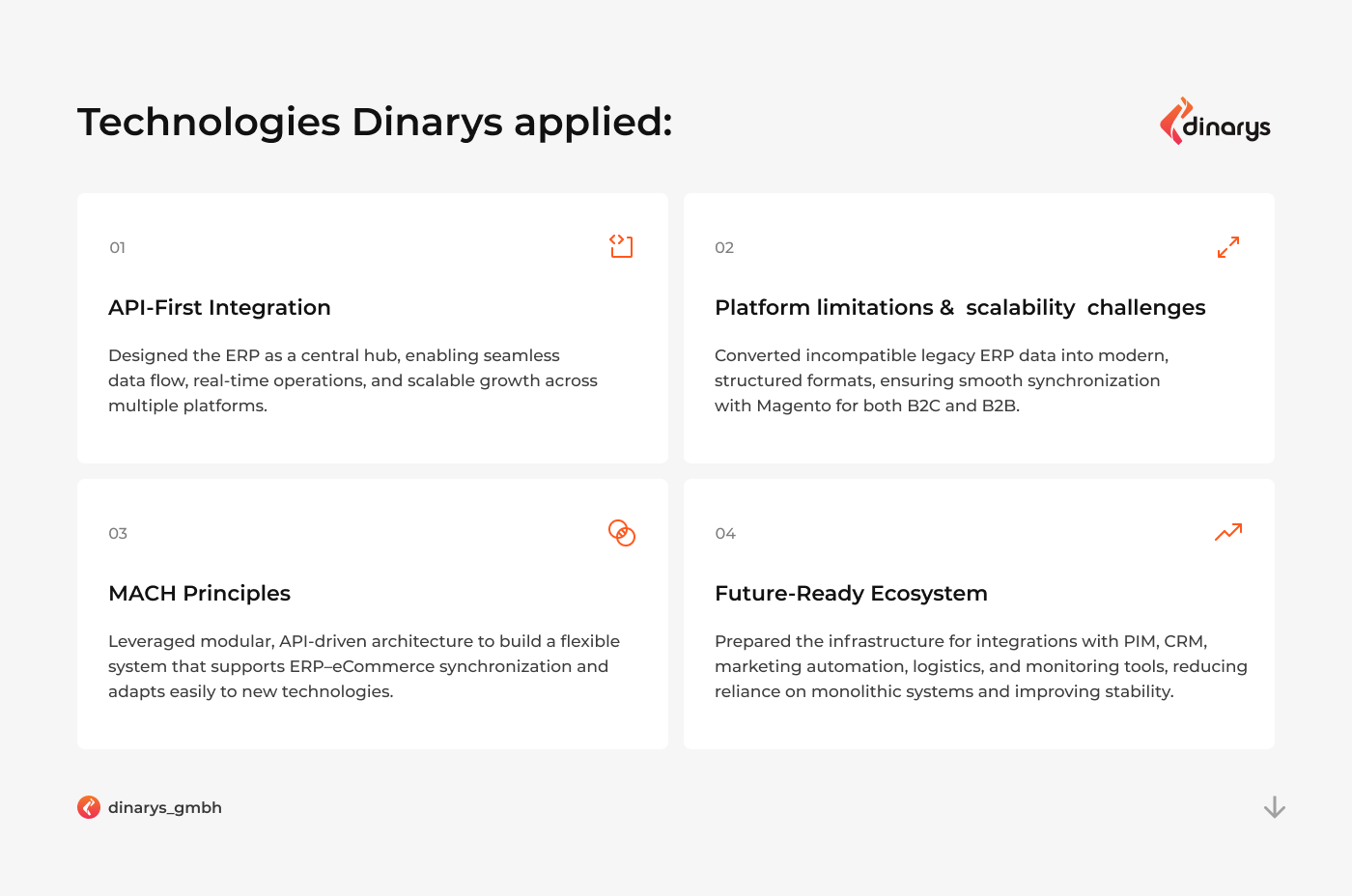
Look for projects that explicitly name the architectural approach (for example, MACH / API-first) and explain why it was chosen. For instance:
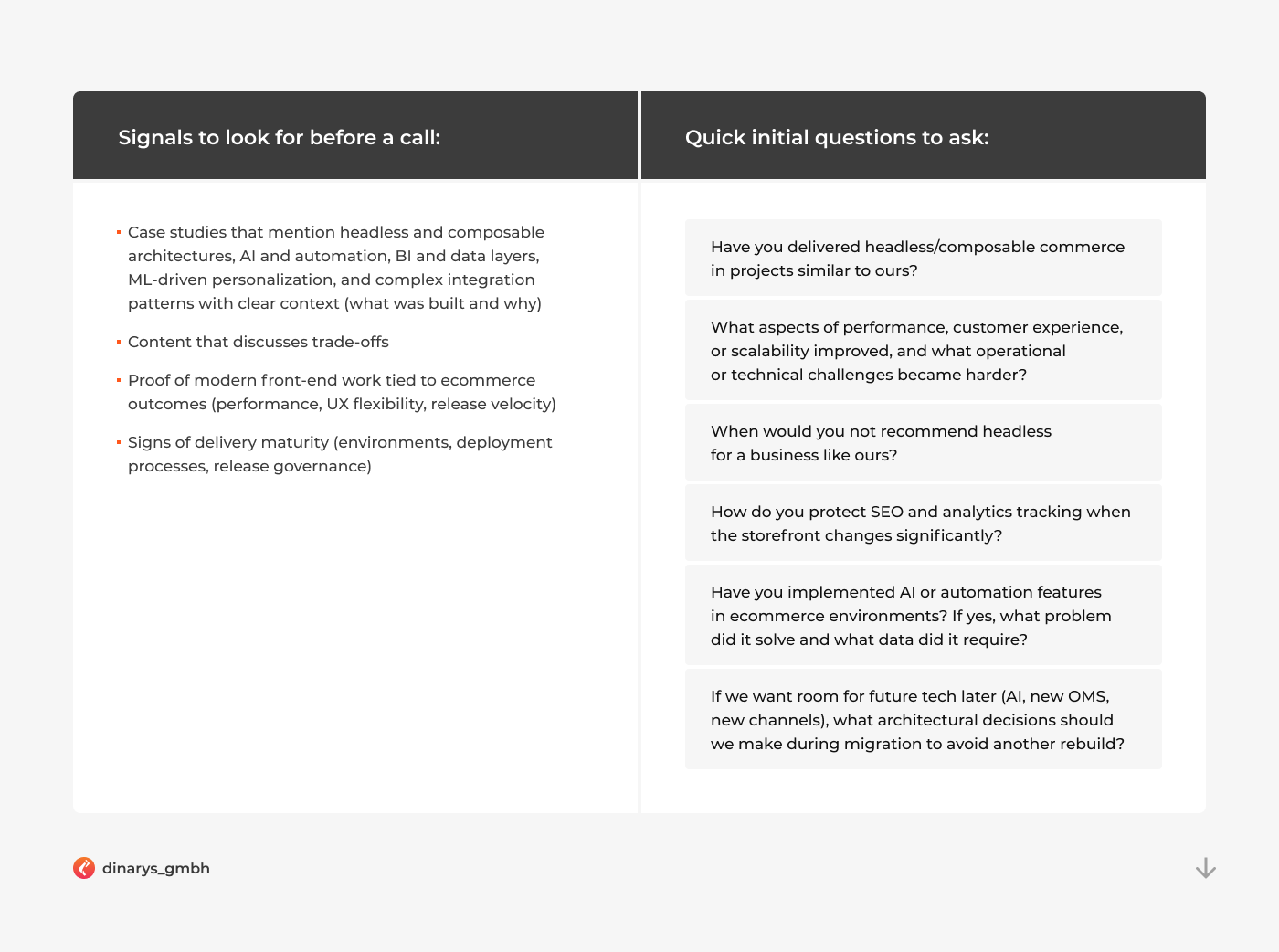
Use the signals and questions below to confirm a vendor’s modern tech readiness:
A vendor that treats modern architecture as a universal upgrade is usually selling a concept. A partner with real experience will talk in specifics, mentioning constraints, trade-offs, and what your team will need to own once the new platform is live.
#5: Integration capability
In many platform migration projects, the storefront isn’t the hard part. Operational systems and processes are.
These include inventory and pricing rules, payment and order flow, shipping and fulfillment, returns/refunds, and the ERP/OMS/WMS/PIM/CRM integrations that keep everything in sync. When any of that becomes inconsistent, the site may still look fine, but you’ll feel the result in oversells, fulfillment exceptions, support load, and lost attribution.
That's why the ability to integrate with third-party systems is one of the core selection criteria. A mature vendor won’t just rebuild integrations as-is — they’ll audit the operational stack for fit. In practice, that means validating whether:
Your current OMS/WMS/PIM/CRM, tax, shipping, fraud, and analytics tooling still makes sense on the new ecommerce platform
It’s smarter to replace or re-architect integrations to reduce fragility and cover more of the operational flow end to end.
This fit audit is what makes the difference between a real upgrade and a like-for-like transfer that drags old bottlenecks into the new platform.
What strong integration looks like:
Clear ownership of integration rebuilds
Experience with the systems that matter to ecommerce operations:
Analytics and tracking (GA4/GTM, platform events, server-side where relevant)
A testing approach that validates end-to-end flows:
Order creation → payment capture → fulfillment → cancellation/refund
Inventory updates and oversell prevention
Customer account sync and B2B rules (if applicable)
A good partner treats integrations as part of the core scope because doing so ensures stable migration and sets the foundation for future expansion.
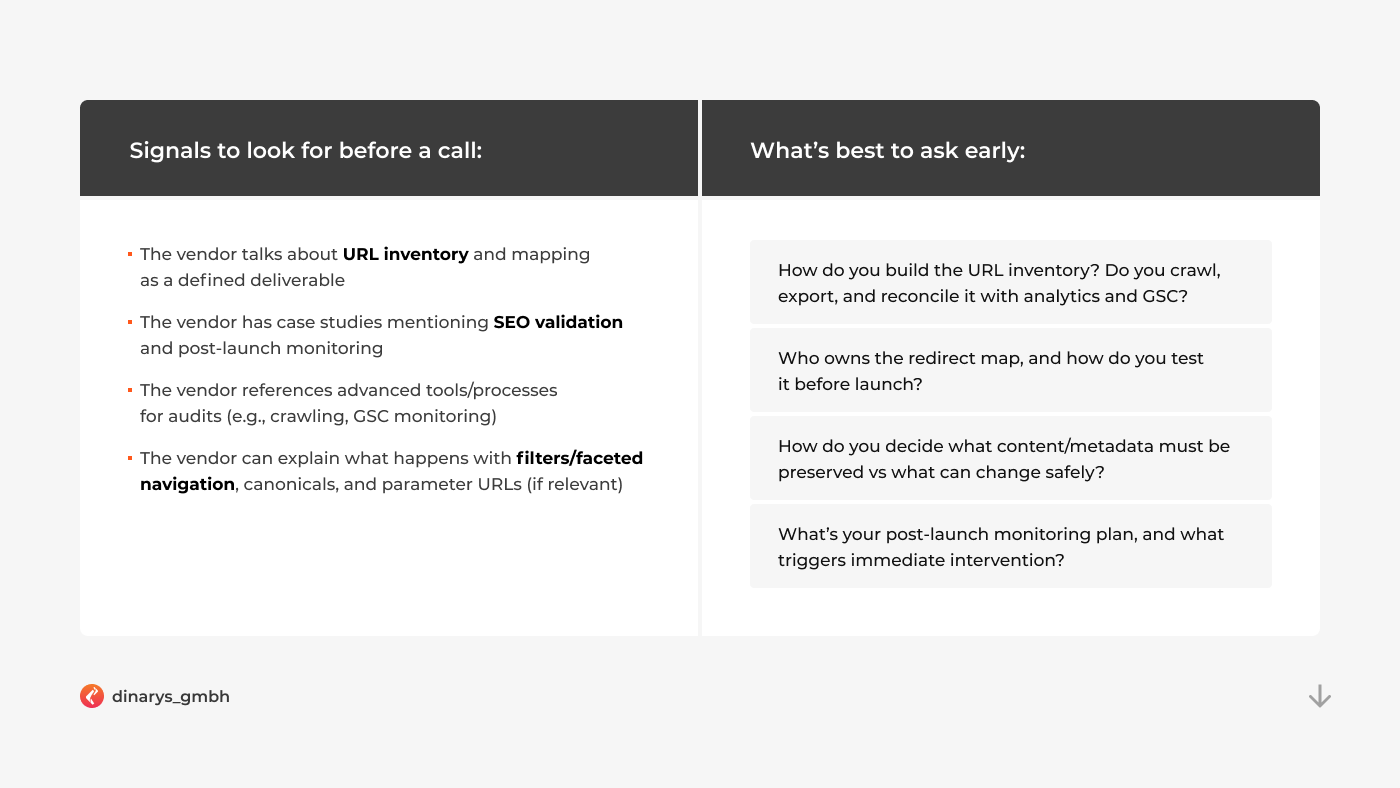
#6: SEO plan
In ecommerce, SEO is your revenue channel. An ecommerce platform migration puts it at risk. Hence, special emphasis should be placed on a clear, testable SEO preservation process that protects how search engines currently discover, understand, and rank your key pages.
Most ranking problems after migration come from small misses:
URLs changing without full mapping
Important pages losing internal links
Metadata not carrying over
Canonical rules changing
Templates altering indexability
If a vendor can’t explain their SEO process clearly, you’re taking an avoidable risk.
So the key question is: How does the team preserve SEO elements before, during, and after moving to a new platform?
A strong migration partner shows you a method that reduces avoidable losses and gives you a clear plan to detect and fix issues fast if performance dips after launch.
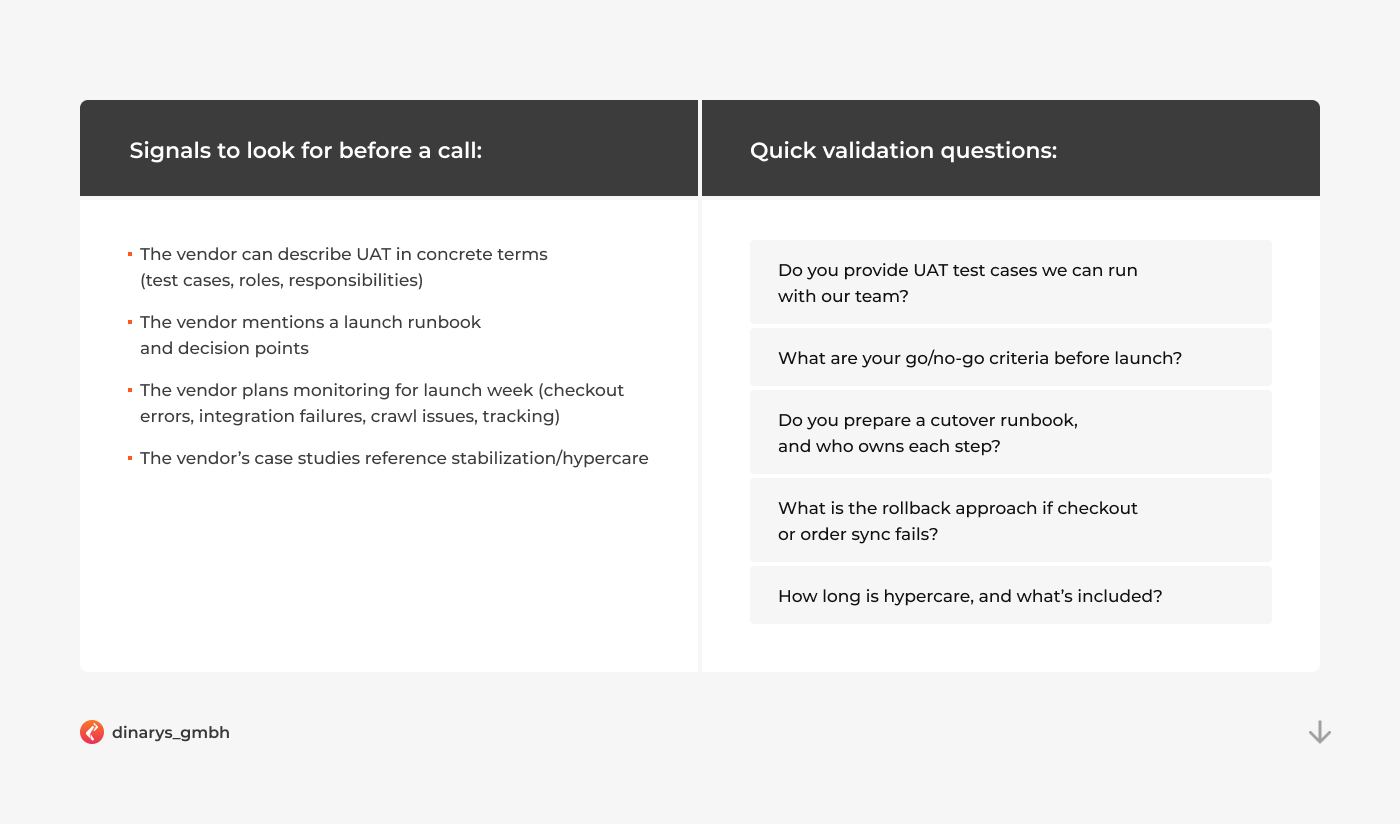
#7: QA and cutover
When moving a store to a new platform, most issues come from what wasn’t tested, what wasn’t validated in real workflows, and what doesn’t go according to plan on launch day.
A new storefront can look correct in staging and still fail in production if QA is shallow or cutover is treated as a simple switch. Migration experts put a lot of structure around testing and go-live to lower the chance of unpleasant surprises and shorten recovery.
What strong QA and cutover discipline usually includes:
Type of work
What it includes
Test strategy and coverage planning
What’s tested, by whom, in which environments, and against which acceptance criteria
Decision owner, technical steps, order protection, communication plan
Post-launch hypercare
Monitoring + fast fixes during the first days/weeks
A reliable ecommerce platform migration partner should rely on a process that makes launch outcomes testable and predictable.
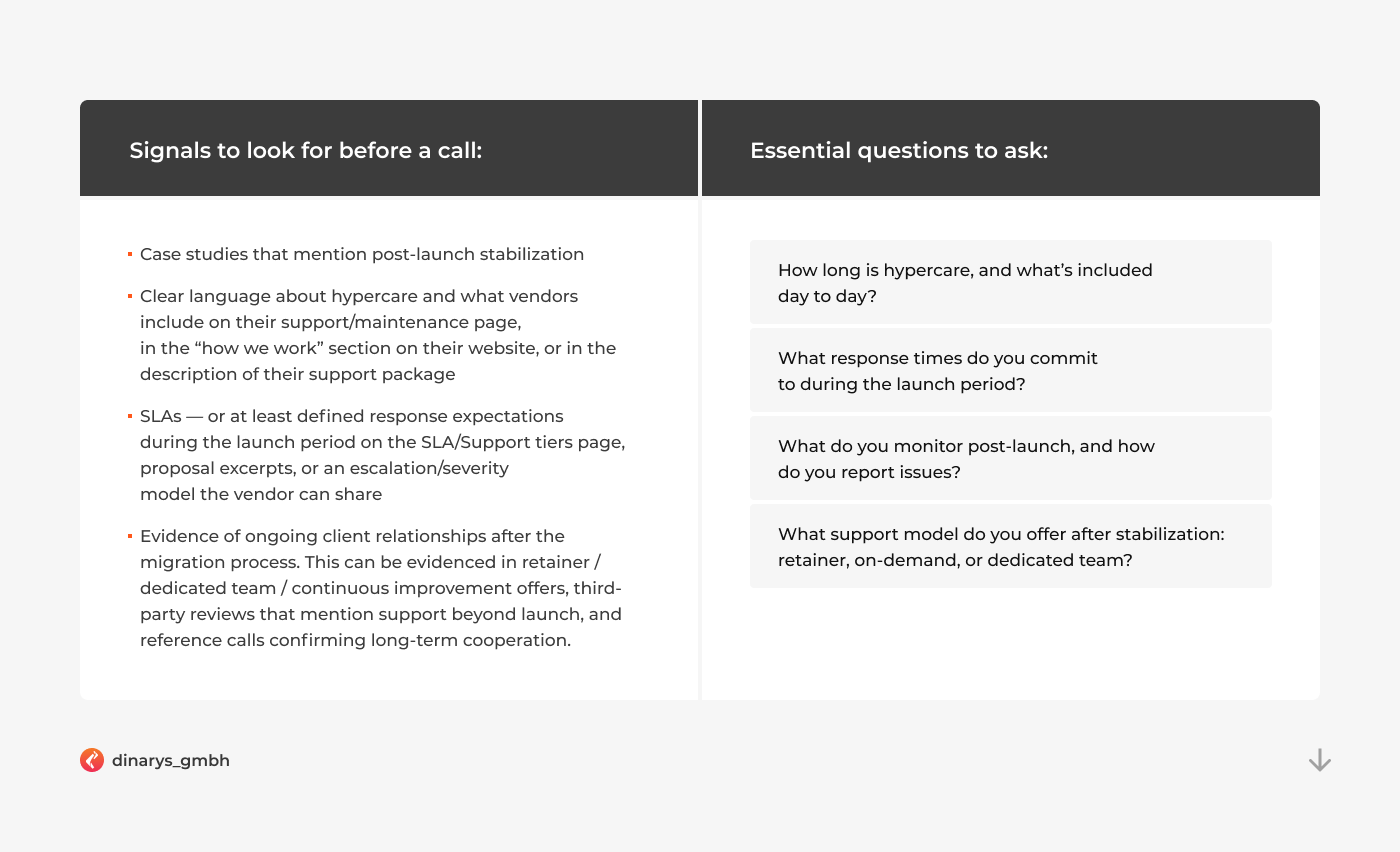
#8: Post-migration support model
For most stores, a few weeks after launch are when real user behavior, real traffic, and real integrations expose the issues you couldn’t fully simulate in staging.
That’s why the post-migration support model matters. Top migration partners should treat post-migration support as a handover phase with structured stabilization, preventing small issues from turning into prolonged disruptions of your entire operation.
What to confirm in post-migration support:
Hypercare window (usually the first 2–6 weeks): dedicated time for fast fixes and monitoring
Issue triage process: how bugs are prioritized, who responds, and expected response times
Stabilization tasks: performance tuning, resolving edge-case data issues, improving reliability of key workflows
Optimization path: what happens after stabilization (CRO improvements, performance work, roadmap support)
A good partner will be transparent about these things. If post-launch support is vague, your team may end up owning the stabilization alone — right when the business needs the online store to run reliably.
How to Further Validate Your Shortlisted Ecommerce Migration Companies
By the time you’ve applied the criteria above, you’ll have a shortlist of vendors that look credible on paper. The risk at this stage is false confidence: Most companies can present a clean story when you only see what they choose to publish.
So instead of reviewing more polished materials, focus on what’s harder to manufacture: reputation outside the vendor’s own website.
Third-party review platforms like Clutch, DesignRush, Pangea.ai, and G2; repeat engagements; and long-term client relationships tend to reveal patterns that case studies won’t show. These include predictability of communication, how issues are handled during launch, and whether the team stays involved when things get messy.
Consider having a short reference call with a client who has been through a similar transition, as it can often give you more signal than another deck or proposal. Listen for specifics: What was harder than expected? What did the vendor own and what was pushed back on the client? How quickly was the online store stabilized after launch?
If a vendor struggles to provide independent references, or if feedback is limited to carefully selected testimonials, it’s not an automatic dealbreaker, but it should raise your standard of proof before moving forward.
NEED PROOF BEFORE YOU COMMIT?
Review Dinarys’ portfolio to see ecommerce delivery and replatforming projects we’ve handled. Then ask for references who can confirm how collaboration and launch stabilization worked in practice.
List of the Best Ecommerce Migration Companies 2026
After applying the research-stage criteria and narrowing your shortlist, the next step is to look at specific vendors that consistently stand out in ecommerce replatforming. The companies below are known for smooth migration delivery across different platforms, industries, and levels of complexity. They possess the processes and technical depth needed to support stable transitions in 2026.
ELEKS
ELEKS is a global software engineering company headquartered in Tallinn, Estonia, that has been operating since 1991. They work with enterprise teams on complex ecommerce and online retail systems where the commerce platform is tightly connected to broader business operations, often supporting projects that involve integration work and modernization of the wider digital environment around the store.
Partnerships: Salesforce, SAP, Amazon Web Services, Microsoft, Adobe, IBM, Cisco, Dell Technologies, Google Cloud
Ecommerce platforms: Salesforce Commerce Cloud, SAP Commerce, Adobe Commerce
N-iX
N-iX is a global software engineering services company headquartered in Valletta, Malta, that has been operating since 2002. They’re positioned as a long-term technology partner for mid-market and enterprise businesses, with delivery teams that support complex digital products and large-scale systems in environments where reliability, security, and cross-system coordination matter.
Migration-relevant services: Ecommerce software development and consulting (including platform-based builds), integration work around retail operations, cloud and data services, and delivery practices that support controlled releases and migrations.
Ecommerce platforms: Adobe Commerce/Magento Open Source, Shopify, BigCommerce
Codal
Codal is a global digital product agency focused on solving business problems through strategy, design, and engineering. The company was founded in 2009 and is headquartered in Chicago. Codal brings together strategists, technologists, designers, and architects, and is best suited for migrations that require careful design/architecture choices and structured launch execution.
Company overview:
Selected clients: Thermos, Lifefactory, Origin USA, Cost Plus Drugs
Dinarys is an ecommerce development agency based in Berlin, Germany, that has been in the market since 2014. Their focus is on ecommerce delivery across development, consulting, and replatforming. Dinarys is a good fit for migrations that require structure around data accuracy, integrations, and stabilization, not just rebuilding a storefront.
Migration-relevant services: Ecommerce consulting and audits, replatforming and migration roadmap, data mapping and consistency checks, platform implementation, integrations, QA/UAT support, DevOps and monitoring, post-launch hypercare and optimization
Innowise is an international full-cycle software development and IT consulting company founded in 2007, with headquarters in Warsaw. They operate as a large delivery organization (3,500+ IT professionals), making them especially relevant for migrations where execution discipline, QA coverage, and coordination across multiple systems matter.
Company overview:
Selected clients: NTT DATA, Commercial Bank of Qatar, SPAR, Familux Resorts
Migration-relevant services: Store migration / replatforming (B2C and B2B), integrations, SEO and performance improvements as part of migration, post-launch monitoring/support
Partnerships: Amazon Web Services, Google Cloud, Microsoft, Salesforce, Shopify, BigCommerce, Bagisto, Odoo
Relevant Software is a software development and consulting company that positions itself around delivery precision and predictable execution for industry leaders. They’ve been in business for 12+ years and list delivery locations across Europe alongside offices in Lviv, Ukraine; Warsaw, Poland; and Valencia, Spain. When it comes to ecommerce platform migration, Relevant Software’s blend of consulting, engineering, and QA is most valuable when the move requires both accurate data migration and seamless continuity of operational workflows.
Migration-relevant services: Ecommerce product discovery and UX/UI, web and mobile development, QA (including automation), DevOps, PWA, headless commerce work that connects APIs and services (tax, search, analytics, localization), plus retail integration/modernization and QA/testing as part of retail/ecommerce delivery
Partnerships: Not publicly listed
Ecommerce platforms: Not publicly listed
Vaimo
Founded in 2008, Vaimo is a full-service digital commerce and customer experience agency headquartered in Stockholm, Sweden. Vaimo works across consulting, design, development, support, and analytics for brands, retailers, and manufacturers worldwide — an approach that fits migrations where you need a stable transition and a clear plan for everything beyond the storefront, including integrations, data flows, SEO, and post‑launch support.
Migration-relevant services: Consulting, design, development, support, and analytics services, with experience in platform migrations and post-launch improvement
Dinarys can review your scope, migration risks, and source-to-target path, then outline what it takes to preserve data integrity, operational stability, and SEO.
In 2026, picking an ecommerce migration partner is less about brand recognition and more about operational fit. What matters is whether a vendor can handle your platform specifics and still run the transition in a controlled way that keeps revenue stable.
There isn’t one “best” migration company for every store. The right choice depends on your source to target path, the complexity of your operations, and how much risk you can tolerate during cutover. A structured evaluation, focused on clear scope ownership, repeatable processes, and verifiable proof, reduces surprises and helps you land on a partner that supports steady future growth.
FAQ
The timeline depends on how complex your ecommerce platform setup is. A straightforward move (small catalog, few integrations, limited customization) can land in the 8- to 12-week range. For mid-market and enterprise builds, a realistic ecommerce platform migration often takes 4–6 months, while multi-store or multi-region programs can stretch to 6–9 months.
What drives the timeline is what must be rebuilt or validated: integrations, catalog logic, checkout rules, the condition of the store’s data. If a vendor promises a very short timeline without explaining testing, cutover, and stabilization, that usually signals shortcuts, not efficiency.
The budget varies based on scope. Smaller stores that stick mostly to standard features might complete a move for $10,000 to $50,000. Once you’re talking about ecommerce replatforming involving licensing, implementation, custom development, and data migration, costs rise quickly. Intel Market Research cites $250,000–$500,000 as the typical replatforming range for many projects at that level.
A useful way to evaluate proposals is to check whether the estimate reflects a comprehensive suite of work (discovery/platform selection, implementation, data work, integrations, QA/cutover, and stabilization), or whether it’s priced like a storefront rebuild with the difficult parts excluded. Budget clarity usually starts with a well‑defined platform selection process and a clear statement of what the vendor owns end to end.
Even with a strong vendor, internal involvement is necessary to keep the migration aligned with real workflows. Your marketing/SEO stakeholders should validate redirects and content priorities; merchandising should validate catalog and pricing behavior; and IT/ops should confirm integrations, order flows, and compliance requirements.
What changes between vendors is how structured this involvement is. The best teams give you clear checkpoints and review artifacts so your time is focused on growing your business. They also define what happens after launch, including whether the vendor will provide ongoing support to stabilize your ecommerce website or your team is expected to take over immediately.
Yes, if the migration is handled as a controlled transition, not just a lift‑and‑shift data transfer that ignores SEO and operational dependencies. Some fluctuation in SEO ranking is normal, but ranking drops are usually tied to avoidable issues: incomplete URL mapping, broken canonicals, missing structured data, or content changes that remove relevance.
A strong approach combines SEO safeguards with operational discipline: redirects, parity checks, monitoring, and real checkout validation. It also includes data security measures so customer and order information is handled correctly during exports, staging, and cutover. When these pieces are owned end to end, you’re far more likely to protect visibility and deliver a smooth transition for both search engines and returning customers.
Avoid peak sales periods when disruption is most expensive. For many retailers, Q1 and early Q2 are the safest windows because you have time to stabilize before the next major promotional cycle.
Planning is about giving the project enough runway for testing and stabilization. If you’re keeping an existing design versus redesigning, the timing can shift significantly. Either way, you’ll want a buffer after launch for performance optimization and fixes, as real-world traffic is what validates whether the new platform is stable. That buffer is what differentiates a controlled cutover from a rushed change that puts revenue and trust at risk.
You may share this article
Let professionals meet your challenge
Our certified specialists will find the most optimal solution for your business.