Headless commerce refers to an architectural approach where the frontend (what users interact with) is separated from the backend (where commerce logic, data, and operations are managed). These parts communicate through APIs, which allows each layer to evolve independently.
In earlier ecommerce setups, the frontend and backend were tightly connected — a classic monolithic structure that has been in the industry for years. Changes to user experience often required changes to the backend system, and vice versa. Headless architecture removes that dependency.
In simple words, the storefront can be built using modern frameworks such as React, Vue.js, or Next.js, while the backend can run on platforms like Shopify, commercetools, Magento, or custom services.
This separation is the core idea, but in practice, headless commerce is not just about decoupling two layers. It actually introduced a major shift in how ecommerce systems are designed, although the technologies behind the headless concept aren’t new.
From platform-centric to architecture-centric systems
Traditional platforms define how things should work: catalog structure, checkout flow, integrations, and extensions are all shaped within the platform’s boundaries.
Headless systems don’t impose the same structure. They provide building blocks:
Component
Function
Examples
Commerce Logic APIs
The "Engine." Handles the heavy lifting of transactions, such as cart management, checkout, tax calculation, and order processing.
Shopify (Headless), commercetools, BigCommerce
Search & Discovery Services
The "Navigator." Specialized tools that power lightning-fast product filtering, autocomplete, and AI-driven search results.
Algolia, Elasticsearch
Content & Personalization
The "Storyteller." Manages marketing copy, images, and tailored user experiences (CMS) across all devices.
Contentful, Sanity, Straity
Frontend Frameworks
The "Face." Modern libraries used to build a high-performance, custom user interface (UI) and user experience (UX).
Next.js, React, Vue.js
Instead of adapting the business to the platform, the system is assembled around business requirements. This is why headless is often associated with composable commerce. Businesses select and combine services — commerce engine, headless CMS, search, payments, analytics — based on their needs.
What headless enables in practice
Headless architecture is typically used when businesses need more control over how their systems behave and evolve.
Many real-world brands are using headless commerce to create incredible customer experiences. Here are a few notable examples:
Nike: Nike's "Nike By You" allows customers to design their own shoes on the website and have them manufactured. This involves a ton of custom data for different colors, materials, and designs. To handle this, Nike has a powerful headless back-end that can process thousands of unique orders at once. At the same time, the visual interface is built with React, giving a fast, seamless, and engaging customer experience.
The New York Times: While not an ecommerce brand in the traditional sense, The New York Times uses a headless approach to content management. The articles, images, and videos are all stored in a single CMS, which then sends the content out to the web, mobile app, and other platforms via API. This gives them immense flexibility and control over how their content is delivered.
Burberry: High-end fashion brand Burberry uses a headless commerce approach to blend its online and offline experiences. In its physical stores, customers can interact with smart mirrors that show complementary product recommendations. At the same time, its website is visually beautiful and personalized to each customer. This creates a cohesive and luxurious brand experience across all touchpoints.
What headless doesn’t simplify
Headless commerce increases flexibility, but it doesn’t reduce complexity. It redistributes it. Instead of being managed inside a single platform, complexity moves into:
scalable architecture design
service orchestration
integration logic
frontend-backend communication
There is no predefined structure that guarantees consistency. The system only works as well as it is designed.
This is why headless commerce is rarely treated as a quick upgrade. It’s usually introduced when the business needs a system that can support multiple channels, complex integrations, or long-term evolution without platform constraints.
Why headless development requires experience of top headless ecommerce development companies
Headless commerce is often introduced as a way to gain flexibility. In practice, it changes where responsibility sits.
Instead of relying on a platform to define structure and behavior, teams take ownership of how the system is designed, how services interact, and how the entire setup evolves over time. This shift is what makes headless powerful and demanding.
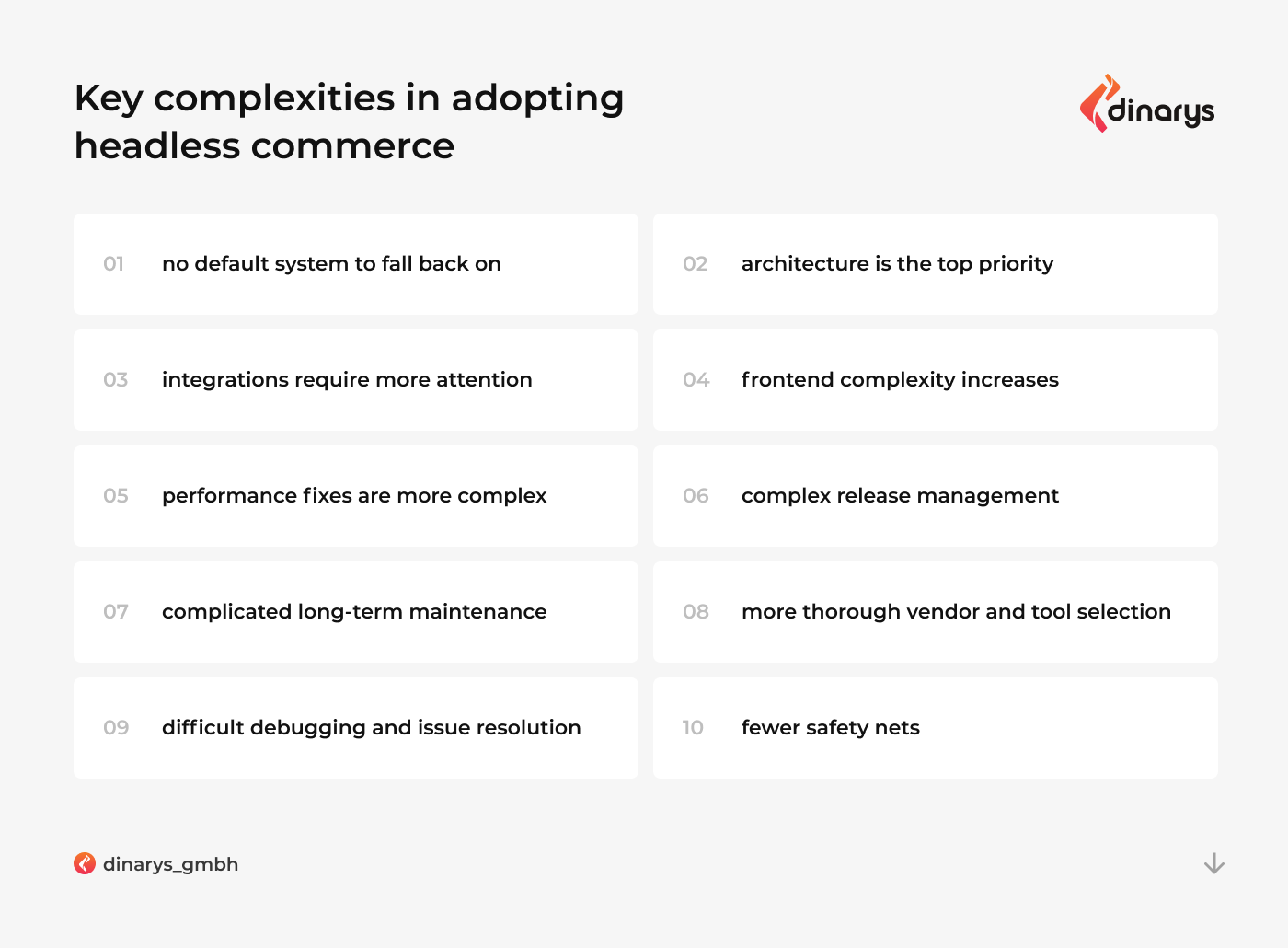
Difficulty #1: There is no default system to fall back on
In traditional platforms, many decisions are already made. There is a standard way to handle catalogs, checkout, customer data, and integrations. Even when customization is required, it happens within a defined structure.
Headless removes that structure. There will be no default:
how the frontend should communicate with backend services
how data should be structured across systems
how checkout flows should be orchestrated
how errors should be handled across services
Everything needs to be customized and defined during implementation.
This creates freedom, but also responsibility. Teams without experience tend to recreate patterns inconsistently: different parts of the system follow different logic, which becomes difficult to maintain.
Difficulty #2: Architecture becomes the top priority
In a headless setup, architecture isn’t a background concern. It defines how the system behaves every day. Decisions about service selection (commerce engine, CMS, search, etc.), API structure, data ownership, and communication patterns directly affect how stable, flexible, and scalable the system will be.
Poor architectural decisions often don’t fail immediately. They show up later, when:
adding new features becomes slower
integrations start conflicting
performance degrades under load
Experienced specialists design systems with these future states in mind, not just initial delivery.
Difficulty #3: Integration is no longer a secondary task
In headless systems, integrations are not “add-ons.” They are the system. Each service: commerce, CMS, payments, search, analytics — needs to communicate through APIs. This introduces challenges that are easy to underestimate:
Challenge
Description
Impact on System
Data Consistency
Multiple systems (CMS, PIM, ERP) hold related data.
Risk of showing incorrect prices or out-of-stock items if synchronization rules are unclear.
Error Handling
Failures are rarely "all or nothing."
Requires logic for "partial failures," such as an order being created in the database even if the payment or email confirmation fails.
Latency & Performance
Every API call between the frontend and backend adds time.
Poorly optimized "Digital Bridges" lead to slow page loads and a degraded user experience.
Dependency Chains
Services are linked; one failure can trigger a domino effect.
If the Search API goes down, the entire product catalog might become invisible to the customer.
Teams without integration experience often build connections that work in ideal conditions but fail under real-world usage.
Difficulty #4: Frontend complexity increases, not decreases
Headless is often associated with modern frontend frameworks, which can give the impression that frontend work becomes easier or more flexible. In reality, frontend responsibility expands.
The front-end is no longer just a presentation. It becomes responsible for:
orchestrating API calls
managing state across multiple services
handling fallback scenarios
ensuring performance and responsiveness
From development vendors, this requires:
strong knowledge of frameworks like React, Vue, or Next.js
understanding of data fetching strategies
experience with caching, SSR, and edge rendering
Without this, frontends become slow, inconsistent, or difficult to extend.
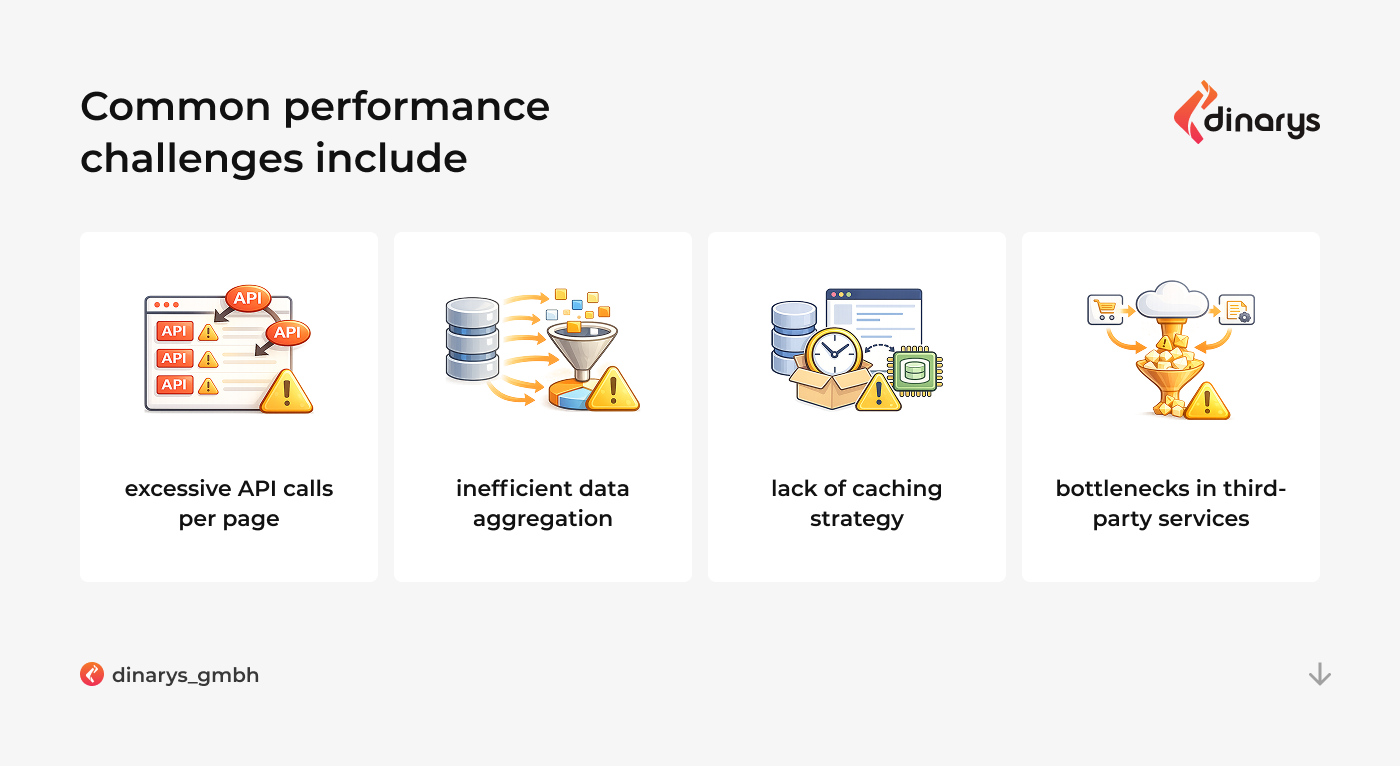
Difficulty #5: Performance is a system-level concern
In monolithic platforms, performance issues are often tied to backend logic or infrastructure. In headless systems, performance depends on how the entire system is assembled.
These issues aren’t solved by scaling infrastructure alone. They require:
thoughtful orchestration
efficient API design
clear separation of responsibilities
Experienced teams design for performance from the start, not as a later optimization.
Difficulty #6: Release management becomes more complex
Coordinating releases becomes more challenging as:
changes in one service can affect others
API changes require versioning and backward compatibility
deployment timing needs alignment across teams
Without proper processes, teams face broken integrations, inconsistent environments, and difficult rollbacks. In turn, for business these mean:
Revenue loss due to checkout failures or incorrect pricing being shown to customers.
High "hidden costs" as developers spend time fixing bugs in production that weren't caught in testing.
Prolonged downtime during failures, leading to brand damage and lost customer trust.
Inability to launch new features or campaigns quickly because the system is too fragile to change.
To avoid such problems, teams need discipline in version control, CI/CD, and communication between team members.
Difficulty #7: Long-term maintenance requires system thinking
Headless systems evolve continuously: new services are added, existing ones change, and business requirements shift. Over time, systems tend to accumulate:
undocumented dependencies
duplicated logic across services
inconsistent data flows
Without strong governance, the system becomes harder to understand and maintain. To avoid such negative scenarios, experienced specialists document architecture decisions, enforce consistency across services, monitor system health, and always plan for seamless system scaling in the future.
Difficulty #8: Vendor and tool selection carries long-term impact
Headless architecture often involves selecting multiple vendors and services, including a commerce engine, CMS, search tools, payment providers, and analytics solutions. Each of these choices introduces its own set of dependencies, such as pricing models, API limitations, performance characteristics, and even constraints tied to the vendor’s roadmap.
Changing these components later is rarely simple. It can be both expensive and disruptive, especially once the system is already in use and tightly integrated.
Because of this, experienced teams evaluate tools not only based on features, but also on:
how well they fit into the overall system
how they scale over time
how effectively they interact with other components
Difficulty #9: Debugging and issue resolution are more difficult
In a monolithic system, issues are usually contained within a single environment, which makes them easier to trace and resolve. In headless systems, problems can originate from multiple layers at once: frontend logic, backend services, integrations, or third-party APIs.
Because of this, identifying the root cause requires an understanding of how the entire system works together, not just individual components. What looks like a frontend issue may actually be caused by an API delay or a data inconsistency in another service.
Without that level of experience, teams often end up fixing symptoms instead of underlying problems, introducing temporary workarounds that solve immediate issues but increase system fragility over time.
Difficulty #10: Headless increases freedom, but removes safety nets
The core trade-off of headless architecture is straightforward. It provides more flexibility, fewer constraints, and greater control over how the system is built. At the same time, it introduces more decisions, more responsibility, and more opportunities for things to go wrong.
Unlike traditional platforms, there is no built-in structure enforcing best practices. The system ultimately reflects the quality of its design and implementation, rather than the limitations of the platform itself.
Why experienced specialists with technical capabilities are essential
Experienced headless development teams:
think in terms of systems, not individual features
design architectures that remain stable under change
anticipate integration and performance issues early
balance flexibility with maintainability
understand trade-offs between different approaches
They treat headless not as a trend, but as an architectural responsibility. Without that level of experience, headless projects often:
become harder to maintain than the systems they replaced
introduce new dependencies without removing old ones
slow down development instead of accelerating it
Headless architecture doesn’t simplify ecommerce systems. It makes their structure more explicit. And that structure needs to be designed carefully.
How to evaluate headless ecommerce development companies
Evaluating a headless development company is different from evaluating vendors for platform-based projects.
In traditional setups, much of the structure is defined by the platform (sometimes, legacy platforms). In headless, that structure is created during implementation. This means the quality of the outcome depends heavily on how the vendor thinks about systems, not just how they write code.
At the research stage, the goal is not to verify every technical detail, but to understand how the vendor approaches complexity, trade-offs, and long-term system ownership.
1. Understanding of headless and composable architecture
A suitable vendor should be able to explain headless architecture in practical terms: not as a concept, but as a working system. They should be comfortable discussing:
how services are selected and combined
how responsibilities are distributed across the system
how data flows between components
More importantly, they should explain trade-offs. Headless is not always the right choice. Vendors who position it as universally better often overlook its complexity. Strong teams describe when headless works well and when it introduces unnecessary overhead.
2. Experience with real headless implementations
Experience is not about the number of projects, but about the type of problems solved. Look for vendors who have worked on:
multi-service architectures
API-driven systems
custom frontend implementations
replatforming to headless setups
At this stage, pay attention to how they talk about past work. Do they mention challenges, trade-offs, and limitations? Or only outcomes? Real experience usually includes:
things that didn’t work as expected
decisions that had to be revisited
constraints that shaped the solution
3. Approach to system architecture
Headless systems depend on architecture more than any single technology choice. A strong vendor can explain:
how they design system boundaries
how they define data ownership
how they manage dependencies between services
They should be able to describe their reasoning, not just the final setup. This is important because architectural decisions are difficult to change later. They influence:
performance
maintainability
ability to add new features
Vendors who treat architecture as a secondary step often create systems that are hard to evolve.
4. Integration and API technical expertise
In a headless environment, APIs are the foundation of the entire business ecosystem. Because the storefront and backend are separated, the strength of your commerce operation depends entirely on the quality of the "digital bridge" connecting them.
When evaluating a development partner, their technical stack is less important than their architectural philosophy:
A suitable partner must demonstrate deep experience in both designing and consuming APIs, with a specific focus on the mechanics of data synchronization.
They should be able to articulate clear strategies for handling failures and retries, as well as a proactive awareness of API rate limits and performance constraints that could otherwise throttle your storefront during peak traffic.
More importantly, an expert partner views integration as a cohesive system, not merely a collection of isolated connections. To vet their expertise, move beyond basic functionality and ask how they manage the following:
Partial failures: What happens if a customer’s order is saved, but the loyalty point update fails?
Data conflicts: How does the system resolve discrepancies when a product price is updated in the PIM and the ERP simultaneously?
Long-running processes: How do they handle asynchronous tasks, like generating a massive inventory report, without slowing down the live site?
A partner who cannot explain these scenarios clearly is likely treating your architecture as a simple "plug-and-play" setup. In a real-world production environment, this lack of foresight leads to fragile systems that struggle to scale or recover from routine errors.
5. Frontend development capabilities
In a headless architecture, the frontend is a critical operational layer. Because the traditional "all-in-one" platform is gone, headless moves a significant portion of system complexity to the frontend. This means your digital storefront is responsible for managing data, performance, and user state in ways that a traditional website never had to.
When evaluating a vendor, technical fluency in modern frameworks like React, Vue.js, or Next.js is merely the baseline. A truly capable partner must demonstrate a sophisticated understanding of state management: how the app remembers what is in a user’s cart or their login status across different pages. Moreover, they should be experts in modern delivery methods, such as server-side rendering (SSR), static site generation (SSG), and edge rendering, to ensure that your site is fast and SEO-friendly.
Beyond the tools, the right vendor must understand the deep mechanics of how the frontend interacts with the broader system. You should look for clear strategies on:
Data fetching and caching: How do they minimize API calls to keep costs down and speed up the user experience?
Performance optimization: How do they ensure the site remains lightweight even as more features are added?
Omnichannel consistency: How is the UI maintained so that a customer sees the same branding and logic on a mobile app as they do on a desktop browser?
Ultimately, the front-end in headless is operational. It acts as the brain that coordinates user requests with backend services. If a vendor treats the frontend as a purely visual task, they will likely struggle to build a system that is resilient, scalable, and high-performing in a real-world commerce environment.
6. Performance and scalability approach
Performance in headless systems is not automatic. It must be designed. A reliable vendor should explain:
how they minimize API calls
how caching is implemented across layers
how they manage data aggregation
how they monitor performance over time
They should also be realistic. Performance trade-offs exist, and not all optimizations are free. Vendors who treat performance as a post-launch activity often introduce systems that degrade under load.
7. Delivery process and coordination
Headless projects involve multiple services, teams, and dependencies. Coordination becomes critical. A suitable partner should describe how they structure delivery phases, how frontend and backend teams collaborate, and how changes are communicated across components
They should also explain how they manage:
parallel development
dependency tracking
release coordination
Without this, even well-designed systems can become unstable during delivery.
8. Long-term support and system ownership
A strong vendor must move beyond a "build and leave" mindset. They should offer a structured approach to post-launch support, which includes proactive monitoring and optimization to ensure that API response times and frontend performance stay within acceptable limits. Furthermore, they must demonstrate a commitment to system improvements over time, helping you swap out individual building blocks or upgrade frameworks as the technology landscape shifts.
Beyond basic support, a sophisticated partner will prioritize the long-term health of your digital asset. They should provide a clear plan for maintaining documentation, architectural consistency, and system observability.
9. Realistic expectations and ability to challenge decisions
Headless commerce is frequently marketed as a universal modern solution, a positioning that often creates unrealistic expectations for stakeholders. That’s why, a reliable vendor must act as a strategic advisor rather than just an implementation partner. Their primary responsibility is to clearly explain where headless adds tangible value, such as high-performance mobile experiences or complex multi-region storefronts, at the same time being transparent about the risks regarding cost and maintenance.
A partner with deep expertise will challenge your assumptions when necessary. They should possess the professional integrity to identify:
When headless is unnecessary: If your business requirements can be met by a standard, well-optimized theme on a monolithic platform.
When simpler solutions are more appropriate: If the speed to market or a limited internal DevOps team makes a "plug-and-play" model more sustainable for your current growth stage.
10. Clarity and relevance of services offered
In a mature headless ecosystem, the services a vendor provides must be a direct reflection of real-world project requirements. Because headless commerce is a specialized architecture, a suitable partner should offer deep expertise in replatforming to headless architecture and broader system modernization to ensure your tech stack is future-proof.
Their service portfolio should be grounded in:
API development and integration, which involves building the bridges between services
High-performance frontend development that uses modern frameworks for speed
Prioritizing performance optimization and regular system audits to identify bottlenecks before they impact the customer experience
When evaluating a vendor, pay close attention to how these services are articulated. Clear, specific explanations usually indicate a history of solving actual production problems. In contrast, generic service lists that lack detail often suggest surface-level positioning. A vendor who cannot explain the how behind their optimization or integration services likely lacks the technical depth required to manage a complex, decoupled system.
11. Tool and vendor selection approach
A strong vendor must be able to articulate a clear methodology for how they evaluate tools beyond simple feature lists. They should demonstrate a sophisticated ability to balance "best-of-breed" performance (picking the absolute best search or CMS tool) against system simplicity. Their goal should always be to avoid unnecessary complexity that leads to "integration hell.”
When a vendor focuses only on the "coolest" new tech, they may be ignoring the lifecycle of the project. Tool selection decisions tend to stay with the system for years, and a reliable partner treats these choices as long-term investments. They should be able to explain why a slightly "simpler" tool might be the superior business choice over a more complex, feature-heavy alternative that increases your maintenance burden.
Top headless ecommerce development companies 2026
The headless commerce development companies listed below have experience working with headless and composable architectures across different platforms and industries.
Their work typically involves building API-driven systems, designing frontend experiences, and integrating multiple services into a cohesive headless solution.
This list is not a ranking. Each company operates with different strengths, development cycles, tech stack, platform expertise, headless commerce expertise, and levels of complexity. They should be evaluated based on how well their experience aligns with your system requirements and long-term goals.
Dinarys
Dinarys is a headless commerce agency that helps businesses design and implement headless and composable commerce systems tailored to real operational needs.
Company overview
Headquarters: Berlin, Germany
Operation period: Since 2014
Top clients: Toyota, Accenture, BORN, Panodyssey, Vaimo, Prostor, SanMar Canada
Services provided: Headless commerce development, composable architecture design, replatforming to headless, API development, system integrations, frontend development, performance optimization, composable commerce consulting
Headless ecommerce platforms they work with: Magento, Adobe Commerce, Shopware, Pimcore, Shopify, BigCommerce, commercetools, WooCommerce, Emporix, SAP, Salesforce
Scandiweb is a digital commerce development agency working with enterprise brands on headless and composable commerce implementations, with a focus on scalable system architecture.
Company overview
Headquarters: Riga, Latvia
Operation period: Since 2003
Top clients: Puma, The New York Times, Jaguar Land Rover
Services provided: Headless commerce development, composable architecture, frontend development, system integrations, performance optimization, ongoing support
Headless platforms they work with: Adobe Commerce, Shopify Plus
Certified partners: Adobe Commerce, Shopify Plus
Netguru
Netguru is a software development company delivering headless commerce solutions with a strong focus on modern frontend technologies and API-driven systems.
Company overview
Headquarters: Poznań, Poland
Operation period: Since 2008
Top clients: IKEA, Volkswagen, Keller Williams
Services provided: Headless commerce development, frontend development (React, Vue), API development, system integrations, digital product design
Ecommerce platforms they work with: Shopify, commercetools, custom solutions
Certified partners: Not publicly disclosed
Valtech
Valtech is a global digital agency specializing in enterprise-level headless and composable commerce solutions across multiple platforms and markets.
Headless commerce platforms they work with: Shopify, custom headless stacks
Certified partners: Not publicly disclosed
Wrapping up on headless ecommerce development agencies
Headless commerce gives businesses more control over how their systems are built and how they evolve. At the same time, it shifts responsibility from the platform to the team implementing it. Because of that, the choice of development partner becomes critical. The same architecture can either stay manageable or become difficult to work with over time, depending on how it’s designed.
Selecting a vendor with real headless experience helps ensure the system remains stable, flexible, and aligned with how the business operates.
FAQ
Headless commerce is an architectural approach where the frontend (what users interact with) is separated from the backend (where products, pricing, and orders are managed). These layers communicate through APIs instead of being tightly connected.
This means the storefront is no longer limited by the capabilities of the platform. Teams can build custom interfaces using modern frameworks like React or Vue, while keeping the backend logic stable and independent.
In practice, headless commerce is less about the separation itself and more about how systems are structured. It allows businesses to design their ecommerce experience around their needs rather than adapting to predefined platform logic.
Traditional ecommerce platforms combine frontend and backend into a single system. This makes them easier to set up and manage, as many decisions are already defined by the platform.
Headless separates these layers, which removes those predefined structures. Instead of following a fixed setup, teams define how the system works, how data flows, and how different components interact.
This creates more flexibility, but also more responsibility. The system no longer depends on platform rules — it depends on how well it is designed and implemented.
Headless architecture is typically considered when a business starts facing limitations with its current setup. This can include restrictions in frontend customization, difficulty supporting multiple channels, or challenges with integrations.
It’s also relevant when ecommerce becomes part of a broader system involving CRM, ERP, CMS, and other tools. Managing these connections within a single platform can become difficult over time.
In these cases, headless allows businesses to build a system that reflects how they actually operate, rather than trying to fit their processes into platform constraints.
Headless commerce is not always the best choice for smaller businesses. It requires more development effort, more planning, and ongoing technical involvement compared to traditional platforms.
For businesses with simpler needs, the additional flexibility may not justify the added complexity. Platform-based solutions often provide enough functionality without requiring custom architecture.
Headless becomes more relevant when the business grows beyond those limitations. Until then, simpler setups are usually more efficient and easier to manage.
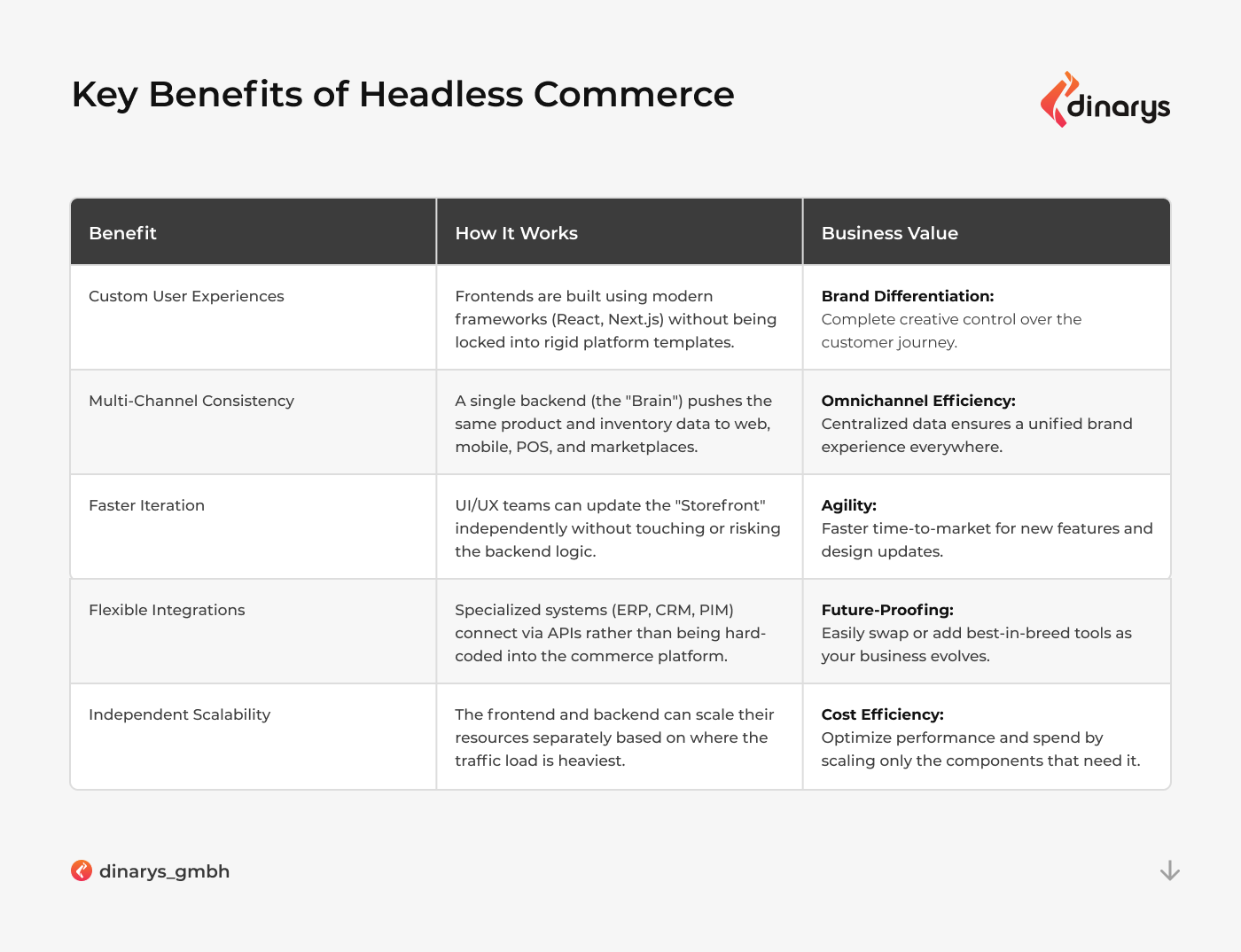
Headless commerce provides flexibility in how systems are built and how user experiences are designed. Teams are not restricted by platform templates or predefined workflows.
It also supports multi-channel operations more effectively. The same backend can serve websites, mobile apps, marketplaces, and other touchpoints through APIs.
Another benefit is the ability to scale and update parts of the system independently. This makes it easier to evolve the platform over time without rebuilding everything.
Headless systems introduce more complexity compared to traditional platforms. Without predefined structure, teams need to design architecture, integrations, and workflows themselves.
This increases the risk of inconsistent implementations, performance issues, and integration failures if the system is not planned carefully. Problems often appear later, as the system grows.
Maintenance can also become more demanding. With multiple services and dependencies, keeping everything stable requires ongoing effort and coordination.
Headless development removes many of the constraints that guide implementation in traditional platforms. This means teams must define system structure, data flow, and integration logic themselves.
Without experience, it is easy to create systems that work initially but become difficult to maintain or scale. Decisions made early can have long-term consequences.
Experienced developers understand these patterns. They design systems with future changes in mind and avoid choices that introduce unnecessary complexity.
Headless systems are usually built using modern frontend frameworks such as React, Vue, or Next.js. These tools allow teams to create custom user interfaces and optimize performance.
On the backend side, businesses use API-based platforms like Shopify, commercetools, Magento, or custom services. Additional tools are often used for CMS, search, payments, and analytics.
The system is composed of multiple services working together. The exact stack depends on business needs and how the architecture is designed.
Choosing a headless development company requires evaluating more than technical skills. It is important to understand how the vendor approaches architecture, integrations, and long-term system ownership.
Look for experience with real headless projects, especially those involving multiple services and complex data flows. Vendors should be able to explain decisions and trade-offs clearly.
A reliable partner will also set realistic expectations. They should explain not only the benefits of headless, but also the risks and limitations.
Headless commerce usually involves higher initial costs due to custom development, system design, and integration work. It requires more effort compared to platform-based solutions.
Ongoing costs can also be higher. Maintaining multiple services, managing integrations, and updating the system over time adds to the overall investment.
However, for businesses with complex needs, this cost can be justified. Headless allows them to build systems that support long-term growth and adapt more easily to change.
Working with top headless commerce agencies or best headless commerce agencies usually means approaching an ecommerce project as a full system, not just a storefront build. Instead of relying on traditional monolithic platforms, these teams design headless commerce builds where the commerce layer is separated from the frontend and connected through APIs.
The development process typically includes custom frontend development using modern JavaScript frameworks, combined with headless CMS solutions or headless CMS platforms for content management. At the same time, backend processes are structured to support integrations, data flow, and scalability. This approach allows businesses to build scalable online stores that can evolve over time rather than being limited by platform constraints.
Experienced industry leaders in headless CMS development and development services also focus on long-term outcomes. Their development solutions usually include project management, post launch optimization, and continuous improvements to support business growth. As a result, headless storefronts become part of broader enterprise solutions that connect online stores with the rest of the business rather than operating as isolated systems.
You may share this article
Let professionals meet your challenge
Our certified specialists will find the most optimal solution for your business.