Content
E-Commerce
Nov 10, 2026
Filters, Guided Selling or an AI Shopping Assistant for Complex Products?
Time to read: 6 minutes

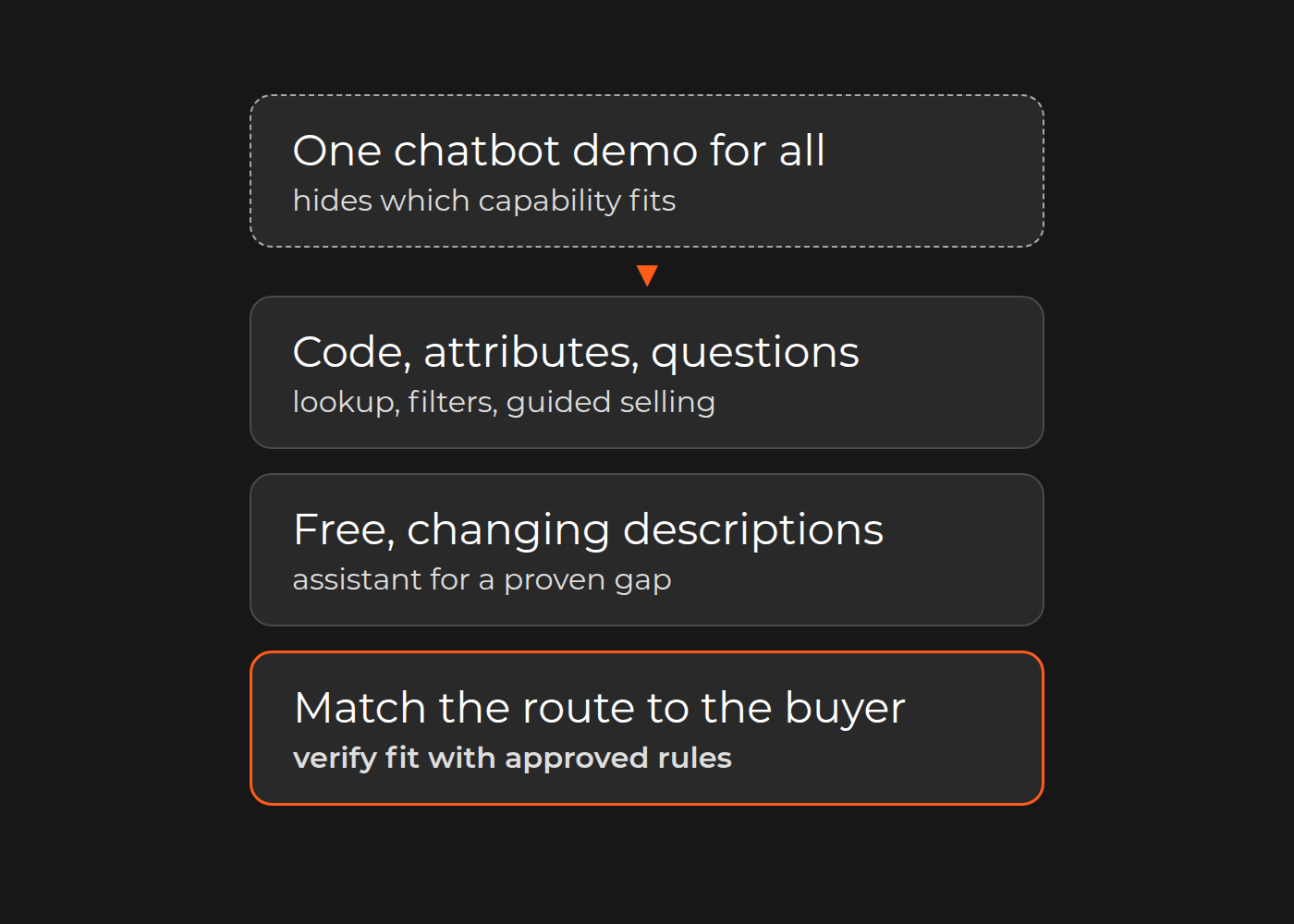
One buyer enters a product code. Another describes a job. A third supplies a photo. Comparing all three through one polished chatbot demo hides which discovery capability you need.
Use filters when buyers know the attributes, guided selling when a predictable question sequence determines the choice, and an assistant when flexible clarification solves a demonstrated gap. Preserve direct lookup for known items. Semantic and visual search can find candidates without replacing the evidence needed to verify fit.
Run representative buyer tasks through your current search and filters first. Correct missing fields, confusing labels, and approved synonyms where those explain the failures. If that resolves the task, stop. Catalog size alone does not establish a need for a language model.
Match the capability to what the buyer knows
These routes can coexist. They are not successive upgrades, and “native” describes where a capability comes from—not how it matches. Inventory the functions actually configured in your platform before adding another product.
A code or known attributes: exact lookup and filters
Keyword/exact lookup suits a SKU, product name, or recognized term. Compare identifier variants and approved synonyms against the existing search. A synonym bridges vocabulary; it does not establish substitution or compatibility. Keep the direct code route even if you add guided selection elsewhere.
Filters and comparison suit known dimensions, material, model, or other attributes. Check whether buyers can reach matching records and understand their differences. Missing fields, inconsistent units, and unfamiliar labels can defeat an adequate filtering capability.
A description or image: semantic and visual discovery
Semantic or hybrid search is worth comparing when varied descriptions fail despite useful catalog data. Test familiar and unfamiliar wording: does broader matching find relevant candidates without flooding results with unrelated items? A language-matching gap alone is not a reason to add conversation.
Visual search may help appearance-led discovery from an authorized reference image. Compare it with text and category browsing. Similar appearance can hide different dimensions, hole patterns, or revisions. The useful output may be lookalikes followed by a model question—not a final recommendation.
Unresolved requirements: guided questions or an assistant
A rule-based quiz or configurator suits a predictable question sequence with approved answers and rules. Compare it with a clearer model filter: do the questions help buyers who would overlook that field? Long or unexpected branches need an exception route and add maintenance work.
An AI shopping assistant is worth investigating when buyers describe needs freely, answer out of order, or correct earlier details in ways a fixed flow handles poorly. Compare completed selections, clarification, backtracking, corrections, and time. Fluency is not evidence that the product satisfies the need.
Run different routes against one category
Use permitted queries and consultation examples with acceptable outcomes approved by a product expert. Keep catalog data, buyer account, and visibility rules the same across options. Otherwise, a route with broader permissions or cleaner source data can appear better for the wrong reason.
Fictional example: a buyer wants a refill for an A4 six-ring binder. FIT-v2 requires the model and documented hole pattern. For model B-6, R-6 is approved; R-2 is a two-ring refill not approved for B-6; R-6U has no approved relationship even though it resembles R-6.
| Buyer task | Useful route to compare | Correct outcome |
|---|---|---|
| Enter “R-6” | Existing exact lookup | Find the named eligible item |
| Choose A4 and six-ring | Attribute filters | Attribute matches, not a fit claim |
| Select “fits B-6” | Maintained model filter | R-6 under FIT-v2 |
| Ask for refill without model | Quiz versus assistant | Ask model, then apply approved rule |
| Supply a photo or vague phrase | Visual/semantic discovery | Candidates; clarify model before fit |
Filtering may return R-6U as an attribute match without establishing model compatibility. A quiz and an assistant can both collect the missing model. If the buyer cannot identify it, or no approved fit record exists, every route needs an honest verification or expert-handoff outcome. Do not score a discovery list as a verified selection.
The ecommerce lead owns the buyer tasks and current baseline; the catalog expert approves fit; the search/IT lead checks access, relevance, refresh behavior, and integrations. The budget owner needs a shortlist with retained operating effort—not a blended score that hides wrong-fit recommendations.
Include the work required to keep each route correct
Ask the intended operator to demonstrate one ordinary change for every shortlisted capability:
- Filters: add an attribute or model relation, expose it, and check labels and units.
- Keyword search: add a synonym and inspect a near-identical identifier for unwanted matches.
- Semantic/hybrid search: change a description and inspect candidate and ranking changes.
- Visual search: replace an image and check rights, image-to-SKU mapping, and near-identical products.
- Quiz: change a model rule and update affected questions and branches.
- Assistant: change a product rule and replay conversations that used it; inspect retrieval, dialogue, and exceptions.
A quiz that is awkward only on rare exceptions may still beat a conversation requiring broader monitoring. Conversely, an assistant may cover important tasks the quiz cannot handle acceptably. Use task frequency, consequences, and observed effort to decide.
For any route that reaches cart or quote, check the current price, stock, account eligibility, and valid SKU at handoff. An assistant’s earlier answer must not override authoritative commerce data. Preserve the collected context when a person needs to finish the request.
Configure, buy, or build only the missing capability
Configure existing functions when the platform can represent the required fields, matching, or questions. Include catalog preparation and storefront work in the estimate; native does not mean zero work.
Buy a specialist product when a packaged capability covers the gap. Examine feed/API mapping, languages, interface coverage, refresh behavior, data terms, export/exit, and retained operator work. Packaged does not mean zero integration.
Build an extension when a documented rule or integration gap remains. Define that uncovered logic and its support owner instead of duplicating the search stack by default. Without scoped quotes and internal effort estimates, comparative cost and ROI remain unknown.
Dinarys sells catalog and commerce engineering, including custom work, so it has an interest in this decision. Its BigCommerce case describes AI-assisted categorization, names/SKUs/images, menu customization, and custom request-to-quote for an unnamed office supplies product wholesaler. The published scope covers more than 137,000 products in a three-month project. This supports catalog and interface components—not a recommendation algorithm, compatibility engine, shopping assistant, or search-uplift claim.
If the real gap is source attributes or their distribution, consider PIM services. If inconsistent listings and categories block selection, catalog management services are the nearer service route. The appropriate result can still be a configuration change rather than a custom build.
Leave with a capability shortlist, not a chatbot commitment
Record each unresolved buyer task, current coverage, the candidate route, required data/rules, and its maintenance owner. The answer may be lookup plus a quiz, keyword plus semantic retrieval, or visual discovery followed by a model selector. Formal acceptance tests come after this capability choice.
Talk to Dinarys about the remaining gap with a sanitized category sample, reviewed buyer queries, approved fit and exclusion rules, current search configuration, account constraints, and the route shortlist. Those inputs support a comparison of configuration, specialist software, and custom integration on the same catalog—without assuming an assistant is the destination.


Let professionals meet your challenge
Our certified specialists will find the most optimal solution for your business.