Content
E-Commerce
Nov 10, 2026
Ecommerce Support Is Growing Faster Than Orders: What Should Change?
Time to read: 5 minutes

The FAQ bot replies, but an operator still opens the order system, checks the shipment, and decides whether a change is allowed. A faster answer has not removed the work. It may have added another interaction before the real work begins.
To reduce ecommerce support workload, change the journeys that require current order data or a permitted action—and repair the upstream faults creating avoidable contacts. For a Head of Support or CX, the first decision is which work needs to change, not which AI agent to buy.
Confirm that contacts are outgrowing orders
Compare support and order volumes using consistent definitions and comparable periods. Count unique customer journeys as well as tickets: chat and email about the same shipment are two contacts, but may represent one customer need. Preserve both as effort without counting them as independent needs.
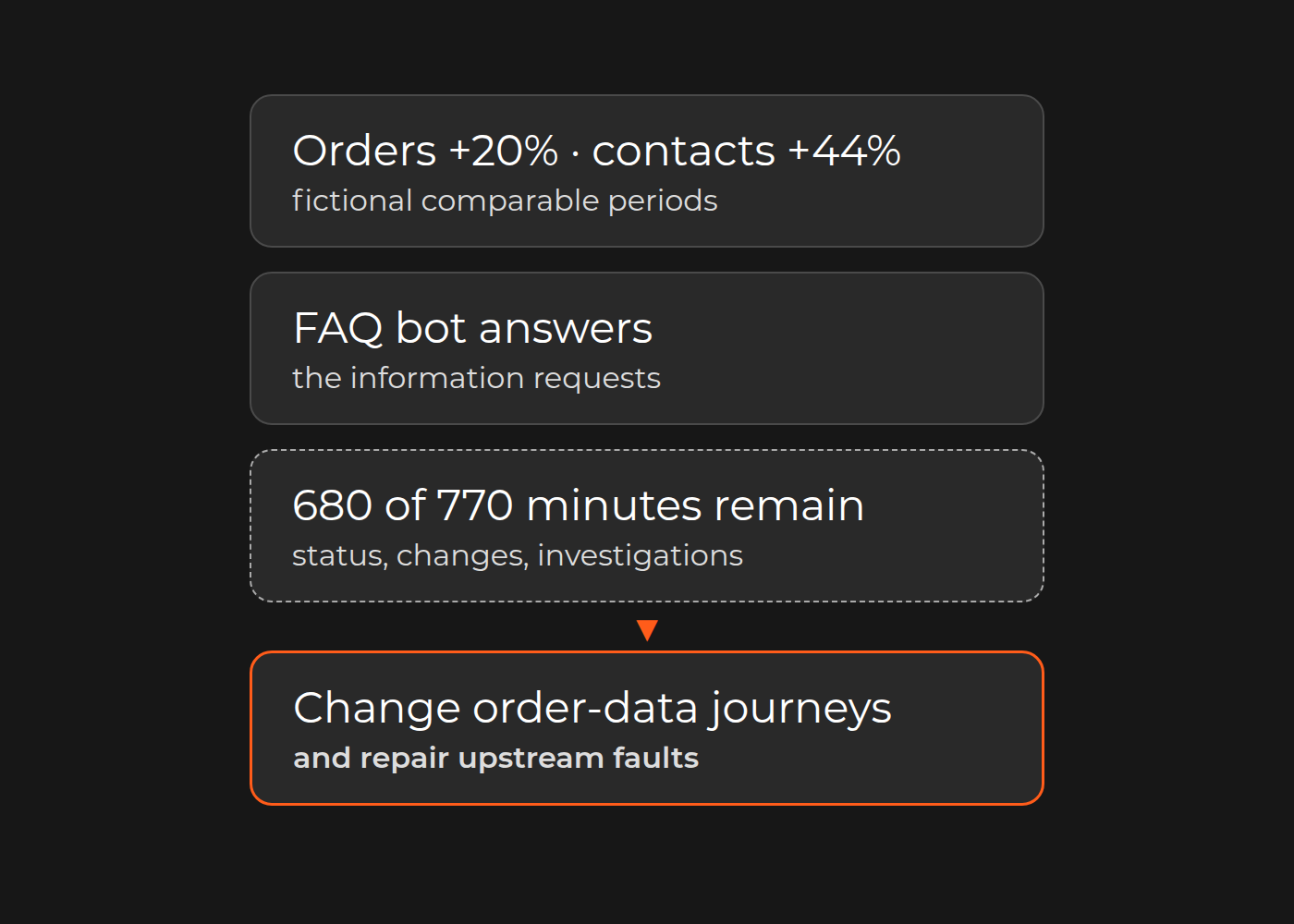
In a fictional business, 10,000 orders generate 1,500 contacts: 15 contacts per 100 orders. In the next comparable period, 12,000 orders generate 2,160 contacts: 18 per 100. Orders grew 20%; contacts grew 44%. These figures justify investigation, not a diagnosis.
Contacts this month may concern earlier orders. Where possible, compare order cohorts after the same observation window. Check channel-counting changes, product mix, market, subscription versus one-off orders, and incidents before interpreting the overall rate. If a delivery incident explains the rise, address that incident rather than treating the increase as evidence that you need a new support tool.
Classify the customer's primary need
Use a minimized, authorized ticket sample. Classify each journey once by its primary need, then record any suspected upstream failure separately. This keeps the request in one primary-need total while preserving the possible cause.
| Primary need | Evidence needed | Likely intervention |
|---|---|---|
| General information: return window | Approved policy and version | Clearer content, macros or native FAQ automation |
| Order information: shipment status | Verified ownership; current OMS/carrier status and timestamp | Authorized read access or better status communication |
| Business action: address change | Ownership, permitted action, current state and cutoff | Controlled workflow with confirmation and escalation |
| Investigation: conflicting tracking | Source timestamps, precedence rules and incident context | Human investigation, not an invented status |
Record contacts, active handling time, waiting time, system switches, escalation, repeat contacts, final evidence and owner. A quick policy question may occur more often than a complex order exception but consume less total effort.
Turn the sample into a workload decision
Here is a fictional 100-journey sample. Information requests take 90 active minutes, status checks 210, permitted changes 200, and investigations 270: 770 minutes in total. Even eliminating every general-information minute would leave 680 minutes of work. That is why a high FAQ answer rate can coexist with an unchanged queue.
Record your own sample in a simple journey map: one row per customer journey, with its primary need, contacts, active and waiting time, escalation, suspected upstream cause and owner. Link contacts belonging to the same need with a journey ID, and keep suspected causes separate from confirmed causes. Do not put names, addresses, payment data or message bodies in a shared analysis file.
Trace avoidable contacts to the owning process
Add tags such as missing communication, stale data, unclear policy, fulfillment incident, checkout defect or unknown. A support label is a hypothesis until operational evidence supports it.
- “Where is my order?” rises after a carrier delay: compare carrier and order management system (OMS) timestamps with the fulfillment and integration owners. Better answers cannot repair a missing shipment event.
- “My promo code did not apply”: ask ecommerce to reproduce the affected cart and promotion before attributing the problem to customer error.
- “Charged but no confirmation”: reconcile payment state with order creation before advising another attempt. Authorization alone proves neither settlement nor a lost order.
A status journey can also carry a verified delivery-failure tag. Do not add it to the journey total a second time. Send the underlying defect to the team that can change it; support should not become the permanent workaround.
There is relevant engineering behind this distinction. Dinarys' Untamed case describes engineers working under the client's CTO to build a customer subscription-management system, integrate a React dashboard and develop its backend. That is a concrete example of changing self-service capability, not proof of a production AI support agent or a transferable ticket-reduction rate.
When the obstacle is inconsistent operational data, the SanMar ERP integration case is the closer component example: Dinarys built a custom API connector to translate legacy ERP data for Magento B2B and B2C sites. It supports the integration approach, not a claim that SanMar used AI to resolve customer contacts. A demonstrated data gap can therefore lead to ERP integration work, rather than a new chatbot.
Decide what a successful change would complete
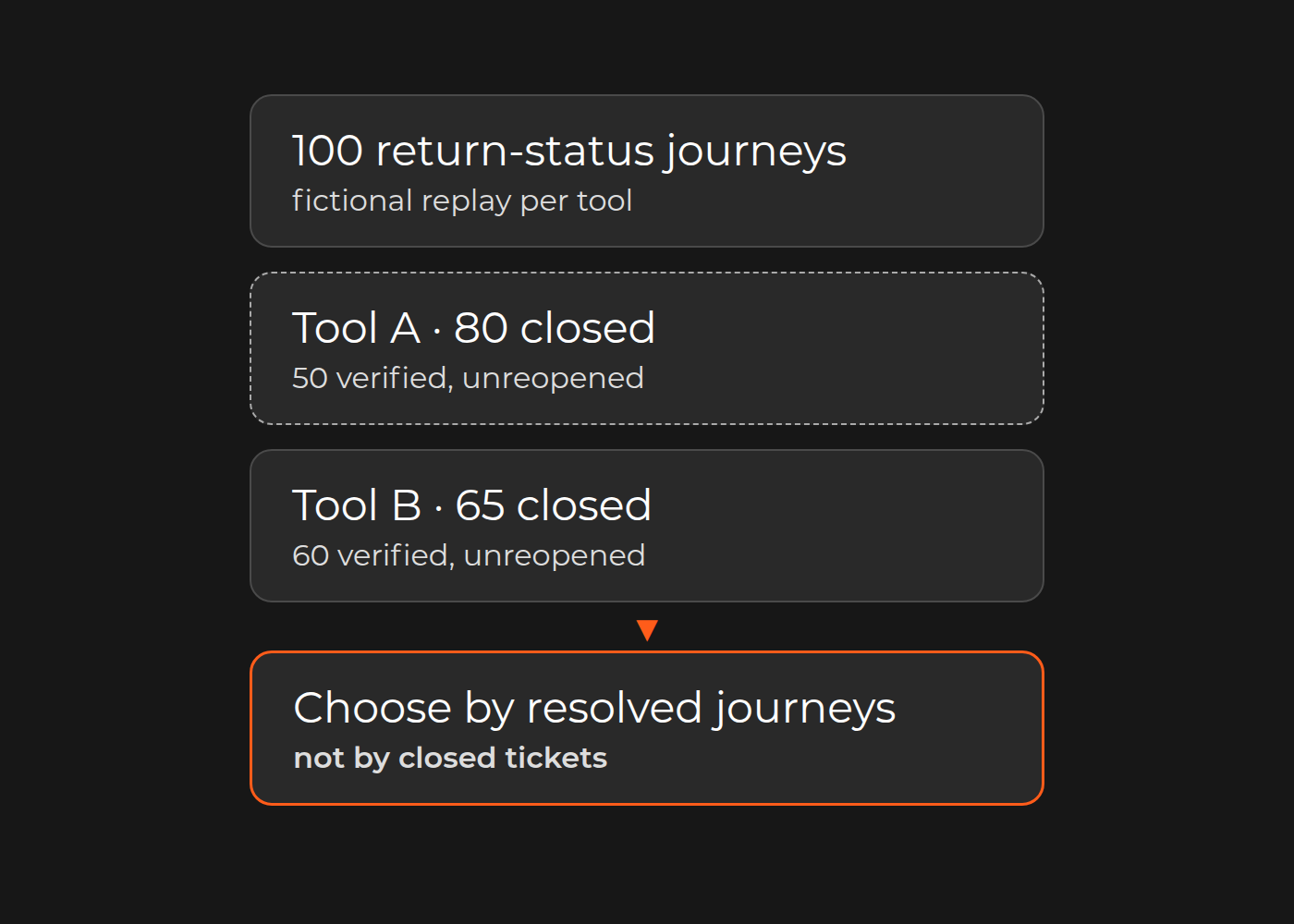
For information needs, require a correct, relevant answer grounded in the appropriate source. For actions, require authoritative confirmation of the permitted change. Observe whether the same need returns within an agreed window; silence alone does not verify resolution. Keep unknown outcomes visible.
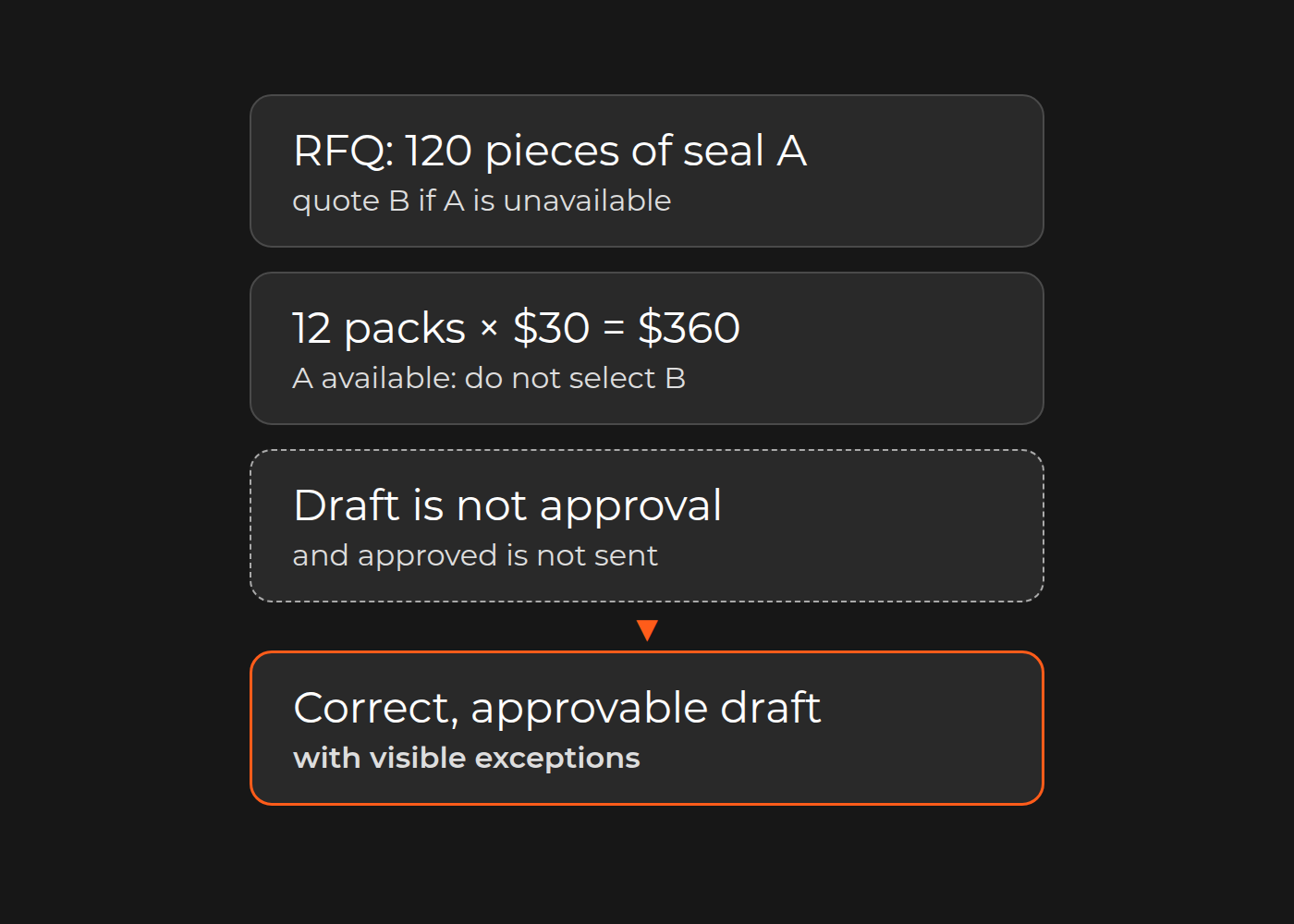
For example, an address-change request is not complete because the conversation says “done.” The authorized customer must have changed the intended order before the fulfillment cutoff, the order system must confirm the new state, and support must be able to retrieve the action record. If the parcel is already committed to dispatch, a clear handoff may be the correct outcome instead.
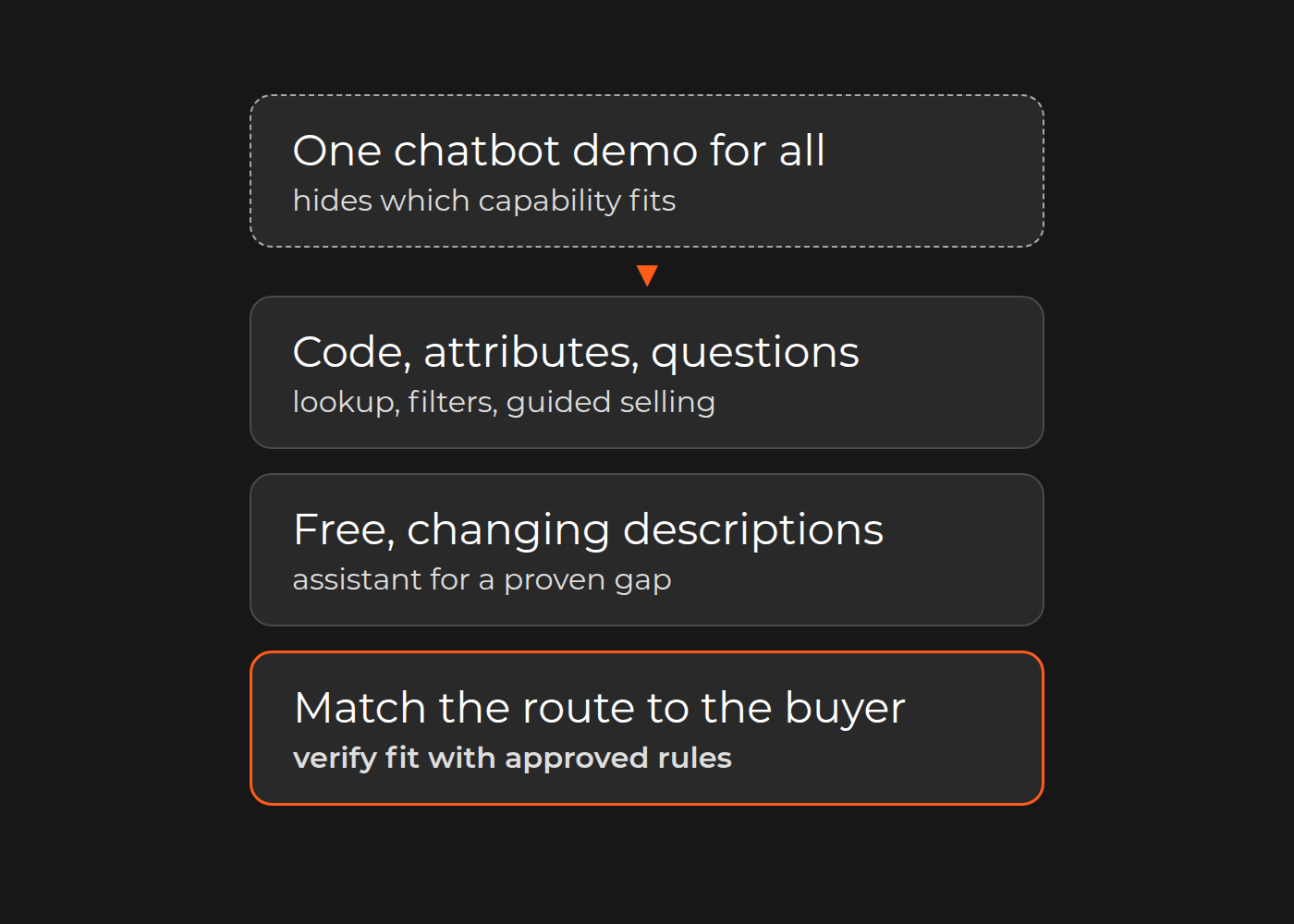
Once you have identified worthwhile journeys, compare native helpdesk automation, workflow integration and AI agents on those same examples. Product selection comes after this diagnosis; implementation acceptance should then test permissions, completion and escalation—not just the quality of a reply.
Select one intervention—not an automation target
Choose a frequent, bounded journey with clear policy, available source data and checkable success. Read-only order-status assistance may be a better starting point than a financial action. Identity, ownership, freshness and disagreement handling still need explicit tests.
Use native helpdesk configuration or a standard connector if it covers the need. Repair upstream faults with the commerce or fulfillment owner. Consider custom integration only for a demonstrated gap in current data or a permitted workflow—not merely to add a conversational interface.
Discuss your ticket sample with Dinarys. Bring anonymized journeys, the order-cohort observation window, handling-time definitions, existing helpdesk/OMS connections and the source-system owner. Support should accept the workflow, IT/security should approve access, and the COO or ecommerce budget owner should decide the scope. The next step is one justified change with an accountable owner and evidence of completion.


Let professionals meet your challenge
Our certified specialists will find the most optimal solution for your business.