Content
E-Commerce
Nov 10, 2026
Payment Declined or Checkout Broken? Finding the Orders You Really Lose
Time to read: 6 minutes

You paid for the visit, the buyer selected a product, and checkout started. Then the funnel stopped. That gap does not tell you whether the customer rejected the shipping cost, their issuer declined payment, authentication was unfinished, or payment succeeded while the store failed to show an order.
The funnel report cannot tell you “declined or broken.” Separate the causes by joining the browser journey to the payment provider state and the order record. For a CMO or Head of Ecommerce, the first decision is which repeatable problem segment needs attention—not whether every incomplete checkout was a recoverable sale.
A decline is not proof of a broken checkout
An issuer decline is a payment decision, not automatically an application defect. A fraud block, invalid request, network interruption and unfinished customer authentication need different handling. Stripe's decline documentation distinguishes issuer declines, blocked payments and invalid API calls. Other providers have their own status and reason taxonomies; use your provider's evidence rather than translating every failure to “declined.”
A checkout interface can still handle a legitimate decline badly—for example, by losing the cart or offering no useful next step. That UX defect is separate from the issuer's decision. Conversely, a missing browser confirmation does not establish payment failure. Check the authoritative provider state and corresponding commerce order.
Follow the evidence from browser to order
Use authorized records without card details or unnecessary customer data. Ask analytics, payment and commerce owners to agree identifiers, timestamps and definitions. One checkout journey can have several payment attempts, and one provider event can have several deliveries. Retain those records, but classify the journey once at an agreed checkpoint. Keep pending and unknown outcomes visible; extend observation when the payment method requires it.
Browser journey: an absent event is not abandonment
Retain the checkout/attempt reference, steps, validation errors, device/browser and payment-return behavior. Ask analytics to distinguish a measurement failure from an observed exit. Consent settings, blocked scripts or interrupted navigation may leave the browser record incomplete; the payment and order records must still be checked.
Cart rules: an unavailable option may be policy
Retain the cart version, promotion, currency, delivery method, guest/login state and expected total. Compare displayed totals and eligibility with the business-approved result. An unexpected fee may need a commercial decision or clearer presentation; it is not necessarily a payment fault. A control-cart matrix helps reproduce conflicts across promotions, payments and fulfillment.
Provider state: authorization is not capture
Keep the provider reference, attempts, status/reason, amount, currency and state time. The payment owner distinguishes a decline from pending authentication, an invalid request or another provider-specific outcome. Do not bypass risk controls or retry indiscriminately.
Commerce order: a row is not payment completion
Check the order reference, state, total and linkage to relevant attempts. An authorization without a matching order requires reconciliation; an order row without the required payment state is also incomplete evidence. Assign the payment/commerce integration owner rather than treating either record as conclusive alone.
Event processing: delivered is not created
Retain event references, delivery and processing state, and the reconciliation outcome. A webhook reaching an endpoint does not prove that the downstream order was created. Locate the failed boundary before deciding whether repair belongs to event processing, order creation or instrumentation.
Worked example: 100 starts, several different problems
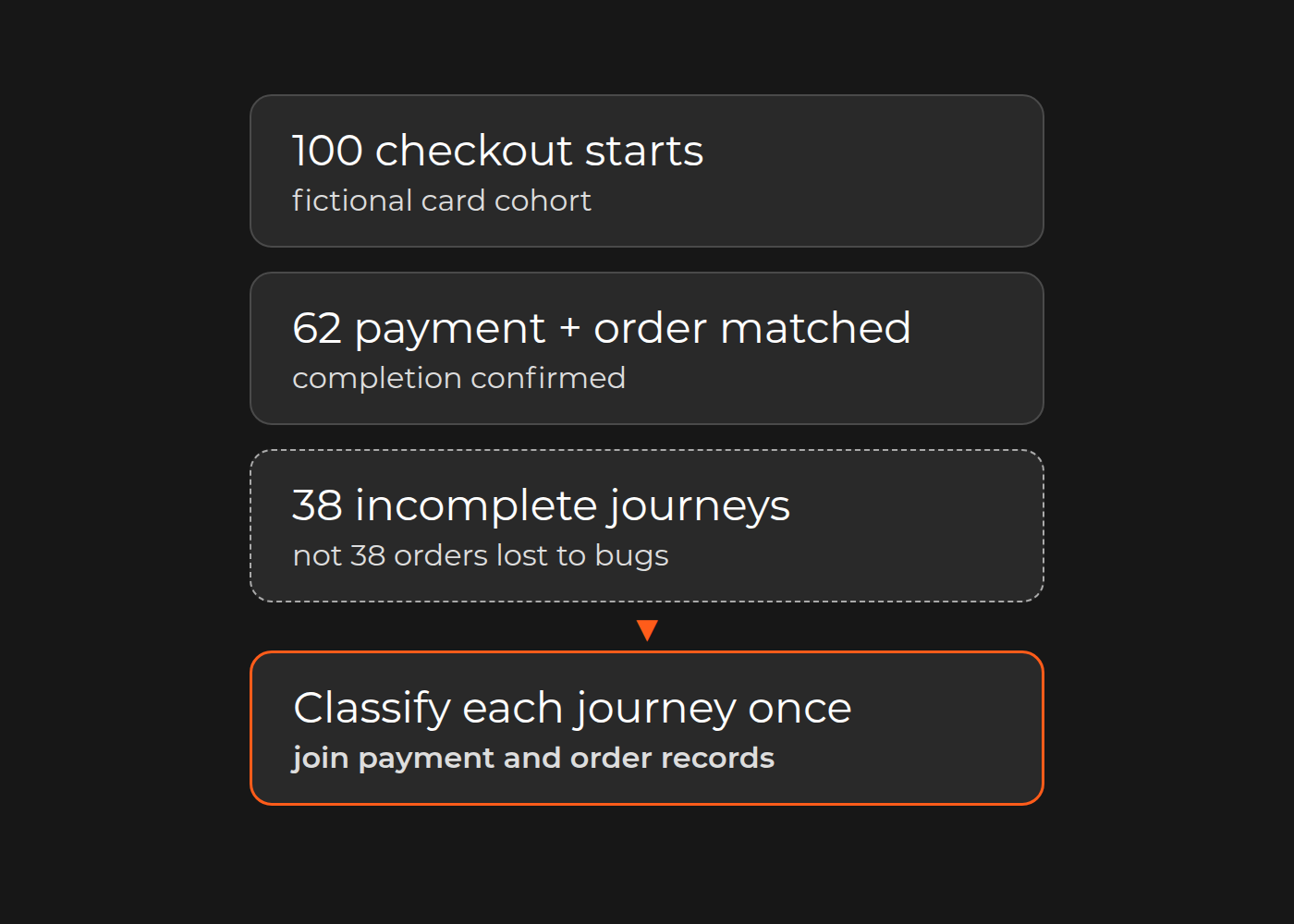
This is a fictional card-checkout cohort, not an audit or client result. At a defined 24-hour investigation checkpoint, 100 unique journeys have these mutually exclusive classifications:
| Classification at checkpoint | Journeys | Meaning |
|---|---|---|
| Matching successful payment and order | 62 | Joined completion condition met |
| Authorization present; order absent | 5 | Reconcile; not five proven captured payments |
| Only observed attempts ended in issuer decline | 10 | Inspect decline handling, not ten assumed application failures |
| Explicit authentication incomplete | 8 | Inspect authentication/return flow; cause unknown |
| No payment attempt observed | 12 | Exit, validation friction or missing measurement |
| Insufficient/conflicting linkage | 3 | Unknown until reconciled |
| Total | 100 | One classification per journey |
The six categories sum to 100; attempts and event deliveries are supporting records, not additional lost orders. If the ten decline-only journeys contain 14 declined attempts because four buyers tried twice, the journey count is still ten. Stripe likewise advises analyzing unique declines rather than inflating the rate with failed retries.
Do not multiply all 38 incomplete journeys by average order value and call it revenue lost to bugs. The five mismatches may still be pending or recoverable through reconciliation. The 12 journeys without an observed attempt do not establish voluntary abandonment.
When can you call a journey lost?
Agree the endpoint with payment and commerce owners: the method's pending period has ended, known attempts and linked orders have been reconciled, and no completed order exists for that purchase journey within the observation window. Report confirmed non-completions by established cause, alongside pending, unlinked and unknown journeys.
The example table is an investigation checkpoint, so it cannot yet supply that final count. A mismatched authorization may later acquire an order; a declined buyer may complete through another linked attempt. To identify orders lost to a checkout defect, add reproduced failure evidence and distinguish it from commercial exits and payment decisions. Even then, recoverable revenue needs a separate estimate with explicit assumptions about whether buyers would complete.
Segment to find a reproducible pattern
Break the joined map down by device/browser, payment method, delivery option, promotion, currency and guest/login state. Keep the denominator beside each count. Ten failures among 20 journeys and ten among 2,000 deserve different interpretations, but a small segment is not conclusive evidence of cause.
If four of the five fictional mismatches occur on a mobile browser after returning from payment, that is a lead—not proof that the browser caused them. Check the provider timeline, order creation and event processing. A common backend delay may affect those same journeys.
Reproduce the suspected condition in an authorized sandbox with approved fixtures and no real transactions. Inspect successful and unsuccessful controls. A repeatable failure connected to logs is a stronger engineering brief than a high abandonment percentage.
A relevant delivery example—not your diagnosis
The Prostor case describes Dinarys' Magento 2 migration and checkout work including OTP authentication, bank card tokenization and guest checkout, alongside loyalty and pickup integration. Those are concrete purchase-flow components. They do not identify the cause of your failed payments or establish a checkout uplift you can expect. Use the case to ask how an implementation team coordinates identity, payment and order-state changes—not as evidence that a redesign is already justified.
Bring one checkout segment for a loss map
Discuss a checkout loss map with Dinarys. Bring permitted, minimized funnel and payment/order records, known problematic carts, the observation window and the payment, delivery and order-state owners. Share no card data. Ecommerce should set the business priority, IT/payment owners should validate the failure, and the authorized budget owner should approve the repair scope.
The next decision is whether one setting or support fix is enough, or a segment needs coordinated UX, rules and integration work. Ecommerce testing services provide a relevant route for a reproducible checkout test scope. Before releasing a fix, define checkout acceptance tests that verify the linked payment/order outcome and recovery paths—not just a confirmation screen.


Let professionals meet your challenge
Our certified specialists will find the most optimal solution for your business.