Content
E-Commerce
Nov 10, 2026
Slow B2B Quotes Are Consuming Your Sales Engineers' Time
Time to read: 5 minutes

While an engineer deciphers an RFQ and searches for an acceptable alternative, the salesperson may have nothing useful to send. But “quoting is slow” does not tell a sales director what to fix. Reading the request, selecting products, calculating terms, and waiting for approval are different bottlenecks.
Time those stages on a sample of one recurring request type, separating hands-on minutes from waiting. Compare delays and their reasons before choosing intake, catalog, pricing, or approval work. The longest stage is a starting point, not proof that its work can safely be removed.
For a technical distributor or manufacturer, the first decision is not which AI tool to buy. It is whether the delay is repetitive clerical work, missing product knowledge, or a commercial decision that still needs an accountable person.
Follow the request, not just the document
Choose a recognizable RFQ family, such as spare-parts lists for one product group. Follow requests from receipt to authorized response. Combining standard reorders with drawing-dependent assemblies produces a poor baseline.
Record four separate stages:
- Interpret the RFQ. Capture requested items, quantities, units, attachments, and missing information. An unreadable drawing revision is unresolved, not permission to infer a specification.
- Identify products and alternatives. Separate customer part numbers from sellable SKUs. Record pack conversions, compatibility checks, and substitutions requiring engineering or customer review.
- Establish commercial terms. Retrieve the authorized price, customer agreement, minimum order quantity, currency, and validity. Yesterday’s quote is not necessarily today’s authorized price.
- Approve and transmit. Keep an internally complete draft, approved offer, and sent response distinct. Software status alone does not confer commercial authority.
Your current tooling may cover some of this. Adobe Commerce’s negotiable-quote documentation describes drafts, review, and negotiation with prerequisites for its B2B functionality. Inspect that existing workflow before adding software; it does not establish technical-document extraction or your installation’s entitlement.
Measure active work separately from waiting
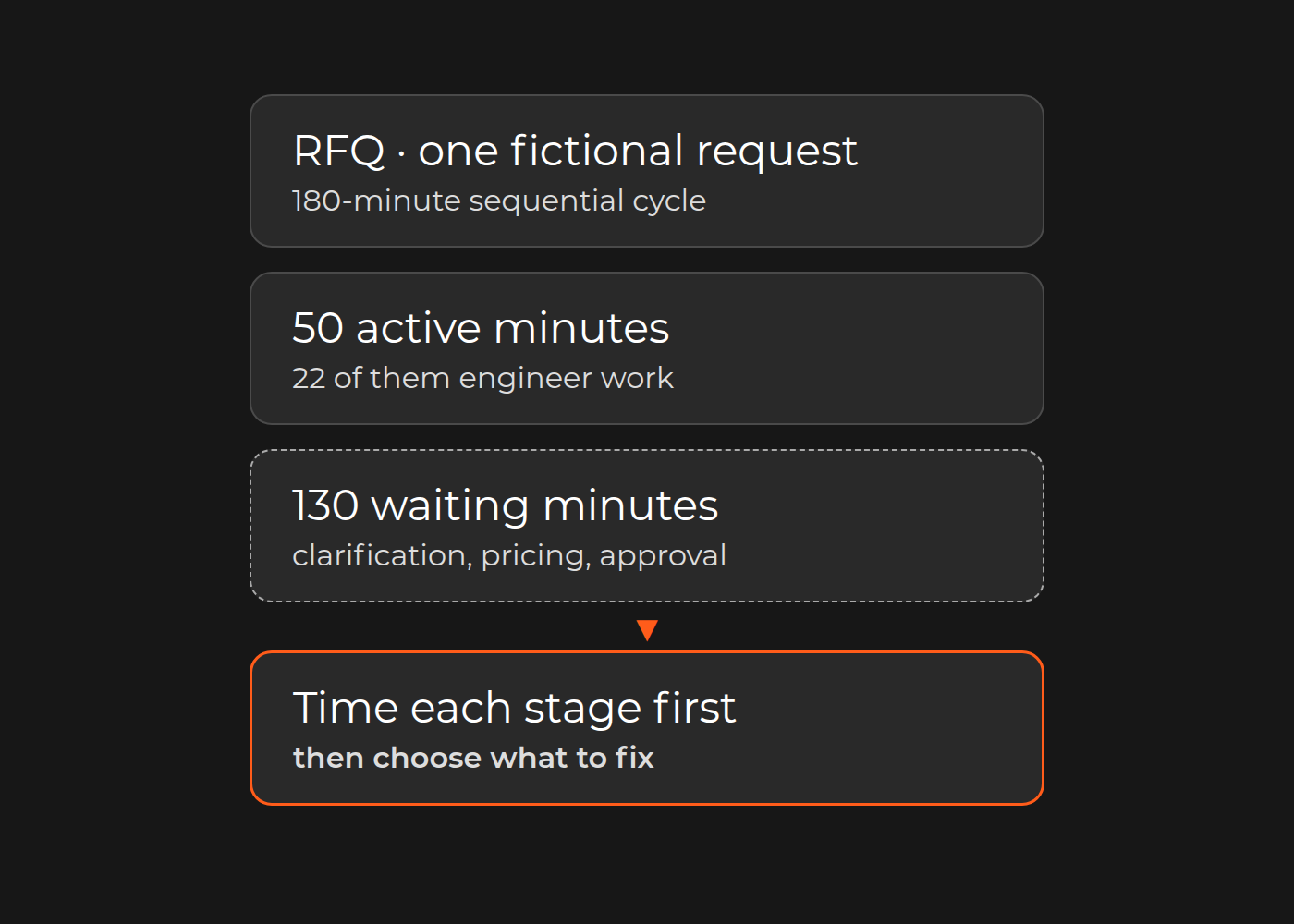
The following fictional single request assumes sequential steps on one working day, no overlapping work, and working-minute durations. It is not a benchmark or a Dinarys result.
- RFQ reading: 8 active minutes; 30 waiting. Which drawing revision applies? Sales desk owns clarification.
- SKU/alternative selection: 22 active; 40 waiting. Is the requested seal compatible? Sales engineering validates it.
- Price and terms: 12 active; 20 waiting. Does the agreement cover this pack? Pricing decides.
- Approval/transmission: 8 active; 40 waiting. Who can approve the exception? Commercial approver owns it.
That totals 50 active minutes and 130 waiting minutes: a 180-minute sequential cycle. Only the 22-minute selection step is engineer work in this example. The quote can be slow without engineering being the dominant bottleneck.
Even removing all eight reading minutes leaves 172 minutes if nothing else changes. This is arithmetic, not a saving forecast. Compatibility work may contain valuable judgment, while an approval queue may need clearer delegation or scheduling rather than AI.
To build your own time map, copy the four fictional rows above into a spreadsheet and replace them with an authorized sample before drawing conclusions. Add receipt, first response, completed draft, approval, transmission, and open/withdrawn status to your real request-level record.
For real work, separate customer-response pauses, use consistent calendars, and do not sum overlapping tasks into elapsed time. Keep both the customer-facing clock and internal working-time clock so the team cannot appear faster by excluding difficult requests.
Keep the hard requests in the evidence
Include unanswered, withdrawn, and still-open RFQs. Completed-only reports hide backlog aging. Record line count, complete versus unresolved lines, exception reasons, rework, and engineer touch time separately from sales administration.
Review the distribution, not just the mean. A long tail of drawing clarification needs a different remedy from routine reorders. A fast partial answer is not a complete quote; “engineer capacity recovered” cannot be inferred from shorter elapsed time.
Use the log to test these hypotheses:
- Repeated structured fields may need a better intake template or native RFQ workflow.
- Customer aliases and packs may need governed catalog mappings.
- Price exceptions may need clearer commercial rules, CPQ configuration, or an approval queue change. An authorized price that exists but cannot be reached suggests an integration gap.
- Variable documents may justify source-linked extraction with explicit unknowns.
- Genuine compatibility decisions remain engineering work; access to approved information may matter more than automatic substitution.
Once the dominant issue is visible, compare quote-automation routes on that same RFQ family. A partner-selection exercise should follow the diagnosis, not replace it.
Match the likely gap to actual engineering evidence
The SanMar ERP case describes Dinarys building a custom API connector that converts legacy ERP formats for Magento B2B/B2C product and order exchange. That is relevant when commercial/product data cannot reach the quoting workflow.
The BigCommerce catalog case, for an unnamed office supplies product wholesaler, describes normalizing inconsistent product fields, AI-assisted categorization, and custom request-to-quote functionality. It supports bounded catalog and request-intake work—not validated engineering substitutions, automated quote pricing, or a completed AI RFQ/CPQ deployment. Neither case establishes a reduction in your quote cycle.
Use Dinarys’ ERP integration services as the nearest route for a demonstrated data-access gap. Pricing and engineering owners must still supply the rules the software will enforce.
Select the first RFQ family deliberately
The sales director champions the outcome; sales engineering validates products and substitutions; pricing owns commercial constraints; IT/ERP accepts integration and data risk. The CEO/CFO or authorized P&L owner approves investment. Choose a family with repeat volume, permitted historical requests and final quotes, a manageable catalog, and an owner who can judge correctness.
If a standard cart or price template resolves the need, stop there. Exclude undocumented compatibility judgments from any straight-through assumption.
To discuss one RFQ family with Dinarys, bring an anonymized time map, representative permitted RFQs and final quotes, SKU aliases, and the current pricing/approval path. The immediate output should be a defensible problem boundary—not a claim of recovered sales or guaranteed turnaround.


Let professionals meet your challenge
Our certified specialists will find the most optimal solution for your business.